Showing posts with label Chicago Sun-Times. Show all posts

Wednesday, June 04, 2014

This is an International Competition? Chicago issues Bid Documents for proposals to create "North America's City of Lights"

click images for larger view
It was last January that  Mayor Rahm Emanuel announced his idea to boost tourism by turning Chicago through an international competition to turn the Chicago into “North America's City of Lights"  Now, the Sun-Times'  Fran Spielman has uncovered the fact that the "competition" consists of what is basically an RFP for a “City-wide Lighting Framework Plan”.

This is no competition.  No jury is referenced.  Proposals will go through The Department of Fleet and Facility Management Department.  The deadline for any questions is only two weeks away, with a "pre-submittal conference" at City Hall on June 13th, with July 7th the deadline for submissions, with the winning bid to be announced in “late summer”.  There will be no compensation for the first two phases.  Up to four finalists will receive $25,000.
At first glance, this doesn't seem like the way to get great design, and the officially unheralded release of the RFP, coupled with the extremely tight deadlines - it took four months to announce the project, but participants get only a month to prepare, and only 10 days to ask questions - indicates the fix may already be in.  Still, there's a lot of study here, which I'll be doing, and you can also look at the official documents on the city's website here.  You can also read our original report from January . . .

Chicago: City of Light? Mayor Rahm Sees Luminous Future for his Town's Architecture 

Official proposal documents on City of Chicago  Bids, RFP, RFQ, RFI, Small Order

Sunday, May 18, 2014

Of $300 million pork barrel Roller Coasters and the Sweet Scent of Chocolate in the Chicago Air - why newspapers still matter

click images for larger view
The prognosis for newspapers, especially in Chicago, is deeply problematic.  The Sun-Times continues to throw parts of itself - including a lot of talented people - overboard, just to scrap together enough cash to get through another day, while over at the Tribune, the company is stripping its namesake newspaper of assets and loading it up with debt just before pushing it out as an independent company, a stripped vessel pitched on treacherous seas.
apologies, as always, to Stanley Tigerman.  Related story here.
What makes it more painful is when you see what newspapers, even ones in diminished states, offer what no web-based news aggregator can or ever will.   For the moment at least, both papers still have crack investigative teams that uncover scandals and outrages and campaign - often successfully - for reforms.  For example, this Sunday's edition of the Sun-Times, which wouldn't let the Koschmann case be buried, tells us how corrupt former Cook County President Tod Stroger has again found his way onto the public payroll, while  on the art's beat there's also a great profile on the restoration of historic Thalia Hall and a Hedy Weiss' QandA with Mary Zimmerman.
Thalia Hall
Over at the Trib, there's another Zimmerman interview from Jennifer Weigel, plus David Kidwell's The man who knew everybody, a great profile of John Bills, the machine fixer charged with rigging the bidding for Chicago's Red Camera contract, plus an overview of the life and work of improv master Mick Napier.
We hope to be writing later this week on Rahm Emanuel's plan to slum up Lakeview with a tornado-like path of destruction for a third-of-a-billion dollar roller-coaster Brown Line overpass just north of Belmont, but in today's Trib, Blair Kamin has beaten me to the punch with a detailed analysis on why this is such a bad idea.
Last but not least, I've written about the wonderful Blommer Chocolate plant before, but today Phil Rosenthal has a great piece Inside Blommer Chocolate, giving us a look at the previously off-limits factory, and detailing the history of a 75-year-old Chicago institution that fended off a hardball campaign by mega-conglomerate Cargill to acquire it, remaining a family-run business that handles 45% of all cocoa beans processed in the United States.  An entire new residential neighborhood has grown up around the handsome, light-colored brick plant at 600 West Kinzie, including a new park just across the street.  Blommer remains an unique part of the character of Chicago, wafting the faint aroma of chocolate throughout River North whenever a new batch is being made.
The aroma used to be a lot stronger, and drift a lot wider, before the EPA teamed up with NIMBY's to have it classified as a health hazard, as I wrote about in A Bureaucrat Triumphs and a Little Bit of Chicago Dies.
I also wrote about the new park, which, I argued six years ago, should be officially renamed the Chocolate Park.

Friday, June 14, 2013

In the Age of the Supply Chain, is there any room for Gratitude? John H. White at Chicago Sun-Times Rally


Pulitzer-Prize winning photographer John H. White usually achieves eloquence, not through words, but through the images he captures through the lens of his camera.   Unlike most of us, he pauses to think before he speaks, and chooses his words with deliberation.  Still, White has become the rallying point in the outrage over the decision of the Chicago Sun-Times to fire its staff of professional photographers in favor of iPhone pictures taken by reporters or sent in by the general public.

It was White's words of gratitude that brought a respectful silence to a Thursday, June 13th rally at the plaza of the James R. Thomson Center, and put the situation into sharp perspective.

Gratitude is a concept that's largely disappeared from today's commerce.  A company, to be sure, is in business to make money.  When we pick up a newspaper, or read it on-line, we've executed a commercial transaction. We've paid our money and expect value for it.  We don't say “Thank you” to the people who created it, any more than when we put on a shirt, or eat a plum, we thank the seamstress or the farmer.  As if we even know where we could  find them.
click images for larger view
At the deep end of the Age of the Supply Chain, gratitude, or even respect, has become a sentimental artifact, as has, seemingly, the very idea of an individual worker having value.  Every point of the process of production is standardized, consolidated, and abstracted.  Efficiency, not man, is now the measure of all things.  When price is driven down towards zero, the margin for excellence disappears.  The quest for the ‘insanely great’ becomes a spreadsheet pursuit of ‘what's the least we can do and still survive?’ It is not a coincidence that announcements of layoffs usually spike stock prices.  At every point of exchange, at every level of production, the primary dynamic of the Supply Chain is to eliminate human labor to the greatest extent possible, and commoditize and drive down wages of that which remains.
Hence we have Chicago newspaper reports on community sports events being created by people in the Philippines being paid pennies an hour.  We have a major daily - the Chicago Sun-Times - that hollows itself out as it struggles to survive, becoming less a newspaper than a collection of financial stratagems.  Business content created by a separate subsidiary, centered on a Sunday magazine consisting primarily of fawning portraits of corporate executives.  Arts and dining content taken from the Chicago Reader.  The entire ‘Nation and World’ confined to a single page or less, much of it devoted to a bizarre map flagging the origin of individual stories.  Ironically enough, the most consistently professional part of the paper may well be its Splash society section, printed on thick paper, the better to reproduce color photographs of the beautiful people, no small number of whom are probably part of the consortium that bought the paper to keep it from going down the tubes. 

But, in the end, what remains of the Sun-Times?  A thinning veneer of star columnists, reviewers, and reporters wrapped around a collapsing center.
Apologists, experts and realists all agree:  It must be so.  In their Panglossian haze, nothing that's happening, no matter how troubling, can be anything other than the best that can be expected.  Resistance is futile.

And it is true, we cannot go back to where we were.  We will never again have four competing dailies.  The strangely reassuring sound of a thick brick of newsprint hitting our doorstep each morning is not coming back. The trees thank you.
But there is not, as the corporate feudalists would tell you, only one path - their path- to the future.  And when the supply chain that once made life better for everyone now seems only to add to America's 60,000,000 low wage workers, when it stops building us up and instead eats away at muscle and bone in the pursuit of better margins, when it transforms the pursuit of excellence to a lowest-common-denominator ‘good enough’, then passive acceptance is no longer an option, lest we descend to the beggar's world described by Bertolt Brecht (via Marc Blitzstein) . . .
What keeps a man alive?
He lives on others.
He likes to taste them first,
then eat them whole if he can.
Forgets that they're supposed to be
his brothers.
That he himself 
was ever called a man.
The Sun-Times decided John J. White was unnecessary.  If that's what happens to the best of us, what kind of future awaits the rest of us?  Yet at Thursday's rally, White found room for hope, even after having taken a major blow, in people coming together in common cause.  “I never knew until today,” he said, “that you could fly with broken wings . . . your kind words gives fresh wind to our wings.”

Thursday, June 06, 2013

Pics from This Morning's Rally for Chicago Sun-Times Photograpers

click images for larger view
Images of this morning's rally in support of photographers whose entire department was eliminated by the Chicago Sun-Times.  A photoset that proves conclusively: there is no substitute for a professional.
More after the break . . .

Wednesday, May 22, 2013

Apotheosis of the Skyscraper: The Rise of Mies van der Rohe's IBM Building

click images for larger view
Destroy them.  Destroy them all.

Do you think glass box skyscrapers are the devil's spawn?  Do you just want to drive a stake through their Miesian heart?  Well, you may be in luck.  A  new report from ‘green’ consultants Terrapin Bright Green proposes demolishing and replacing pretty much every Manhattan skyscrapers erected from 1958 to 1973.  (Maybe keep a couple like Seagram and Lever House as souvenirs, charms on a cheap bracelet.) Terrapin says all those modernist towers constitute a lost generation, too energy inefficient to ever be made environmentally responsible.  And it must be true because they're not only ‘Green’ but ‘ Bright Green’.  They say you can replace all those buildings with 44% more square footage and expend 5% less energy.  Developers - not to mention architects contemplating those juicy replacement projects - are salivating.  And all that embedded energy that would be lost in the carnage?  Fuggaedaboutit!  It'll be recovered by the replacement buildings in just a decade-and-a-half.  Or maybe three.  Just in time for a new generation of hucksters to discover how all those structures the Terrapin report is shilling for harbor defects so offensive to public morals that they, too, must be consigned to the chopping block.

Given how Chicago seems increasingly to judge itself on how close we ape New York (see streets turned into canyons and forward-facing subway seats), is it only a matter of time before we can rid ourselves of all of our own Miesian towers?  Illinois Center?  Equitable and Metcalfe?  The Daley and Federal Centers? Dump 'em all in the lake and let 'em sink like Crown Hall in Stanley Tigerman's The Titanic.

Only don't expect the IBM, the Mies van der Rohe skyscraper now known by its address, 330 North Wabash, to be anywhere near the beginning of the line.  Not only, as we wrote previously, is it much more energy efficient by virtue of being one of the first curtain wall designs in Chicago to include a thermal break, the building is adapting to its times in ways previously unimagined.  Conceived as an office building, a large chunk of floors are in the finishing stages of conversion into the Langham Chicago hotel, set to open in July. (More in Part Two)

The story of the IBM is a case study of how the confluence of design, technology and real estate create a great skyscraper, and how it is used, abused and adapted it over time.

In the 1950's, no corporation said ‘modern’ more than IBM.  Making its Chicago home a 1913 building at 618 South Michigan, it replaced the Burnhamesque classical facade with a flashy glass curtain wall.  By the mid-60s, in the throes of explosive growth, IBM was looking both for more space and to make a architectural statement.
In 1967, the company entered negotiations to buy 1.5 acres at Wabash along the north bank of the
Chicago River.  It then hired the most famous architect in Chicago, Mies van der Rohe, for what would be his last skyscraper design.  When the 80-year-old Mies was taken to the location in his wheelchair, he gazed down at what was originally a crowded railyard and then an abject surface parking lot, and was said to have remarked “Where's the site?”

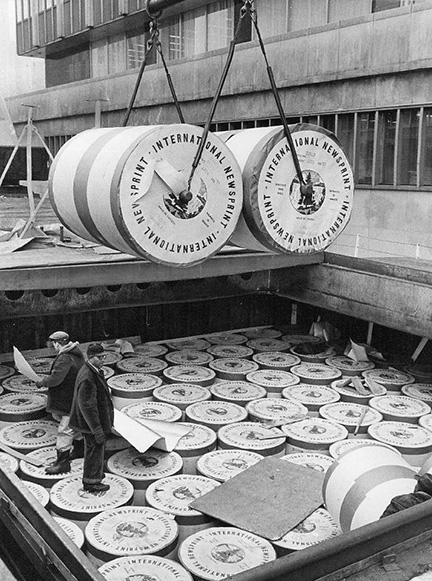
The challenges were many.  The site was pinched in at the center by the angled right-of-way of Wabash Avenue.  The IBM property had been acquired from Field Enterprises, then the owners of the Chicago Sun-Times, which  in 1957 had opened a new headquarters building, designed by Naess and Murphy, just across the street. As part of the sale, the Sun-Times retained the right to use below-grade space on the southward portion of the IBM site as a storage facility for huge spindles of newsprint, making it impossible to address the river in any meaningful way.  The new building would also have to be constructed so as to not disturb the below-grade train tracks that brought in the newsprint.
photograph: The Chuckman Collection
To accommodate the part of Wabash avenue that cut into the site, Mies had originally come up with a very un-Miesian design, reduced at the center and wider to the north and south.  “We of course rebelled,” said architect Dirk Loan, Mies's grandson, who had come to work in his office.  “We said why don't we go and talk to the city about IBM acquiring it.  And in the end, they did.”  And so the tantalizing idea of a Mies ‘U-shaped’ building faded forgotten into history.  The standard central elevator core was, in the IBM, split into two to accommodate the rail tracks running beneath the building.  Along the river, a shear wall drops from the plaza to the river, with a desultory staircase leading downward close to the bridgehouse.
The building that Mies created tends to be ranked by historians in a category below New York City's Seagrams or 860-880 North Lake Shore Drive, but the IBM remains an urban masterwork, taking command of the site with grace and proportion - 275 feet by 125 feet by 695 feet high, set back from the river by a generous plaza. 
Mies liked to put his buildings on a plinth, but at the IBM, that plinth is almost mannerist, dictated by the strange surface conditions of downtown Chicago, where much of the city was raised up out of the muck over a century ago.  As it runs past the IBM, Wabash Avenue, like Michigan Avenue to east, is raised a full story above the natural level of the city, and it's flush with the IBM's ground floor.  State Street, however, to the IBM's west, starts off closer to natural level, and gradually rises up to meet the level of the State Street Bridge. 
At the IBM's south plaza, State Street is a few steps up from the street, but by the time it gets to the to the north edge of the building's site, it's a full level lower.  A grand granite staircase rises from street level up to the building's smaller north plaza. 


The story that the IBM was deliberately placed to block views of non-Miesian round towers of Bertrand Goldberg's Marina City from Michigan Avenue was countered by project director Bruno Conterato, who said the IBM's placement was designed to relate both to Marina City and the Sun-Times Building.  “By going well back on the site,” he told Inland Architect, “we in effect set up a line of three towers, since the Marina Towers are canted on their site, with the east structure farther north than the west one.”
The lobby floor is a soaring 26 feet high. “We could have attempted to alter the lobby's height,” said Conterato, “to achieve a perhaps more human scale, but that would have ruined the overall scale of the building.  It would have looked like a sawed-off building if we had designed a lobby less high.”

As in other Mies skyscrapers, the effect of that open, clear lobby is to ‘dematerialize’ the building.  The curtain wall stops at the lobby's ceiling.  The outer columns descend to the ground, forming an open arcade around the recessed, glass-enclosed lobby.  At night, the dark tower seems to float above a pillow of light.
The elevators are faced in travertine, with Conterato traveling to marble quarries near Rome to supervise the cutting of the stone so that the grain would match perfectly across the panels mounted in the lobby.  The same granite and gridlines of the lobby flooring extend under the glass and out onto the plazas in a continuous flow.  All standard Miesian touches.
Left: Federal Center; Right: IBM Building
There are a couple things, however, that are a bit different about the IBM.  The cladding is not the bronze of the Seagram or painted steel of the Federal Center, but bronze-anodized aluminum.   At the Federal Center, the window frames are recessed from the spandrels; at the IBM, it's the spandrels that are recessed and the window frames that are raised, providing a more articulated facade, especially when embroidered with snow.
Even so, the IBM could be said to be the apotheosis of the Miesian skyscraper.  It's perfectly autonomous - no bustle like at Seagrams or offset towers as at 860-880.  It's set on its own hill, like the Acropolis.  Although now hemmed in by the Trump Tower to the east, the open view along the river is inviolably powerful.  Base, shaft and capital (mechanical floor) all in one volume, a perfect grid both in plan and section.  Windows, taller than wide, in continuous ribbons between brawny spandrels that lock in the horizontal even as the trademark Mies i-Beam mullions, rising from top to bottom in unbroken sweep, proclaim the vertical like a hundred arrows pointing heavenward.
Has any other architect  - including even Louis himself - ever bested Mies in realizing Sulivan's vision of the tall building as ‘every inch a proud and soaring thing, rising in shear exulation that from bottom to top it is a unit without a single dissenting line.’?

NEXT:  The IBM Goes from Lost to Soft

Friday, April 01, 2011

Gang disputes Roeder Ford Calumet Environmental Center numbers

click image for larger view
In an email, Studio/Gang architect Jeanne Gang disputed the numbers quoted in a recent article by Chicago Sun-Times real estate reporter on the costs and status of the proposed Ford Calumet Environment Center, which Studio/Gang won a competition to design all the way back in 2004.  Articles around that time quoted it as being s $6,800.000 project.

However, writes Gang, "The project construction budget was established after the competition, in 2006, and was, including site work, $17 million.  Now in 2011 the cost is $20 million (not 27).  The difference is due to time escalation of cost, NOT cost overruns . . . The budget may have to be adjusted now due to [the current] financial situation, but the project is not cancelled.  In fact, they are in the middle of a fundraising campaign."

Having had to deal media flacks his entire career, it's puzzling how Roeder would just swallow a city bureaucrat's latest spin whole.  "If your mother says she loves you, check it out," was the mantra for cub reporters at the old City News Bureau, but perhaps the new realities of print journalism make that it impossible.

Being a blogger rather than a reporter, I'm not double-sourcing Gang's figures, either, but my bet is they're a lot more reliable than a second-hand version of a city bureaucrat's spin.

More importantly, the word that fundraising for the project is continuing is encouraging.  At the time of competition, it's projected completion date was 2006.  If the city had spent half the effort they wasted trying to jam a children's  museum in Grant Park, the Ford Calumet Environmental Center would have been completed long before the challenges of the recent global financial meltdown, and people would be coming to Chicago from throughout the world to see it.

Sunday, December 26, 2010

Angel of Peace and Mayor of Daley: Separated at Birth?

To the left is sculptor William H. Kieffer's Angel of Peace, which can be found at the Chicago Episcopal Diocese Center and Plaza on east Huron.  To the right is Mayor Richard M. Daley, who can be found, at least until next May, in Chicago's City Hall.  It's a remarkable image by Chicago Sun-Times master photographer Al Podgorski that perfectly captures a moment in the life of a city and its long-time leader that expresses, all at once, relief, power, exuberance and anxiety.  It's the perfect counterpoint to John J. Kim's shot of a side-glancing Rod Blagojevich leaving his trial and climbing into a limo.  Altogether, there are ten eloquent and striking images in the Best Sun-Times photos of 2010.  They remind us of what the blogosphere can't replicate: a professional photojournalism that combines an expert eye with being able to be at the right place at the right time.  Check out the full version of Podgorski's Daley portrait and all the other CST best photos here.