(Plus, a spectacular 1965 film on the construction of Bertrand Goldberg's masterpiece)Serving on a condo board can be a thankless, high-pressure job. That's the only excuse I can think of for the declaration, equal parts loony and arrogant, of the

board of the
Marina Towers Condo Association:
"Because of the architectural significance of our building, the Condominium Association holds a common law copyright on the use of the Association name and building image. This means that under Federal and Illinois law, advertisers, movie makers and others cannot use the Association name or image without first obtaining express written permission from the Association . ."
Bloggers such as
Marina City Online have been having a field exposing the shear stupidity of the declaration, reportedly drafted by the board's long-time attorney Ellis Levin, a long way away from his days as a progressive, independent legislator.
What kind of idiot do you have to be to actually insert the phrase "under Federal and Illinois law," when copyrights are a federal protection, and have nothing to do with state law? Then there's the inconvenient fact the condo owners only own the top 40 floors of each 60-story tower. Exactly how can they claim to own a copyright to "Marina Towers" when the first 20 stories of the towers, and the other structures of the commercial complex, are owned by someone else? And then there's the matter of

exclusivity. Upon a quick Googlecheck, here are just a few of the other "Marina Towers" throughout the world.
Alexandria, Virginia
Corpus Christi, Texas
Marina del Rey, California
Oceanside, North Carolina
Beirut, Lebanon
Chennai, India
Dubai
No doubt the MTCA will soon be attempting to shake them down for royalties.
Marina City Online's Steven Dahlman deftly dissects the sloppy posturing of the board's proposal
here. He has even engaged attorney Thomas D. Rosenwein, who refutes its basic legality
here. Chicago Carless' Mike Doyle, redeeming himself from his support for the Chicago Children's Museum land grab in Grant Park, has also covered the topic
here. And to get feel for the eclectic mix of residents at the towers, check out the
MarinaWatchDog blog, which consists entirely of comment postings - some reasoned, some impassioned, some almost inscrutably strange.
As you probably already know, I am also a long term resident of Marina City. I feature numerous photos of Bertrand Goldberg's masterpiece on my website and this blog, and I guess I actually qualify as a commercial interest, as I receive regular, if pitiable, checks from Google from the ads they run there.
The proposed change to Rule Number 5 is scheduled to be voted on November 15th. So I say to Ellis and the board, pass your rule and then - please, please, please - come after me. If you're so dead set on embarrassing the building, the board, its residents, and - come to think of it - the very notion of intelligent human life, I will be a willing co-conspirator in getting your buffoonery the widest possible audience.
The Making of Marina CityOn a much more positive note, an unexpected pleasure I encountered when researching this post is
photographer Steven Dahlman's

aforementioned Marina City Online
website, co-created with real estate broker Michael Michalak. As opposed to MCTA's own almost laughably pedestrian
website, Marina City Online has a wealth of useful information, including a listing of recent unit sales, maps and floorplans, and an encyclopedic
history of Marina City, beautifully illustrated.
Did you know, for example, that Marina City is located on Block 1 on Chicago's original 1837 township map, or that the site was once owned by former Chicago Mayor Thomas Dyer (1856-57)? There's even a Currier and Ives lithograph showing the site and its environs circa 1892.
But perhaps the most spectacular feature of the site is a 1965, documentary,
This is Marina City, produced by the Portland

Cement Association. The bad news is that film has grown more than a little fuzzy with time, but the film's color images are still nothing short of breathtaking. You see the site before construction begins, surrounding by a vanished city, huge cold storage warehouses on the other side of Dearborn, surface parking at the level of the river where the IBM building is now. The film was a showpiece for the trade unions, who financed the project as a calling card for their services, just as the PCA would produce the film to promote its products.
Every phase of construction is covered - the excavation for the caissons, the complex formwork for the central cores, rising like slender reeds high into the skyline; more formwork, this time like something out of Gaudi, for the curving balconies, the painstaking pouring of the floor slabs, and views of the building at the time of its opening - the skating rink and the modern sculptures that once encircled it, the original elevator lobbies, Johnny Lattner's riverside restaurant, the gleaming glass

displays cases of the first grocery store, and the office building, now the Hotel Sax, that then included the offices of Bertrand Goldberg, himself. An enthralling time capsule of a great building and its time. See it
here.
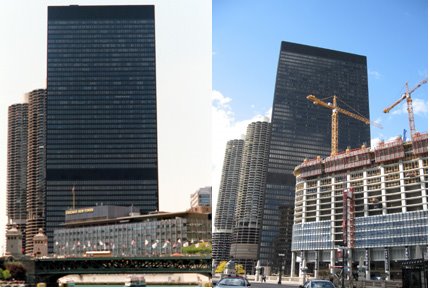 When it was first opened, Chicago's IBM Building, a tower designed by the firm of Mies van der Rohe, and completed in 1973, four years after the architect's death, was one of the city's most prestigious addresses. Things change, however, and the building's present owner, Prime Realty Group, is seeking approval to convert an increasing portion of the structure to residential use.


