Showing posts with label Block 37. Show all posts

Monday, May 15, 2023

Chicago: Where Today is Tomorrow's Paradise Lost

    Redefining Redlining, an installation by Amanda Williams of 50,000 red tulips in vacant lots along Prairie Avenue

 
Brandon Johnson becomes Chicago's mayor today, and already we're being flooded with facile commentary - especially and reliably in the Trib - that this event clinches the doom of the city, an alarmist narrative bullhorned through social media, where the often fact-free snark once confined to exchanges at the corner tavern are blasted out like a National Enquirer headline twenty times a second, everywhere all-at-once.  

Teens run amuck one Saturday on Michigan Avenue? It's all over!  Stores close on Michigan Avenue?  The apocalypse!  Crime and violence?  It's never been this bad!  Doom! How far have we fallen from paradise!

Which raises the questions:  when exactly was this Lost Paradise from which we've apparently now irremediably separated? 

The 1920's, the boom and then the bust, bank runs, mass unemployment, a city overrun with gang violence and rampant corruption? That lost paradise?

The 50's and 60's, when there were seven department stores on State Street, and numerous local chains like Charles Stevens, Lytton's, Maurice L. Rothschild, Chandler shoes, and Evans furs that employed thousands?  That bought the ads that sustained the dailies, and made the contributions that kept numerous civic and cultural institutions viable? 
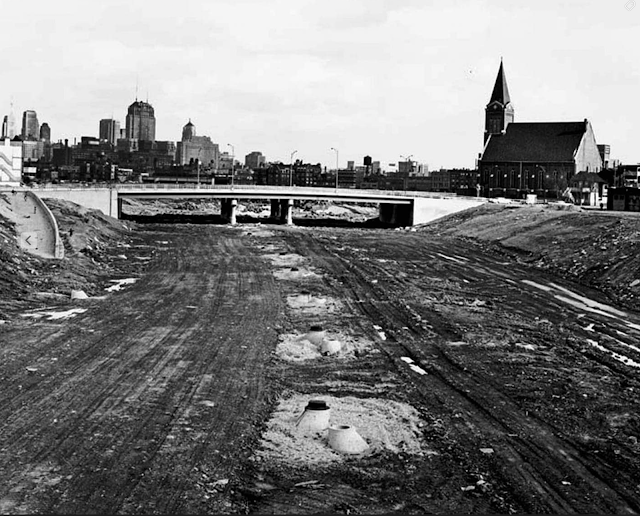

photo: Library School Dropout on Twitter

 Those same 50s and 60's when segregation was rife?  When Mayor Richard J. Daley made a deal with the devil in taking the millions of dollars and countless jobs that came with Eisenhower's Interstate Highway System initiative, which, contrary to its name, mostly became a giant vacuum that sucked hundreds of thousands of middle-class whites out of the city for the short trip to suburbs and the promise of spanking new, single-family houses, broad lawns and few or no minorities?  Panic peddlers' self-fulfilling prophecy that the blacks were taking over and you had to sell now - at whatever price - before it was too late. And then those same panic-peddlers turning around and making more millions overcharging Afro-Americans for what soon too often became overcrowded, overpriced housing with little or no maintenance, thereby creating the very same new slums they were warning the bilked, fleeing whites of.  Large swatches of which were then burned down in the 60's riots. That lost paradise?
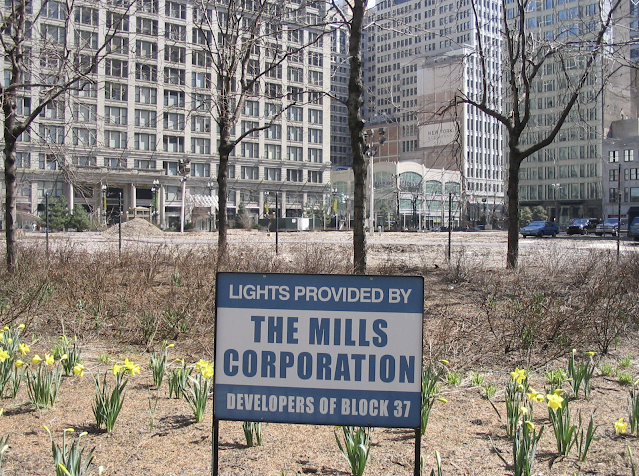

after the city demolished all the buildings, including several landmarks, on Block 37 in 1989, it remained a vacant lot for over a decade and a half.

Or maybe the 70's and 80's? Water Tower Place opened, along with luxury and flagship stores all down Michigan Avenue, a sparkling "new downtown", and one safe for white people.  Because suburban malls were killing off both the Loop and the neighborhood shopping centers that once rivaled it in sales volume.  The department stores closed one by one, the local chains were killed off by huge national discount chains and their generic big box warehouses. Where once every new movie had an exclusive-run in one of the Loop's stunning movie palaces, films now opened in first-run circuits of dozens of theaters all across the suburbs, where population was shifting. Kung-Fu and "blaxploitation" double-bills kept the party going for a few more years, and then the theaters downtown simply went out of business. That lost paradise?


photograph:  It's a Beautiful Day in Chicago on Facebook


Those touting the "good old days" invariably invoke the eras of the sainted name of Daley as their vanished "golden age" when a safe city prospered under their authoritarian but benevolent thumb.  They cite 2021's 797 murders as proof that it's never been this bad, and conveniently forget that the number was exceeded in six of seven of Richard J. Daley's last 7 years in office, and six of Richard M. Daley's first seven, hitting an all-time peak of 974 in 1974.  That lost paradise?
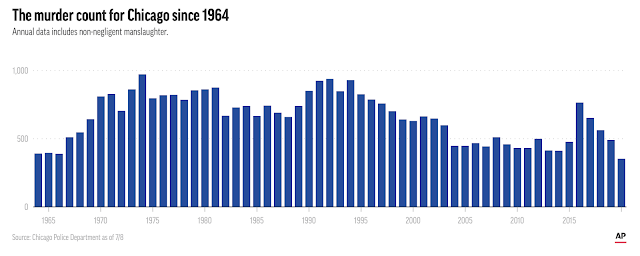

Cities have always been built out of conflict, which often turns violent.  Nothing new here.  There were draft riots in cities all across the north during the Civil War.  There have been race riots in cities all across America throughout history, with an especially infamous one in Chicago 1919 after a black kid wandered over into the "whites only" section of Lake Michigan and was stoned to death.  729 people were slain "gangland style" in Cook County from 1919 to 1933.  "Gangs of New York" wasn't just a movie.

Yet, no matter what Trump and the MAGAs would tell you, it's not a problem exclusive to Democrat-run "hellholes". In 2021, the vast majority of the twelve states with the highest firearm mortality are red states.  The rate in Illinois was less than half that of the most dangerous state, Mississippi.  To be clear, violent crime is a major problem in Chicago, but the number of murders declined in 2022, and are declining even more so far this year.

As the growing rows of products kept under lock and key attest, shoplifting remains a major problem for Chicago retailers, but even Walgreen's recently admitted to their shareholders that they may have oversold that narrative.  Crime is usually cited when a store pulls up stakes, but most often it's a last straw rather the decisive one.  

The reality is this:  Compared to all other regions of the world, the United States has had a surplus of retail for decades.  Shopping and strip malls were massively overbuilt, eventually resulting in mass retrenchments, closures and even demolition.  The local department store chains that were the bedrock of each city have all but completely disappeared, closed or absorbed into Macy's or another of a shrinking number of mega-chains.  Lord & Taylor pulled out of Water Tower Place seventeen years ago, long before Covid or crime became issues.  
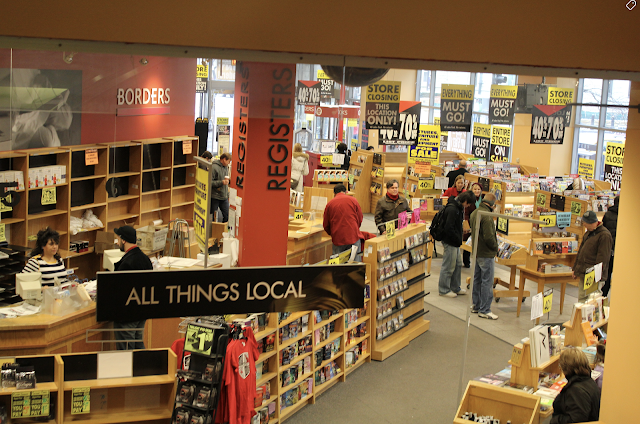
Borders Michigan Avenue superstore closes after only 16 years in business

For a brief period, North Michigan Avenue was heaven for book lovers.  In Water Tower Place, there was the iconic Kroch & Brentano's, and the two-level Rizzoli store with its handsome wood furnishings and beautiful art books.  Down the street was the idiosyncratic bookstore of Stuart Brent, with his ties to local authors and great selection of stuffed animals in the basement.  Britain's Waterstones added a huge flagship just off Michigan.  Then, in 1995, a Borders superstore set up shop across from Water Tower in what was originally the Bonwit Teller department store.  Within 18 months, all the other bookstores were gone.
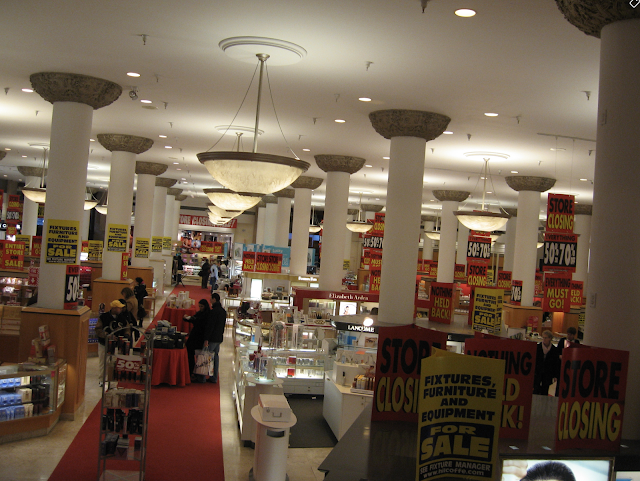

This is how it works in this, our age of the supply chain.  It's all about consolidation, commoditization, and supersizing.  Sears and Wards and their catalogues wiped out thousands of Mom & Pop general stores, just as the great Chicago department stores would wipe out the small retailers along Lake Street.  Big box discounters destroyed most department store chains.  Louis Sullivan's ornate Carson Pirie Scott is now a Target. Amazon caught Sears and everyone else napping, and pretty much ate their lunch. Small, quirky bookstores were decimated by the rise of chains like Kroch's, which, in turn, were destroyed by superstores like Borders, Crown and Barnes & Noble.  And then Borders collapsed under its own weight, and we're back to quirky bookstores again.  And LPs outselling CD's.  Go figure.

Just as in Manhattan, where the Ladies Mile emporiums were replaced by Macy's and Gimbels at Herald Square, Chicago's retail center shifted from the Loop to North Michigan, and - no matter what anyone may claim - no one really knows where it goes next.  For what it's worth, the luxury retailers along Oak and Rush appear to be doing fine.

Transitions in cities are, inevitably, worrisome and painful, nowhere more cogently expressed than in our current disconnect between the city of Chicago getting ready to hand hundreds of millions of dollars in subsidies and tax breaks to developers to make apartments out of emptying 1920's towers on LaSalle street, while a completely new city full of skyscrapers rises in Fulton Market. As always, the demand from banks and law firms for offices in sparkling new buildings is usually less a matter of necessity than prestige and vanity. (see: the destruction of Natalie de Blois's 52-story, recently completely rehabbed 270 Park Avenue in Manhattan for Jamie Dimon's $3 billion Ozymandian tower.) 
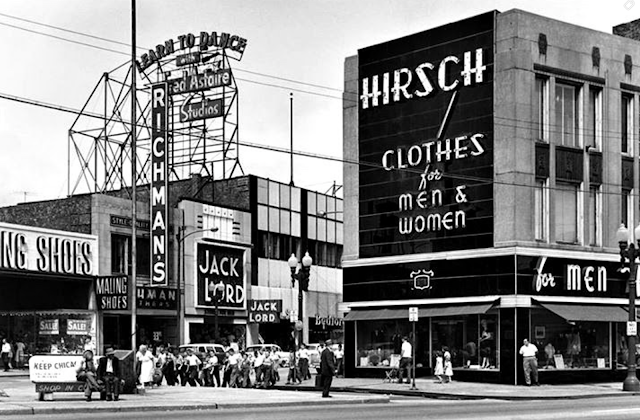
photograph: Vanished Chicago on Facebook

Paradise?  I try not to live in the past, but memories endure..  When I was a kid, we lived on Racine near Belmont, in an attic apartment atop a frame three-story.  On the first floor were the Lagenbergs, of whom we no longer spoke other than about the parties they used to have in the unfinished basement.  On the second was Mrs. Johnson, an elderly Swedish lady who lived there with her son, who after getting kicked in the head in a fight kept pretty much to himself.  Nearby, Lincoln & Belmont was our downtown, with Wieboldt's and Goldblatt's department stores, Maurice L. Rothschild, Stylebilt Hilton, and Hirsh, name in huge letters on its vitrolite corner sign.  There was a Woolworth and a Kresge's across the street from each other. Once, I decided to run away from home and called our number from the Meyer's pharmacy on Ashland to let my mom know.  She never picked up the phone, so I just went back.

While our entire extended family - grandparents, aunts and uncles - made the move to the suburbs, my folks bought a house in Albany Park, where Lawrence Avenue was lined with great deli's, the Terminal movie palace, Dutch Mill candies, Bresler's Ice Cream (run by a lovely older couple for whom the shop was obviously a lifelong dream), Maury's Hot Dogs, clothing stores, Schwartz's girdles.  And as soon as we moved in, the Jews began moving out.  (I didn't take it personally.) Little by little, all those wonderful places were gone, many moved to Devon Avenue which, after a few decades, they abandoned as well. So it goes.


still from the 1964 film, Goldstein


Almost every Saturday I took the L downtown to see a movie at the one of the Loop's incredible palaces.  The projectionist's union was strong, so there was always a 9 a.m. show.  My grandmother took me to see It's a Mad, Mad, Mad, Mad World at the McVickers and I never recovered.  The theatre was clean, modern, and luxurious. The seats were reserved and sold in advance.  Ushers still guided you to your seat.  I waited expectantly for the start, but there was no image, only the sound of an overture with the full L.A. Philharmonic coming through the state-of-the-art stereo system as vividly as if they were in the room.  Then, the plush red curtains parted to reveal the bold, saturated colors of Saul Bass's brilliant line-art title sequence filling every inch of the massive, three-panel Cinerama screen, leading into stunning copter shots of a speeding car on a California desert highway.  My lifelong love of both The Movies and classical music began on that day.

Paradise is a narcotic, an idealized vision of a perfect past from which we're always in free-fall.  Time is like a river flowing endlessly through the universe and, Helen Heraclitus notwithstanding, you can't step into the same river twice.  Things change.

What William Goldman once said about Hollywood - "Nobody Knows Anything" - holds equally true when it comes to Chicago's future.  With all we've gone through since our founding, I seriously doubt Brandon Johnson will single-handedly be our final undoing.  He's just one part, good or bad, of a much larger, infinitely complex dynamic shaping what's to come, what might be.

One thing I do know - 100%. There is ZERO value in letting intelligent commentary about Chicago's problems and future drown in the bottomless sea of unrelenting, mindless snark, even if out of such narratives, political movements grow.  

MAGA metastasizes rural America's traditional distrust and hatred of cities.  The small-town America Paradise where everyone looks like yourself, and acts like yourself, and differences aren't a problem because they're neither encouraged or even allowed. Spurn the immigrants. Jail the drag queens.  Bully the transgenders. Burn the books.  We are all alike.  We will not be replaced.   Chicago is one big shooting gallery; it's emptying out as everybody moves to New Jerusalem Paradise (Florida, Texas, et. al.)

The polemic spun from such a mindset is not to be trusted. By its very nature, it abhors cities, which, like Chicago, are created to reconcile the irreconcilable:  different races, different nationalities, different religions, different genders, different viewpoints, different priorities and goals.  Not perfectly, often with brutality, sometimes with violence, but cities contain multitudes.  We are not all alike, but we are all together.  And that's worth fighting for.

Restoration, a sculpture by Milton Mizenburg Jr. "named in honor of the recent transformation of its surrounding Oakland community."


Tuesday, October 21, 2014

Y Crane? Truss Me, Block 37 is Rising Again!

click images for larger view
It's a story a  quarter-century in the making, but could well be the fastest start of any Chicago skyscraper ever.  As soon as west coast developer CIM Group announced that they had obtained all necessary permits for their new tower on September 10th, scaffolding appeared along Randolph Street next to the troubled Block 37 retail mall that will serve as the project's base.  Soon, a y-topped crane was in place, rising far above the roof of the existing four story building.
image courtesy The Chuckman Collection
Once this had been the site, at the corner of State and Randolph, of architect Peter Wight's Springer Block, built in 1872, and modified by Adler and Sullivan in 1884, and, at the corner of Randolph and Dearborn, Holabird and Roches's 1921 United Artists (Apollo) theatre. In 1989, the entire block was demolished for a sugar plum vision of a massive new development that would reinvigorate State Street, but for decades thereafter all that remained was a dirt-covered vacant lot.  Proposal after proposal - including one with towers by by Helmut Jahn  - failed to come to fruition.  Although right across from Marshall Field's Macy's massive flagship, the highest use this prime property achieved was as a temporary art gallery and winter ice skating rink.

Finally, in 2005, ground was broken for the four-story Block 37 shopping mall, which upon its opening promptly became a huge white elephant.  Where Lord and Taylor and Harrods of London had once been mentioned as tenants, there was, instead, a mall without an anchor, its top floors completely empty.

While the angled walkways and central light court give the interior a certain elegance, on the outside,  it's a numbingly generic building.  Shorn of the artwork value-engineered out of the original plan, the exterior finds its only relief from the visual monotony in undulations in the metal facade that, if you're lucky, self-animate when they reflect the light from signs on adjacent buildings such as the Oriental Theater . . .
or, if you're not, make the whole thing looks like slabs of aluminum siding with a case of hiccups.

Eventually the original developer lost control of the project, which was taken back by the lender, Bank of America, for $100 million, and then sold it to CIM Group for $84 million two years ago.  While 64% of the mall's 275,000 square feet remained empty, CIM has recently struck a deal for a new restaurant and earlier this month, another with AMC to bring an 11-screen, 44,000 square foot cinema complex to the tumbleweed-populated fourth floor.
Now the residential tower that was always envisioned for the northwest corner of Block 37 is finally coming into play - and quickly.  Those same hiccups that enliven the mall facades are being used by architects Solomon Cordwell Bunez to break up the monotony of the curtain wall facade of their new skyscraper, with a giant zipper of incised windows running up the full height of the tower about two thirds in on the Randolph Street side..  The roof of the mall structure will become home to an "amenity deck" for the apartment residents, including an outdoor deck, pool, spa and fitness center.  According to the building permit, structural work will include "a 5′-6″ matt transfer slab, steel transfer trusses approximately 30′-0″ tall, post-tensioned concrete slabs, concrete columns and concrete core-shear wall."
At 38 stories and 436 feet high, the Block 37 apartments at 25 West Randolph will tower over its neighbor across the street, Rapp and Rapp's 1926, 300-feet-tall Oriental Theater building, and nip away at the decades-long visual dominance of Jacques Brownson's 648-foot high Daley Center across the street to the west.  With 690 units, it will be the largest apartment building every constructed in the Loop, and the largest addition to date to a city center that has already seen its number of residential units triple - from about 2,000 to over 6,000 by next year.  It will either be culmination of a boom, or the first victim of the next real estate bubble - or perhaps both.
If things proceed as quickly as they began, we can probably expect the first tenants to move in next Friday.


Epic Flail: 
25 years of trials and tribulations at Block 37

What Would You Put under Block 37?  Crain's Opens up the Big Hole, and Wants to Know

Pebbles Go Bam Bam or Broken Glass Boogie Woogie at Block 37's 22 West Washington

Tales from the Crypt: City to Bury $300 Million Mistake under Block 37

Can Signage Save Block 37?


Block 37 Regains a Third Dimension

Hope at Block 37? - Ownership Changes Still Again

Mayor Richard M. Daley: The Emperor of Dirt

Block 37 - The Curse Lives!

The Entombment of the Plug Bug


Planning and its Disconnects: The Cautionary Tale of Block 37

Saturday, June 15, 2013

Saturday News: What Would You put under Block 37? Crain's opens up the Hole, and Wants to Know

photograph courtesy Crain's Chicago Business
          My money lies under pedway
       My money lies under the mall
      My money lies under the pedway
     Please bring back my money to me

The bad news: the millions the city dumped into a hole below Block 37 isn't coming back.  That's how much was spent on a "superstation" for a $1 billion express service to O'Hare that didn't exist and had no plan for existing, and a crossover to a Red Line that doesn't serve any airport, in probably the most expensive place in Chicago to do it.   After dumping $218 million into the project, the city decided cost overruns were so out of control the only thing to do was just abandon construction and seal up the whole thing. 

The good news:  thanks to Crain's Chicago Business, we now know what our money pit monument looks like.  On Wednesday, Greg Hinz and photographer Stephen Serio (no just handing the reporter an iPhone here) were given the first public access to Mayor Daley's batcave - 472 feet long, 68 feet wide, and an average of 28 feet high.  See all the photo's here.
Block 37 groundbreaking ceremony, 2005
The fun news: as Mel Brooks will tell you, ridicule is often the best revenge for pain, and Crain's is now offering you the chance to put your best sarcasm to good use  . . . 
Calling all architects, designers, urban planners, visionaries! What do you see in that space? Tell us in a paragraph or two, and, because we all know a picture is worth a thousand words, send a rendering, too. 
Best of all, there are no prizes and no money, just a promise that the best ideas will be featured in a subsequent article.   Of course, you could play it straight and come up with useful concepts, but why limit yourself?  Submit your most warped concepts to Crain's via email by next Friday, June 21.

Let me get you started . . .

click image for larger view
photo courtesy Crain's Chicago Business; sheep, not
Block 37 Sheep Monument to Chicago Taxpayers and Voters:  The space will be fitted out to house a large herd of sheep that will save money by replacing the current expense of mowing with grazing at Millennium and other nearby parks.  The sheep's passivity will commemorate the passivity of Chicago voters in electing and re-electing hacks, autocrats and actual criminals.  Waste from the animals, to be sent to the city's urban farms, will represent the oratory of elected officials, while ceremonial shearings will symbolize what gets done to taxpayers.  The resulting wool will be pulled over our eyes.

Update [6/28/13]: Here's Greg Hinz's follow-up with the proposals he got from local architects, including shown below, Grant Gibson's Embrance the Hubris, keeping the space useless but giving it patterned gilded interior . . .

More here.

. . . and talking about big abandoned holes and ideas about what to do with them  . . .
click image for larger view

Mine the Gap at the Chicago Spire Hole

More reading on Block 37:

Tales from the Crypt: City to Bury $300 Million Mistake under Block 37
Can Signage Save Block 37?
Block 37 - The Curse Lives!
The Entombment of the Plug Bug
Planning and its Disconnects: The Cautionary Tale of Block 37

Thursday, January 31, 2013

Arets, Gang, Gamper, Ghost Facades, Airports, Crosstowns and Engineers Running Amuck - it's the February Calendar!


Oh, yeah, grab your Valentine (hey! - not there) - it's the February Calendar of Chicago Architecture Events.

click images for larger view
February starts off with Wiel Arets talking about his book Autobiographical References at the Graham on Friday the 1st, while Saturday the 2nd, Clare Lyster leads the second Archi-Salon - System Synergy at the Art Institute in conjunction with the exhibition Building: Inside Studio Gang Architects, where curator Karen Kice offers the last gallery talk on Thursday, the 21st.

February 17-23 is National Engineers Week, and CAF recognizes the work of engineers with this month's Wednesday lunchtime lectures: Joshua Freedland of Wiss, Janney Elstner talks about Engineering of the Washington Monument  on the 6th, Joseph Burns of Thornton Tomasetti provides A Look Under Chicago's Block 37 on the 13th, Tom Jacobs of Krueck and Sexton talks about Glass Engineering in Architecture on the 20th, and Terry McDonnell discusses The Revitalization of the (Sears) Willis Tower Skydeck on the 27th 

Of course, every week is Engineers Week at The Structural Engineers Association of Illinois, but this month SEAOI looks at the Wells Street Bridge Construction, Tuesday the 5th at the Parthenon (the timeless landmark, not the building in Athens) and at the Design of Low-Rise Reinforced Concrete Buildings on Thursday the 14th at UBS Tower.  It all leads up to Dr. Shankar Nair's lecture Skyscrapers-Past, Present, Future, sponsored by SEAOI at CAF on Tuesday, the 26th.

Elsewhere, Gensler's Elva Rubio discusses Ghost Façade: 618 S. Michiganfor Landmarks Illinois at the Cultural Center on Thursday, the 21st in the afternoon, while that evening Susan King of Harley Ellis Devereaux talks about the Living Building Challengeat the Chicago Center for Green Technology

Over at Fullerton Hall at the Art Institute, the School of the Art Institute is sponsoring lectures by landscape architect Martha Schwartz on Tuesday the 5th, and Martino Gamper on Monday, the 18th, while the people from the indispensable website Forgotten Chicago mark their 10th anniversary with a lecture at the Cultural Center for Friends of Downtown on Thursday, the 7th.

Remember the Crosstown, the proposal to cut a new superhighway all long the west side?  David Spatz does, and he'll be talking about Crosstown Expressway Politics and the Limits of Urban Power in Metropolitan Chicago at the Chicago History Museum on the 7th, and if you can't afford a car, Christopher Ziemann will be discussing Bus Rapid Transit in Chicago atAPA Chicago on Tuesday, the 26th

The Urban Land Institute Chicago has seminars on Airports, Infrastructure Investment and the Built Environment at the Ridgemoor Country Club on the 8th, and the Chicago Hotel Market in 2013 and Beyond at the Union League on the 28th. Dr. Chris Luebkeman of Arup discusses Designing for the New Normal in the Next Decade on the 13th at AIA/Chicago, which is also sponsoring a February 28th panel with Dan Wheeler, Susan Conger-Austin, Odile Compagnon and others on Architects Balancing Practice and Academic Work.
Architect Stuart Cohen does double duty,  discussing Incremental Architecture, with Julie Hacker, at AIA/Chicago on the 7th, and on the 27th, lectures on The Architecture of Howard Van Doren Shaw for the Institute of Classical Architecture and Art at the Driehaus Museum (a/k/a Nickerson Mansion.)

And finally, early morning on the 29th at the Central Music Hall, Dr. Vladimir Fragile will discuss  This is NOT a Leap Year (You All Need to Go Home Now.)

I'm sure we'll be adding even more, but for now, check out the nearly 50 great items on the February Calendar of Chicago Architectural Events.

Friday, December 28, 2012

Time to Kick 2012 Down the Stairs: Our Top Ten Stories of the Year

I really wasn't planning to do this, but I just got a stern letter from the U.S. Department of Blogs, Memes and Spam reminding me that at the end of each year, every blog on the internet must publish some kind of "Top Ten" list or face stiff fines for falling below federal recycling minimums.

So, to keep me free from grand jury consideration, let's start the countdown on our ten most popular posts for 2012:

Number Ten:  An Open Letter to Rahm Emanuel on Bertrand Goldberg's Prentice Hospital - a few truths versus One Big Lie. (10/16/2012)
Number Nine: The Mummy of River North:  Chicago has gone New Hotel Crazy (Just not at LaSalle and Huron)(1/10/2012)

Number Eight:  I've Got You (1913) Under My Skin:  Virtual Restoration at 618 South Michigan. (8/29/2012)

Number Seven:  Can Signage Save Block 37? (7/23/2012)

Number Six: The Invention of Dreams - The Themes of Martin Scorsese's Hugo - Part I (I guess I should finally get around to finishing Part II.) (3/9/2012)

Number Five:  Two Gated Communities:  Will the Lathrop Homes be Drowned in a River of Gentrification? (7/23/2012)

Number Four:  Future Prentice: ideas for saving endangered Betrand Goldberg building subject of Chicago Architectural's Club 2012 Chicago Prize competition. (8/21/2012)

Number Three:  The Architects behind the Architects:  Anne Tyng dies at 9. (1/7/2012)

Number Two: Frontier Outpost:  The Roosevelt Collection and the Future of the Viaduct District.(10/29/2012)
And now - drumroll please - our most popular story of 2012:
Number One:  Four Buildings and  a Funeral - Wrigley: The life and death of a great Chicago corporation as seen through the buildings William Wrigley created for the city in which he made his fortune. (2/8/2012)

There were also several posts from previous years that actually got numbers in 2012 that would have placed them among this year's ten most popular . . .

Two Cats Ponder the Tax Cut Deal:  yes, pictures of cats are what keeps the Internet spinning, and this portrait of my late cat Dante and his companion Chet was our second most popular post in 2012.  (12/6/2010)

Gary Comer College Prep, John Ronan Architects.  Ran the cats a very close race. Our third most popular post in 2012 (9/20/2010) 

On the great stair of the Art Institute, fear and hope stream  beneath your feet in color and light.  The story of Swami Vivekananda's speech at the 1893 World Parliament of Religions.  January 12, 2013 will mark the 150th anniversary of Vivekananda's birth.  Our seventh most popular post of 2012. (10/3/2010)

Caedemon: The End of Cabrini Green  Our tenth most popular post in 2012.  (3/29/2011)


Triskaidekaphobia be damned:  on to 2013!