A daily blog on architecture in Chicago, and other topics cultural, political and mineral.
Click on the COMMENTS link under each post to join the discussion.
Showing posts with label Modernism's Messengers: The Art of Alfonso and Margaret Iannelli. Show all posts
Showing posts with label Modernism's Messengers: The Art of Alfonso and Margaret Iannelli. Show all posts
2013 has been the year that brought Chicago sculptor, designer and architect Alfonso Iannelli out of the shadows, with both a major exhibition at the Cultural Center curated by Tim Samuelson, and a lavishly illustrated monograph by David Jameson, Alfonso Iannelli: Modern by Design.
Now, there's only only this Saturday to help a Kickstarter campaign to restore Iannelli's monument to Georgia Guard make its $15,000 goal. Iannelli created the memorial in 1927 in Park Ridge's Town of Maine Cemetery for the child of a close friend. The plot is also Iannelli's own final unmarked resting place.
Richard Nickel photograph
Ultimately, the larger plan includes creating a marker for Iannelli. For now, the Kickstarter campaign, administered through Preservation Chicago, hopes to begin to restore the cast-concrete monument to Georgia Guard, which, having reached the end of its own natural life, has weathered to the point of near collapse.
The Kickstarter campaign must reach its $15,000 goal by 11:00 a.m. EST, this Saturday, November 23rd, or the funding will be lost. You can read more and contribute here.
UPDATE [11/23/2013]: With 90 minutes to go, the campaign has met and exceeded its goal, with $17,036 in pledges.
Alfonso and Margaret Iannelli -click images for larger view
The new show at the Chicago Cultural Center, Modernism's Messengers: The Art of Alfonso and Margaret Iannelli, echoes two current controversies - immigration and gender in artistic partnerships - in telling a fascinating story with two compelling, parallel hooks: rediscovering the work of sculptor and artist Alfonso Iannelli, and uncovering the vital, often inseparable role that his wife, Margaret Iannelli, played in its creation.
To begin, the story of Alfonso Iannelli is a portrait of the American immigrant experience. Late in the 19th century, his shoemaker father had left Andretta, Italy to seek his fortune in the United States, and a few years later was secure enough to bring over the rest of the family, including ten-year-old Alfonso. Soon, Alfonso was studying art in New York, and in 1906 he became an apprentice to Gutzon Borglum, the sculptor who would later go on to create Mount Rushmore.
(click to watch on YouTube in a larger window)
According to the Tim Samuelson, Chicago's official Cultural Historian and the curator of the exhibition, young Alfonso was ripe for assimilating Borglum's philosophy, which was all “about the idea that America has to to find its own artistic voice.”
“Iannelli,” says Samuelson, “was very much an advocate of collaboration in all things, that
society was full of strong individuals who work together to create a
harmonious society. He believed in the idea of democracy. I think this
all came out of his immigrant experience - the freedom of the individual
to create out of himself, but then the ability of the individual to
have interactions with like-minded individuals.”
By the time Iannelli decided his future lie in the Great American West and moved to Los Angeles, Margaret Spaulding was already there. Another transplant from New York - she was born in Mount Vernon in 1893 - Margaret's family settled in L.A. in 1903. “Even as a teenager,” says Samuelson, ”she was getting every foreign fashion and art magazine that she could. ” By the time she was 16, she was teaching art, and shortly thereafter had carved out a career as an illustrator for fashion advertisements. She continued her outside work even as she joined Alfonso's L.A. studio in 1913.
“Margaret talked,” says Samuelson, “in
a breathy voice and the men would be mesmerized by this beautiful
blonde, dressed in these stylish clothes and talking about art in a
whisper.”
The Iannelli Studios had gotten a commission to do posters - at $5.00 a piece - for the Orpheum vaudeville theater in downtown Los Angeles.
“The earliest posters,” says Samuelson, “were done on tinted cardboard, starting
in 1912. You see how they were made to read as a panel. They had to
crank these out, but they made these studies. They knew what acts were
coming and so they would try to plan to make sure that when they were
placed in the cases the posters would relate to each other.”
It was a job ‘perfectly suited to Alfonso Iannelli's desire to put modern art in
highly visible public places. The posters conveyed the spirit and
energy of the performers, instead of simple caricatures.’
The posters got the attention of Frank Lloyd Wright's son, John, and in 1914, Alfonso accepted an invitation to come to Chicago to work with Wright on Midway Gardens, at 60th and Cottage Grove. During the five months he was away, Margaret continued work on the posters, and the designs began to show more of her artistic influence. “ She was looking at Art Nouveau,”, says Samuelson. “She was looking at Secession.
Especially if you look at the Orpheum posters, there's nothing that's
Wrightian in those at all. If there was an article in The International
Studio on Japanese art, she tore it out and she'd file it away. The
whole use of line and negative space, it's very much that.”
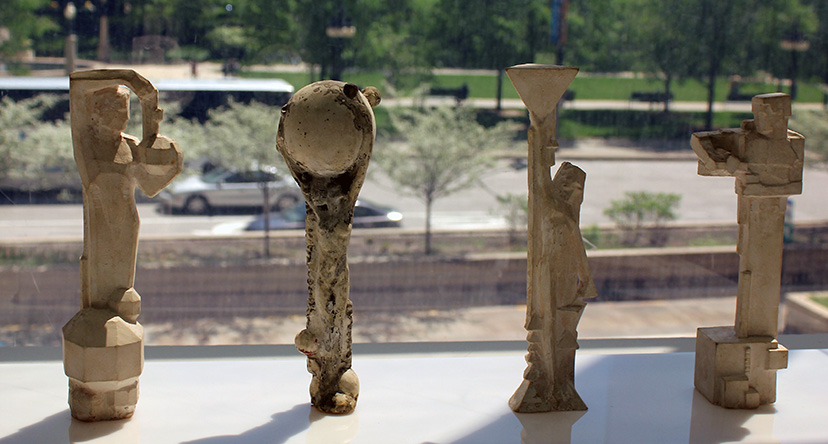
Alfonso Iannelli, studies for Midway Garden sprites
Meanwhile, back in Chicago, Alfonso was working with Wright to create what the long-vanished Midway Gardens remains most famous for today - its striking ‘Sprite’ sculptures. Several of the originals, plus a group of studies, are on display at Modernism's Messengers. The Sprites are displayed on a raised platform that gives you a good idea of their original relationship to the viewer.
“They were never on the ground,” says Samuelson. They always looked down at you.”
“This one had a mast that came out of the concrete, and cubes of glass,
kind of like those light fixtures at Fallingwater, and the light bulbs
would stagger up. They called this one the totem. In an early
description, it's also called the gift-giver, that it's greeting you and
bringing you cascading flowers in a vase. Midway Gardens was an
experiment in merging art and culture. Of course, it quickly went
broke.”
The downturn at the start of World War I saw the gardens sold in 1916 to Edelweiss Brewing
Margaret Iannelli
click for larger view
Company, which converted Midway Gardens into a beer garden. “They painted the
sculpture. The gift-giver, instead of looking like she was bringing you
flowers, was painted to look like she was bringing you foaming beer
steins.”
The changes - and cheapening - gained only a temporary reprieve. Not even an appearance by the legendary Pavlova could save Midway Gardens from the ravages of Prohibition. It was demolished in 1929, bankrupting in the process two demolition companies who had underestimated the solidness of the construction, “Wright actually said he was happy to see it go.”
When the work at Midway Gardens was published, Iannelli was appalled to discover that Wright claimed all the credit for the sculptures himself. A contentious correspondance ensued, resulting in a rupture that precluded any further collaboration. When Alfonso returned to Los Angeles, however, the Orpheum posters ‘displayed a new aesthetic of geometric complexity deriving from
Alfonso's experiences with Frank Lloyd Wright. Flat geometric areas of solid color
predominated the designs, often contrasting with areas of gold and jet
black.’ While both Ianelli's embraced strong geometries in their work, that of Alfonso tends to be harder and more abstract. Margaret's have more of a pulse of life.
On Valentine's Day, 1915, Margaret and Alfonso were married in Santa Ana. Soon afterward, they moved to Chicago, setting up their studio at the top of Holabird and Roche's Monroe Building on Michigan Avenue. By the time the Iannelli's, now with two children, moved the studio for a final time, to Park Ridge, Margaret was showing signs of mental illness.
At times she would erupt into episodes of rage. Periods of intense productivity alternated with times when she could make nothing at all. On occasion she would disappear for days.
After a major breakdown in 1923, Margaret was institutionalized, first at a sanitarium in Wisconsin, then on farms in the northwest suburbs of Chicago. She continued to take on projects, but she never fully recovered, finally being committed to Elgin State Hospital in 1929, where she would remain 38 years - more than half her life. Her last works were a series of colorful illustrations for the hospital newsletter, painstakingly created by running the pages through the mimeograph once for each color. The last known issue to include her work was in 1948. “Details of Margaret's last nineteen years remain sealed in the medical records of the institution.” She died, two months after breaking her hip, on November 29, 1967. No one claimed her body. She was given a pauper's burial in an unmarked grave.
It's uncertain if she even had known of Alfonso's death two years before.
After Margaret was institutionalized, Alfonso began to take on studio assistants, including Edgar Miller, Bruce Goff, and Ruth Blackwell, who would also become his new life companion. His studio remained active during the 1930's, with a lot of work at the 1933/34 Century of Progress Exhibition. There were also the theaters - the Catlow in Barrington, and Pickwick in Park Ridge- but as the thirties came to a close, work dried up. (Be sure not to miss the arrow pasted on one of the Cultural Center gallery's high windows, pointing to the view towards Iannelli's last major commission.)
“The irony” says Samuelson, “is he was trying to be the voice of modernism, but to the new
voices in modernism - the Institute of Design and Moholy and the
movements of the 20th century -Iannelli's work was much too figurative.
They were taking modernism into an entirely another direction.”
“In the end,” Samuelson says, ”there weren't many people seeking him out in the studio,
and then suddenly he becomes the spokesperson for the Prairie School.
Instead of people coming to discuss the new trends and the philosophies
of modernism and life, almost everyone was coming to talk to him about
Frank Lloyd Wright and 1914.” His last known poster was for an exhibition of the work of Adler and Sullivan at the historic Pilgrim Baptist Church, the former K.A.M Synagogue that burned to the bare walls in a 2006 fire.
When he died in 1965, Iannelli's ashes were buried anonymously in a Park Ridge cemetery. He became news again in 2011, when his former design studio was threatened with demolition. It was saved at the last moment when it was purchased by the Kalo Foundation and has now been preserved as The Iannelli Studios Heritage Center.
2013 is a year of discovery for the Iannelli's. In addition to the show at the Cultural Center, next month will see the publication of Alfonso Iannelli: Modern by Design, a lavishly illustrated monograph by David Jameson.
Samuelson is a master storyteller, and in the Iannelli's, he has a great story to tell. First, the Americanization of Alfonso - how, even before he came here, he was shaped by American culture, and soaked up its values and reshaped them with his own work. And then, Margaret's story, which the Pritzker Prize's announcement that it will not redress its slight of Denise Scott Brown makes especially timely. Samuelson's wall text lays out the story of Alfonso and Margaret in compelling and illuminating detail. Hints are placed as to who was the dominant designer in certain works, but the observer is also often left to decide for themselves.
There is no question that the backstory of the rediscovery of Margaret and her role in the work of the Iannelli Studio lends a special poignancy to the exhibition. Ultimately, however, the art must stand for itself, and here, it does. This would be a great show even if the walls were bare of text.
It's a very sweeping display of many types of work, from graphics to sculpture, architectural renderings and ornament, illustrations, advertisements, furniture and even Iannelli's industrial work, including a patented design for a blender's glass container.
Tim Samuelson and appliances designed by Alfonso Iannelli
I don't want to oversell it. We're not rediscovering a lost Picasso or Rodin, but as they said of Dvorak, if the Iannelli's aren't necessarily at the top of the food chain, they are still second-rate artists of the first order. In itself, their work is pleasurable to encounter. In fostering an understanding of the history of early 20th-century art and architecture in Chicago and America, Modernism's Messengers: The Art of Alfonso and Margaret Iannelli is deeply rewarding.
It's like the the folks over at the Chicago Cultural Center were trying to keep it a secret, but this Saturday, May 18 at 10:00 a.m. marks the opening of a highly anticipated show on the work of Alfonso and Margaret Iannelli. Best remembered today for Alfonso's collaboration with Frank Lloyd Wright on Midway Gardens, the Iannelli's actually had over half a century of making interesting art.
The last time I checked, the show was a collaboration between Chicago Cultural Historian Tim Samuelson and scholar and collector David James, author of a companion book, Alfonso Iannelli: Modern by Design, scheduled to be published this coming July. (I had the privilege of previewing some of the pages, and it looks to be spectacular.)
No curators are mentioned in the sketchy information on the exhibition's page on the Cultural Center website, but I can't believe either Samuelson or Jameson had anything to do with the shockingly inane description that manages to say nothing of the qualities of the art but tries to sell the show as some kind of pulpy True Romance . . .
Opening on May 18 and continuing through August 27 in the Chicago Rooms at the Chicago Cultural Center, (78 E. Washington) is Modernism’s Messengers: The Art of Alfonso and Margaret Iannelli – 1910 to 1965. In this show, one discovers not only the love they both had for modernism, but also the love that they had for each other.
Despite very different backgrounds and very different approaches to life, their work together and apart displayed such a partnership that one could not tell where Alfonso’s work ended, and Margaret’s began.
Yep, that's the entire description. There's more information on the press release, which reveals near its end the real reason we should find the exhibition interesting. It's because the show . . .
emphasizes a strong tenet of the Chicago Cultural Plan which is attracting and retaining artists. That is a practice in Chicago’s history and a goal of today. Additionally, this exhibit promotes the values and impact of culture and fosters cultural innovation.
Ah yes, heaven is the land of a bureaucrat's non sequiturs. The Iannelli's lived to confirm the tenets of the Chicago Cultural Plan, apparently now the high point of human evolution. Along with “the values and impact of culture’” and “cultural innovation”. And “modernism”. Mustn't forget modernism. And motherhood, and cuddly bunnies. Did I mention there might also be some art involved?
Actually, the personal saga of Alfonso and Margaret is a dramatic and poignant story, but if that was all they had going for them, we wouldn't be remembering them now. The work, ultimately, is what matters, and in the case of the Iannelli's it's fascinating stuff. I expect to be at the front of the line to check it out on Saturday. To get you started, here's a couple of our past articles: