Remember when they first announced Millennium Park, when it was going to be topping over the unsightly Metra tracks with a gracious new greenspace? And how then Cindy Pritzker got involved, John Bryan came in to raise the bucks, and Anish Kapoor, Jaume Plensa, and Frank Gehry were brought in to make Millennium Park the most spectacular urban park of the new century?
Could we revive just a little bit of that spirit for the Statue of the Republic, a diminished replica of Daniel Chester French's sculpture for the 1893 World's Columbia Exposition? Sun-Times architecture critic Lee Bey reports it's in for a much-needed re-gilding, but why stop there?
 |
| Illustration courtesy World's Fair Chicago 1893 |
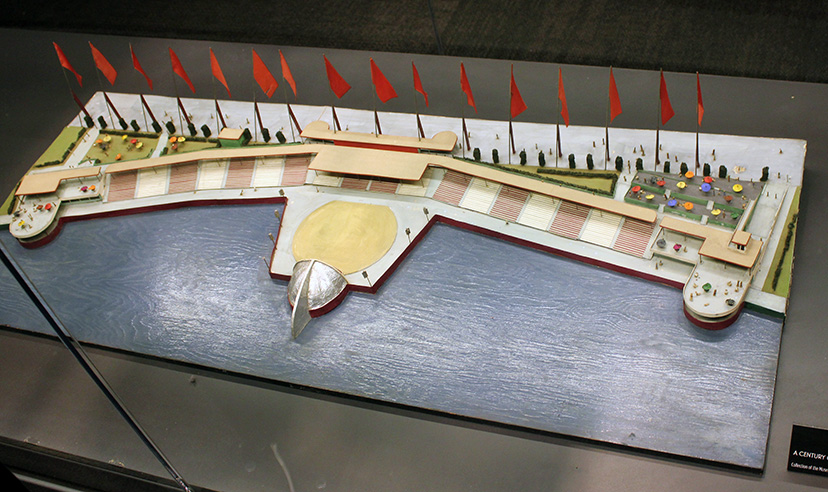
Originally, The Republic, 65-feet-tall, dominated the vista from the 1893 Fair's domed Administration Building across the Great Basic to an eastern terminus with a casino, harbor and pier extending 2,500 feet into Lake Michigan. It was meant to symbolize national unity. Remember that?

Like almost the entire rest of the Fair, the colossus was never built to last, constructed of plaster staff sprayed over a metal skeleton. After the Fair's closing, The Republic stood watch over an increasingly bleak landscape as a series of fires destroyed its massive buildings. The grand statue was allowed to decay, becoming stained, its gilding stolen and losing an arm, until in 1896 the South Park board secretly ordered one of their engineers to burn it down at break of day.
 |
| Illustration courtesy World's Fair Chicago 1893 |
Over two decades later, in 1915, the corporation that ran the Fair still had leftover funds in the bank and, closing out the books, $48,000 of that was donated to the B.F. Ferguson Fund, created to promote public sculpture in the city. It was the fund's second commission, after Lorado Taft's The Fountain of the Great Lakes, which still stands in the Art Institute's south garden.

Funded by that bequest, a bronze replica of The Republic - at 24 feet, downsized to a third of the original's height - was cast from a surviving plaster maquette. The pedestal was designed by architect Henry Bacon. It was dedicated May 11, 1918, the 25th anniversary of the opening of the 1893 Fair. Unlike the original, it was fully gilded, although time and wear since the last restoration in 1992 has made it look like it's developed a serious skin condition.


It's where it is because it was placed at the site of the 1893 Fair's Administration Building, but all vestiges of the significance of that location have long since been effaced. Today, The Republic is marooned between a golf course and a marina, in an isolated part of Jackson Park that's essentially a traffic circle, cars rushing past on Hayes Drive, and visible only in a small, immediate vicinity. With the Obama Presidential Center opening this summer, that's no longer good enough.
An argument can be made that it's pretty cool just to unexpectedly stumble upon The Republic on a walk through the park, but in both size and artistry, it's meant to be a marker, not an oversight. It should be moved.

Where? Where it's no longer half-hidden, but allowed to terminate the vista from the south of the east lagoon, along Wooded Island and the Osaka Garden, to the soon-to-be-re-opened south entrance of the Museum of Science and Industry, which, although substantially rebuilt, still has much of its original grandeur from 1893. Such a relocation would emulate the way the original Republic anchored one end of the 1893 Fair's Grand Basin. It could be placed on land, or on a small island constructed for the purpose in the lagoon itself.
Ideally, The Republic would be re-cast to its original height, but Chicago has apparently grown too small for such ambition. We can't even fix the nearby, historic Clarence Darrow bridge, which has been allowed to sit closed and rotting since 2012, while empty promises of something soon being done go unfulfilled year after year.
 |
| Clarence Darrow Bridge, Burnham & Root, 1880 |
According to Lee Bey, the re-gilding has a price tag of a cool million. Anything more ambitious may sound unattainable, until you consider Science and Industry secured a $10 million grant from the Driehaus Foundation to fund the re-opening of the south entrance facing Columbia Basin. And would it be rude to mention the Obama Presidential Center is coming in around $850 million?
A repaired and re-opened Darrow Bridge and a recast, re-gilded, relocated Republic would complete the current renewal of Jackson Park. Surely, somewhere, we still have enough civic pride left for that?
###