Sunday, November 19, 2006

Great Weekend Reads: Lifson on Agora, TribBus on Gang

Do 106 headless torso's an Agora Make? Edward Lifson of WBEZ's Hello, Beautiful has a great post on his blog on this week's dedication of sculptor Madgalena Abakanowicz's Agora, a ten million dollar installation, whose contributors include Robin Williams, which places 106 supersized lower torsos on a site in Grant Park just north of Roosevelt. Lifson's hugely entertaining and informative posting is a free-form riff including everything from a talk with the artist, a comparison with Eisenman's Berlin Holocaust memorial, the works of Rodin and Boccioni, and one of our mayor's own kind of improvisations that occur when an event actually takes him beyond his printed script and he begins to rap on his personal view of the city. Oh, and lots and lots of pictures. The post is all over the place, and all the better for it - it captures superbly the clash of ideas and "typologies" (sorry - I just came from Joe Rosa's Young Chicago), power modes and personalities. Thinking aloud should always be this good. Read and see it all here.

Jeanne Gang: Architect as Businesswoman - The Trib's Sunday business section includes an interview by Susan Diesenhouse of Aqua architect Jeanne Gang, currently on tour with her IIT students in Brazil, which covers everything from practical aesthetics, handling large projects like the half-billion buck Aqua, and the influence of rising materials cost on architecture. Read it here before it goes into paid archive hell.

Friday, November 17, 2006

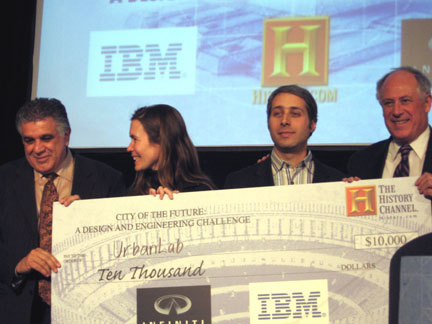
UrbanLabs team wins $10,000 History Channel City of the Future competition


A team put together by UrbanLabs Sarah Dunn and Martin Felsen has won the $10,000 first prize in today's City of the Future competition., sponsored by the History Channel. Strawn/Sierrelta and Valerio DeWalt Train/ARUP were the honorable mention winners. UrbanLabs moves on the competition finals, competing with teams from similar competitions held in NYC and L.A. details to follow.

There's a Hole in Your Building, Dear Larry, Dear Larry

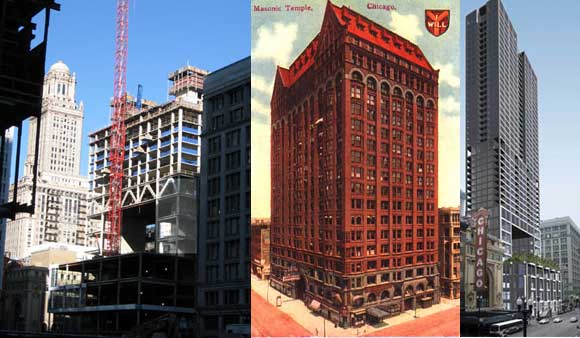
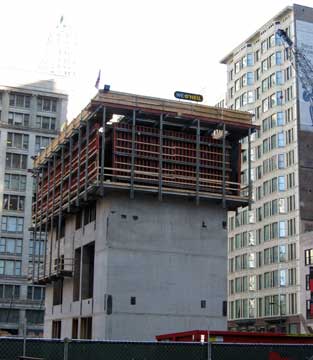
Getting a head start on the construction on Block 37 just kitty-corner to the southwest, and just across the street from The Department Store Formerly Known as Field's, Larry Booth's MOMO is raising its distinctive profile.
And while that name in my mind will always conjure up the mobster whose surprise birthday party gives him a fatal heart attack at the beginning of Get Shorty, in the mind of the building's developer, William Smith, it stands for "Modern Momentum", the marketing concept behind the 31-story residential skyscraper designed by Laurence Booth and Booth/Hansen Associates, replacing earlier designs by Lucien Lagrange, once Smith's favorite architect (Erie on the Park, one of Chicago's best recent buildings, and Kingsbury on the Park), but now apparently scorned and exiled.

MOMO's most distinctive feature is a four story gap above the four story podium, two floors of which have been purchased by the Joffrey Ballet. Not only does it bring light and openness in what is depicted as a landscaped terrace in renderings, but it raises the condos above an existing multi-level garage, whose architect, ironically enough, happens to be Lucien Lagrange.

Most people think of MOMO replacing a squat, two-story structure that for as long as anyone can remember housed a Walgreen's drug store, as well as, for longer-lived memories, the Loop theater, originally a newsreel house, that was converted to an "art" house that had long runs with everything from Mel Brook's immortal The Producers, to the soft-porn of Russ Meyer.

However, the MOMO is actually restoring the parcel to its former glory. It's the location of the Masonic Temple, the great 1892 skyscraper designed by John Wellborn Root and Daniel Burnham that at the time of its construction was the world's tallest building, and remained the city's tallest for another 30 years. It also may have been the first real vertical shopping mall. It's first nine floors, centered around a light court, were filled with shops, and the floors themselves not numbered but named like streets. Shoppers of that time, however, were not quite ready for a fin de siecle Water Tower Place, and the entire building was demolished in 1939, replaced with the two-story Walgreen's building, erected as a temporary "taxpayer" structure holding down the site and generating just enough revenue to pay the property taxes until such time as a favorable environment for major redevelopment returned. In the case of the Walgreen's building, that took over 60 years. The Masonic Temple, known for the Winter Garden at its crest, is only slightly outdone by MOMO - 302 feet in height for the Masonic, 409 for MOMO.

Laurence Booth is on something of a role lately. Not only does he have MOMO underway, he's just finished renovating the classic art deco skyscraper The Palmolive Building into condos (Vince Vaughan is rumored to be scoping out the penthouse for himself and Jennifer), and at 30 West Oak, another Smithfield residential project, he's completing one of the most beautiful new towers to rise in Chicago in years.

Thursday, November 16, 2006

Garfield Park focus of Toronto Sister Cities Design Charette

Hot on the heels of this Friday's City of the Future design competition at CAF, word comes of another charette that will take place this Sunday and Monday that will bring together six teams consisting of a total of twelve graduate students from Toronto and Chicago to design a youth center for Garfield Park using, in the words of the press release, "principles learned from the Massive Change theory and exhibit at the Museum of Contemporary Art. The multi-disciplinary competition also draws its inspiration from the guidelines derived from the City Global Visionaries Symposium," another product of the relentlessly self-promoting Bruce Mau.

Monday's event will pair up students from Mau's Institute without Boundaries and from the U of I's Chicago and Urbana-Champaign campuses "who have expertise in urban planning, architecture and landscape architecture." Although the competition was created "in the spirit of Massive Change," it's the product of the City of Toronto's International Alliance Program, that city's Design Exchange, Chicago Sister Cities International Program, and the City Design Center at the University of Illinois, where the students will develop their design concepts on Sunday, with input from Mau and Canadian Architect Ian Chodikoff, The designs will be presented to an international jury at the Chicago Cultural Center on Monday, with the winning concept to be announced that afternoon. The students' design concepts will be put on display beginning November 21st at a location soon to be announced.

Wednesday, November 15, 2006

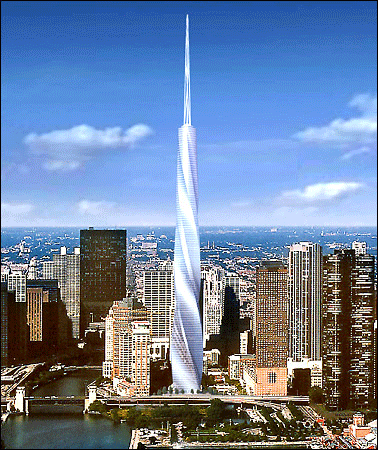
Is it Spire Yet? - Calatrava developer announces project team

A press release today from Shelbourne Development, the Irish company that this past July took over from Chris Carley the proposed 400 North Lake Shore Drive, a/k/a the Calatrava Spire, announces a "global team" to build the proposed 2,000-foot-high residential tower. Calatrava has been signed as "lead architect and engineer", while Chicago's Perkins+Will is the project's lead architect, with Thornton-Tomasetti as "structural engineers of record." No word if they've actually sold any of the tower's extremely pricey units, but general counsel Tom Murphy, the mouthpiece for Shelbourne's executive chairman, Garrett Kelleher, is quoted in press release as saying, “We look forward to breaking ground on The Chicago Spire before June and building a property the city will look up to with pride.”

Step Right Up and Guess The City of the Future - eight top Chicago designers compete in Friday marathon at CAF


There'll be a great show at CAF on November 17th.

Details are out on this Friday's public design competition, The City of the Future: A Design and Engineering Challenge, sponsored by The History Channel. The event, which promises "a frenzied build" in which the teams will have four hours to assemble their models, still strikes me as something of a stunt, but they're certainly doing it up right.

The final list of eight participants is a blue ribbon roster of many of Chicago's best architectural firms:

Brininstool + Lynch

Valerio Dewalt Train Associates, teamed with ARUP
Strawn Sierralta
CUAdc + friends
Dirk Denision Architects
Garofalo Architects
UrbanLab
TEAM PROTOSTUDIO

The jury will be no less illustrious: the GSA's Leslie Shepherd, the Art Institute's Joe Rosa, Chicago's Commissioner of Development Lori Healy, former CAF curator and Architect Magazine editor Ned Cramer, and Diane Legge Kemp of DLK representing co-sponsor American Institute of Architects.

The teams are charged with answering the question, "What will Chicago look like 100 years from?" Beginning at 8:30 A.M. , they'll begin assembling their models in the handsome atrium of the 1904 Railway Exchange Building at 224 South Michigan, whose roster of tenants has included its architect, Daniel Burnham, plus Mies van der Rohe and, currently, both Skidmore Owings and Merrill and Goettsch Partners. They'll have exactly until 12:30 to complete their work - I'm betting at about noon for the "frenzied build" to kick into high gear - and beginning at 12:50, each team will be visited at its respective station by the jury, which will begin deliberations at 3:00 and announce the winner, just before the whole thing is scheduled to wrap at 3:45.

A similar competition was recently held in New York City's Grand Central Station for the east coast, and another will follow in Los Angeles early next month. The winner of each competition receives $10,000 and moves up to the finals. Poor Daniel Libeskind is billed as the "national juror" who will lead the main event, but just as he was squeezed out at WTC, the National City of the Future winner, who gets another $10,000, will actually be selected by on-line voting after the work of all three finalists goes up on the History Channel's website on January 2nd.

It should get interesting this Friday, and it's open to the public, so make up a good excuse for your office voicemail and grab a ringside seat.

With all that energy on display, it's a shame that Friday's exercise is kinda moot, since as we all know, a hundred years from now, all architecture will be created by biotech-generated glands in our bodies secreting proteins with the strength of carbon fiber and the transparency of Starphire, configuring themselves at the direct command of our brainwaves into whatever external structure we may need or desire, in a manner that is unyieldingly reliable and delightfully and infinitely spontaneous all at the same time. I'll probably be dead by then, but send me a postcard.

Tuesday, November 14, 2006

Divertissement - Rem Traceur

Program Change: Goettsch in China at Wednesday lunchtime lecture at CAF

There's been a change in this Wednesday's Multhauf lunchtime lecture at the Chicago Architecture Foundation at 224 South Michigan. The lecture by Neal Samors has been cancelled, and in its place, James Zheng of Goettsch Partners will talk about the firm's recent projects in China. Over the last decade, Goettsch Partners has designed projects in over 12 Asian cities covering 1,500,000 square meters, most of them in China. The lecture begins at 12:15 P.M., and attendees are free to bring in a box lunch (there's a Corner Bakery just off the lobby.)

Monday, November 13, 2006

Rupert's Rag Wipes Chicago Racks

As Chicago's two major dailies, the Trib and Sun-Times, seems to be in a kind of Dutch auction to see which can disintegrate the fastest, I can think of a lot things the local journalistic scene could really use, but somehow the arrival of the New York Post wasn't one of them.

Still, there it was, settled in at the bottom of the rack at the Marina City market: New York Post - Midwest Edition.

So, what's up with that? I thought we had seen the last of Rupert Murdoch when he packed up his Wingo and dumped the Sun-Times in the capably rapacious hands of Lord Black, but here he is again, with a "Midwest Edition" that looks pretty much identical to what you'd buy in New York. The Robert Novack column that ran in Sun-Times under the headline "Rout brings no reform to House GOP', runs in the Post as "GOP: Still the Stupid Party:, just a page away from "New York's Shame: Re-electing Democrats", a selection of letters to the editor that includes the insight, "My business as a police oficer picks up when the Democrats are running the show." And the issue closed so early, it didn't even include coverage of last night's Bears drubbing of the Giants.

Who's the target market for this? When you can get the daily Wall Street Journal or New York Times for a buck, what kind of idiot would spend $1.75 - oh, wait, that would be me - but believe me, it was just for research purposes. I can't see doing it again unless the Post's front page carries a headline as compelling as its classic Headless Torso Found in Topless Bar - now that's journalism.

Bunshaft, Graham buildings at Great Lakes get reprieve

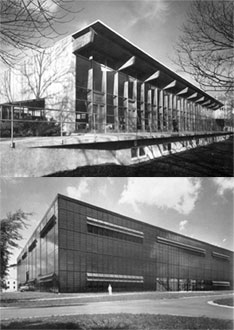
Via AIA Chicago's Joan Pomaranc comes word that the fall issue of the National Trust for Historic Preservation's Midwest Preservation News reports plans to demolish two buildings designed by Skidmore, Owings and Merrill's for the Great Lakes Naval Training Center have been put aside to investigate possible reuse. The structures were subject of a June advocacy alert from DOCOMOMO Midwest, which indicated that the Navy was planning to raze the structures, at an estimated cost of $5,000,000. According to the alert:
"Commander Tony Edmonds, executive officer of the Naval Facilities Engineering Command Midwest, told the Chicago Tribune that the proposed demolitions are part of the Navy's 15-year effort to downsize. Every year, the Navy demolishes two or three buildings as it consolidates programs and functions. 'We found these two buildings were prime candidates because they were among those that yielded the greatest payback if they are demolished, Edmonds said."
A group that included the Midwest Office of the National Trust, Landmarks Illinois, the Mies van der Rohe Society, Chicago Bauhaus and Beyond, the AIA and the suburb of Highland Park, among others, lobbied for saving the structures.

Building 42, (top picture) was designed by SOM's Gordon Bunshaft in 1942; Building 521 (bottom picture), the Gunnars' Mates School was designed in 1954 as a training facility by SOM's Bruce Graham, who had undergone radar training at Great Lakes. It was the first project Graham worked on at SOM. DOCOMOMO described the alterations made to the two buildings as "additive" and reversible.

The U.S. Navy has now agreed to permit the Great Lakes Naval Museum Association to investigate using the Bunshaft building, and the Navy itself will "investigate rehabilitation of Building 521 for use as the new base galley and club. SOM donated services to develop design concepts and cost estimates for rehabilitation, which the Navy will use to help compare rehab and new construction costs."

Sunday, November 12, 2006

At Last, some Good Louis Sullivan News

Our Lincoln Square correspondent tells me that the scaffolding has come down at the Krause Music Store, and that its 1922 facade, which was Louis Sullivan's last commission "looks beautiful", cleaned up and with the ornamental details coming out in sharp detail. I hope to get up there and take some pictures for posting soon.

Weekend Reading: Kamin on What is to be Done, and Trib Magazine on Dunn and Felsen in Young Chicago

In the wake of the loss of three Adler & Sullivan buildings to fire in Chicago this year - two, the Wirt Dexter Building and George M. Harvey house, in less than two weeks - an article in this Sunday's Tribune by architecture critic Blair Kamin considers where we go next. The city is showing signs of finally going beyond mere stonewalling. Right after the Wirt Dexter fire, Landmarks Commision spokesperson Connie Buscemi was pretty much washing her hands of the problem. "What type of work will be done and how, that is the jurisdiction of other agencies," she told the Trib. Now, against rising popular disgust, she's changing her tune. "We are looking at what could be done with regard to not just landmark buildings but older buildings that have heavy timbers and the use of open flames,"she tells Kamin, who turns to Preservation Chicago's Jonathan Fine to come up with some possible new regulations that are already part the National Trust for Historic Preservation guidelines. One, for example, mandates that the use of torches - which were implicated in the destruction of both the Wirt Dexter, and, this past January, of K.A.M. Pilgrim Baptist Church - should require the presence of a fire watchman with a fire extinguisher, a simple step that could have prevented the loss of both buildings.

Elsewhere, the Tribune Magazine includes something of a preview of Young Chicago, the exhibition opening at the Art Institute later this week that is being curated by Joseph Rosa, the museum's new curator of architecture and design. Fresh from a profile in this month's Chicago magazine, UrbanLab's team of Sarah Dunn and Martin Felsen are featured, as are designer Jason Pickleman and architect Clare Lyster. You may want to try to pick up a print copy, since - as is often the case with the Trib's stingy or perhaps just inept internet presence, the article's illustrations are omitted from the web version.

Check both of these pieces out before they disappear into paid archive hell.

Friday, November 10, 2006

Extension - new architectural gallery - debuts Friday night

Architect Michael Wilkinson has forwarded news of the opening of a new gallery, which its organizers say will be "an experimental forum for testing new thought and practice in architecture and is a platform for dialog between national and international practices." It opens its doors tonight, Friday, November 10th, at 6:00 P.M.

Called Extension, it's situated at 1835 S. Halsted and will be open on weekends, Friday through Sunday, from 12 to 5:00 P.M, with extended hours on the second Friday of each month from noon to 10:00 P.M. Its director is Paula Palumbo, and the board includes such luminairies as Martin Felsen, Sarah Dunn, Ellen Grimes and Clare Lyster.

Extension's first exhibition features the installation and work of Plasma Studio . . .
"an innovative architecture and design practice based in London and Northern Italy. Partners Eva Castro and Holger Kehne’s work challenges uniform repetition, standardization and strict determination of space. As a result each project responds as a unique holistic solution, appealing to all the senses, by framing and incorporating the dynamics of daily life such as peoples’ activities, light and weather. Plasma studio’s installation in the Extension Gallery is intended to intensify the spatial experience of the gallery by challenging its Cartesian system."
Pictured above is a stainless steel corridor the firm designed for the Hotel Puerta America in Madrid.

On the Thursday before the opening, Kehne gave a lecture, Elastic Realities, at UIC's School of Architecture. The exhibition at Extension will run through January 14th.

November 15th deadline for 2007 IALD Awards submissions

An email today from the folks at the International Association of Lighting Designers reminds us that next Wednesday, November 15th, is the deadline for submitting your work for consideration for the 2007 IALD Annual Lighting Design Awards. Last year's winners included Stephen Margulies' work on Goetsch & Partners 111 S. Wacker, and C.M. Cling and Associates work for the Charlotte Douglas International Airport, shown here. The 2007 awards will be presented at a New York City benefit next May 7th. You can download a PDF with information and submission forms on-line, but you apparently need to call (312/527.3677) or email IALD's Jennifer Jones, who was so excellent in Duel in the Sun, for an FTP login and password.

Thursday, November 09, 2006

Aftermath

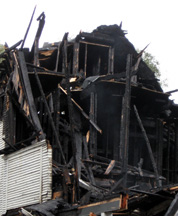
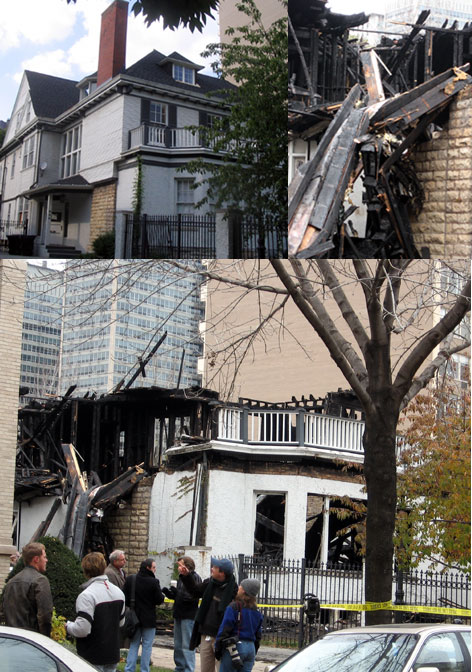
Three days after a fire gutted Dankmar Adler and Louis Sullivan's 1888 George Harvey House in Lakeview, the Chicago Tribune reported on Monday that the Chicago Police Department's bomb and arson unit has begun an investigatation into the cause. The article says that owner Natalie Frank, who bought the house with her husband in 1994 for one a quarter million dollars, had not lived there for over a year.

Ten months after another conflagration reduced Adler & Sullivan's 1891 K.A.M. Pilgrim Baptist Church to its bare outer walls of stone and brick, there have been calls for its full restoration, but at an estimated cost of $25 to $30,000,000, no action has yet been taken, and such a project seems far beyond the capacity of its working class congregation.

A correspondent tells me that the former Krause Music Store, whose 1922 facade was Louis Sullivan's last commission, is currently covered in scaffolding and plastic sheeting as its being adapted for an undisclosed reuse.

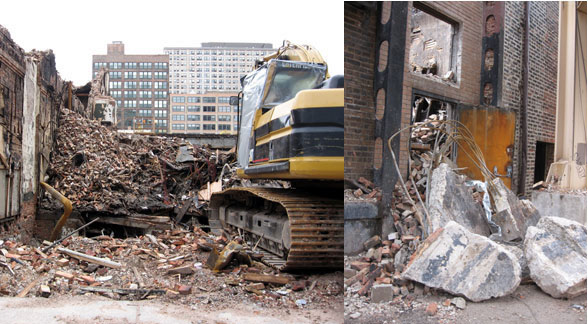
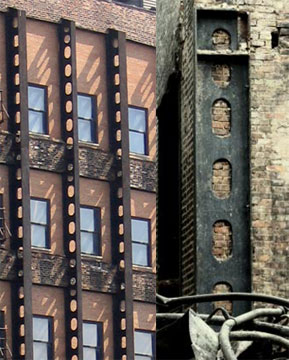
Meanwhile, architectural salvage firm Urban Remains has begun selling artifacts from Adler & Sullivan's landmark 1887 Wirt Dexter Building, also destroyed in a massive fire on October 24th that this week was officially declared an accident, caused by a cutting torch being used to dismantle a boiler for scrap. Urban Remains is selling 60 linear feet of the tall perforated beams that stood outside the back wall of the structure, as well as seven ornamented cast iron columns taken from the Wabash Avenue facade. Urban Remains tells me that a section of perforated beam has gone to the Chicago History Museum, but that Sullivan's ornamented limestone were corbels were lost in the ruble.

The Wirt Dexter was demolished by Heneghan Wrecking, whose company slogan, especially in these circumstances, takes on a chillingly ironic subtext.

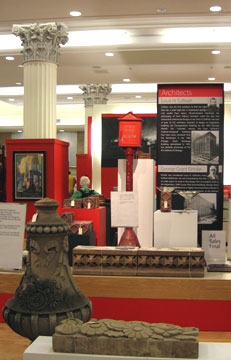
Ruin and dispersement seem to have become the new hallmarks of this year's celebration of the 150th anniversary of Louis Sullivan's birth. When Marshall Fields became Macy's in September, a gallery on the Wabash side of the store began offering up for sale a wide array of fragments salvaged from buildings from a range of architects that include George Elmslie and Sullivan himself, including bits and pieces from another demolished masterpiece, the Chicago Stock Exchange. All sales final.

Wednesday, November 08, 2006

Joseph Freed Chicago's new Levi Leiter?

In the last decades of the 19th century, Levi Leiter, working with Potter Palmer and Marshall Field, moved Chicago's primary retail district from Lake Street to a formerly unpaved cross street so deep with mud that a yarn had it swallowing a horse and carriage whole, and transforming State Street into one of the world's great thoroughfares. By the 1890's, Leiter was landlord at both ends of the street, with Marshall Field's to the north, and anchoring the south end of department store row, Siegel, Cooper and Company, inhabiting William LeBaron Jenney's Second Leiter Building, a classic spare landmark that helped define the Chicago style of architecture.

Flash forward to another century. State Street is no longer "That Great Street". One by one, the great department stores have folded, Marshall Field's is now Macy's, and next year its once great rival, Carson, Pirie Scott, will shut down its store in the architectural masterpiece designed by Louis Sullivan. A new Sears store also hangs in there, in a building once home to the Boston Store, but by all accounts its performance has been disappointing.

And now questions are rising over what will happen to the shopping mall rising across the street from Macy's on Block 37. Just last November, the Mills Corporation threw a lavish party, complete with a pair of quick change artists and a troup of models in coveralls and gold lame, handing off their gold shovels to celebrities including Mayor M. Daley for a ceremonial groundbreaking. It was all downhill from there.
When Mills Corp. was brought in, it was seen as a great coup - a major player in retail that had created Gurnee Mills and was in the midst of several hundred-million-dollar plus developments. But almost instantly it all began to unravel, with the disclosure of financial irregularities, projects falling apart, and Mill's basically selling itself off, and dramatically reducing its stake in Block 37.

Today, Crain's Chicago Business is reporting that Mills is selling the last of its stake to Joseph Freed and Associates, the Palatine based developer. According to Crain's, it was Steve Jacobsen, who had shepherded Mills's efforts at Block 37 and jumped ship to Joseph Freed when it began to head south, who engineered the sale. With this deal, Joseph Freed now has to figure out what to do with over half a million square feet of retail space along State Street.

Five years ago, it bought the Carson Pirie Scott Building, and spent millions restoring the structure to Sullivan's original design, including last year's restoration of the colonaded cornice whose columns are steeped in Sullivan's rich ornament. The top floor behind that cornice has already been reconfigured for a new tenant, the School of the Art Institute. Now, Freed is faced with filling 250,000 square feet of space that Carson's will vacate early next year. With today's deal it has also taken on another 265,000 of new retail at Block 37, scheduled to open in 2008, where a new tower for Morningstar Investments is finally rising on the site of the landmark Delaware Building, whose designation was stripped in 1989's amid a mad dash to demolish every structure on the block, just so it could all lay empty for a decade and a half.
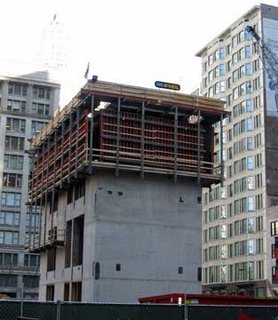
With Carson's and 108 North State, the official name of the Block 37 mall, Freed may well have the greatest influence on State Street since Levi Leiter. And in many ways, the challenge is both greater and more treacherous. When Leiter, Field and Palmer were active, they were creating State Street as a new paragon of American urban life. Today, Freed is facing a State Street that is an also-ran, a weak sister to North Michigan avenue, down for the count. Yet, the best of its architecture still speaks of greatness.

It's a tightrope. If Sullivan's great first-floor retail rooms at Carson's are filled with big box retailers with metal shelving and plastic shopping carts, it will be a desecration that diminishes the city as a whole. The challenge is to find new retail uses that both provide the kind of shopping modern consumers desire, while keeping a throughline with the street's long, rich architectural legacy. For worse or for better, and probably for decades to come, Joseph Freed will be decisively redefining what it is to be "State Street."

Tuesday, November 07, 2006

Rare Barnacle Found on Chicago Bridge

Well, maybe not. Maybe this is actually an artwork from Veronica Cordeiro, Roamless. A Nondetermined Composition. A Pilgrimmage to No Where. 2005–06 that will be part of Negotiated Localities, an exhibition opening November 17th at the Betty Rymer Gallery of the School of the Art Institute, which is described thusly:
"A provocative examination of the related concepts of sustainability and locality and their impact on contemporary artistic practices. Co-curators and SAIC faculty Cindy Coleman and Claire Pentecost have assembled ecologically sensitive artists, designers and writers who propose unexpected approaches to putting the local and the sustainable into practice through specific works and ongoing projects." (Is it just me, or does writing like this really seem less like English than some secret alternative language - or perhaps just a grant proposal?)
The wide range of participating artists will include architect Ellen Grimes. The exhibition will run through January 5th. The Betty Rymer Gallery is at 280 S. Columbus Drive, and is open Tuesdays through Saturday 10:00 A.M. to 5 P.M., with free admission. Information on-line here.

Sunday, November 19th, will see a Negotiated Localities day of events, including an interactive workshop at the Gene Siskel with Chris Luebkeman, leader of the "Foresight and Innovation Initiative" at Arup to "identify the leading drivers of change that will affect Chicago's future." Other sessions will include the 58 minute video of Ms. Cordeio's Roamless, and concludes with a tour to Chicago's Northerly Island and North Lawndale neighborhood. Information on-line here. Tickets are $25.00, $15.00 with student ID. Space is limited and reservations can be made at 312/443.3711.

Saturday, November 04, 2006

Happy 150th Birthday Louis Sullivan - We've Burned Down Your Third Building This Year!


In January, it was the K.A.M. Pilgrim Baptist Church. Little more than a week ago, it was the 1887 Wirt Dexter Building. Today, an early morning blaze has made the George M. Harvey House the third Dankmar Adler and Louis Sullivan landmark to be destroyed by fire just this year. Architectural preservation in the city of Chicago has hit another new low. Does anyone here know how to play this game? Read all about it and see the sad pictures here.

Thursday, November 02, 2006

Countdown to Empire - Can You Fly Down to New Orleans by Noon?


UPDATE, FRIDAY, 11:00 A.M.: A comment to this post indicates that the deadline IS actually this coming Monday at noon, rather than today. You may want to double-check with CAF or the email listed on History Channels competition site, hyperlinked below.

And now, on to last night's post . . .

If you're reading this post Thursday night, it's most probably already too late for you to submit your credentials for The History Channel's The City of the Future: A Design and Engineering Challenge, a competition -tipped off to us by co-sponsor AIA's Joan Pomaranc - which, in the words of partner organization Chicago Architecture Foundation's website, "will challenge Chicago's top architecture firms and students to design their vision of a 22nd Century Chicago." The CAF site says submissions are due by Monday, November 6th, but the History Channel's own submission guidelines puts the cut-off at noon today, Friday the 3rd, at the offices of jones/kroloff in New Orleans.

Chicago is one of three cities - New York and L.A. being the others - where two design teams will be selected to compete "alongside a nationally recognized slate of designers in imagining the Chicago of the Future." A charrette briefing is scheduled for Friday the 10th at CAF, leading to a public event at CAF on November 17th where "Teams will race against the clock in the morning to build a three-dimensional representation of their ‘Chicago of the Future’." The entries will be judged by a panel that will include the GSA's Leslie Shepherd and the Art Institute's increasingly ubiquitous Curator of Architecture of Design, Joseph Rosa. The winning team gets $10,000 and advances to the national finals, with its own $10,000 prize, where the winner will be selected by the studio audience attending a broadcast of ABC's Dancing With the Stars. (Just kidding - the prize will be determined by another panel whose Chief Juror will be no less than Daniel Libeskind.) The deadline for the East Coast was October 23rd, but those on the West Coast have until Friday, November 24th to submit.

The program is an offshoot of the History Channel's Engineering an Empire series, covering the marvels created by various civilizations from the Greeks and Egyptians, to the Mayans and Aztecs. (Seven Degrees of Peter Weller Department: the actor, who is about to star as Frank Lloyd Wright in a new play at the Goodman, is also host for the series.)

But do we really need to encourage an "Architecture of Empire"? The thing that ties together most of the buildings covered in the History Channel series is a necrotic obsession with death. The series own website says it best: "A Massive Ego Buried in Every Tomb", often indifferently dragging legions of their subjects into the abyss with them. Great for future tourism. Bad for the bystanders.

In Louis Sullivan's time, the "Architecture of Empire" was the phony overscaled classicism of the 1893 Columbian Exposition, a stage set for the emergence of America as a global power. In our own day, it's perhaps best symbolized by the new U.S. Embassy in Baghdad, a $500,000,000, 104-acre enclave whose 15-foot-thick perimeter wall entombs its inhabitants from the dark, violent reality just beyond the gates.

Will any of the City of the Future entrants have the insolence to advance a program with a little less Empire, a bit more humanity?

Safdie, Ando, Pedret and Rural Studio's Andrew Freear among names on November calendar of Architectural Events in Chicago

Not even the holidays can stop the wealth of architecture-related events in Chicago, with over three dozen items on the November calendar. Moshe Safdie appears this Sunday at the Spertus Institute in a Chicago Humanities Festival event, Andrew Freear of Rural Studio and Lars Danielsson both make appearances next Tuesday, with William Pedersen at IIT on Wednesday. Later in the month, Annie Pedret lectures at Archeworks, and Tadao Ando appears at a benefit for the Frank Lloyd Wright Preservation Trust. You can learn all about Lustron at a Preservation Snapshots lecture or sign up for an all-day Global Visionaries Symposium, tied in to the MCA's current Massive Change exhibition, that features Bruce Mau, Wikipedia's Jimmy Wales, Stewart Brand and economist Hazel Henderson, among others. That's just the tip of the iceberg - you can check out the November calendar and all its events here.