Showing posts sorted by relevance for query Louis Sullivan Chicago History. Sort by date Show all posts

Monday, August 12, 2013

Refinding, Losing - and abusing- Louis Sullivan (Again) - Buildings Burn, Landmarks are Reborn, and an Essential Monograph goes Out-of-Print

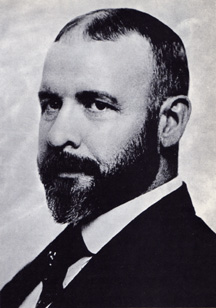
Louis Sullivan - clicks images for larger view
It was supposed to be a celebratory year.  2006 was the 150th birthday anniversary of Chicago architect Louis Sullivan.  With his partner Dankmar Adler, he had created some of the most striking masterpieces of the first Chicago School.  Sullivan split with Adler after the economic crash that followed the 1893 World's Columbian Exposition, but even as his career entered a long, tragic decline, he continued to create astonishing works such as a series of small Midwestern banks, and the Krause Music store on Lincoln Avenue.
And there were a number of celebratory events, including the Chicago History Museum's Louis Sullivan at 150 website.  You could still see the restored spectacular theater of Adler and Sullivan's Auditorium Building . . .
and you could still shop at Louis Sulivan's Carson Pirie Scott . . .
But perhaps the most striking way Chicago choose to celebrate Louis Sullivan was to burn down three of his buildings in just a eleven-month span of 2006.
On January 6, Adler and Sullivan's 1890 Kehilath Anshe Ma’ariv Synagogue, which, as Thomas Dorsey's Pilgrim Baptist Church became known as the birthplace of Gospel Music, burned to the bare walls in a fire set off by a construction worker using an acetylene torch on the roof.
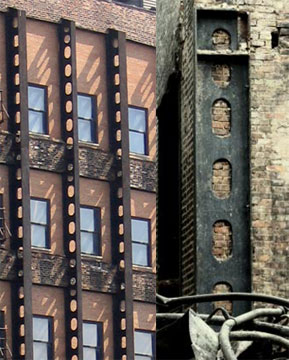
Then, on October 24th, a worker using an acetylene torch to take apart a boiler in the basement started another blaze that destroyed Adler and Sullivan's Wirt Dexter Building on Wabash.
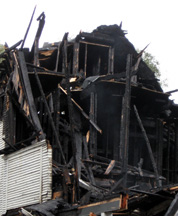
The following month, one of the firm's last surviving residences, the George Harvey House, whose owner was reported to have wanted it demolished for a new condo development, burned to the ground in a suspicious middle-of-the-night fire.

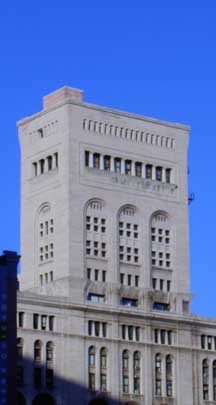
Today, seven years after that trifecta of disaster, the Auditorium still stands, although its tower's backdrop is no longer the blue sky, but the blue of VOA's new dorm for Roosevelt University.
Carson Pirie Scott has almost received a major and welcome update.  Celebrating the death of the department store, Carson's shut its doors early in 2007 after over a century of doing business in Sullivan's landmark.   In 2001, Carson's had sold the building to developer Joseph Freed, and before running aground against the disaster that is Block 37, Freed had made Sullivan's building their calling card, with a $190 million investment that included Harboe Architects leading a team that restored Sullivan's intricate cast-iron ornament . . .
. . . and uncovering the ornament designing by Sullivan for an early 20th-century remodeling of 22 South Wabash . . .
Now renamed Sullivan Center, the former Carson's store has become something of a magnet for architecture and design.  It's currently the home for both Gensler Chicago and the School of the Art Institute and its Sullivan Galleries on the 7th floor.  Last year, the building was reborn as a handsome, two-level flagship for a flagship City Target, the retailer's concept for expanding beyond suburban malls into the center city.
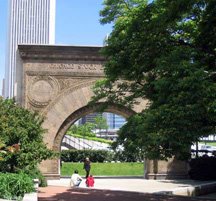
Photographer Richard Nickel lost his life photographing another Adler and Sullivan masterpiece, the 1894 Chicago Stock Exchange Building, while it was being demolished in 1972.  The trading room, lovingly restored by John Vinci, was reconstructed at the Art Institute.  The great entrance arch was also saved and erected within a charming park at Monroe and Columbus, where you could actually walk through it . . .
. . . until 2009, when with the construction of Renzo Piano's Modern Wing, the Stock Exchange arch was left like a garden gnome, stranded and inaccessible in the middle of a ditch-like flowerbed.
2010: The Year of Louis Sullivan

Then, four years after the official 150th birthday anniversary, four seminal events finally gave Louis Sullivan his due.
First, here was Louis Sullivan's Idea, Chicago cultural historian Tim Samuelson's masterful overview of the life and architecture of the great architect.  Designed by graphic artist Chris Ware, it made full use of the Chicago Cultural Center galleries with a a display of carbon filament lighting and supersize photos that gave you a real feel of what it must have been like to encounter the vanished buildings.  Unfortunately, Cultural Center shows don't get catalogs, so the only thing left of this great show are the memories and this eccentrically shot video . . .

At about the same time, the Art Institute of Chicago mounted Looking after Louis Sullivan, a striking collection of photographs by John Szarkowski,  Aaron Siskind and Richard Nickel.
April saw the debut of Louis Sullivan: The Struggle for American Architecture, Mark Richard Smith's labor-of-love documentary on the architects life and art.
To top it all off, in September of the year, we really hit pay dirt with the publication of The Complete Architecture of Adler and Sullivan, a landmark book that was an epic of scholarship and storytelling by Ward Miller, John Vinci and Tim Samuelson.  First the first time, there was a catalogue raisonné of every project Adler and Sullivan worked on, lavishly illustrated, including a large number of eye-opening color photographs.

Finally, the legacy of Louis Sullivan was here for everyone to see, for all time.

Well, not really.  Quite understandably, the first edition of The Complete Architecture of Adler and Sullivan sold out quickly.  It is now out-of-print.  Amazon.com lists copies from $450 to $1218.  Another dealer will sell you one for $3508.  2010 ended with the book being acquired, along with the other assets of The Richard Nickel Committee, by The Art Institute of Chicago.  There has been no second edition, and, so far, none has been announced.

Louis Sullivan: the Rodney Dangerfield of great architects.

Refinding, Losing (and abusing) Louis:

Wednesday, August 02, 2006

Louis Sullivan at 150 - a new Chicago History Museum website lists over 50 events in a six-week celebration of the great architect's birth

Architect Louis Sullivan, had he lived, would have turned 150 on his upcoming September 3rd birthday. Working with other arts and architecture organizations in Chicago, the newly renamed Chicago History Museum has just put up Louis Sullivan at 150, a website on all things Sullivan, with a calendar listing the numerous tours, seminars, lectures and films that will take place over six plus weeks beginning on September 2nd in honor of the legendary Chicago architect.

Among the highlights are a number of tours of the Charnley-Persky House, as well as a series of Louis Sullivan: Lost and Found Loop walking tours, on Wednesdays and Saturdays over five weeks, under the auspices of the Chicago Architecture Foundation.

On September 17th from 1:00 to 4:00, a Richard Nickel Bus Tour will be led by his biographer, Richard Cahan. On September 18th, there will be tours of the Auditorium Building, as well as "The Parthenon of Modern Civilization: The Restorations of the Auditorium Theatre" a panel discussion with Ben Weese, FAIA, Jack Hartray, FAIA, Laurence Booth, FAIA and Daniel P. Coffey FAIA; moderated by Rick Kogan. There will also be concerts in Ganz Hall.

On Monday, October 9th, Lost Chicago author David Garrard Lowe will present a lecture on
Louis Sullivan & the Beaux Arts. The Newberry Library will offer up a ten week seminar by scholar-in-residence Diane Dillion on The Architecture of Louis Sullivan.

CAF tours of Holy Trinity Cathedral on September 9, 23 and 30, where, on September 24th, there will also be a fundraiser to benefit the church's restoration with historian Tim Samuelson and the Pan Orthodox Choir. On October 4th, another seminar, Chicago's Great Heritage: Preserving the Work of Louis Sullivan" will feature Mary Brush, Gunny Harboe (who recently completed the restoration of the long-missing cornice on Sullivan's Carson Pirie Scott store on State Street), and Vincent Michael. October 12th will bring the first Chicago screening, at the Graham Foundation, of a new half-hour documentary: The Small Town Banks of Louis Sullivan, followed by a discussion that will include the film's producer and director, Joe Federici. The celebration will end with a three day symposium, Louis Sullivan at 150, October 13 through the 15th at the Chicago History Museum.

The Louis Sullivan at 150 website includes over 50 events spread on 29 separate days, and also offers up an extended biography of Sullivan, his partnership with Dankmar Adler, his work, life and writings. There's a very generous complement of photographs of Sullivan's buildings and ornament. It's a site that draws you in with its depth of interesting content, and if the various events live up to the same high standard, we're in for a great celebration.

Wednesday, December 30, 2015

Death and Transfiguration: Louis Sullivan and Richard Nickel Dangerous Years

click images for larger view
(all images from Richard Nickel Dangerous Years,
courtesy Cityfiles Press


Richard Nickel Dangerous Years What He Saw What He Wrote,  Hardcover: 264 pages. $60.00 (Online Price: $50.00, including tax and shipping.)
Ultimately, you buy a book about Richard Nickel for his beautiful, often haunting photographs, and the new book Richard Nickel Dangerous Years: What He Saw and What He Wrote doesn't disappoint.  It includes scores of images never
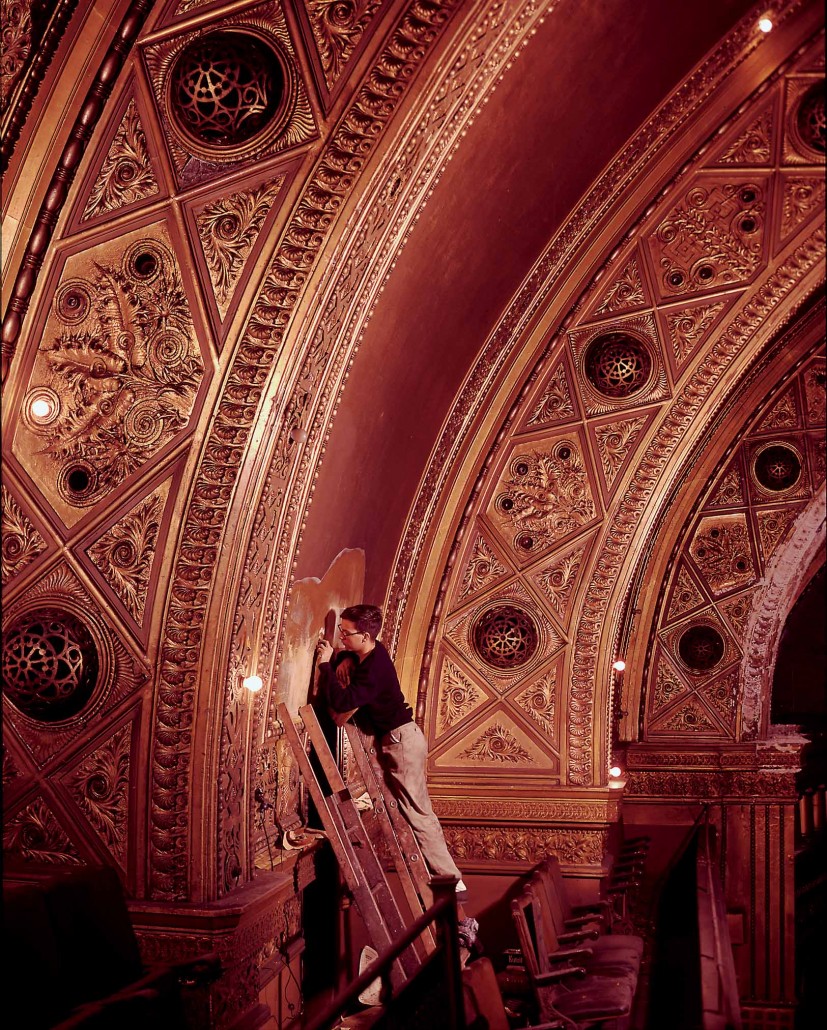
before published, some - like the photo at the top of this post of a very young John Vinci working on bringing Adler and Sullivan's crown jewel, the Auditorium Theater, back from death's door - in gorgeous color.  If you came out of Christmas with some gift cash or cards, and if you love architecture or Chicago or both, this is an essential volume you'll want to add to your library and pull down from the shelf to revisit again and again. 
Dangerous Years is much a portrait of the artist and his times as a collection of Nickel's photographs.  Authors Rich Cahan and Michael Williams have taken an almost reliquary approach to their new book, including not only the pictures of the buildings, but reproductions of the documents of Nickel's life.   Press clippings, postcards, lists, drafts, angry letters -mundane objects that manage to make the period feel vitally alive - a "To Whom it May Concern" letter written by the Institute of Design's Crombie Taylor to help Nickel get access to buildings; a Western Union telegram from Mayor J. Daley about a meeting in City Council chambers "to discuss the pending demolition on the Garrick Theater building . . . "
Not all that long after he described himself as "completely stupid", there's a piece of lined three-hole punch paper where Nickel explores in a series of small drawings the thought process behind Sullivan's ornament.  There are daily itineraries,  Notes that Nickel took of his 1957 interview with Frank Lloyd Wright  "In his opinion, L.H.S got everything from Adler, [and] if it had not been for Adler, Sullivan might never have made the grade of 'Master'".

There are photos of Nickel himself, an unremarkable-looking man in glasses of unexpressive countenance, often dressed in white t-shirts.  
Dankmar Adler residence
The feeling went into the images he captured, the now classic photographs of a world in anguished death throes, proud and beautiful old buildings spurned and forgotten, hemorrhaging rubble as they await obliteration . . . the gaping maw of the sanctuary of Burnham and Root's Church of the Covenant, split open like a cracked egg. 

There's also revealing images of buildings, not in the usual idealized isolation, but in their actual context, including a photograph of Frank Lloyd Wright's under-construction Price Tower rising out of a abject streetscape with a gas station and used car dealership in the foreground, the perspective placing both Wright's skyscraper and the gas station's vertical sign in a visual equivalency.   There are photographs documenting both the grounds and the cottage Louis Sullivan built for himself in Ocean Springs, Mississippi, destroyed by Katrina in 2005.

You want there to be a take-away, some inspirational message to be drawn.  But history always confounds.  And what is history?  The expression of power through people and events.  And the story of Richard Nickel is a time capsule of a shifting paradigm moment in American urbanism, in deep concentration on the city's South Side.

Richard Nickel and the Remaking of Post-War Chicago
In the 1940's, postwar Chicago had another word for the city's architectural heritage: The Slums.  As Afro-Americans poured into the city during the war, they formed a burgeoning "Black Belt" that swelled to take over former white neighborhoods east of the railroad tracks on Chicago's South Side.

It was among the twenty-three square miles the city had designated as "blight", said to threaten another 56 square miles adjacent, altogether more than a third of Chicago's land mass.    The feds had the money, and the city had the plan:  destroy it - all of it.  Create a tabula rasa for new development so destructed that it reminded a visiting Englishwoman of London after the German bombing raids.

Much of what was destroyed only grew into being slums; proud old buildings built for the middle and upper class, now deteriorated through neglect and misuse.  Within a single half-mile, there were 19 houses designed by the firm of Louis Sullivan and Dankmar Adler for wealthy Jewish families.

In booming turn-of-the-century Chicago, Burnham and Root and Holabird and Roche were the architecture firms of power, getting the big commissions for the huge office buildings that would come to define the Chicago School of Architecture.  They were the brains and the muscle.  Adler and Sullivan were the heart.  Most specifically Louis Sullivan, the iconoclastic genius who had no problem combining high commerce with high art, expressing the compressed energy tightly contained within the new commercial buildings into spectacular ornament bursting forth from the plain facades.

By the mid 20th-Century, however, Miesian modernism had begun its triumphant ascent, and Sullivan was out of fashion, an antique.  He had died in 1924 in a hotel room made out of a broom closet, a broken alcoholic, reduced in his final years to not especially lucrative commissions for small-town banks, works nonetheless so exquisite that their veneration increases down to our present day. 
Mid-Century Chicago had neither the patience nor the interest for such curiousity.  To the planners, what a building had been - or could be again - was unimportant.  All that mattered was securing their antiseptic visions for the future: pristine towers rising from sprawling gardens - or parking lots.
Rothschild Building (demolished)
What took place en masse on the South Side was also taking place in Chicago's commercial core, building by building.  Chicago's globally recognized architectural heritage was being decimated landmark after landmark for new, often numbingly mediocre towers.   Or worse.  Adler and Sullivan's spectacular Garrick Theater building, which combined an auditorium with a soaring early skyscraper, was proposed to be destroyed for a parking garage.

Into this mix came a young man born in Chicago to working class second-generation Polish Americans - his father drove a delivery truck for the Polish Daily News.   Like most young men of the era, Richard Nickel joined the army after high school, and afterwards returned to Chicago with a Rolleiflex camera he bought while serving in occupied Japan.  He enrolled in the Institute of Design, founded by László Moholy-Nagy, a refugee from the famed Bauhaus in Germany.

Nickel learned photography from Aaron Siskind and Harry Callahan.  Eventually he would earn both bachelor's and master's degrees.  Around 1953, he was asked to join a Siskind project to create "a 'definitive' study of the architecture of Adler and Sullivan. Nickel probably didn't realize it at the time - he described himself as having "no feelings about architecture - knew nothing about Sullivan - in shirt, was completely stupid", but joining that class would define - and control - his short life.

The study was shopped around to potential publishers as a book, The Complete Architecture of Adler and Sullivan.  But the records of the firm had been destroyed, the scope of the work unknown, with individual buildings disappearing almost weekly.  Although he would never complete the book, Nickel threw himself into the research, scouring old architectural magazines and engaging building owners in correspondence.
Obsession or habit, Louis Sullivan became Richard Nickel's life.  And it began to go beyond documenting to advocacy.  Almost single-handedly, Nickel jump-started the architectural preservation movement in Chicago, organizing picket lines protesting the demolition of the Garrick.  He developed relationships with owners and wreckers to salvage ornament from buildings being bulldozed, often in physically hazardous circumstances, often only with the help of an equally young John Vinci and Tim Samuelson.

Nickel became a ruthless archivist, forcing himself to rise again one lost battle after another.  He broke through a sixteen-foot wall of an Adler and Sullivan building under demolition to get at a vault he was told might contain photographs and blueprints.  Finding only real estate plans instead, he remarked, "The story of my life, struggling over nothing."  Nickel lost the battle to save the Garrick, but the city created the Commission on Chicago Landmarks to make sure it didn't happen again.  And then let it happen again when it cleared the way for the destruction of another extraordinary Adler and Sullivan masterpiece, the Stock Exchange Building.  Nickel wanted to save things, but his most enduring work is a necrology.  He created a photographic documentary on the willful destruction of a city's history.

--------------------------------------------------------------------

Attention to Nickel seems to take on a kind of Brigadoon quality.  Every few years a new book appears, and then disappears from sight.  Cahan's acclaimed 1994 biography, They All Fall Down: Richard Nickel's Struggle To Save America's Architecture, is listed on the publishers website as "out of stock".  CityFile's 2006 Richard Nickel's Chicago: Photographs of a Lost City is listed as "sold out", with new copies on Amazon going for multiples of  the cover price.

Most egregiously, Nickel's magnum opus, The Complete Architecture and Adler and Sullivan has proved to be something of a phantom itself.  Left by Nickel for others to complete, it was finally published in 2010, and soon sold out.  At the end of that year the book, along with the rest of Nickel archives, was acquired by the Art Institute.  Not unlike keeping Seurat's La Grande Jatte out of sight in the basement, the Art Institute, with an endowment of nearly a billion dollars, continues to allow one of the essential monographs on American architecture to remain out-of-print (new copies at Amazon.com are priced from $700 to over $1,000.)

The story of Richard Nickel has become a passion play on the divide between our ideals and how we actually live our lives.  It's become almost a narrative of ritual sacrifice, the story of a working class schlub who unlocked the secrets of the sublime and knew its servant, Sullivan, better than anyone else, but who, in the end, simply chose to know the wrong things, and was cast adrift in a world where all the best people - the rich and powerful and the far larger number of us who aspire to be both - prudently chose to learn the right things, the practical market driven things that make Nickel's obsession, however admirable, ultimately naive and pathetic.
 At a point of despair, Nickel, whose love of the water had led him to become an accomplished sailor, quotes from Benjamin Britten's opera Peter Grimes, where the old sea captain Balstrode, sympathetic but wise to the ways of the world, advises Grimes, driven mad from the pressures of his own nature hounded by the venal, uncomprehending mob, on what is now the tormented fisherman's only way out . . .

. . . lose sight of land, then sink the boat. D'you hear? Sink her.

That was Richard Nickel's life.  His struggle.  He had his time, and then it ended.  And now we have his work, his obsessive work, that has grown in importance and recognition, and finds a kind of apotheosis in the remarkable, poignant, often deeply personal images of Richard Nickel Dangerous Years.

-----------------------------------------------------

"Stock Exchange is a scandal and a tragedy beyond words . . ."  Nickel had written. He worked for three months on rescuing the great Trading Room, painstakingly restored and rebuilt by John Vinci inside the Art Institute of Chicago, a stunning ghost of almost unbearable beauty,  a perfect shrine unmoored from meaning.

And then, in early 1972,  Nickel wrote to Samuelson a startling confession, "I'm afraid our days of adventuring, salvaging, avoiding the cops, etc. in the cause of Sullivan will soon terminate.  For me anyway, since I plan to marry Carol sometime this spring summer . . ." At age 43, Nickel had fallen in love, to 33-year-old Carol Ruth Sutter. "She's crazy about me and I figured the least I could do was reciprocate."  A newer, freer, more domestic Nickel emerged from the decades of obsession.  A new person appeared to be coming into being.

But not before one last excursion to the Stock Exchange to retrieve more ornament.  The demolition workers who watched him enter the building were the last to see him alive.  Reported missing the following evening, it would take over a month before his body was found under rubble that had collapsed into the structure's basement.

For us, the meaning of Richard Nickel's life is the amazing body of work he left behind.  For Richard Nickel, did it all boil down to that sliver of grace when he finally found love?


Read More:


Phantoms: Richard Nickel's Chicago

An Epic Journey - and the Architecture Book of the Year: The Complete Architecture of Adler and Sullivan

Sunday, April 24, 2011

Last Weeks for Must-See Exhibition, Louis Sullivan's Idea

click images for larger view
Okay, you've had almost a year - it opened last June - so if you miss the best architectural exhibition I've seen in ages, you've got no one to blame but yourself.  One final warning:  The extraordinary Louis Sullivan's Idea, at the Chicago Cultural Center, closes Tuesday, May 2nd.
An inspired collaboration between City of Chicago Cultural Historian Tim Samuelson and graphic artist Chris Ware, it offers an eloquent selection of artifacts and photographs,  a strong and convincing viewpoint, and a compelling story.  Ware makes full use of the double-height galleries with large photographs that give you a clear idea of Sullivan's work both in scale and detail. 
And the story Tim Samuelson recounts is a true epic, from the dismissal of the early work of Sullivan and his Jewish partner Dankmar Adler by Chicago's first architect, John Van Osdel as "architecture run crazy.  It's an experiment in Jewishness like we have never seen before," to the crucial influence on Sullivan of the free-thinking, now almost forgotten John Edelmann, foreman of William LeBaron Jenney's office when Sullivan came to work there, who "regarded human beings as inseparable, integral parts of the natural order," and whose image was captured by Sullivan in the sketch you see above.   It carries Sullivan through to his greatest triumphs, and to his troubled final years, when his indomitable spirit carried him through abject poverty and rapidly declining health to produce his last two gifts to architecture, the books The Autobiography of an Idea, and A System of Architectural Ornament.
This fall there will be the highly anticipated exhibition of the work of Bertrand Goldberg at the Art Institute, and it has its worked cut for it in meeting the raised bar that Louis Sullivan's Idea presents.  You can see more images of the exhibition and my original report, including a video of Tim Samuelson talking about the show here, but really, Louis Sullivan's Idea is like a great building; it's not meant to be read about, but to be seen and experienced.

Between now and May 2nd, the Chicago Cultural Center, 77 E. Randolph, is open every day of the week, Monday through Thursday 8 a.m. to 7 p.m, Friday, 8 a.m. to 6 p.m., Saturday 9 a.m. to 6; and Sunday 10 a.m. to 6 p.m.  Enter on Randolph, walk up the staircase winding around the outdoor garden, go through the doors on the 2nd floor landing and turn to your right, and enter into the life and thought of one of history's greatest architects.
New - Free Louis Sullivan Tours with Sam Guard
And yes, you actually get awarded for your procrastination, starting Monday, April 25th, construction engineer, historian and story-teller par excellance Sam Guard will be offering special three-hour tours (no cracks about the SS Minnow, please) that begin at the Cultural Center and then spill into the streets of Chicago to encounter the real thing, Adler & Sullivan's Carson Pirie Scott store, the Gage building and ending up at the Auditorium.

Guard is scheduling the tours, all beginning at 1:00 p.m.,  for Monday 4/25, Wednesday 4/27,  Friday, 4/29, Saturday 4/30, and Sunday, 5/1. "These are free of charge, only your full attention is required."  Space, however, is limited, so rsvp to Mr. Guard via email (samguard@sbcglobal.net) to reserve your place.

Friday, September 17, 2010

An epic journey and the architectural book of the year: The Complete Architecture of Adler & Sullivan

click images for larger view
"Can you see anything?"
"Yes . . . wonderful things"
Howard Carter to Lord Carnavon, as he glimpsed for the first time the wonders of Tutankhamen's tomb.

We tried to give architect Louis Sullivan a fitting celebration on the 150th anniversary of his birth, but  kind of made a botch of it. 2006 will be best remembered as the year we burned down three of his handful of surviving buildings.

What 2006 wasn't, 2010 is shaping up to be. First two exhibitions: a very fine one, Looking after Louis Sullivan, with photographs by John Szarkowski, Aaron Siskind and Richard Nickel along with architectural fragments and drawings by Sullivan, at the Art Institute, and a truly extraordinary show, Louis Sullivan's Idea, at the Chicago Cultural Center.

Now, we have a landmark publication, The Complete Architecture of Adler and Sullivan. If you love Sullivan, or Chicago architecture, or just architecture, you will have to have this book.

The Complete Architecture draws on the vast holdings of The Richard Nickel Committee and Archive, which is the conservator of work of the great Chicago photographer. It began, in the early 1950's, as Nickel's student project, to photograph all of Adler & Sullivan's surviving work.  It soon became the obsession of Nickel's life.

Even after the student project concluded, Nickel pressed on, making his work and discoveries the subject of a master's thesis. In 1956, his teacher, Aaron Siskind, signed a contract with Horizon Press for a photographic monograph on Adler & Sullivan's work. Nickel was enlisted, to his surprise (dammti, he was a photographer, Jim, not a writer!) to compose the text.

How was I to write about Sullivan with only a meagerly art history and architecture training and no writing experience? As I think about it now, I feel perfectly justified in not having the text ready.

Nickel continued to write, create new photographs, and salvage ornament. He interviewed Frank Lloyd Wright, Dankmar Adler, and many others.  He enter a long correspondence about the book with publisher Ben Raeburn, but the writer's block continued, right up until Nickel's untimely death in 1972, crushed in the rubble of a great masterpiece, The Chicago Stock Exchange Building, as it was being wantonly demolished to construct a generic office tower of stupefying mediocrity.

There is far more to this story, which I hope, in my usual last words, to "be writing more about soon."  For now, I want to introduce you to this remarkable book, a labor of love nurtured, if you consult the acknowledgements pages, by a "who's who" of Chicago architecture, above all guiding light, architect John Vinci, a close Nickel friend who oversaw the reconstruction of the Stock Exchange's great trading room at the Art Institute, Chicago Cultural Historian Tim Samuelson, who continued Nickel's research, and Ward Miller  who, as Executive Director of the Richard Nickel Committee, has spent the last five years bringing this book to reality.

The Complete Architecture includes a catalogue raisonné of every project Adler and Sullivan worked on, both in partnership and apart - built, unbuilt, renovations and refutations of projects in which their participation was rumored.  John Vinci has contributed six especially valuable essays on the work, its influences, its history and techniques

Ultimately, however, as Nickel knew from the start, this is not a book about reading, but about seeing.  In it's nearly 500 pages, there are over 800 images.  Some have been seen before.  Most have not, and many are a revelation.  The book was produced by Meridian Printing, known for the high quality of their art books, including the photographs of Irving Penn and Richard Avedon.  Ward Miller talks of spending many long, 8:00 a.m. to 11:30 p.m. days at the company's plant in East Greenwich, Connecticut, supervising the reproduction of all 815 images, to come as close as possible to the quality of silver gelatin prints.

In this book, all the well known masterpieces - the Stock Exchange, the Wainwright, the Auditorium the Schiller - are represented, often with striking new views: the mosaic flooring of the Schiller, an ad for its opening.  The true glory of The Complete Works, however, may be rescuing less prominent works from the footnotes: the Dooley Block in Salt Lake City, the John Borden house, the Mayer Warehouse, the Gage (Revell) building . . .

. . . in detail and in color.  That's another revelation, the color plates in the book.  Black and white photographs are, inevitably, an abstraction of the subject.  Buildings we've grown accustomed to only seeing in black and white gain an additional dimension in color.  Black and white entombs; color is  the breath of life.  You feel like you can reach in and touch time, experience it, not as a recalled memory, but as a visceral immersion in the moment.  The photograph of the interior of the destroyed K.A.M. Temple/Pilgrim Baptist Church, shown at the top of this post, is in itself worth the price of the book. (I should note, also, that all of the images you see here are my own crude scans and fall far short of the quality of the reproductions in the actual book.)

The detail is often stunning.  You not only see the John D. Allen & Sons department store in Clinton, Iowa through the usual exterior views, you see the selling floor and - in color - experience the true impact of the polychromatic ornament.  We see the National Farmer's Bank not just in the usual view that seems like as a neutron bomb has hit the area and taken out all the people, but with a full house of bankers and their customers breathing life and energy into the great interior.
Through multiple views, you can feel the draw of Sullivan's beloved Ocean Springs cottages, destroyed by Hurricane Katrina.  A view of the interior is so completely and specifically detailed, you feel as if if you stared long enough, you'd see the great architect popping back into the room.
Let me be clear:  The Complete Architecture is a work that will quickly become an essential resource for every architectural scholar, an amazing compendium of data.  But as I thumbed through the pages, again and again, the impact transcended the mere documentary, into the realm of shear emotion. Here is a profoundly moving  portrait of a life - two lives - through trial, triumph and tragic decline.  Here is the whole picture of a man: the masterpieces, the experiments, the eccentricities, the huge, soaring forms, the intricate, obsessive detail.  For Louis Sullivan, this book, better than any biography,  is an epic journey of the progress of a soul, battling to assert itself in the tumultuous, indifferent stream of life, struggling to capture in a bottle, in the mask of architecture, the very essence of what it is to be alive.

The Complete Work of Adler & Sullivan is scheduled to be published later this month.  Amazingly, the price of the book is only $95.00.  The print run is limited, so I would order your copy now, which you can do directly by calling the Richard Nickel Committee at 773-528-1300.

Thursday, November 09, 2006

Aftermath

Three days after a fire gutted Dankmar Adler and Louis Sullivan's 1888 George Harvey House in Lakeview, the Chicago Tribune reported on Monday that the Chicago Police Department's bomb and arson unit has begun an investigatation into the cause. The article says that owner Natalie Frank, who bought the house with her husband in 1994 for one a quarter million dollars, had not lived there for over a year.

Ten months after another conflagration reduced Adler & Sullivan's 1891 K.A.M. Pilgrim Baptist Church to its bare outer walls of stone and brick, there have been calls for its full restoration, but at an estimated cost of $25 to $30,000,000, no action has yet been taken, and such a project seems far beyond the capacity of its working class congregation.

A correspondent tells me that the former Krause Music Store, whose 1922 facade was Louis Sullivan's last commission, is currently covered in scaffolding and plastic sheeting as its being adapted for an undisclosed reuse.

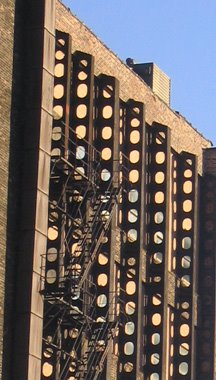
Meanwhile, architectural salvage firm Urban Remains has begun selling artifacts from Adler & Sullivan's landmark 1887 Wirt Dexter Building, also destroyed in a massive fire on October 24th that this week was officially declared an accident, caused by a cutting torch being used to dismantle a boiler for scrap. Urban Remains is selling 60 linear feet of the tall perforated beams that stood outside the back wall of the structure, as well as seven ornamented cast iron columns taken from the Wabash Avenue facade. Urban Remains tells me that a section of perforated beam has gone to the Chicago History Museum, but that Sullivan's ornamented limestone were corbels were lost in the ruble.

The Wirt Dexter was demolished by Heneghan Wrecking, whose company slogan, especially in these circumstances, takes on a chillingly ironic subtext.

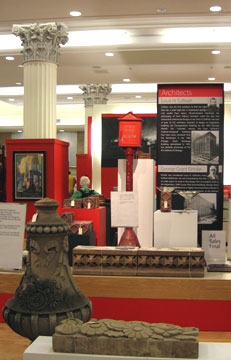
Ruin and dispersement seem to have become the new hallmarks of this year's celebration of the 150th anniversary of Louis Sullivan's birth. When Marshall Fields became Macy's in September, a gallery on the Wabash side of the store began offering up for sale a wide array of fragments salvaged from buildings from a range of architects that include George Elmslie and Sullivan himself, including bits and pieces from another demolished masterpiece, the Chicago Stock Exchange. All sales final.