Thursday, September 10, 2009

Carmine said one Thwack; here are three!
Gustav Mahler's final symphony, the 10th, was left so far from finished at the time of composer's 1911 death, age 51, that fervent Mahlerian advocates from Bruno Walter to Bernstein to Boulez have refused to perform the work in any of the versions completed by other hands, most successfully that of Deryck Cooke, which remains the gold standard to this day, the one that finally convinced Mahler's  widow, Alma, to allow the work to be performed in full. The last two of the symphony's five movements, and most of the third, were left by Mahler only in short score, not fully orchestrated. Yet I don't think I'm alone in considering the Tenth, despite the weakness of the inner movements, perhaps the most extraordinary and affecting of all of Mahler's works.
Today, an increasing number of conductors, like the Berlin Philharmonic's Simon Rattle, are performing the Tenth complete. One of the great losses of the last Chicago Symphony season was when health problems forced conductor Riccardo Chailly to drop out of scheduled performances of the Tenth with the CSO, after which the program, itself, was dropped in favor of substitute programming.
Through about noon Monday, however, you can hear Chailly's superb performance of the 10th with his own orchestra, the Leipzig Gewandhaus, that took place this past Monday at the London Proms. It's available via streaming audio here, and it's highly recommended.
If you know the work, however, you'll be slightly shocked not to hear, at the beginning of the last movement, the usual Thwack!s on a muffled bass drum. According to Tristan Jakob-Hoff, Chailly has taken his own pencil to the score and replaced the single-note Thwack! with a "short, two-note anacrusis before each note – 'buh-duh-DUM! Buh-duh-DUM!'"
Jakob-Hoff calls it "something better . . . .That particular rhythmic motif appears in various guises all the way through the symphony’s last three movements."
I'm not convinced. One of the most extraordinary things about the Tenth is how, at key points, it erupts with incredible rawness. Think of that sustained high-pitched note on the trumpet that sounds almost like a riff on an air raid siren, a terrifying prophecy of the sweeping waves of brutality and violence in which, not long after Mahler's death, the 20th Century would begin to drown.
To me that Thwack! is equally pivotal. It's said to have been inspired by a similarly struck drum Mahler heard outside his New York window, part of a funeral procession for a city fireman. When Chailly accents the drumbeat to mirror and integrate it with parallel melodic figurations elsewhere in the symphony, he softens, dilutes, takes the edge off the shock.
As Mahler was finishing his work on the Tenth, his health had begun to fail; he could feel the premonitions of death. And, he knew that the love of his life, Alma, was having an affair with another man. Those dull, empty, echoless thuds are the airless horror of the moment you turn and find the end of your being pressed like a prison cell wall against your face. The sick dread sinking in the pit of your stomach, the light suddenly snuffed out by an unseen, indifferent hand as you realize: there's no life, no love, no music.
Except, of course, Mahler gives us all three. They are his answers to that dread, to the abyss. If, as Leonard Bernstein argued, Mahler's Ninth Symphony was a series of farewells to the things the composer loved best, the Tenth takes it further. Mahler now sees those things from the grave, continuing on after him as if he never existed. To me, the final adagio of the Tenth is Mahler coming to terms with that fact with music that is giving, sublime and incredibly moving. No personal resurrection, but the gift of spirit, anima, in every breath of those Mahler touched and who live on, down to the audiences of today.
End of essay: Why I think a whack with one note is better than a whack with three.
Judge for yourself, but remember you have only through Monday noon to hear Chailly's exceptionally fine performance, here.
 widow, Alma, to allow the work to be performed in full. The last two of the symphony's five movements, and most of the third, were left by Mahler only in short score, not fully orchestrated. Yet I don't think I'm alone in considering the Tenth, despite the weakness of the inner movements, perhaps the most extraordinary and affecting of all of Mahler's works.
Today, an increasing number of conductors, like the
Berlin Philharmonic's Simon Rattle, are performing the Tenth complete. One of the great losses of the last Chicago Symphony season was when health problems forced conductor Riccardo Chailly to drop out of scheduled performances of the Tenth with the CSO, after which the program, itself, was dropped in favor of substitute programming.Through about noon Monday, however, you can hear Chailly's superb performance of the 10th with his own orchestra, the Leipzig Gewandhaus, that took place this past Monday at the London Proms. It's available via streaming audio here, and it's highly recommended.
If you know the work, however, you'll be slightly shocked not to hear, at the beginning of the last movement, the usual Thwack!s on a muffled bass drum. According to Tristan Jakob-Hoff, Chailly has taken his own pencil to the score and replaced the single-note Thwack! with a "short,
 two-note anacrusis before each note – 'buh-duh-DUM! Buh-duh-DUM!'"
Jakob-Hoff calls it "something better . . . .That particular rhythmic motif appears in various guises all the way through the symphony’s last three movements."
I'm not convinced. One of the most extraordinary things about the Tenth is how, at key points, it erupts with incredible rawness. Think of that sustained high-pitched note on the trumpet that sounds almost like a riff on an air raid siren, a terrifying prophecy of the sweeping waves of brutality and violence in which, not long after Mahler's death, the 20th Century would begin to drown.
To me that Thwack! is equally pivotal. It's said to have been inspired by a similarly struck drum Mahler heard outside his New York window, part of a funeral procession for a city fireman. When Chailly accents the drumbeat to mirror and integrate it with parallel melodic figurations elsewhere in the symphony, he softens, dilutes, takes the edge off the shock.
As Mahler was finishing his work on the Tenth,
 his health had begun to fail; he could feel the premonitions of death. And, he knew that the love of his life, Alma, was having an affair with another man. Those dull, empty, echoless thuds are the airless horror of the moment you turn and find the end of your being pressed like a prison cell wall against your face. The sick dread sinking in the pit of your stomach, the light suddenly snuffed out by an unseen, indifferent hand as you realize: there's no life, no love, no music.
Except, of course, Mahler gives us all three. They are his answers to that dread, to the abyss. If, as Leonard Bernstein argued, Mahler's Ninth Symphony was a series of farewells to the things the composer loved best, the Tenth takes it further. Mahler now sees those things from the grave, continuing on after him as if he never existed. To me, the final adagio of the Tenth is Mahler coming to terms with that fact with music that is giving, sublime and incredibly moving. No personal resurrection, but the gift of spirit, anima, in every breath of those Mahler touched and who live on, down to the audiences of today.
End of essay: Why I think a whack with one note is better than a whack with three.
Judge for yourself, but remember you have only through Monday noon to hear Chailly's exceptionally fine performance, here.

Sept 15 deadline for shaking down the Graham for cash; Fields Fans gather on the 13th
September 15th is the deadline for submitting grant proposals to the Graham Foundation. The rules and required inquiry form can be found on-line.
It's looking a little empty over at Madlener House right now (actually, this Michelle Litvin photo is from 2008), now that Cecil's Indian rope trick constructions have climbed up to the ceiling and disappeared. However, we're promised that on October 16th there'll be a new exhibition, Actions: What You Can Do With the City, exploring how everyday human actions can animate and influence the perception and experience of contemporary cities. Inevitably, you can follow the Graham on Twitter for continuing updates.
Fields Fans Never Say Die - They'll be rallying under the great clock at State and Washington from 1 to 2 p.m. this Sunday, September 13 in support of bringing the Marshall Field's name back to the store currently known as Macy's. The current New Yorker has a story about shopping in Chicago (bring money. seriously.) by Patricia Marx, who comments, "(Marshall Field's) was sold to Macy's in 2005. Chicago has been in mourning ever since. How can one not grieve for an emporium--Field refused to call it a department store--whose slogan was "Give the lady what she wants?" For more info on the rally and Fields Fans, contact Jim McKay, Co-Organizer, at jjmckay@fieldsfanschicago.org, 312-927-4424, or check it all out on-line.
It's looking a little empty over at Madlener House right now (actually, this Michelle
 Litvin photo is from 2008), now that Cecil's Indian rope trick constructions have climbed up to the ceiling and disappeared. However, we're promised that on October 16th there'll be a new exhibition, Actions: What You Can Do With the City, exploring how everyday human actions can animate and influence the perception and experience of contemporary cities. Inevitably, you can follow the Graham on Twitter for continuing updates.
Fields Fans Never Say Die - They'll be rallying under the great clock at State and Washington from 1 to 2 p.m. this Sunday, September 13 in support of bringing the Marshall Field's name back to the store currently known as Macy's. The current New Yorker has a story about shopping in Chicago (bring money. seriously.) by Patricia Marx, who comments, "(Marshall Field's) was sold to Macy's in 2005. Chicago has been in mourning ever since. How can one not grieve for an emporium--Field refused to call it a department store--whose slogan was "Give the lady what she wants?" For more info on the rally and Fields Fans, contact Jim McKay, Co-Organizer, at jjmckay@fieldsfanschicago.org, 312-927-4424, or check it all out on-line.
Wednesday, September 09, 2009
Great Moments in Meteorology
 Do I detect a underlying sense of resigned disappointment? (via the Chicago Sun-Times)
Is it just me, or does this perspective leave you feeling a bit queasy?
 215 West Washington and environs, by Bob Johnson.

Monday, September 07, 2009
David Miller(/Hull Partnership) tonight, FotU at Sanfilippo, Pecha Kucha at Big Bold - 11 new additions to September calendar
We start with a reminder that the post-holiday season kicks off tonight at 6:00 p.m. at  the Chicago Architecture Foundation with a lecture by David Miller of the Miller/Hull Partnership, AIA's 2003 firm of the year.
Then there's a dozen MORE events we've just added to the September calendar. There are still tickets available for Friends of the Uptown Theatre's September 20th fundraiser which offers a rare opportunity to visit the fabled Sanfilippo Estate and its priceless collection of of Jazz Age objects. The event includes a concert played on the estate's stunning theatre organ.
This Thursday, the 10th, curator Edward Keegan will be leading the first of three gallery talks for his new exhibition, Big. Bold. Visionary: Chicago Considers the Next Century. That same evening sees receptions for the opening of two more exhibitions, Glessner House's exhibition of the residential work of Burnham and Root in and around Prairie Avenue and, just down the street in Keith House, Prairie Avenue Gallery hosts a showing of the work of second year masters' students from the Art Institute's Architecture, Interior Architecture and Designed Objects program. On Sunday, the 27th, the Prairie Avenue Gallery will also be sponsoring a panel discussion with Vince Michael, Rolf Achilles, Bill Tyre, Mark Sexton and Tina Feldstein on the future of Glessner House and the Prairie Avenue district.
On Thursday, the 17th, the Illinois Chapter of the National Organization of Minority Architects offers up its first annual Architectural Jazz Night, while on Friday the 18th, the American Institute of Steel Construction sponsors SteelDay 2009 at Millennium Park.
On Tuesday, the 29th, there'll be a special Burnham edition of Pecha Kucha night at the Big. Bold. Visionary. show, with the list of presenters already including Burnham Pavilion lighting designer Tracey Dear, Kyle Reynolds of Valerio Dewalt Train and - apologies in advance - me.
We're now up to 70 - count 'em - 70 events on the September calendar. Check it all out here.
 the Chicago Architecture Foundation with a lecture by David Miller of the Miller/Hull Partnership, AIA's 2003 firm of the year.
Then there's a dozen MORE events we've just added to the September calendar. There are still tickets available for Friends
 of the Uptown Theatre's September 20th fundraiser which offers a rare opportunity to visit the fabled Sanfilippo Estate and its priceless collection of of Jazz Age objects. The event includes a concert played on the estate's stunning theatre organ.
This Thursday, the 10th, curator Edward Keegan will be leading the first of three
 gallery talks for his new exhibition, Big. Bold. Visionary: Chicago Considers the Next Century. That same evening sees receptions for the opening of two more exhibitions, Glessner House's exhibition of the residential work of Burnham and Root in and around Prairie Avenue and, just down the street in Keith House, Prairie Avenue Gallery hosts a showing of the work of second year masters' students from the Art Institute's Architecture, Interior Architecture and Designed Objects program. On Sunday, the 27th, the Prairie Avenue Gallery will also be sponsoring a panel discussion with Vince Michael, Rolf Achilles, Bill Tyre, Mark Sexton and Tina Feldstein on the future of Glessner House and the Prairie Avenue district.
On Thursday, the 17th, the Illinois Chapter of the National Organization of Minority
 Architects offers up its first annual Architectural Jazz Night, while on Friday the 18th, the American Institute of Steel Construction sponsors SteelDay 2009 at Millennium Park.
On Tuesday, the 29th, there'll be a special Burnham edition of Pecha Kucha night at the Big.
 Bold. Visionary. show, with the list of presenters already including Burnham Pavilion lighting designer Tracey Dear, Kyle Reynolds of Valerio Dewalt Train and - apologies in advance - me.
We're now up to 70 - count 'em - 70 events on the September calendar. Check it all out here.
Turandot unlikely to lay egg at Bird's Nest
 Zhang Yimou's
Turandot
at the Bird's Nest
music by Giocamo Puccini
And you thought Zeffirelli was over the top?
For China's National Day celebration on October 1, Zhang Yimou is remounting his spectacular production of Turandot, staged at Beijing's Forbidden City in 1998, in the Herzog & de Meuron "Bird's Nest" Olympic stadium where Zhang also staged the blockbuster opening ceremonies of the 2008 games.
Mahler/Schamaler, this will be an "Opera of a Thousand", with China's CCTV reporting there will be 1,000 square meters of video screens and 34 projectors. The choreographer will be Chen Weiya and the lighting engineer Sha Xiaolan. Singers and conductor to be named later, if ever.
To accommodate set-up for the production, the Avenue of Eternal Peace will be closed to vehicular traffic for four days, with 63 bus lines rerouted to the 5th ring road. "This is a great thing we’re doing," said Beijing's mayor, Wang Qishan, in defending the closure to reporters. "I wish we could do this every day. It will employ 200,000,000 people. It will pump 3 trillion yuan into our economy. It will cure all known diseases. The publicity we’ll receive throughout the world - unbelievable. You can’t even give us that exposure globally. We'll be bigger than Oprah!"
And if there's any doubt where the age of affluence has been moving to, the production's budget is a staggering $180,000.000, about six times City Opera's most recent budgets, or enough to fund over three seasons at Lyric. After Beijing, it's set to go on tour. Read the CCTV report here. See the video report here.
Sunday, September 06, 2009
Urbs in Silva
Millennium Park was an instant Chicago landmark when it opened in 2004 and its attractions - the Pritzker Pavilion and Gehry bridge, Cloud Gate (aka "Da Bean") and Crown Fountain with its giant spouting faces - are as popular as ever. Over the past five years, however, something perhaps even more remarkable has grown up all around them: hundreds of trees of over eight species, part of an incredibly varied assembly of plant life, built atop a parking garage and what is essentially a viaduct over the former Illinois Central tracks, that has been called the largest green roof in the world.
 Spring is the time of the pear trees lining the east-west promenades, breaking in spectacular white flower. Along the north-south promenades, the big boys take over. Soon we'll see the spectacular Fall flaming of the Autumn Blaze maples (2003 Tree of the Year!) which seem well on the way to reaching their potential maximum height of 50 to 60 feet.
 Encountered on the ground, the trees form perimeters for the park walkways. Seen from above, the treetops merge, seeming to stand shoulder-to-shoulder, soaring in a majesty that ups the ante on the manmade skyline of the city of big shoulders. Seeing Renzo Piano's Modern Wing rising out of the dense foliage, it puts me in mind of the story I read as a boy of the vines of the jungle overtaking the grand opera house in the (then) lost city of Manaus, at a time when nature still had the upper hand in putting man's vanity in its place.
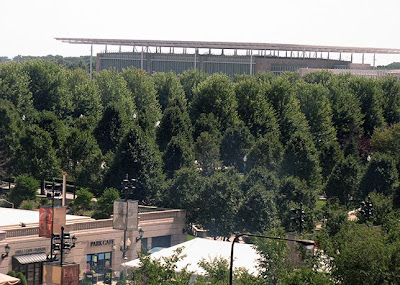
 Spring is the time of the pear trees lining the east-west promenades, breaking in spectacular white flower. Along the north-south promenades, the big boys take over. Soon we'll see the spectacular Fall flaming of the Autumn Blaze maples (2003 Tree of the Year!) which seem well on the way to reaching their potential maximum height of 50 to 60 feet.
 Encountered on the ground, the trees form perimeters for the park walkways. Seen from above, the treetops merge, seeming to stand shoulder-to-shoulder, soaring in a majesty that ups the ante on the manmade skyline of the city of big shoulders. Seeing Renzo Piano's Modern Wing rising out of the dense foliage, it puts me in mind of the story I read as a boy of the vines of the jungle overtaking the grand opera house in the (then) lost city of Manaus, at a time when nature still had the upper hand in putting man's vanity in its place.

This just in: Oprah dyes Chicago River Purple; acai juice futures soar on the CME
 24th season opener spectacular turns all of Chicago "Oprahriffic" Reverses effect of St. Patrick's dye for the river's fish, who are all asking, "What's in the damn box?" Image courtesy of feastoffun, via the chitownproject blog, via Chicago Now's Marc Fellon.
Saturday, September 05, 2009

Friday, September 04, 2009
Daniel Burnham turns 163; Big. Bold. Visionary opens tonight
 The pride of Henderson and Chicago's own, Daniel Burnham was born on this day in 1846, and to note the occasion, a new exhibition, Big. Bold. Visionary: Chicago Considers the Next Century, featuring visions of the future by today's Chicago architects, opens tonight at 6:00 p.m., at the Chicago Visitors Center, 72 E. Randolph.
 Correction: the exhibition at the Visitors Center is not, as listed in an earlier version of this post, Chicago Considers the Nest Century, but actually Chicago Considers the Next Century, and does not, it has been discovered, focus on birds, raising chicks, or artfully arranging twigs. (There is, however, a cleverly deployed ferret.) ArchitectureChicago Plus regrets the error.
Thursday, September 03, 2009
Wednesday, September 02, 2009
A Late Summer's Night Dream
 Last night saw the premiere of Judith Paine McBrien's long awaited documentary Make No Little Plans: Daniel Burnham and the American City. It's a mainstream but immensely satisfying look at Burnham's life, work and thought, with stunning images that will never look better than on the huge screen erected on the Pritzker Pavilion stage. We expect to be writing more soon, but we're a bit too woozy tonight to do the work justice, so we'll just share these snapshots of a perfect urban evening where Chicago takes on the kind of magical allure that inspirits Burnham's optimistic vision.


September 8th deadline for registering for Civil Rights Movement architectural tour
 October 8 through the 12, the Society of Architectural Historians is offering a four day study tour of civil rights movement memorials in Alabama and Georgia. Included will be the Atlanta homes of Martin Luther King, Jr., Ebenezer Baptist Church, then on to the Tuskegee Institute, and other historical sites in Montgomery and Selma.
In each city local architectural and urban historians, preservationists, and former participants of the movement will help us to understand the monuments and landscapes that we see and to recall those that are no longer available to see.The tour will be led by Dell Upton, Chair of the Art History Department at UCLA. More information and registration, which closes September 8th, on-line.
Tuesday, September 01, 2009
Oprah to Shut Down Michigan Avenue for 2 1/2 days
We all love Oprah . . . but are they nuts? What city bureaucrat signed off on shutting down Michigan Avenue, one of the busiest streets in the city, for two and a half days so that Winfrey can tape the opening show of her 24th season at Michigan and Ohio? An hour or two, okay. The better part of a morning, maybe. But shutting down Michigan Avenue, all the way from Wacker to Ohio, from midnight on Monday the 7th through 5 a.m. the following Wednesday, the 9th is . . . what's the word? Insane.
Business Week spotlights Jeanne Gang as "Name to Know"
 The August 31st Business Week offers a fairly in-depth profile of Chicago architect Jeanne Gang, which includes a video interview in which she discusses the emergence of the design for the Aqua tower as a "vertical landscape". The story covers her relationship with developer James Loewenberg, projects such as the Starlight Theater and Ford Calumet Environmental Center and Solstice in Hyde Park, and references our own Chicago Reader cover story: "Lynn Becker goes further, declaring that Gang represents a third school of Chicago architecture, 125 years the first school invented the high rise and the second ushered in Modernism." Apparently BW reporter Michael Arndt failed to get ahold of Bob Somol to get the straight dope about the irrelevance of Chicago architects. (And yes, I know, I've still to put my Studio Gang profile - and extensive interviews with Jeanne Gang and Mark Schendel - up on my Repeat site, but hope to do so soon. Scout's honor.)
Business Week says that even in the current deep recession, Studio Gang is holding its own, with 2009 revenue "on track" to match last years $8 million. Check out the entire article here.

Monday, August 31, 2009
Burnham Plan, Unity Temple at 100. Bold Visions, Pecha Kucha_x3, Koo da Wit, Jensen, Hovey, Remembering Len Despres - 60+ events on September calendar
 September not only sees the culmination of the centennial celebration of Daniel Burnham's 1909 Plan of Chicago, but of Frank Lloyd Wright's iconic Unity Temple, which celebrates with a gala raising funds for the building's restoration. Preservation Chicago has its own autumn benefit in the Elks Memorial. Pecha Kucha goes nuts, with no less than three events: at Martyr's, downstate, and at a new exhibition opening this Friday at the Chicago Visitors Center, Big. Bold. Visionary. Chicago Considers the Next Century, which finally gives Chicago architects the chance to bring their talents to the Burnham celebration. On Wednesday at the Pritzker Pavilion, there's the premiere of Judith McBrien's long awaited documentary, Make No Little Plans: Daniel Burnham and the American City.
Jackie Koo discusses her new Wit Hotel for Friends of Downtown, also on Thursday, and gives a tour for the IES, Chicago Chapter. The School of the Art Institute launches an ambitious lecture series with Kathleen James-Chakraborty and Narelle Jubelin. CAF welcomes the authors of Beyond Burnham at a lunchtime lecture, and hosts a talk by Pamela Bannos on the old Chicago city cemetery, whose residents were forcibly relocated to create Lincoln Park. The Chicago Central Area Plan, the restoration of the Guggenheim, a Glessner House celebration of the life of Leon Despres, IDOT capital spending, David Hovey, Jens Jensen, and a historic pub crawl (pickling: my kind of preservation). And, as they say, much, much more. 60 great events and growing. Check them all out here.
Saturday, August 29, 2009
A Champagne Toast to the Prairie Avenue Bookshop
 As I'm reminded every morning when I face myself in the mirror, nothing lasts forever. Not even wonderful things. Not even the Prairie Avenue Bookshop, which will be closing its doors end of business on Monday, August 31st.
It billed itself as the world's largest architectural bookstore, and who could argue? From the window of its capacious home at on south Wabash you had a great view of the Auditorium Building, Adler and Sullivan's peerless masterpiece, and within it's warm interior, so handsome it was used as Christopher Plummer's architectural offices for the film, The Lake House, you encountered an intoxicating selection of books and periodicals you'd find in no other store.
It would be cold, indeed, not to sense the sadness of the occasion. But better to celebrate that something so remarkable survived so long, going back 35 years to its original location, on Prairie Avenue next to H.H. Richardson's Glessner House, when Chicago's one-time street of millionaires was still troubled and derelict. Not only did this shaky idea for a business survive, it endured, soon moving to quarters in the middle of the revitalizing Printers Row district. Then, finally, to its present home - six times larger and offering up as much as 14,000 volumes.
And lest you be tempted to think Prairie Avenue's closing extends from overreach, consider how many bookstores Prairie Avenue has outlasted: Kroch and Brentano's just up the street, its flagship store now a false front for a soaring new condo tower. Not so long ago, there was also a Kroch's in Water Tower Place, along with a Rizzoli with an international flavor and an unparalleled selection of art books. The British-flavored Waterstone's was just across the street. The inimitable Stuart Brent held down the fort for decades further south on Michigan. Then Borders opened a superstore in the old Magnin's department store, and soon the dominoes became to fall. In short order all of them were out of business, leaving only the cockroach-like Waldenbook outposts, more like glorified airport terminal kiosks than the real thing.
In weak moments, you might imagine that Prairie Avenue might have survived if they just did more, more of something - better use of the internet, more book signings, more opening up the store to meetings. But consider this: This past winter, Borders announced that, even after driving out all the competition, their Michigan Avenue flagship wasn't meeting expectations, and was to be closed after the 2009 Christmas season. If they can't figure out to make a go of a bustling location with long lines backing up from the checkout counters, it's a bit churlish to expect that Prairie Avenue could have done better. In this dawning age of ebooks, the Kindle, and listening to best sellers being read to you by celebrity voices on your iPhone as you commute to work, the question is no longer one of the survival of bookstores, but of books, themselves.
If you haven't already, stop by on Monday. 418 S. Wabash, hours 10:00 a.m. to 6:00 p.m. All titles are 70% off. In terms of selection, all the most usual suspects are pretty much gone, but there's a marvelous sampling of interesting underdogs, their monographs finally shining brightly, now that they're out of the shadow of big brand bullies like Gehry and Wright. There's still a good collection of out-of-print titles, and of periodicals, including issues of the invaluable Prairie School Review, created by the Hasbrouck's in the 1960's. You may not find exactly the book you came to buy, but you'll likely find something unexpected that will delight you.
And so, let's celebrate a fantastic run. Not just the books, the bricks and the mortar, but the great staff, Karl and Beth Eifrig, Emily Tamblyn, and, I know, others I'm leaving out, who were always there to find the books I needed right now to meet my deadline, and, of course, Marilyn and Wil Hasbrouck, who kept the Prairie Avenue Bookshop a remarkable Chicago cultural asset for three and a half decades. What we owe them is beyond evaluation.
Subscribe to:
Posts (Atom)