Showing posts sorted by relevance for query verizon. Sort by date Show all posts

Wednesday, January 14, 2026

An Annex That's Anything but Secondary: The Chicago Architecture Biennial Reanimates Dead Retail at 840 North Michigan

One Point Perspective Study No. 2, Luftwerk, photo Pablo Gerson, courtesy CAB


No one’s writing about it, but it's an absolute trip.

When the sixth iteration of the Chicago Architecture Biennial opened last September, it received a decent amount of press. For the satellite at 840 North Michigan, opened at the end of October? Next to none.

Which is unfortunate. The five floors of installations at 840 are every bit as compelling as those at the Cultural Center. What makes it even more compelling is the site. Not the bordello-styled Yates Gallery at the Cultural Center, but within a frozen-in-time design of an abandoned superstore. The 840 annex is not just a container; it's one of the key parts of the exhibition.


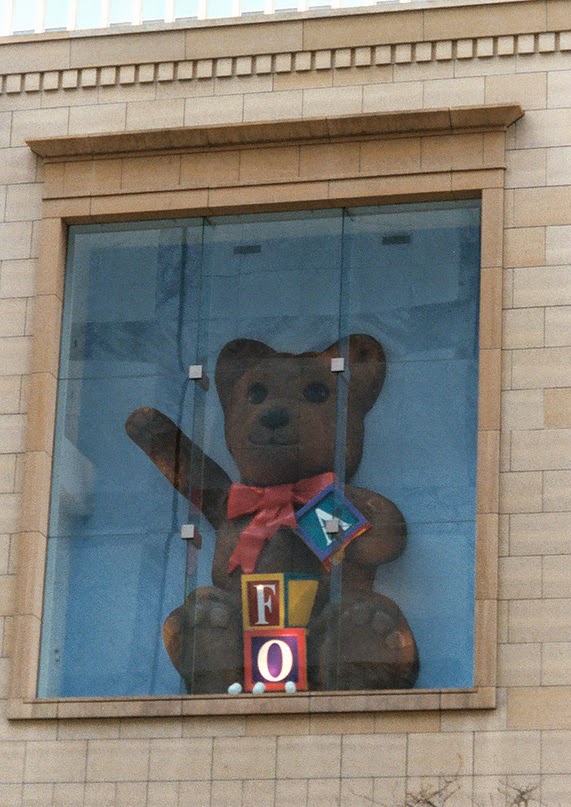
The building itself began life in 1992, as Plaza Escada, a modestly-scaled homage to the patrician architecture of 1920's North Michigan Avenue, then rapidly being erased by new towers.  Designed by architect Lucien Lagrange in a vaguely French Second Empire style, it included a corner clock tower and a huge teddy bear in a two-story window, calling card for the developer's other major tenant, FAO Schwarz.

The bear bit the dust in 2002. Escada went bankrupt in 2009, decamping for more modest lodgings on Oak Street.  H&M took over the FAO Schwarz space.  Eventually every bit of Lagrange's handiwork was stripped clean, replaced with a glass curtain wall for H&M, and, for the Escada space, black granite for the truly horrific lump-of-coal Verizon flagship, largest in the country, sucking in like a black hole all memories of the grace that once characterized the neighborhood. 


And then it got worse.  The Amazon effect, taking increasing market share from bricks-and-mortar retail, eroded the flush times for North Michigan.  Then COVID ushed in the apocalypse.  By the early years of this decade, Macy's across street, and H&M, Verizon, and the ambitious Uniqlo were all gone, leaving an entire block of empty space.


Which brings us back to the Biennial Annex. H&M, stripped bare and frozen in time, is somehow a perfect exhibition space.  As much as the exhibits themselves, it's an amazing commentary on architecture and time.


I have no interest in declaring whether individual exhibits are sane or stupid.  Make a visit, enjoy the ride, and come to your own conclusions.


For my own trip, I started out in the basement, where Ecologies explores "how architecture exists within the interconnected systems that shape our world - climate, technology, food and the human body". All within walls once designed to hold racks and encourage purchases.


From there, I took the elevator up the the 4th floor, where you're instantly immersed in the windowless redworld of
Discotecture: Altered States. [Ivan L. Munuera and TAKK (Mireia Luzárraga and Alejandro Muiño)]


It's a kind of architectural music of the night, drawing on how "the architecture of nightclubs actively shapes cultural, social, and environmental practices."


Then I moved from this hermetic, otherworldly space to the other side of the floor, a raw, unfinished, light-filled double-height space overlooking Michigan Avenue, dominated by the absurdist
Los Porfiados (The Stubborns). [gt2p, Santiago, Chile]


Los Porfiados with Louie, The Bitterang Farm in the foreground


A popular Chilean toy supersized into monumental, brightly colored inflatable sculptures that reach all the way to the high ceiling, they sway when touched, exploring "resilience not as rigidity, but as adaptability and collective balance.  The work is incomplete without people."  


Los Porfiados share the space with other installations.  The Annex hosts more than 30 installations from over 35 artists and studios. I don't have time to cover them all, but there's a digital guide describing each one
here.

Instead, I conclude with the following photographic sampling of just some of things you're going to see as you move down from floor to floor, to the entry-level lobby.


The run of the 840 North Michigan Annex has been extended through February 15th, but, as I'm always blindsided by how quickly seemingly distant dates sneak into the present, my recommendation to you is to make a point of visiting this remarkable exhibition before it slips by.


Future Climate Souvenirs, Parsons & Charlesworth

The Uncomfortable Giant, Blanco, Estudio Jochamowitz River and Ghezzi Novak

Living Histories: Space for Reckoning, STOSS Landscape Urbanism, MPdL Studio with Mark Lamster

Farm Park, CLUAA

George for George: An Unblocked Englewood x Innovation Blue Collaboration, Tonika Lewis Johnson and Amanda Williams

Speakers Corners, Johnston Marklee

Untitled: Head in the Clouds, Ibañez Kim

Shared Resource, Besler & Sons

In Other Rooms, Bair Balliet


###

Unless otherwise indicated, all photos © Lynn Becker.  All rights reserved.

Wednesday, May 06, 2026

It's Finally Happening! Massive, Long-Empty Mag Mile Space Finds its Mate


 For 28 years, it was La Strada, at Michigan and Randolph, an upscale, below-grade restaurant with its own outside (stopped) clock.  Then, in 2007, it closed to make way for a tiny-footprint, 40-story apartment tower that never came to pass.

It took another 15 years for La Strada to finally get ground into dust . . .


...but this time it was for a 74-foot-tall, 15,000 square-foot black box from the Lamar Johnson Collaborative that seemed to have taken its design cues from the now long-closed Verizon Death Star about a mile up the street.

Completed in 2023 at what you'd think was a prime location across from the Wrigley Peristyle and Millennium Park...

Michigan and Randolph, 2023

... it also stood empty and raw, a massive, unfinished interior for which I had a particular fondness - I'd loved to have seen it kept in perpetuity as a pop-home for flower markets, art faires, and UFC cage matches.


The owners, alas, having sunk untold millions into building the thing, had other ambitions.  It was marketing as a restaurant space, but I noticed in April that the bottomless pit had grown a floor at street level.  I went to the internet to find out what was going on - nada, but the space started filling up with various retail-looking furnishings.


Then, about a week ago, the smoking gun appeared.  A sales counter with an unmistakable logo: ByeBye Chicago.  Yes!  We're getting a souvenir superstore!  Des Plaines-based Chipman Design Architecture describes their inspiration:

We're excited to share a sneak peak of our latest project for Chicago's newest retail souvenir destination, Bye Bye Brands.

Image courtesy Chipman Design Architecture

Inspired by the L trains that connect Chicago's neighborhoods, the design reflects how the city moves, carrying people from every corner into the center where tourism, culture, and city life converge.  Ground in Chicago's industrial roots, the space layers bricks, bold graphics, and iconic Chicago language into a vibrant tribute to the city.

ByeBye already has several, much small locations up and down Michigan Avenue, and I don't know if the massive (5,000+ square-foot) outlet will replace any of them, but on Wednesday, I caught employees busily stocking merchandise and putting on the finishig touches.  I still haven't seen an opening date - or any outside signage - but it's got to be soon.


No comment yet from the street vendors who have traditionally set up their own souvenir carts on Michigan just outside the building.

###


Michigan and Randolph, 1871

Michigan and Randolph, 1959

La Strada's stopped clock

151 North Michigan under construction

...some months later

Another look at the great space lost


The Chicago Cultural Center reflected in the large windows of 151 North Michigan

Bye Bye Chicago store, 320 North Michigan

Construction plans for Bye Bye Chicago superstore

The aforementioned Verizon Store Death Star, long closed,
but still a plague on its corner across from Water Tower Place


Sunday, November 30, 2014

Lump of Coal in Chicago Architecture's Holiday Stocking: Verizon lands with a Thud on the Mag Mile

Words I never thought I would write: Bring back Lucien!
click images for larger view
This is a photograph of 840 North Michigan.  Dating from 1992, it was another retro special from Chicago architect Lucien Lagrange, who, until he was tripped up by the economic crash of '08, was the undisputed king of a style of architecture that pretended the 20th century - and much of the 19th- never happened.

As detailed on a post on the indispensable Forgotten Chicago website, this was previously the site of Holabird and Root's 1928's Michigan Chestnut Building,  where much of the seven stories were taken by the Chicago outpost of Saks Fifth Avenue, which remained there for less than a a decade before moving to its new store down the street in a building that's currently occupied by Niketown.

Michigan Chestnut was the type of restrained, classically accented, mid-rise architecture that gave the Magnificent Mile its name.  Beginning in the 1980's, however, one by one, those buildings were demolished in favor of mega-projects.  Michigan Chestnut, itself was scheduled to replaced by a 30-story tower, but when that project fell through, we got Lucien Lagrange's low-rise Plaza Escada instead.

His design, complete with clock beneath a mansard roof, stretched the classical vocabulary like silly putty to accommodate the needs of a modern commercial structure.  The surrealism of it all was underscored by the ridiculously large upper window occupied by a massive teddy bear.
The window advertised toy retailer FAO Schwarz.  The store and fashion house Escada were 840's largest tenants.  A lavish Waterstone's bookstore soon opened the basement, but folded after only four years, shortly after a Borders superstore opened just a few doors south. FAO Schwarz closed early in 2002.  Finally, after declaring bankruptcy, Escada exited in 2009.  Eventually H and M took over the FAO Schwarz space, while the former Escada store remained stubbornly empty..

Cover of U.S. Equities brochure
In a slick brochure, U.S. Equities marketed 47,00 square feet of space in what they proclaimed "The most prestigious address on The Magnificent Mile."  Finally, last year, Verizon agreed to take over 27,000 square feet formerly occupied by Escada, split between a "destination" store and offices.
This past spring, scaffolding went up along Michigan and all the way down Chestnut, as Lagrange's elegant if quirky facade was ripped away . . .
. . . .and the building gutted down to its bare bones.
The new undercladding was neutral and featureless . . .
. . . but the finished design soon revealed itself as one of the most heavy-handed and graceless to ever land on Michigan Avenue.  It's best at night . . .
. . . when the funereal granite basically makes the building disappear as it merges with the darkness. leaving only the huge windows giving a direct view into over-lit interiors.
As a sign on the outside of the building, the above-pictured display would be blatantly illegal.  As a multi-story video wall mounted on 840's short side, carried directly to the street through a huge window, it's A-OK.
In the harsh light of morning, however, the new 840 is an architectural hangover.  It's hard to imagine anything so expensive could be more shockingly awful.  It's as if grave robbers had dug up the most oppressively pompous 1960's corporate design and strung up the corpse on one of the premiere facades along North Michigan Avenue.
The building permit attributes the $5 million project to architect William E. Abbot.  I'm sure he was only following orders.  Who in their right mind would have ever thought this design was a good idea? 

Earlier this year, the owners had refinanced 840 with a $52 million loan.  Then, just last month, an East Coast developer paid $144 million for what Crain's Chicago Business called "a stake" in now fully leased structure.  So the original investors got a windfall, the new owners got control of a prime Michigan Avenue corner, but as for the rest of us, all we got was this massive eyesore.
During the day it's like a giant black hole, sucking up all the oxygen off the street.  It's like a giant,  obscene tombstone for the destruction of all the elegance of the 1920's buildings that gave the "Mag Mile" its original character