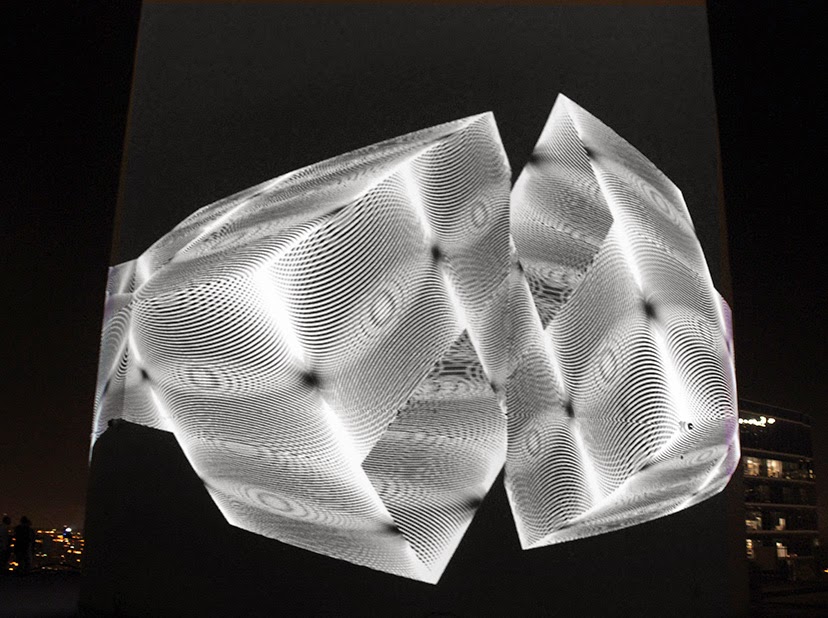
Showing posts with label Chicago Loop Alliance. Show all posts

Friday, September 19, 2014

Luftwerk's Film Noir Redemption in Couch Alley - only through Saturday


click images for larger view
Flow/IM Fluss continues in Couch Place from 5:00 p.m. to midnight through Saturday, September 20th.  The weather project for Friday, warm and rainless, looks to be especially perfect.
When you think of the black-and-white photography of the great film noir thrillers of the 1940's and 50's, you think of the striking interaction of shadows and fog, and of night pierced by dramatic shafts of light.  It's a prototypical expression of the city and its snares, the allure and danger of the only partially seen.
The passageway bridging State and Dearborn midblock between Lake and Randolph is called Couch Place.  In Old Chicago, it was a street, the southern boundary of the Tremont House, one of the city's early high-end hotels.  Long ago, however, it became nothing more than a narrow alley, a place where deliveries were made, garbage was kept to be picked up, and rats scurried across the pavement, unseen but heard.  The fine facades along Randolph Street may have been of gleaming terra cotta, but at the stage door end of the building, it was plain, homely alley brick, often with cheap paint flaking off of its surface.  The bright marquees out front spoke to our hopes and illusions, the claustrophobic, menacing alleys to our fears and darker realities.  It was kind of place you could imagine Elisha Cook, Jr. skulking in a doorframe, or Humphrey Bogart emerging rubbing his head after being hit from behind by someone who thought he was getting too close to the truth.

And then they went and cleaned it up. As a part of the attempt to revive Chicago's theater district, Couch Place was gussied up in 2007.  The dumpsters went away, new paving installed, and vintage posters mounted evoking the days when the alley held the stage doors to movie palaces such as the Oriental and State-Lake.  The tall neon sign for the new Goodman theater lined up as the alley's visual terminus to the west.
Even with all that, Couch Place remains very sparsely traveled.  Thursday night, however, it was wall-to-wall people, as it was premiere of FLOW/Im Fluss, a new light and water installation by Luftwerk, a/k/a artists Petra Bachmeier and Sean Gallero, creators of such striking temporary artworks as Luminous Field at Cloud Gate, and this past winter's Spring Light for the Chinese New Year, at the Chicago Cultural Center and McCormick skating rink at Millennium Park.  In October, the pair will mount INsite, lighting up Mies van der Rohe's iconic Farnsworth house.
Petra Bachmeier and Sean Gallero being photographed
by Public Art in Chicago's Jyoti Srivastava

Flow/Im Fluss celebrates the 20th anniversary of Chicago and Hamburg being named as Sister Cities.
Inspired by the element of water and its all-encompassing connectivity, Luftwerk’s FLOW/Im Fluss visualizes the characteristics of the Chicago River and Hamburg’s River Elbe through video compositions projected on water screens. 
Based on scientifically collected measurements like oxygen levels, currents, contamination, and chemical compounds FLOW/Im Fluss interprets data from the two rivers to create a visual experience. 
The projected video will illuminate screens made of water - inviting viewers to immerse themselves into the flow of data collected from both rivers. 

The event, which also includes music, is sponsored by the Goethe Institut and Chicago Loop Alliance, as part of its sequence of events Activating spaces in the Loop with temporary art installations.
The best way to experience Flow/Im Fluss is to walk through it, from State to Dearborn and back. Step into the lines and swirls of light piercing the darkness, and walk through the fine mist that both provides the screen for the projected geometric forms and imparts to you as a visitor an almost baptismal cleansing of the dirt and squalor of the “dark alley”  of the soul. 


Sunday, August 24, 2014

Up on the Rooftop - Night and Art at Marina City with Luftwerk, soon to light Mies van der Rohe's Farnsworth House

click images for larger view
Saturday night marked another showing of the work of Luftwerk light sculptors Petra Bachmaier and Sean Gallero.
Marina City rooftop core at daytime
A large crowd made the trek up to the 60th floor rooftop of the west tower of Bertrand Goldberg's iconic Marina City to see a projection of  Luftwerk's geometric transformations wrapping around almost the entire circumference of the tall round service core that punctuates the top of each tower.
The presentation had major competition from the nighttime cityscape of Chicago stretching in all directions far into the horizon.

But then again, there was more than enough time to enjoy both.

Luftwerk has two other major projects coming up.  On September 17th to 20th, Couch Place, the theater district alley that runs between State and Dearborn behind the Ford Oriental Theater will be the site for the Chicago Loop Alliance sponsored FLOW/Im Fluss . . .
Inspired by the element of water and its all-encompassing connectivity, Luftwerk’s FLOW/Im Fluss visualizes the characteristics of the Chicago River and Hamburg’s River Elbe through video compositions projected on water screens.
Based on scientifically collected measurements like oxygen levels, currents, contamination, and chemical compounds FLOW/Im Fluss interprets data from the two rivers to create a visual experience. 
The projected video will illuminate screens made of water - inviting viewers to immerse themselves into the flow of data collected from both rivers.
The installation celebrates the 20th anniversary of the Sister Cities relationship between Chicago and Hamburg. (And since it's the Elbe and not the Rhine, you don't have to look for any shiny gold rings to grab at, or fear being pulled under by some river maidens with a funny sense of fun.)

There will also be performances of Birgit Uhler's Traces, for trumpet, radio, speaker, objects and tape feeds each night the FLOW/Im Fluss is on display.
Then on October 17th, through the 20th, Mies van der Rohe's Farnsworth House in suburban Plano will be the focus for INsite, in which Luftwerk will transform the iconic structure “into a canvas of light and sound, featuring original music by percussionist Owen Clayton Condon and curated by Steve Dietz.”  Tickets are $100.00 ($200.00 for opening night), which may seem a bit steep until you realize that it includes transportation from Chicago to the Farnsworth House and back, a trip of 58 miles each way.

Read More about Luftwerk in Chicago and Mies van der Rohe's Farnsworth House:

Luminous Field, at Millennium Park's Cloud Gate sculpture

Luftwerk takes over Cultural Center Facade and McCormick Rink ice to celebrate Chinese New Year

Glass House Struck by Gavel - the history and rescue of Mies van der Rohe's Farnsworth House

The Little Farmhouse that Roared: Cycles of Time at Mies van der Rohe's Farnsworth House


Thursday, July 18, 2013

Whalenado! Float streams Fruit of the Sea past Architecture of Chicago

click images for larger view

It's an aquatic invasion.  The Chicago Loop Alliance turned to St. Louis-based illustrator Noah MacMillan to create Float, a 2,500-square-foot mural wrapping around the corner of Holabird and Roche's 1915 Century Building at State and Adams.  It's one of a number of major summer-time projects from the Alliance that includes The Gateway, a colorful seating area in the median of State Street between Wacker and Lake, and Block Thirty Seven, a Pop- Up Art Gallery in a never-occupied space in the lightly inhabited Block 37 shopping mall across from Macy's.

Float, which officially went on display earlier this week, depicts, in the words of the artist, “aquatic animals floating through a coral reef of Chicago” in a “surreal parade” that sees a great whale sliding past Alexander Calder's Flamingo, and an octopus stretching out its tentacles to the City/County Building.  Do the clown fish and jelly fish represent the City Council? 
We first wrote about the Century back in 2008, when it was an eyesore of dilapidated scaffolding.  The year after, the General Services Administration, which owns the building, took measures to ameliorate the squalor and has worked with the Loop Alliance to make it one of their Pop-Up galleries on a continuing basis.  Last year at this time, the Century's mural space and first floor windows were a solid, bright red as part of the Alliance's Color Jam project, in which artist Jessica Stockholder turned the corners of the intersection, and even the street itself, red, green, orange and blue.
The basic problem remains, however.  The GSA hasn't really decided - at least publicly - what to do with the Century and another terra cotta skyscraper,  Mundie and Jensen's 1913 Consumers Building, a few doors south on State, which were acquired after 9-11 to provide a security moat to the adjacent, half-block long Dirksen courthouse building, from 1964, the first structure to be completed in Mies van der Rohe's Federal Center complex. The feds now own the entire block, save Berghoff's.
South of Quincy, which has been transformed from a street to pedestrian court along State, the GSA turned to 4240 Architecture to rehab and retrofit three buildings on the block.  The low structure at 18 West Jackson was rescued from its status of having one of ugliest facades in city.  The former Bond's store on State also received a new, more open facade.  Along the south side of Quincy Court, there's Alfred Alschuler's 1937 Benson Rixon store building at 230 South State, which, when new, was the epitome of style and elegance before a long descent that found McDonald's becoming the long-term anchor tenant. 
Photograph: Chicago History Museum
Back in 2009, the GSA had published a Building Preservation Plan from Johnson Lasky Architect.

Unfortunately, few of the report's recommendations, such as restoring the original ground floor windows, appear to have been followed.
Instead, 4240 was called upon to clean up and update the building, complete with a new, modern in a completely newer style entrance along Quincy.
The GSA appears to have pretty much emptied out the office floors of the Consumers and the Century.  The Consumers' terra cotta still gleams, but over at the Century, even the vivid colors of Float can't fully distract from the begrimed, long-crumbling Manueline Gothic-styled terra cotta or all the dead-behind-the-eyes windows.  
In the past, the options studied by the GSA range from placing a new fill structure between the Consumers and the Century, to replacing everything on the half-block with a huge new mega-structure.  To be fair, the small floorplates of these early skyscrapers present a signficant challenge to creating the kind of office spaces that are today's standard.
While the GSA's actions to “de-slum” the ground level spaces of the buildings north of Quincy is commendable, Chicago deserves better than having to endure the derelict state of the Century's facade year after year, with no resolution in sight.


Friday, June 07, 2013

Art Friday: Kanecko Finally Re-Opens; Red Tables on State; and a Great New Gallery Arises Out of Block 37's Ruin

I've just decided that I won't be able to finish up my story on the winning entries to the Chicago Architectural Club's bus rapid transit shelter competition until next week, so for this weekend - in addition to this year's Chicago Blues Festival and the Printers Row Lit Fest, here are a few more great things to visit in Chicago.
click images for larger view
It's been almost two months, but Millennium Park's Jun Kanecko Exhibition is finally open, and it's a wonder.  Opening day, April 12th, there was an accident involving some idiot climbing on one of the colorful, oversized ceramics, and the show was shut down to allow all the sculptures to be more securely seated.
 
The North Boeing Gallery, filled with Kanecko's whimsical Tanuki's, re-opened a week or two ago, and the South Gallery, filled with more traditionally sculptural Dangos, has now re-opened as well, complete with new signs reminding people, “Do Not Climb on the Sculptures”.
Dango means ‘rounded form’ or “dumpling’, while the Tanuki ‘is considered to be a trickster who causes trouble and mayhem in both the human and supernatural worlds,’ which will probably be the legal defense of the person who damaged the art - ‘a Tanuki made me do it’.  It's a delightful addition, running through November 3rd, as custom-made for photo-ops as Kapoor's bean.
Meanwhile, over on State Street, art meets street furniture in something called “The Gateway” an experiment in placemaking from the Chicago Loop Alliance designed to mark the entry into the Loop at the expanded median just south of Wacker and a way to animate an underused asset with fire engine red tables, blue chairs, and, perhaps most importantly, active management by a cleaning team and support staff from 7:00 a.m. to 10:00 p.m. daily through September, providing an Al Fresco meeting place for patrons of neighboring restaurants and fast-food joints, including a soon-to-open Chick-fil-A in the Page Brothers Building . . .

. . . where yesterday morning finishing touches were being applied as uniforms, personally addressed to each new employee, were arrayed along a window-side counter.
Our last item today may be the most interesting.
Block Thirty Seven Pop-Up Gallery Opens

The Chicago Loop Alliance has taken on a 17,000-square-foot, never-occupied space in the tenant-challenged Block 37 complex that  to create Block Thirty Seven, a Pop-Up Art Gallery curated by the Chicago Design Museum.  Currently on display is a great show featuring the work of graphic designs Marian Bantjes, John Massey, Michael C. Place and Wolfgang Weingart, as well as a special exhibition, Re/View focusing on optical illusions.  Tomorrow, June 8th, from 2:00 to 4:00 p,m, the gallery will feature a talk by designer, typographer, writer and illustrator Marian Bantjes to kick off Chicago Design Week.  Tickets are $20.00.
This is an incredible space, with spectacular views onto State and Washington streets through huge, floor to ceiling windows.  It's entirely raw, and all the better for it.   We wish, of course, Block 37's new owners, L.A.'s CIM Group, the best of luck in finally leasing the upper reaches that have remained pristinely free of tenants ever since the mall opened in 2009, but in the interim, Block Thirty Seven is a major addition to the life of the Loop, with enormous potential.
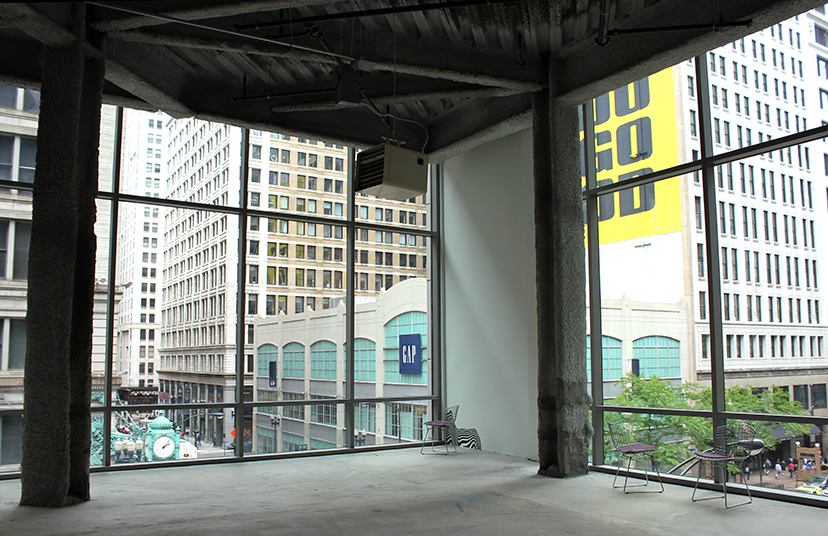
"Upper Levels Will Be Opening Soon" -
cardboard, ink, steel, glass and granite.  Artist unknown.  2009-

More reading on Block 37:

Can Signage Save Block 37?
Block 37 - The Curse Lives!
The Entombment of the Plug Bug
Planning and its Disconnects: The Cautionary Tale of Block 37


Thursday, May 24, 2012

Vinyl Explosion creates Color Jam at State and Adams

click images for larger view
If you're around the corner of State and Adams, anytime from 7:00 p.m. to 7:00 a.m. following, next Tuesday, May 29th through Monday morning June 4th, you can watch the creation of State Street's latest summer art blockbuster, Color Jam, by Chicago-based multi-media artist Jessica Stockholder,  complete with teams of workers and ten-story-high boom lifts.  Sponsored by the Chicago Loop Alliance, which also brought you Tony Tasset's EYE in 2010, Color Jam promises to be .  . .
. . .the largest public artwork in Chicago’s history and the largest contiguous vinyl project in the U.S. It is composed of over 76,000 square feet of colored vinyl—enough material to make 50,000 vinyl records, wrap over 130 city buses or cover one and a half football fields. Printing Color Jam on a standard HP home printer would require 2,100 ink cartridges and 180 hours of continuous printing. [editors note: the discovery that the vinyl, would not, in actual fact, be printed on a HP home printer led Hewlett Packard to announce on Wednesday that the company would be laying off 27,000 workers.]
However you measure it - and personally, I like to think of it as enough vinyl to pipe all our broken dreams to somewhere past Muncie - that's a lot of pieces, and if you're there towards the end of a shift during the set-up period,  I'd watch yourself lest you become the victim of a punch-weary volunteer, a la the wallpaper scene in A Day at the Races.
The buildings at the four corners of State and Adams represent nearly a century of Chicago architecture: the 2003 Citadel Center by DeStefano and Bofill, SOM's 1962 Home Federal, Holabird and Roche's 1915 Century Building, and Eckenhoff Saunders' Unicom Thermal Chilled Water Plant, from 1995.
Color Jam will saturate streets, sidewalks and building facades with a bold and resonant palette, creating a sensation of "walking through an animated film."

As people approach - on foot or in a vehicle - flashes of color will begin to reveal themselves: a stripe on the pavement, an unusual shape on a high floor of a skyscraper.  Closer to the corner, color will begin to intensify and overtake the field of vision.  Geometric shapes will form as they spill from buildings onto the sidewalk, overtaking traffic lanes, joyously "jamming" the street. And in the middle of the intersection - a vortex of color and shape will mark the Loop's latest destination.
You can download the brochure on the project here.  Already up and running on the Color Jam webpage is this streaming webcam overlooking the intersection, where you can watch the installation unfold.

Live video by Ustream
Color Jam will open officially at 10:00 a.m., Tuesday, June 5th, and run through September 30th.

Sunday, May 06, 2012

Inland Steel - Jewel Box of the Loop - Goes to Seed: popup sculpture Garden Alterpolitan

The main floor retail space of the Walter Netsch/Bruce Grahm/SOM Inland Steel Building went green - literally - last week.
photograph: Chicago Loop Alliance (click images for larger view)
As reported by Treehugger, volunteers laid down 3,800 square feet of sod and installed plants and 27 sculptures to create Alterpolitan: An Indoor Sculpture Garden, a collaboration between Noisivelvet, Art Advisory LTD and Turnstone for one of the Chicago Loop Alliance's more than a dozen current installations in its popular Pop-Up art projects.  Check out a video of the laying down of the sod here.
By this past Saturday, however, the lawn seemed to have already entered its brown phase.  I wasn't able to get inside, but the gallery is open weekdays, 10:00 a.m. - 6:00 p.m. for the next couple weeks, "a social space where pedestrians can enjoy impromptu conversations and an artful reprieve from Chicago's bustling downtown."   You can see all the sculptures and learn who made them at Jyoti Srivastava's indispensable Public Art in Chicago website here.


You can also check out Richard Lippold's Radiant One, commissioned by Inland Steel in 1957 for their building's lobby.
It's also a chance to visit one of the most iconic and beautiful buildings in Chicago, the Jewel Box of the Loop.  When the Inland Steel was  completed in 1958, it was the first new skyscraper to be constructed in the Loop since the Great Depression.  It's brushed steel finish showcased the product of the company making the building it's home, and it's innovative design supported the structure on just 14 columns that stand outside of the curtain wall, leaving the interiors completely unobstructed. The floors cantilever out dramatically at the north and south ends, and the green-tinted windows, an early form of anti-heat-gain technology that replaced Netsch's original design of a dual-pane system, give the Inland Steel a visual texture unique in Chicago architecture.  The detached service core is, itself, a spectacular steel-clad tower.
At the time of its construction, Inland Steel was the tallest thing around.  Although it had one less floor, it was sixty feet taller than the 1905 Majestic Theater Building next door, and a hundred feet taller than Burnham's 1903 First National Bank Building across from it on Dearborn.  Over time, the great view from the south captured in this classic Ezra Stoller photograph was obliterated by the replacement of the two-story structure to the south with SOM's rather dreadful 33 West Monroe.  By that time, however, another open view was created to the west when the First National Bank was demolished and replaced by the huge plaza of what is now Chase Tower.
In 2005, another open view of Inland Steel emerged, this time to the North, when the 1902 building Holabird and Roche designed for the Chicago Tribune was demolished to create a 16,000 square foot plaza for DeStefano Partners' One South Dearborn.  And while the turf at Alterpolitan may be turning a bit brown, the plaza to the north, designed by Daniel Weinbach and Partners,  holds one of my favorite spots in Chicago, a grove of sugar maples that have matured into a forest canopy respite from the proud, insistent towers.

Thursday, March 01, 2012

Landmarks, Ty Tabbing on State Street today - March calendar . . . soon

 click images for larger view
Spring was in the air Wednesday - for all about two hours.  What better time not to do necessary work?   So, the March calendar isn't quite ready yet.  I forgot to feed the cat and he gnawed away the "M" key on my keyboard.  I don't think it agreed with him, 'cause when he thew up, it was only an "N". Maybe the rest will come out later.

But I digress.

So here's a heads-up that today, Thursday, March 1st, the Commission on Chicago Landmarks holds its monthly meeting at 12:45 p.m. in the City Council chambers, 121 North LaSalle, Room 201-A, marking still another month of being missing-in-action on the most important preservation issue currently in play in Chicago:  protecting Bertrand Goldberg's iconic Prentice Hospital from Northwestern's determination to destroy it for an empty lot.

Over at the Millennium Room at the Chicago Cultural Center, 78 East Washington, at 12:15 p.m., Friends of Downtown puts on its monthly brown bag luncheon lecture (white bags also ok, clear plastic, no - nobody wants to have to look at all the stuff you're about to eat).

Ty Tabbing of the Chicago Loop Alliance will "present a talk on the history and the remake of State Street over the past two decades, including the removal of the mall."  Tabbing had written to us last November, when we had some rude things to say about the Alliance's Lightscape project, that the Alliance's Pop-Up Art program, using the windows of empty storefronts as temporary galleries, was still a going concern, and he's proven true to his word.

Pictured at the top of this post is a Pop-Up display of Scott Williams "past and present screen printed posters that have a heavy r&B/soul feel.  His posters have gained a cult following here in Chicago."  It's on display 24/7 in the street-level windows of the long-empty Holabird and Roche Century Building at 202 South State, owned by the Federal government.  With the new canopy and display windows, the GSA has turned what was once a derelict corner with rotting scaffolding into a handsome Loop amenity.

There's also, Artists Without Borders, the work of Liz Miller and Baltazar Castillo in the windows of the former Borders store at 150 North State.  I was looking at the work in one of those windows when a guy came up to me - "Hey, I see you looking at this.  You know, I was in the alley across the street over there by the theater and I looked down and I saw this piece of wood and it was shaped just like a dagger.  It looked just like this art in the window here, see?  I was thinking of just laying it down in front of the window, but then I said, nah, that wouldn't probably be right."

But I digress.

And now . . .

. . . a beaver with a stick . . .
from  the exhibition, Loop Value: The How Much Does it Cost? Shop, at the Chicago Architecture Foundation, 224 South Michigan

So I have to go back to the calendar now, or maybe just lie down.