A daily blog on architecture in Chicago, and other topics cultural, political and mineral.
Click on the COMMENTS link under each post to join the discussion.
Even as architects as diverse as Jeanne Gang and Zaha Hadid emerge us fully-empowered practitioners in the world of design, the barefoot and back-room status of female collaborators to famous alpha males stubbornly lingers.
Last year, when architect Anne Tyng died, we wrote about how her collaboration with Louis Kahn on such early and innovative projects as the 1950's Philadelphia City Tower was deliberately effaced so as to humor the prejudices of the day and build up the brand.
Go back another half century, and you have the story of Marion Mahony, the woman whose striking renderings helped establish the reputation of Frank Lloyd Wright and with the conceptional drawings she created for her husband Walter Burley Griffin's clinched victory for their entry into an architectural competition for the design of Canberra, Australia's capital city. But that's a story on its own, and we'll return to it next next.
More recently, two Harvard design students, Caroline James and Arielle Assouline-Lichten, have mounted a high profile petition drive to rectify the fact that Denise Scott Brown was left off the 1991 Pritzker Prize awarded to her personal and professional collaborator of 50 years, Robert Venturi. As of yesterday, the petition has over 11,000 signatures from 88 countries, with a wide range of architects including Renzo Piano, Richard Meier, Herzog and deMeuron, Jeanne Gang, Zaha Hadid, Rem Koolhaas and Rafael Moneo. (Bob Stern won't sign because he objects to the world “demand’, although he says he supports the general idea.) Martha Thorne, executive director of Pritzker Prize, has pledged that the committee will take up the issue at their next session. (If you're in Philadelphia this Sunday the 28th, you can hear Denise Scott Brown in conversation with William Menking.)
Which reminded us of the story we wrote on Robert Venturi's appearance at Crown Hall back in 2005. At the end of the event both Venturi and Scott Brown were very gracious with their time in talking with students and signing copies of their books, but only Venturi spoke, giving an engaging talk on the different perspectives that he and Mies van der Rohe brought to architecture.
That, of course, was a very long time ago, but you still have to wonder
whether we'll still be going through the same thing a few decades
from now. When Wang Shu won the Pritzker Prize in 2012, his wife and collaborator, architect Lu Wenyu, was not cited, although she co-founded their firm, Amateur Architecture Studio, and is reported to work in close partnership with her husband. In Chicago appearances earlier this year, there seemed to be little interest in bringing Lu Wenyu into the discussions and her role appeared to be confined to unofficial photographer.
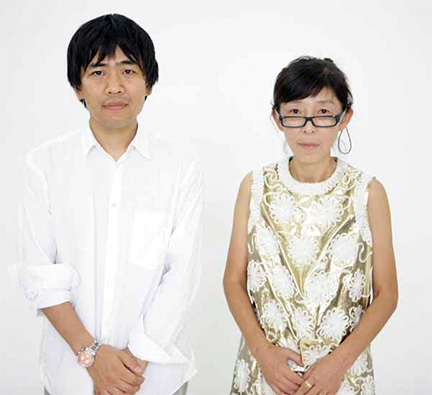
Unless you've been on the dark side of the moon all day (and probably even there, unless you've got AT&T), you've no doubt heard by now that Kazuyo Sejima and Ryue Nishizawa, the duo who make up SANAA, have been awarded the 2010 Pritzker Prize. Apparently, despite what Joe Rosa and Bob Somol told you, Europeans don't have a monopoly on path breaking architecture. (And if you compare SANAA's Serpentine Pavilion from last year to the wildly dysfunctional Hadid Burnham Pavilion in Millennium Park, you can see the kind of quality we could have insisted on, but didn't.)
In an interview with designboom, Sejima resisted citing specific architectural influences, while Nishizawa named the holy trinity of Mies, Le Corbu and Neimeyer, "These are an unforgettable 'trio' for me." Seijima talks about "our interest now is more how to organise ‘a program’ within a building - the layout of rooms and how people move inside. but also how to keep a relationship between the ‘program’ and the outside and then how the outside fits to the surroundings. in each project we have different requirements and the site is different, we try to find our way.," and this appears to be very clear in their recent projects.
There will be an orgy of pontification now that the award has been announced. As I'm seldom let out of the house, I've yet to experience any of SANAA's work firsthand, so I'll restrict myself to couple of cursory observations. . .
The first thing that strikes me about Sejima and Nishizawa's work is how, at the same time, they embrace and subvert that Miesian legacy. (Apologies in advance for the music in these videos - turn down your volume now.)
At roofline and plinth of the Glass Pavilion at the Toledo Museum of Art, the building is a rounded square that defines the basic container, but in between, there doesn't appear to be a single right angle. SANAA addresses individual programs in a series of mostly discrete spaces that can be rectangular, circular or elliptical,. They float within a thin - as little as a meter - ether of separation, and a long snaking foyer and forking exhibition space. The use of glass walls both for the perimeter and the interior, combined with several open air galleries, mediate between transparent, reflective, and opaque. In place of Miesian universal space, you have the specificity of full partitioning, but with an "almost nothing" twist.
The second thing that struck me by looking at the official SANAA photos included in the Pritzker Prize press kit is the emphasis they place on how their work appears in context - not just the context of adjacent structures, but in the wide-angle context of the surrounding community. It's in no way a literal contextualism, a mimicking of surrounding elements, but a more intuitive sense of place. In the case of the New Museum of Contemporary Art in lower Manhattan, the stacked boxes seem a witty riff on the city's congestion and early wedding cake skyscrapers. In the case of the museum in Toledo, a medium density city, it's providing a graceful, low-rise anchor to the mix of parking lots, midrises and even taller trees all around it.
Sejima and Nishizawa will receive their award May 17th on Ellis Island, where they'll be held in protective custody until they can be vetted by the DHS.
A side note of this year's award is that the Pritzker Prize website, since its inception up to a year or so ago an abomination of bad design that seemed to be mocking the prize's mission, is now a pretty professional job, including putting up the press kits as those so-trendy on-line magazines where you actually see and hear (loudly) the pages being turned. (Although there are still rough edges like badly wrapping values in one of the drop-down menus.)
You can also visit the SANAA website, which is Mies minimalist to the extreme - a single page with just six lines of text, consisting entirely of contact information.
portrait photo by Takashi Okamoto, building photographs by Hisao Suzuki,
courtesy SANAA