Saturday, July 21, 2012

The Death of Variety? The Supply-Chaining of the Magic of the Movies

Nostalgia Alert!  If you insist on living in the present, turn back now.  (And it's not nostalgia: it's cultural history, dammit.)


The Big Picture: Variety's future looks bleak - The Los Angeles Times.

One of the happiest moments in my early adolescence was walking one day into the old St. Louis pharmacy on Lawrence Avenue near my Albany Park home and finding, on the bottom shelf of the magazine rack, a copy of Variety, a/k/a "The Show Biz Bible".  I was already in love in movies and with the architecture of the Chicago's movie palaces, which offered a Cooks Tour, if slightly inauthentic, of many basic historical styles, from the French Baroque of the Chicago Theatre, to the Eastern Hallucinogenic of the Oriental, to the Ocean-Liner Deco of the Esquire.
photograph courtesy of The Chuckman Collection (click images for larger view)
photography courtesy of The Chuckman Collection

I stood, mesmerized, drinking a Coke (dispensed in a bottle from their Coke machine), reading my first copy of Variety, as I discovered its comprehensive weekly portrait of what was going on with those theaters, each of which had its own personality and booking policy.  At a time when new releases still opened at a single, downtown theater, the Chicago was the prestige flagship at which the biggest, most prestigious films opened.

photograph courtesy of The Chuckman Collection
Unless they were roadshows, a category that came into its prime in the 1950's as Hollywood as a weapon against television.  Roadshow houses, like the Michael Todd, Cinestage, McVicker's and Palace, scheduled films like they were stage plays, as if a movie's cast and crew somehow had a limited stamina for only so many shows a week.  Other than holiday periods, there were generally only ten performances a week, one each evening, plus matinees on Saturday, Sunday and Wednesdays.  Among many other titles most of which are now mercifully forgotten, roadshow attractions, usually filmed in the much more detailed 70mm format, included such films as Ben-Hur, Lawrence of Arabia, Spartacus, My Fair Lady, and Ryan's Daughter.  The Sound of Music marked the zenith of the roadshow, dethroning Gone With the Wind as the biggest grossing film of all time, and its run in most U.S. cities was measured not in weeks, but  years.
Crowds stretch around the block waiting to get in and see the 1966 James Bond blockbuster Thunderball at the Oriental (photograph courtesy of the Chuckman Collection)
Every week, Variety published the gross receipts for every first run theater, not just in Chicago, but in major cities across the United States and Canada.  Just as in Chicago, each theater in each city had its own unique personality, and, often, a distinctive name to go with it.  There was the Gopher in Minneapolis, the Grand Circus in Detroit, the Boyd in Philadelphia, the Forum 47th, Astor, Victoria and Criterion in New York, plus Orpheums, Paramounts, States and Stanleys sprinkled liberally all across the country.
I was such a nerd as a kid that I amused myself by creating my own estimate of the rental income for every major release by adding up the week-by-week figures for each theater covered in Variety, and also tracking every second run theater in Chicago, using the aggregate second-run grosses for cities like New York also reported in Variety, and then extrapolating the results for a national estimate.  I would always be eager to get my hands on Variety's year-end issue, which included the rental grosses for every film released that year to compare, and my own estimates were usually pretty close to the actuals.  (Except for films that did especially well in the South, or in smaller houses and drive-ins, which Variety covered only fitfully.)  Yeah, I know, it's pathetic, but it was a lot of fun at the time.

In December of 1964, during the prime Christmas Holiday booking season, Goodbye Charlie, a film directed by Vincente Minnelli and starting Tony Curtis and Debbie Reynolds, both big stars at the time, and Walter Matthau, soon to become one, opened, not in one of the big Loop movie palaces, but in a wide "Showcase" release to theaters throughout Chicago.  No one noticed it at the time, but Goodbye Charlie could also have been named Goodbye Movie Palace.  Already, urban population was spilling out in great torrents into the emerging suburban sprawl.  Movie theaters followed - every shopping mall with any claim to importance had at least one.  1972's The Godfather was the last major Hollywood release that opened in exclusive run at downtown theaters.

office tower proposed for the site
of the Chicago Theater

The "Showcase" release became the only release.  The downtown movie palaces lost their central place.  More of their bookings began to target what exhibitors thought inner-city minority populations wanted to see: action films or what came to be known as Blaxploitation films.  Soon the best week's gross at a Chicago movie palace was what would been considered disastrous only a decade or so before.  The economics stopped working.  Theaters crumbled, closed, and, in too many cases, were demolished.  The Chicago Theater just missed being destroyed for an undistinguished Skidmore, Owings, Merrill office tower.

Variety stopped publishing theater by theater grosses.  Motion pictures became relentlessly Supply-Chained.  The idea of a 10-show-a-week multi-year roadshow run, exclusive to a single theater, now seems insane.  You book your film in as many theaters as you can get away with, especially for the big blockbusters.   The Dark Night Rises is on 4,400 screens this weekend.  At most multiplexes, you can choose from screenings scheduled every half hour.

Make no mistake.  Movies have always been a big business.  The major studios that flourished in the 1920's, 30's, 40's and beyond weren't called "Dream Factories" for nothing, and they kept their key assets - the movie stars - under contracts so tight they'd bring a smile to the face of Rupert Murdoch.  And they were vertically integrated, both making the movies and owning the theaters to show them in.  Yet their business model was predicated on creating a sense of the special, from the fairy tale architecture of the palaces they built to lure in the customers, week after week, no matter what was showing on the screen, to the roadshow release that combined high-tech (wide screens, higher resolution, stereo sound) with the manufactured scarcity of limited showings.

Today, while we're seeing a resurgence of distinctive design to make a given multiplex more competitive, it's still pretty much all about supply chained, least-common-denominator efficiency.  You take the risk out of exhibition by not having to choose which movies you book.  You cram enough auditoriums into your multiplex so you can offer the public every major release on any given weekend.  When designed and managed competently, each auditorium will offer a high degree of comfort and technical competence, but, other than size, each auditorium will be essentially identical.  You no longer buy a ticket for the Orpheum, Fox or Pantages, but for Theatre 16, 2 or 34.

And so reporting success and failure in movies is no longer for insiders and their wannabees, but a promotional spectator sport, the weekend's grosses a hit parade boxscore promoted through every news and media outlet in the world.  Who won?  Who lost?  It's a lot more efficient, but the commodization has killed a lot of the magic - just as it's killing Variety


Tuesday, July 17, 2012

Outtakes from the Central Manufacturing District

click images for larger view

So I've just sent off the images for my presentation at this Thursday's Pecha Kucha at Charnley-Persky House on the Central Manufacturing District in Chicago's New City neighborhood, often considered to be the most modern industrial park..  I could only use 20, so these are some that were left over.


Sunday, July 15, 2012

Chicago Streetscene: Light Rails

click image for larger view

Friday, July 13, 2012

Back to the Future: Wrigley Building Plaza closes for Rehab

click images for larger view

You can't get there from here.  At least from a while.  The passageway between Chicago's historic white-towered Wrigley Building and it's annex, which leads to the Trump Riverwalk, has been sealed up so workmen can move forward with a rehab/retrofit of the plaza, which is actually a viaduct owned by the city built over what was once North Water Street, leading pedestrians to find temporary detours a block or more north.
 We're still trying to get more information on how long it will take and what it will look like when finished, but a June press release promised:
Plans also include repairs to the city-owned bridge over lower East North Water Street as well as a new decorative stone walking surface on the plaza. The white glass and metal cladding at the vacant 410 Club entrance will be replaced with terra cotta and a new bronze storefront with added retail entrances off the plaza. The non-historic glass and wood wall separating the plaza from Michigan Avenue will be removed to create an elegant and inviting gateway to the plaza.
So the cheap-looking metal storefronts added a couple years ago when the building was controlled by Mars Candy . .  .
. . .  should be gone.

The new owners are saying all the right things.  In January, when the complex was being given official landmark status, we wrote about the passageway's increased importance as the gateway to River North, which has been completely transformed from the industrial district it was at the time the Wrigley was built in the 1920's.  Let's hope.

Thursday, July 12, 2012

Where Chicago Public Schools deign not tread: GEMS descend on Lakeshore East

click images for larger view
 Ten years ago, this is what the press release said:
OWP&P has been retained by the Chicago Board of Education and has generated preliminary designs for the Lakeshore East Elementary School, the first elementary school in Chicago's central business district.  The design for the structure, which will include a community center administrated by the Chicago Park District, plays off the geometry of the park and includes a masonry exterior and a green roof.
Now, Lakeshore East is finally getting that school, but its not public.  Despite the fact that nearest public high school is Wells Academy, three miles away, the Lakeshore East project has become the Chicago flagship for the supply-chaining of education, and the first American outpost for GEMS World Academy.  GEMS was founded in Dubai in 1959, and has become operator of a large number of schools in that country and throughout the United Arab Emirates.  The for-profit company, which claims over 100,000 students in 125 countries, is going on a tear,  expanding to countries all around the world.
GEMS enters Chicago this fall with the preschool  "Little GEMS International", for children 6 weeks to 5 years, the first to open in the U.S.   It's in the building at Belden and Clark best known for its time as the home to a Tower Records superstore.

GEMS education places an emphasis on global citizenship, with a Core Values listing including:
  • World Citizenship - Empowering students with a global and local perspective.
  • Universal Values - Accepting that we are all different, recognising that we are all the same.
  • Leadership - Developing each student’s individuality and entrepreneurial spirit in order to discover their potential.
  • Forward Thinking - Developing skills for the future, our educational programmes help students to become flexible thinkers who are able to question existing thinking, adapt and creatively meet the demands of the future.
The company's growth has not been without controversy.

At a time when the Dubai Knowledge and Human Development Authority imposed a freeze on school fees, GEMS managed to get the government to allow it to increase its fees by 30% over three years.  In the KHDA ratings of the countries schools, the lowest-rated GEMS school came in as "Acceptable",  three more as "Good".  Both the second and third-ranking schools were GEMS operated facilities, both moving up from "Good" ratings in 2008-2009 to "Outstanding" for 2010-2011.

"The ideal circumstance, and we look forward to this in GEMs, is that you have an excess of supply," David Wilson, director of Gems Education's Asian schools has declared in an interview. One teacher at a Gems Indian Schools said the challenge was not finding good teachers, but having them agree to low salaries.A teacher advocates website reported that the increase in fees amount to 152,000 dh per month, while the increase in teacher's salary expense was 80,000 per month.

"Our chairman Sunny Varkey doesn't care about profit," Raminder Vig, director of schools at GEMS UK told Education Investor.  "He actually gives money away." GEMS has 10 schools in UK, with plans to open six more over the next 2 years.  Vig says the group has yet to make a profit in the UK.

"Margins are not the same as private schools, so you need a strong philanthropic base, and GEMs has that because our founder has pledged to educate one child free for every 10 we make money from,  Zenna Atkins told the Financial Times Jane Bird in 2010.

One commentator claims "for-profit international schools will be the way of the future."  How many years away are we from having our schools controlled by global corporate conglomerates?  GEMS is the Nordstrom's beachhead.  Can the Walmarting of American education be far behind?

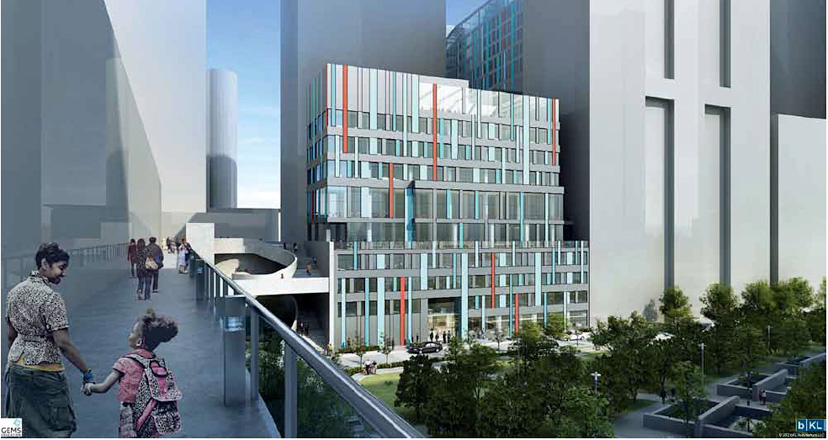
No price tag has been published for the new construction at Lakeshore East, but there's no doubt that it's not being done on the cheap, with not one, but two buildings designed by  bKl architecture, the successor firm to Brininstool and Lynch, with former SOM executive Tom Kerwin.

The first building, fast-tracked for a 2013 opening, will serve students from Kindergarten to 4th grade, will be a 9 story structure just west of the Tides.  It rises nine stories - 153 feet - from a 10,000 square-foot site, with a total of 82,000 square feet of classrooms and facilities.  The entrance is on the lower level of the Lakeshore East Park, along Water Street.  The green roof features a play area.
The real gold plate comes with the second building, to be completed sometime in 2014 on East Wacker Drive, sandwiched between the under-construction 430 foot-high Coast apartment tower, also designed by bKl,  and another residential high-rise to be named later on the now vacant lot to the east.  This school will serve students from grades 5 through 12.  The site is 24,000 square-feet.
 The building rises 13 stories above Wacker.  Although the Lakefront Ordinance document specifies "no basement", the structure actually has multiple floors below Upper Wacker, including 2 levels of public parking, and a spacious"Student Arrival Lobby" on Lower Level 4, with a bus drop off on "sub Wacker Drive."  The expansiveness of the curriculum is inferred by the spaces of the building, which include a large swimming pool (with a viewing deck at the Upper Wacker entrance level), an equally large auditorium, complete with Scene and Stage shops, and a 235 square-foot changing room.  There are separate rooms for instrumental and choral music, a "3D Art Classroom", a room for "Digital Art", a "Black Box" space, and a 3,000 square-foot roof play area on Level 14.
The curtain wall facades feature vertical elements of different widths in three different colors.  It will be interesting to see how these play out.  The color scheme evokes not entirely comfortable memories of the Thompson Center palette.  On the Phase I building, none of the verticals extend the full height of building, which probably serves to de-emphasize the height, but it's hard to tell from just one rendering just how well it will all work out.  The Phase II building is more direct about its verticality.  Like the Phase I structure, it features one setback.  As with the new Lurie Hospital, the playful facade resists resolving into the traditional rectangular glass box tower.

On July 25th, 42nd ward alderman Brendan Reilly will be hosting a community on the project, 5:30 P.M., at the Radisson Blu Aqua Chicago Hotel, 221 N. Columbus.

Tuesday, July 10, 2012

Horses, Streetcars and Hungry Birds - Mural Tuesday

click images for larger view
In West Town, murals along railroad viaducts near Chicago and Lessing. Artists include Sarah Lawshe, Augustina Droze, Plamen Yordanov,  Anne Farley Gaines, and Stephen Giannini.

Sunday, July 08, 2012

Color Jam's Stockholder, Arquitectonica's Spear, Bey, Anthony Wood, Archi-Treasures' Jewels - its the July Calendar of Chicago Architectural Events

So now it begins.  The holiday week is over and the July Calendar of Chicago Architectural Events is ramping up to warp speed.

While some organizations take the summer month off, others are taking their place.  With their new exhibition, Skyscraper: Art and Architecture Against Gravity, the Museum of Contemporary is offering a full roster of events, beginning this Tuesday with Color Jam's artist Jessica Stockholder in conversation with MCA curator Michael Darling.   This Friday, July 13th, Joanna Szupinska offers a curator's tour of the exhibition, and on Saturday Lee Bey offers his own perspective in a Skyscraper Gallery Talk, with Council on Tall Buildings and Urban Habitat Executive Director Anthony Wood offering his own take on Saturday the 28th.. On Wednesday the 18th, Laurinda Spear of Arquitectonica stops by for a conversation with Margarita Blanco and Marisa Fort.

Elsewhere this week, on Thursday APA Chicago holds one of its event in its Daniel Burnham Forum on Big Ideas: The Next 50: Planning, Architecture and Landscape Architecture.

On Wednesday the 18th, Archi-treasures offers up its annual Jewels in July benefit at the DIRTT Green Learning Center, while on Wednesday the 25th,  APA Chicago offers up the mayors of Chicago, Gary and Milwaukee for its annual luncheon on the topic of The Cities That Work.  Saturday, the 28th, the Chicago Art Deco Society holds a benefit to support the Chicago Art Deco Survey at the elegant ballroom of the historic Art Deco Powhatan Apartments.

The bad news is that July 19th Pecha Kucha Less is More at the Society of Architectural Historians home turf, the Charnley-Perskey House, is already sold out.  The good news is that if you haven't already bought a ticket, you won't have to suffer through my presentation.

But wait!  There's much, much more!   Check out the over three dozen events still to come on the July Calendar of Chicago Architectural Events.

Thursday, July 05, 2012

Today: Julie Burros discusses new Chicago Cultural Plan

Seriously, there's really next to nothing going on this holiday week.  Even the monthly Landmarks Commission session is pushed back to next Thursday.

One exception is that today at 12:15 p.m., in the Millennium Room of the Chicago Cultural Center, Friends of Downtown is sponsoring  a talk by Planning Director Julie Burros on the Chicago Cultural Plan.  "Launched earlier this year, the 2012 process similarly features extensive public engagement. A draft plan for public comment will be released in early July."  Town Hall meetings for public input continue this month at Malcolm X College on the July 24th, South Shore Cultural Center on the 25th, St. Augustine College-Essanay Studios on the 28th, and at the Cultural Center, itself on the 31st.  Details here.

July Calendar up soon.

Wednesday, July 04, 2012

Face Off

click images for larger view

Things change, as they say, but the new Ronald McDonald House on Grand, designed by Antunovich Associates, may set a new record.

The 14-story story tower, opened just last month, is already seeing itself dwarfed by the 42-story David Hovey-designed Optima Center rising just behind it.  All those lovely south-facing windows at Ronald McDonald, rather than offering the anticipated view across the river, will soon be only yards away from the newer residential tower.  I've yet to see any rendering for Optima other than one from a towards-the-northwest perspective, so I'm not sure whether the guests at Ronald McDonald - families whose children are undergoing medical treatment -  will be looking at a blank wall or actually be able to follow the comings and goings of cars and residents on the other side of the puny gap.

Some Flags we Have Known: Happy Independence Day!

 click images for larger view


Monday, July 02, 2012

I Am Curious, Morbid (but only through Sunday) - an unnerving show finds the perfect architectural setting

O Rose thou art sick.
The invisible worm,
That flies in the night
In the howling storm:

Has found out thy bed
Of crimson joy:
And his dark secret love
Does thy life destroy.
- William Blake
Salon Wall. photo: Jyoti Srivastava (click images for larger view.)
A table of skulls.  Unending images of death, stacked high, almost to above visibility - different styles, different times, different visions, a single theme - sacred and profane crammed tightly together between ornate golden ribbons.

Has there ever been a better match between an exhibition and a space than Morbid Curiosity, The Richard Harris Collection, which closes out its long run at the Chicago Cultural Center this Sunday, July 8th?  I'm not talking about The War Room, the harrowing collection of art on the atrocities of war across five centuries from artists Jacques Callot, Francisco Goya, Otto Dix, the Chapman brother and Sandow Birk, mounted in the usual white-walled gallery space.

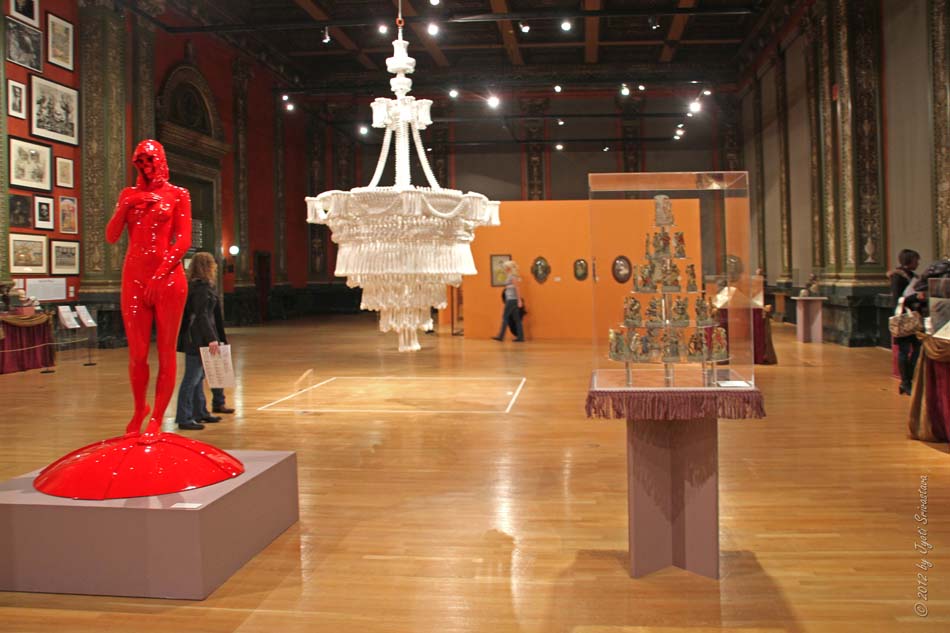
No, we're talking about The Kuntstkammer of Death, "a cabinet of curiosities . . . in which the wealthy and powerful maintained rooms filled art and artifacts, scientific specimens, and exotic objects,"  housed in the half-block long Sydney R. Gates Gallery, an overripe 19th century evocation of Pompeii and the Renaissance, with more than a touch of Tiffany.
photo: Jyoti Srivastava
Morbid Curiosity, curated by Lucas Cowen and Debra Purden, consists of a massive collection of death-related art and objects, ranging across several aeons, from a 1200 B.C. Mexican Skull Mask, through old masters like Durer, newer masters like James Ensor, to the latest work of contemporary  sculptors.

You can find a wealth of photographs on both the Morbid Curiosity: Richard Harris Art Collection site, and on the Public Art in Chicago blog by Jyoti Svristava, who has been kind enough to allow us to share some of her eloquent photographs on this post.  These two resources provide an exhaustive documentation of the show, but it's no substitute to seeing it in the physical context of its Cultural Center setting.  Make no mistake:  you will never see anything like this exhibition, and you owe it to yourself to make it to the Cultural Center before the show closes this coming Sunday, the 8th.  (Closed July 4.)
The Yates gallery is what was originally the Reading Room of Shepley, Rutan and Coolidge's 1897 Chicago Public Library.  At the time of its opening, a Harper's Weekly critic found "delightful relief" in how the classical style of the library confounded their accustomed thinking of Chicago architecture as "a rather crude embodiment of brute force."
It is interesting to note that the position of the reading and reference rooms is in the same as that proposed for the New York Public Library, viz., on the top floor of the building.

The reading room is the most imposing feature of the interior.  It occupies the entire northern front of the building, and is lighted on all sides by windows seven feet wide and twenty-three feet high.  The dimensions of the room are one hundred and forty feet by fifty-five, and thirty-three feet high.  The immense ceiling is carried upon heavy steel trusses.  There are seats for three hundred and forty readers, and room at the newspaper stands for seventy-five more. . . . The color scheme [is]  sumptuous.  The wainscot is of verd-antique, the walls are dark red, and the three members of the entablature - the architrave, frieze and cornice - are treated in color so as to form intermediate steps of yellow, green, and blue between the walls and the ceiling.  The higher parts of the relief ornament upon the pilasters, cornice, and coffers are emphasized with metal --gold of an antique finish against a background of transparent colors.
Another critic was more ambivalent . . .
The color scheme is bronze and green, which in its general effect is very good.  In detail, the colors are crude, metallic and even disagreeable  . . . 
If you take in the exhibition in these, its closing days, even if the blinds are drawn, light lurking behind those continuous strips of 30-foot-high windows and poking around the edges emphasis the openness of the spare steel structure beneath the classicist veneer.  The natural light dissolves the dark mystery communing the space with the macabre objects inhabiting it.
photo: Jyoti Srivastava
I'll never forget seeing the show at its opening, on a typically dark January late afternoon, when the only light in the room was artificial.  Those huge openings became opaque, dark windows into the abyss.  The spindly, biliously-hued pilasters between them climbed to the coffers of the ceiling like the fleshy legs of a giant spider, into whose lavishly decorated web we found ourselves willing prisoners, enthralled within a liebestod contemplation of our own inevitable extinction.
photo: Jyoti Srivastava
 Skulls, skeletons and bones, the remnant artifacts of our expired bodies, re-animated through the imagination of artists - most, themselves, long reduced to dust - conspired in an infinite variety of grotesque variation with the obsessive, gaudy ornament of the room to invoke a claustrophobic ether of corruption and decay.
photo: Jyoti Srivastava
Yet even in these long days of generous sunshine, Morbid Curiosity is a compelling experience, not to be missed.  For your visit, I wish you a day darkened by storm clouds, and a gallery enveloped by the blackness of night.
visitors contemplate Roger Reutimann's Death of Venus. 
photo: Jyoti Srivastava