Showing posts with label Wrigley Building. Show all posts

Friday, January 28, 2022

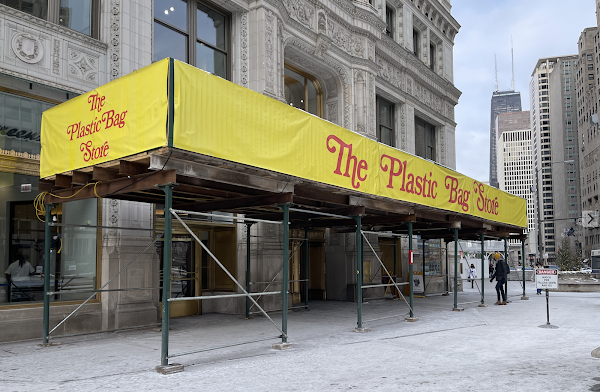
It's Delicious! It's Colorful! It's Fun! It's Plastic! Only through Sunday, The Plastic Bag Store comes to the Wrigley Building.


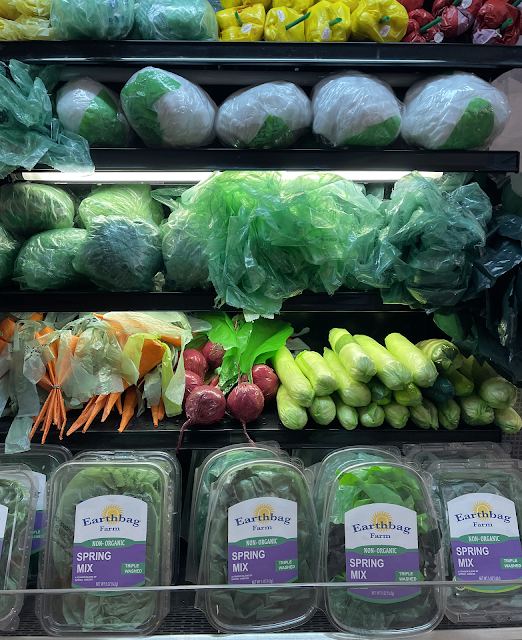
You have only through Sunday to see weird, wacky, very fun, but far from frivolous The Plastic Bag Store at the Wrigley Building. The "anchor attraction" of this year's Chicago International Puppet Theater Festival,    The store is stocked entirely with very real looking fruit, vegetables, fish and pastries, and packaged goods for parody brands - all made of washed and repurposed plastic bags and trash.


The creation of a team headed by Brooklyn-based designer, puppeteer and filmmaker Robin Frohardt, the installation also includes showing of puppet films - unfortunately sold out - in which an anthropologist far in future works to reconstruct the lost culture of the civilization of "the ancient customers", guided by a note placed in a bottle by Helen, a Met Museum custodian living today, and by the "millions of found artifacts" that are predominantly plastic, which, because plastic doesn't biodegrade, are the most common remnants of our culture to survive.

The Plastic Bag Store that you can visit at the Wrigley is, in concept, that future anthropologists reconstruction of what our society was like.


There's also magazines, and a "time machine" that allows you to put in a plastic bottle today and see what it will evolve into in a thousand years.  (Spoiler alert:  it's the same plastic bottle.)

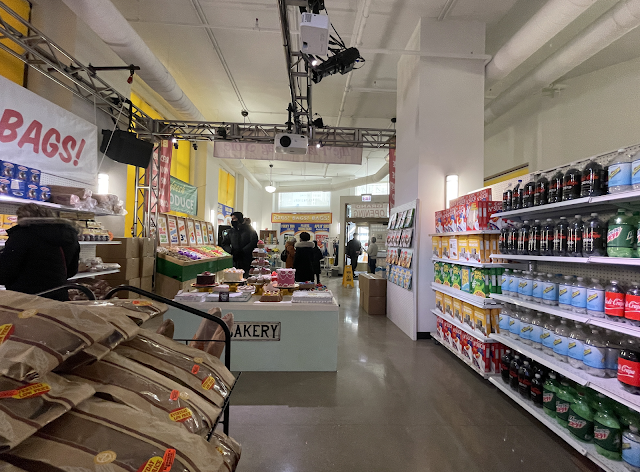
The level of creativity is amazing.  The vegetables look just like vegetables, flowers, flowers, cakes and cupcakes, real pastries.  There's even a deli counter . . .
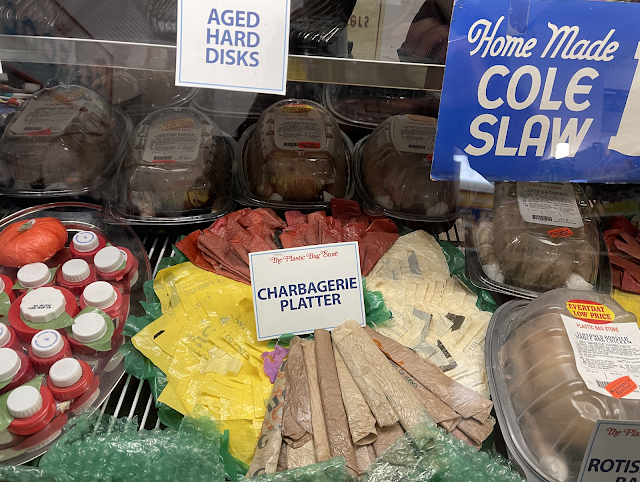

... and a prodigious selection of packaged goods (be sure to look at the backs)  that is truly impressive and inventive . .
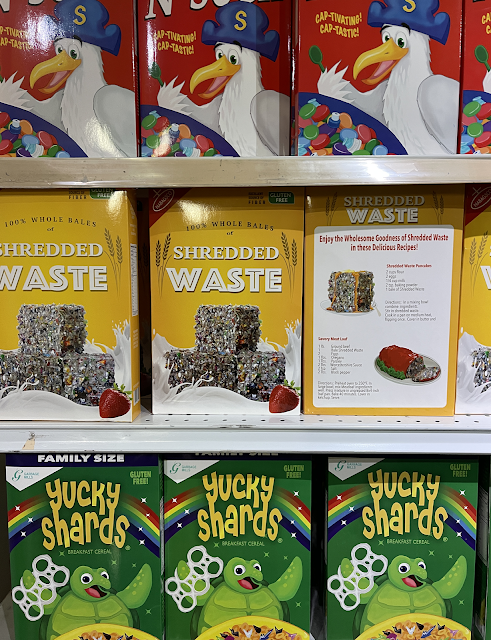
It took me back to my childhood, and to the Wacky Packs that were a really big deal among 7-10 year-olds of my generation.  
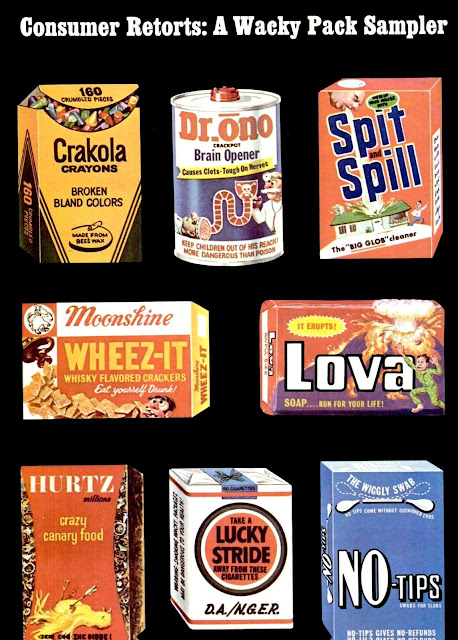

They were inserts trading cards - later stickers - that came with nickel packs of Topps bubble gum that offered up parodies of popular brands and their packaging.  For my demographic, they were snarky-fun high-culture.
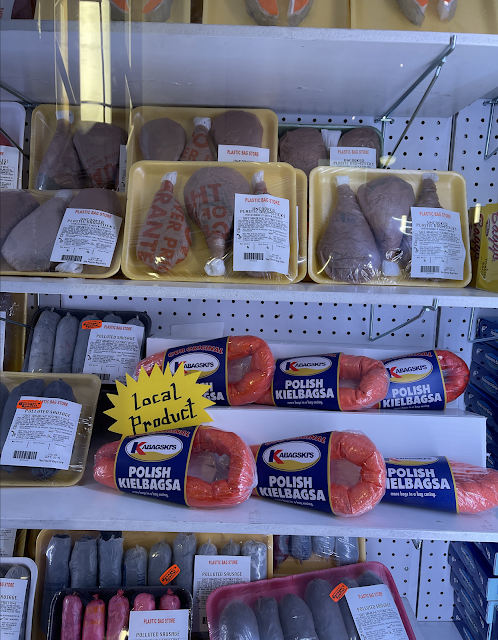

Originally exhibited in Times Square, it took a year to create the over 10,000 objects in the installation. "I collected bags from friends and family members," says Frohardt in her Youtube video.  "I had people save things, I rescued bags the street, I pulled bags from the trash, I pulled them from recycling bins. And then we designed all the packaging.  We had to wash every bottle, and label them."


"My aim, "she says, "isn't to make people feel bad. My aim is holding up the mirror and highlighting the absurdity of all this, and fueling the fire of public outage over all this."

Indeed, you won't find any any numbers or charts at The Plastic Bag Store.  "I didn't want to overwhelm with statistics," says Frohardt, "but more just wanted to create a kind of familiar, visually tactile experience that [people] could relate to or understand in a more visceral way than just a bunch of numbers."

Still, the facts are staggering:

The world produces 5 trillion plastic bags a year.  No more than 3% are recycled. Plastic doesn't biodegrade.  It breaks down into ever smaller pieces of itself, with an increasing toxic effect on living things.  Parts of north Pacific are estimated to hold six times more plastic than plankton.  Ingested as food, often increasingly scarce, it can kill from blocking the digestive system or poking holes in organs.  UNESCO estimates 100,000 marine mammals die each year from plastic pollution.  Of 61 dead whales found in the Phillipines, 45 of the deaths were traceable to plastic ingestion.  One young whale was found to have 88 pounds of plastic in its stomach.  The Great Pacific Garbage Patch floating landfill, twice the size of Texas, is mostly made up of plastic.
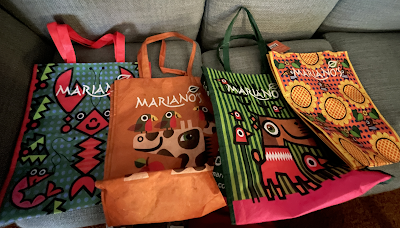

There are alternatives.  I have my own collection of David Lee Csisko reusable bags, "made from 100% post-consumer recycled content . . . the equivalent of three plastic bottles" to cut down on plastic bag use, but sometimes I forget to bring one with me, and I'm back to sin.  New York City passed a controversial ban on plastic bags in 2020.  In Chicago, we have 7 cent "plastic bag indulgences".

Will we ever get our act in order?  Doubtful.  Remember that decades ago we had a perfect recycling system for pop - glass Coke, Pepsi, etc. bottles that you paid a deposit on, and returned to the store for a refund, but we were too cheap and lazy to lug the bottles back and forth once we could get our beverages in eternally polluting plastic.  "Efficiency," they said.  "More hygenic," they said.  And we said, ".... yeah, why not!"  


So, in summary, we're killing our fellow animals, the environment, the planet, and, eventually, ourselves. But what a way to go!
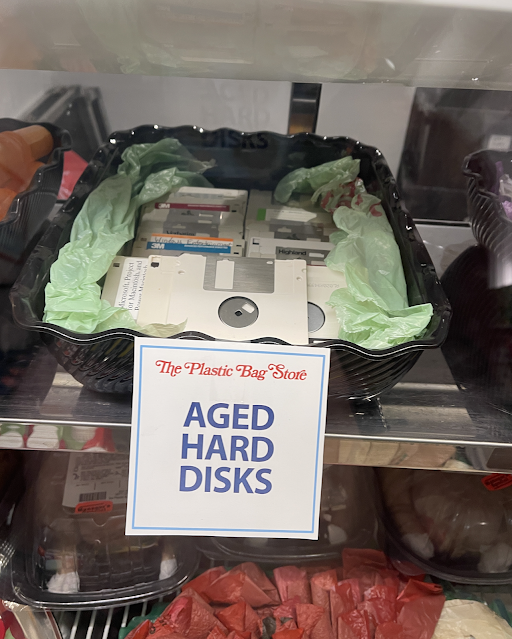

Again, you have only through this Sunday, January 30th, to see the spectacular The Plastic Bag Store at the Wrigley Building.  Frohardt and team will show you a really good time, and you won't even have to think about the sobering implications of her non-guilting, deliciously colorful fun-ride.  But plastic leaves an aftertaste, and odds are, sometimes afterwards, you will.


Thursday, July 16, 2015

Perkins+Will Dumps Mies; Heads to Wrigley

Perkins+Will, Chicago's largest architecture firm, with over $400 million in revenue, announced this morning that they're switching from one architectural icon to another.  Early next year, they'll be vacating their long-time home at Mies van der Rohe's IBM Building, now known as AMA Plaza, for new offices in the recently refurbished Wrigley Building, the classically-styled  that's been a floodlit icon at  the foot of North Michigan Avenue and the River since its opening in the 1920's.  Perkins+Will, established in 1935  has been at the IBM since 1992, when it announced it was moving its 330 employees into nearly 50,000 square feet of space.  The firm currently occupies the 35th and 36th floor at IBM/330, the last skyscraper designed by Mies before his death in 1969.

In making the move, the firm will be trading in Miesian minimalism for the ornately ornamented, glazed terra-cotta grandeur of Graham, Anderson, Probst and White's design, the first tower built north of the Chicago River.  The annex opened in 1924.  The original 425-foot-high south tower, completed in 1921, is dominated by the 20-foot-high clock at its apex.

After being acquired by Mars Candy, Wrigley sold their landmark building and in 2012 moved its last employees to the company's research facility on Goose Island.  The complex has undergone a major rehabilitation, including a rehab of the plaza between the two buildings that has seen the opening of a two-level story Walgreen's, Peet's Coffee, and, most recently, a two-story Ghiradelli Chocolate store opening along the plaza.

Perkins+Will will occupy over 60,000 square feet in the "top floors" of the north tower annex, configured into open-space offices, with employees also having access to a new rooftop terrace.  The firm moved up from fifth position on Architectural Record's just-published list of top U.S. architects, with its revenue approximately 2/3 domestic and 1/3 international.

Full text of this morning's press release after the break.

The Wrigley Building Chronicles 


Update: Side Lot Windfall lastest twist in the epic Wrigley Building Chronicles


Four Buildings and a Funeral - Wrigley: The Architecture that Remains after a Great Company Dies.
Plaza of the Americas to get renovation: Wrigley next, please, please.
Plaza of the Americas rehab:  zzzzzzzzzzzzzzzzzzzzzzzz

Wrigley Building Plaza:  Where Perfect People meet the Rest of Us
 The $2 Million bargain: The Grandeur of the Wrigley Building Plaza restored
The Realtors Dream - Does the Plaza of the Americas Have a Future?
An Affectionate Last Look at a Building Not Worth Saving: Wreckers descend on the Downtown Court Club


Thursday, September 25, 2014

Update: Side Lot Windfall lastest twist in the epic Wrigley Building Chronicles


click images for larger view
Since William Wrigley first started his empire using chewing gum to sell baking powder, the story of the William Wrigley Company, and its role in defining Chicago architecture has been an epic one, and now there's a new O-Henry-like twist.

The ornate cream terra-cotta towers of the Wrigley Building, with its gleaming floodlit night time presence (although a bit dimmer of late) anchoring the foot of Michigan Avenue, have been among the most iconic structures in Chicago for almost a century.  After the huge Mars Candy corporation dumped the building after it acquired the William Wrigley Company and moved out all the employees to Goose Island, however, it didn't have much commercial value.  Shorn of its anchor tenant, with a derelict plaza between the towers and interiors often lightly maintained down through the decades, the nearly half-million square foot property sold for a bargain basement $33 million back in 2011.

Since then, the owners have done a gut rehab of the interior . . .
. . .  and hired Goettsch Partners to do a bang-up restoration of the plaza between the Wrigley Building and the Wrigley Annex . . .
And just months ago, a shiny new, two-story Walgreen's opened in the Wrigley Building Annex.
Almost an afterthought, the original 2011 deal included a site a block to the north that the Wrigley Company also owned and had leased to the Downtown Court Club to construct a massive new sports facility. Now that seemingly sideshow property is about to provide a windfall that will exceed that $33 million purchase price for the both the Wrigley buildings and the athletic club location.  Ryan Ori of Crain's Chicago Business is reporting that the owners, BDT Capital Partners LLC, in the process of demolishing what became the Lake Shore Athletic Club building for a surface parking lot, are about to sell the site for an estimated $40 million, more than it cost them to purchase both the Wrigley Building and Annex and the athletic club property only three years ago.
At that price, the property would appear be primed for a huge high-rise development that would justify the purchase price of the lot it's built on.  A location a block off Michigan Avenue would appear to be a limiting factor, but by extending the Plaza of Americas, by replacing the current narrow walkway with a full street decking, would eliminate that isolation and make the new skyscraper appear to be an extension of the Mag Mile.

It's a hell of a  story, and you can read how it's evolved over the last few years in the articles below . . .

The Wrigley Building Chronicles
Four Buildings and a Funeral - Wrigley: The Architecture that Remains after a Great Company Dies.
Plaza of the Americas to get renovation: Wrigley next, please, please.
Plaza of the Americas rehab:  zzzzzzzzzzzzzzzzzzzzzzzz

Wrigley Building Plaza:  Where Perfect People meet the Rest of Us
 The $2 Million bargain: The Grandeur of the Wrigley Building Plaza restored
The Realtors Dream - Does the Plaza of the Americas Have a Future?
An Affectionate Last Look at a Building Not Worth Saving: Wreckers descend on the Downtown Court Club


Friday, July 04, 2014

A Walk in Chicago, Fourth of July, 2014

click images for larger view


Wednesday, July 03, 2013

What Could Be More American? For Independence Day, Charles Ives' Fourth of July


Ives: Holidays (Symphony) - The Unaswered Question - Central Park In the Dark - Chicago Symphony Orchestra & Michael Tilson Thomas
 
And as a follow-up, what could be even more American than Leopold Stokowski, an English cabinet-maker's son who came to America to successfully invent himself, complete with aristocratic Polish accent, as the romantic ideal of a symphony conductor, created the world-famous sound of the Philadelphia  Orchestra, married not one, but two heiresses, romanced Greta Garbo, shook Mickey Mouse's hand, and became one of the great and enduring champions of the new music of the 20th Century, even as he continued to lead orchestras into his 95th year.  America - what a country.

In the video below he see Stokowski in 1965, when he was a mere stripling of 83, conducting, only days after the world premiere with the same artists, Ive's Fourth Symphony, half a century after the composer's completion of a work so complex it requires two conductors.  (I vividly remember the end of a 1977 CSO performance of the Fourth where Gennady Rozhdestvensky responded to the thunderous applause by holding up the score to the audience.)


Have a Glorious Chicago Fourth!
click images for larger view


Friday, December 28, 2012

Time to Kick 2012 Down the Stairs: Our Top Ten Stories of the Year

I really wasn't planning to do this, but I just got a stern letter from the U.S. Department of Blogs, Memes and Spam reminding me that at the end of each year, every blog on the internet must publish some kind of "Top Ten" list or face stiff fines for falling below federal recycling minimums.

So, to keep me free from grand jury consideration, let's start the countdown on our ten most popular posts for 2012:

Number Ten:  An Open Letter to Rahm Emanuel on Bertrand Goldberg's Prentice Hospital - a few truths versus One Big Lie. (10/16/2012)
Number Nine: The Mummy of River North:  Chicago has gone New Hotel Crazy (Just not at LaSalle and Huron)(1/10/2012)

Number Eight:  I've Got You (1913) Under My Skin:  Virtual Restoration at 618 South Michigan. (8/29/2012)

Number Seven:  Can Signage Save Block 37? (7/23/2012)

Number Six: The Invention of Dreams - The Themes of Martin Scorsese's Hugo - Part I (I guess I should finally get around to finishing Part II.) (3/9/2012)

Number Five:  Two Gated Communities:  Will the Lathrop Homes be Drowned in a River of Gentrification? (7/23/2012)

Number Four:  Future Prentice: ideas for saving endangered Betrand Goldberg building subject of Chicago Architectural's Club 2012 Chicago Prize competition. (8/21/2012)

Number Three:  The Architects behind the Architects:  Anne Tyng dies at 9. (1/7/2012)

Number Two: Frontier Outpost:  The Roosevelt Collection and the Future of the Viaduct District.(10/29/2012)
And now - drumroll please - our most popular story of 2012:
Number One:  Four Buildings and  a Funeral - Wrigley: The life and death of a great Chicago corporation as seen through the buildings William Wrigley created for the city in which he made his fortune. (2/8/2012)

There were also several posts from previous years that actually got numbers in 2012 that would have placed them among this year's ten most popular . . .

Two Cats Ponder the Tax Cut Deal:  yes, pictures of cats are what keeps the Internet spinning, and this portrait of my late cat Dante and his companion Chet was our second most popular post in 2012.  (12/6/2010)

Gary Comer College Prep, John Ronan Architects.  Ran the cats a very close race. Our third most popular post in 2012 (9/20/2010) 

On the great stair of the Art Institute, fear and hope stream  beneath your feet in color and light.  The story of Swami Vivekananda's speech at the 1893 World Parliament of Religions.  January 12, 2013 will mark the 150th anniversary of Vivekananda's birth.  Our seventh most popular post of 2012. (10/3/2010)

Caedemon: The End of Cabrini Green  Our tenth most popular post in 2012.  (3/29/2011)


Triskaidekaphobia be damned:  on to 2013!