Sunday, August 19, 2012

Planes and Towers, Spectated

click images for larger view (recommended)


the drama of this shot is via auto adjust, but it looks so good I couldn't resist.

Saturday, August 18, 2012

Air and Water Show!

click images for larger view
Chicago Air and Water Show 2012, Saturday and Sunday, August 18 and 19, 10:00 a.m - 3:00 p.m., North Avenue Beach.

See a photo portrait of Friday's rehearsal after the break.

Friday, August 17, 2012

Northwestern, Grow Up: Refuting Northwestern's desperate PR campaign to Destroy Prentice.

click images for larger view
Northwestern - the hospital and university - is getting desperate. Faced with growing international opposition from architects, historians and activists to Northwestern's plan to demolish Bertrand Goldberg's iconic Prentice Hospital building, they're mounting a full-press PR effort whose basic tenets are so transparently absurd that they stand only to make Northwestern look brazenly cynical and ridiculous at the same time.

And so we have the op-ed in Crain's Chicago Business by Dean of the Feinberg School of Medicine Eric Neilson in which he contends with what looks to be a straight face that thousands of jobs, hundreds of millions of dollars - no make it $1.5 billion - will all vanish into thin air, and, apparently, thousands will die, if Northwestern isn't allowed to destroy Prentice.    It's like tax cuts for rich in Republican politics.  Demolishing Prentice has become the answer to every problem, the fulcrum on which the entire future of the Northwestern campus rests in the balance between a glorious future and complete disintegration.

This isn't an argument; it's a tantrum.  It's pretty much on the level of threatening to hold your breath until you die unless you get more bubble gum -and then won't you all be sorry.

And then, of course, there's the Chicago Tribune.  On August 12th, with its Pulitzer Prize winning architecture critic Blair Kamin safely packed away to a Nieman fellowing at Harvard, the Trib ran an editorial under the typically pompous headline, Let Northwestern build, shilling for the destruction of the building Kamin has called a "boldly sculptural, brilliantly engineered high-rise"
Chicago Tribune urban planning at work
Hedrich Blessing photography, courtesy the Chuckman Collection

It was full of the usual half-truths and evasions, which is what you expect from those wonderful people who gave you McCormick Place on what should of remained open lakefront.  It was the Tribune we have to thank for what was essentially a vanity project of the paper's isolationist, red-baiting, labor-hating editor Robert R. McCormick, who dispatched political reporter George Tagge to Springfield to lobby legislators to rubber-stamp the project.  Although the original eyesore mercifully burned down in the 1960's, it's much better successor by Gene Summers still crowds what today would have been open lakefront, for all the people.

Thanks, Chicago Tribune.  Please don't hold it against us if we don't have much use for your new "gift" of destroying Prentice.

Northwestern would like you to not notice the letter to Mayor Emanuel supporting saving Prentice from 60 major architects from all across the world.  Frank Gehry?  Jeanne Gang? Who are they?  What trees to they plant?  What bankers do they have on retainer?
Enter Paul Beitler.  He isn't some building-hugging goo-goo, but one of Chicago's successful developers.  In a conversation with Crain Chicago's's Business Shia Kapos, he says, in Kapos' words, that "he's had enough of the 'out with the old' mentality."  Beitler calls Northwestern's bluff. "There are a lot of things in nature that don't fit, but we find ways to work around them and with them.  This building is so unusual that regardless of the its designer it deserves to stand the test of time. If allowed to remain it will be the only building that stands out from the blocks of architectural mediocrity . . . "  You can't kid a kidder, and Beitler isn't buying Northwestern's protests that they have alternative to destroying Prentice.  He's been in the business and done enough deals to know that's pure B.S.

Today, the Save Prentice Coalition issued an eloquent refutation of Northwestern's arguments.  Read the full text after the break.

Speaking from someone who saw its excellence first-hand when I was in the emergency room a couple weeks ago, Northwestern Hospital is one of Chicago's great institutions.  Why is it dealing with the issue of Prentice like the really bad doctor who patronizes his patients with baby talk?

Northwestern, grow up.  

Stop insulting our intelligence with your puerile arguments and false alternatives.   Prentice doesn't work for you?  Fine.  There are a lot of developers for whom it would work out just fine.  There are other places to build your state-of-the-art laboratory.  You already have a lot bridges.  Make more, longer if you have to.  As Paul Beitler says, Prentice is the only distinctive building in a sea of architectural mediocrity that demeans your brand.  Don't destroy it.  Use it in building that brand.  There are a lot of people who want to help.  Let them.

Don't be deluded in thinking that once you destroy Prentice, it will be forgotten.  As the legacy of Bertrand Goldberg's work grows in time - and it will - Northwestern, whatever else its achievements, will be forever known that as the vandal that destroyed a key piece of Chicago's cultural legacy.

You're better than that.  You're all about healing, and healing is about a lot more than what goes on in surgery.  Your campus is a forbidding, unwelcoming physical presence.   It misrepresents you as a mere repository of great corporate power.

Make your campus human scaled. Heal it, as you continue to build.  Start by agreeing to find an alternative that saves Prentice, perhaps the only place on campus where the soaring grace truly expresses the aspirations of your mission.   With just a portion of the same brilliant thinking you bring to the practice and teaching of medicine, you can find a solution to saving Prentice that will let you do everything you want, while making you a true hero in the definition of Chicago's character, past, present and future.


Read the Save Prentice press release after the break.

Wednesday, August 15, 2012

Shimmering in the late summer sun: giant Kelpies land on Chicago's Lakefront

click images for larger view
When we first wrote about Andy Scott's The Kelpies last March, the 10-foot-high maquettes for the 100-foot-high sculptures being erected by the River Carron in Scotland were on display at Edinburgh Airport.
The two horse heads, fabricated of mosaics of interconnected steel plates, have now made their way to Chicago, to the great lawn that separates the Field Museum from the lakefront promenade.
 
 
Even at one-tenth scale, they're pretty spectacular, and there's a small steel human figure on one of the bases to give you an even better idea of the size of the actual sculptures.  The maquettes are part of this year's Chicago Sculpture International, and are expected to be in place for the next twelve months,
You can read all about how the sculptures were fabricated, how they will be inhabited, and the myth of Kelpies as mythical beasts haunting Scottish waterways, luring riders onto their backs, only to be plunged to the river bottom and drowned (consider taking the Wendella instead) - all in our original post, here.

Step back a few paces and see them confidently take their place among the icon towers of Chicago's skyline.

Biggest Pecha Kucha Chicago ever, Thursday at the Art Institute, plus Graham Finishes Breaking Glass, boathouses, and today (Wednesday) ACE Mentor fundraiser at Vertigo Lounge

click images for larger view

This Thursday at 6:00 p.m. Pecha Kucha Chicago will be offering a special road edition in Griffin Court at the Modern Wing of the Art Institute of Chicago,
Chicago’s Volume at the Art Institute of Chicago features 6 minutes and 40 seconds each of creative and passionate minds from the world of architecture, journalism, design, art, education and preservation including musician Jon Langford, curator/architect team Karen Kice with Studio Gang, [offering a preview of the Art Institutes new show, Building: Inside Studio Gang Architects], opening September 24th, photographer Doug Fogelson, Mekon Sally Timms, attorney Troy Klyber, inventor and object designer Steven Haulenbeek, artist Jason Lazarus and visualizer Thorsten Bösch. Architect and PechaKucha Chicago originator Peter Exley will emcee.
With a capacity of 2,000 people, it could be the biggest Pecha Kucha Chicago ever.  The event is free with museum admission.  A cash bar is promised. Trinken und Reden und Zuhören. . . und Triken

------------------------

Also on Thursday, the 16th, noon at the Bridgehouse Museum, in the bridgehouse at the southwest corner of Michigan Avenue and the river, Cathy Breitenbach will be offering up a presentation on the New Amenities:  Chicago River Boathouses, which are being designed by Studio/Gang and Chris Lee.

------------------------

Meanwhile, the Graham Foundation  at 6:00 p.m. Thursday the 16h program will mark the conclusion of its five week Breaking Glass seminar, whose focus was "to initiate collaborative discourse and production between fourteen selected students and practitioners of art, architecture and design."
  • graphic designer Jörg Becker: if. iffer. the iffest.
  • artist Irena Knezevic: World Without Art
  • architect Jimenez Lai: Sensibility vs. Convention in Graphics
Information and RSVP here.

------------------------

And lastly, you can still get tickets for today's (Wednesday, August 15) Summer Fundraiser for the ACE Mentor Program, which "serves Chicago area high school youth who are exploring careers in Architecture, Construction or Engineering."  It's at the Vertigo Lounge at the Dana Hotel and Spa, 2 West Erie, from 6:00 to 9:00 p.m., $40.00 in advance, $50.00 at the door.  A raffle will include event tickets, restaurant gift certificates, furniture pieces and more.  Registration and info here. 

Tuesday, August 14, 2012

CTA's Attack of the Street Walruses

click images for larger view
 This is what $100 million looks like.  It's a rendering of the replacement 8800-square-foot mezzanine for the Red Line Clark and Division subway station, originally opened in 1943 and largely unrejuvenated ever since.  That's up from the $86.6 million price tag quoted in a CTA press release just this past January.  If the new station lasts as long as the old one, and assuming half of those using the station will be boarding and paying a fare, it will cost 50 cents for every one of the 4,000 per-day passengers over the next 70 years.  (The CTA is projecting usage will double.)   But then again, a CDOT flyer distributed by 42nd ward Brendan Reilly this past weekend quotes a cost of $41.3 million, so we've already made over half of the expense disappear.
As with the Chicago and, most recently, Grand stations on the Red Line subway, the contrast between the old, dank and dreary stations and their replacements is like night and day.  The platforms, while constrained to the original size, appear more spacious and welcoming, and the mezzanines are, in physical fact, vastly increased in size and openness.  Below ground, everything is sleek and modern.  It's only when you move above ground that you get this . . .
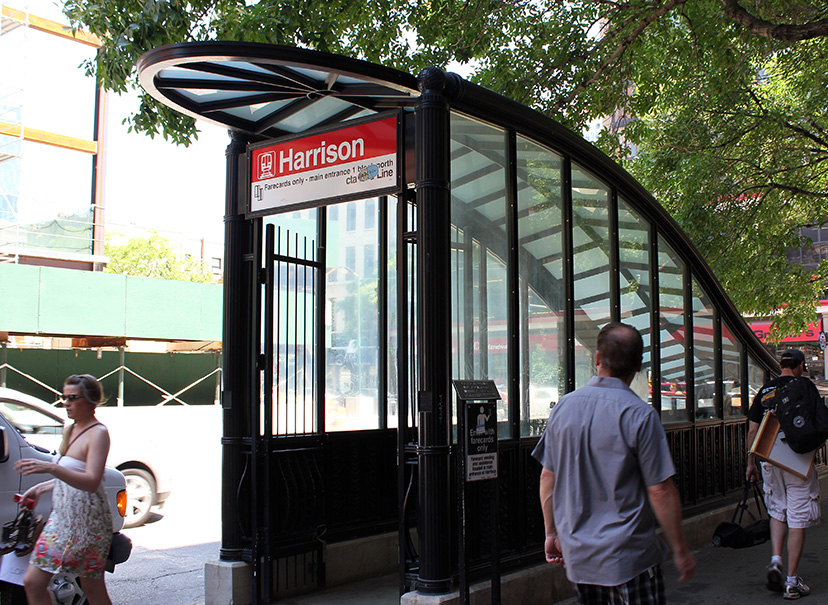
Call it Daley retro.  Word got out during the reign of Richard M. Daley that the mayor was partial to "traditional" design, and while the rap wasn't entirely deserved, the result was a lot of unnecessary pandering with such things as the Botero-limbed bus shelters designed by Robert Stern, and the street enclosures for escalators and stairs up from the subway.

The best that can be said about them is that they're lighter than the box they came in . . .
Other than that, could anything be more maladroit for a city that prides itself on its design?  Encountering one of these objects is like walking down the street and finding a giant walrus lounging on the sidewalk, loudly braying at passersby.

Is this really the best we can do?  As proven by the recently opened Ross Barney Green Line stop at Morgan Street, and this design concept for the intended Loop L station at Washington and Wabash . . .
. . . the answer is, clearly, no.  The way they dominate the sidewalk view, these subway entrances are more than just enclosures - they're emblems, and brazenly dishonest ones, at that.  They misrepresent the bright, streamlined design to be found in the actual station below.  In this "less is more" city, they're like giant billboards refuting Chicago's pretensions to architectural excellence.  On pain of fines, you're expected to clean up after your dog no matter how big the turds, but these huge, stinking - and inescapable - excrescences seem to enjoy blanket immunity. to plop at will.
At these prices, the CTA and CDOT need to step up to the plate.  Chicago deserves better.

Monday, August 13, 2012

Tonight: Stanley Tigerman in conversation with Robert Somol at UIC

You may have noticed the August calendar isn't up - (Does anyone other those involved in the events covered even read the thing?) - but here's a heads up that tonight, 6:00 p.m. to 7:00 p.m. in Gallery 100 of the Art  and Architecture Building at UIC, Stanley Tigerman will confer, converse and otherwise hobnob with UIC School of Architecture Dean Robert Somol.

It's just the first of four conversations - same time and venue - "on topics that are vital to the success of making ideas happen in the city" that will see Martin Felsen in conversation with Alexander Eisenchmidt on Tuesday, the 14th, Sean Lally in conversation with program director Kirk Wooller on Monday the 20th,  and Andrew Zago in conversation with Eisenschmidt, on Tuesday, the 21st.

It's all part of a collaboration with London's Architectural Association  and UIC as the 2012 visiting school, Campaigning Architecture, a "10-day international design workshop that will expose, explore, and develop multiple ways for campaigning architecture – enabling participants to combine the potential of design intelligence with the strategic power of propaganda, in order to get things done in the city."

Sunday, August 12, 2012

Batcolumn vs. Bridgecolumn

click images for larger view
batcolumn - 1977, Claes Oldenburg, sculptor, 101 feet high (600 West Madison)
bridgecolumn - 1908, William H. Finley, Assistant Chief Engineer, 170 feet high (Carroll Street at the Chicago River)

Wednesday, August 08, 2012

Burberry Facade Plaid - Limited Time Only!

click images for larger view
The metal framing that will carry the facade elements of the new Burberry store on North Michigan Avenue is being put in place.
Enjoy it now.  This tan, white and black polychrome plaid, with scaffolding overlays, will disappear as the structure nears complettion.
Already, highly reflective black tinted glass pieces are appearing within the frames.
They're not windows.  The frame is being affixed to the solid wall beneath.
The staircase on Ontario Street that will be a highly visible part of the completed design is already in place, in a well of wallboard whose own plaster geometrics will soon disappear under final finishes.
Eventually, the black of the window glass will take over the whole of solid portions of the facades, as illustrated in the rendering above,  taken from the invaluable skyscraperpage.com website.  The Dark Knight of Michigan Avenue descends.  Raincoat included.

Portrait of a City at Warp Speed: The Eighth Greatest Film Ever? Man With a Movie Camera at Doc Films tonight


The ten highest ranked movies of the just released 2012 edition of the British Film Institute's once-a-decade poll of The Top 50 Greatest Films of All Time is pretty much a list of the usual suspects: Rules of the Game, Tokyo Story, Sunrise, Passion of Joan of Arc, etc.  The big news was dethronement of long-time Number 1 Citizen Kane with Alfred Hitchcock's Vertigo.  Discuss among yourselves.

An even greater jump, however, was a film that went from 27 in 2002 to number 8 this year.  Dziga Vertov's Man With a Movie Camera is a wildly ambitious 1929 silent documentary that is nothing less a picture of what it is to be alive as captured through documenting a day in a great city (in this case mostly Odessa, but some other cities used, as well.)  Coupled to long stretches of conventional montage are bursts of the avant garde techniques that would come to define cutting edge cinema: multiple exposures, jump cuts, freeze frames and more.
Streetscapes, storefronts, racing trains, planes, trams and fire trucks a beautiful woman dressing, trams emerging from their sheds, shooting galleries, dancers, symphonies, posters, advertisements, a walking tripod -  all the forms of urban human life, and all the stages birth to death.  In 68 minutes.

And we also see both endpoints of the story - the intrepid cameraman as he seeks and sets up his shots, and the audience watching him on film as he shoots film while riding a motorcycle.
It's a remarkable study of architecture inhabited.  Not the carefully composed hero shots of individual buildings, but the fabric of buildings placed within a city, engaging with the human beings who designed them, and use them, if only as a backdrop,  Vertov's restless camera often moves through the streets just as we as pedestrians move through the streets. 
While you can view the entire film on You-Tube, tonight you also have a rare opportunity to see Man With a Movie Camera as it was meant to be scene, on a large screen - where the images of buildings can scale life-size - and with an audience, so you can be a spectator in a theater watching an audience in a theater watch Vertov's film.  It screens tonight at 7:00 p.m. at doc films. in the Max Palevsky Cinema at Ida Noyes Hall at the U of C, 1212 West 59th.  $5.00.

Tuesday, August 07, 2012

Full Stop: Wiel Arets new Dean at IIT

As we reported on Friday that Edward Lifson had reported on Thursday, IIT has now made the official announcement that Wiel Arets is the new Dean of the College of Architecture.  As the press release reads:

Illinois Institute of Technology Provost Alan Cramb announced today the appointment of Wiel Arets as the new dean of the IIT College of Architecture. Born in the Netherlands, Arets, an internationally acclaimed architect, educator, industrial designer, theorist, and urbanist, is known for his academic progressive research and hybrid design solutions. He is currently the professor of building planning and design at the Berlin University of the Arts. His architecture and design practice, Wiel Arets Architects, has multiple studios throughout Europe and its work has been nominated for the European Union’s celebrated ‘Mies van der Rohe Award’ on numerous occasions.

Arets, who was dean of the Berlage Institute in Rotterdam from 1995-2002, will join IIT this fall and will lead an academic program originally shaped by the vision and work of Ludwig Mies van der Rohe. Considered by many to be one of the founders of modern architecture and design, Mies chaired the IIT architecture program from 1938-1958 and  designed the IIT Main Campus, home to many of his iconic structures including S.R. Crown Hall.

Arets currently has projects under construction throughout Europe and Japan, including the Allianz Headquarters in Zürich, Switzerland, Amsterdam Centraal Station’s IJhal, the Schwäbischer Verlag in Ravensburg, Germany and the A’ House in Tokyo. His many distinguished projects include the library on the Uithof campus of Utrecht University, the Academy of Art & Architecture in Maastricht, the Euroborg Stadium in Groningen, and the Hedge House in Wijlre, the Netherlands.
“The College of Architecture at Illinois Institute of Technology has a global reputation and attracted outstanding candidates for dean from leading programs worldwide. It is indicative of the position of the IIT College of Architecture that we have found such an accomplished architect to lead the school in a new direction,” said Cramb.

Arets has been a guest professor at many of the world’s preeminent architectural universities, including the AA London, Columbia University and Cooper Union—and served on the Advisory Council of Princeton University from 2003-2012. He graduated from the Technical University of Eindhoven in 1983, where he obtained his Master of Science in Architecture . . .


Sunday, August 05, 2012

13 years later, Cows on Parade still hanging on

Nine Spotted Lady Bug Cow by Brian Calvin,  still at its original location,climbing up the facade of Hotel Talbott, Delaware near Rush.(click images for larger view)
Blame the Swiss.  In 1998, they got the bright idea of casting cows in fiberglas and letting local artists loose on them.  Chicago shoe magnate Peter Hanig saw the exhibition in Zurich, and with Cultural Affairs Commisar(ess) Lois Weisberg, they hatched (you do know that cows come from eggs, yes? really big eggs.) 1999 Cows on Parade, curated by Nathan Mason, in which no fewer than 306 88-pound hollow bovines were transformed by artists from Herbert Migdoll to Karl Wirsum, Tom Bachtell, Mr. Imagination, Terrence Karpowicz, Barbara Koenen and Ed Paschke, to name just a few.  (Paschke's cow, Vaca Victoria, was actually yanked from view because it incorporated gang symbols.)

Helmut  Jahn created Lines at State and Wacker.  Stanley Tigerman and Dong Huy Kim sliced their Cow(ed) into three parts, Damien Hirst style.

Cows on Parade was so successful, it spawned countless street-side exhibitions worldwide, taking on everything from elephants, to ducks, moose, shoes, eggs, frogs, peanuts, another kind of peanuts, and . . . bananas.
Pete Price Banana - photograph: Stuart Ian Burns, Wikipedia
Our neighbors in Racine have been doing an annual festival since 2002, starting with cats, then dogs, then bears, and in 2005, fish and otters . . .


This year, they've been reduced to trunks.   The situation in Chicago is no better.  For still another year, Michigan Avenue is dotted with ten recycled refrigerators, redesigned by local artists.  This year's exhibition is named "MetamorFridges", and is sponsored by ComEd.  Things have grown increasingly commercial, didactic, and - truth to tell - more than a little tired.  Appropriately, this one looks a bit like a bicycle hearse.
A decade is a long time to do variations on a single idea.  Clearly, some fresh thinking is order, and it's useful to look at some reminders of the giddy fun of the original 1999 Cows on Parade, which can still be found around the city.
Some can be found outdoors, such as the one above, on west Dickens.
Other cows have found inside resting places.  piCowso, by Todd Treleven, Jeff McMahon and Scott Wallace, was originally outside SOM's One Mag Mile on Oak Street.  Now, it's retired to the offices of its donor, HavasChicago.
© Jyoti Srivastava. All rights reserved.
Recently my good friend Jyoti Srivastava discovered another indoor cow.  In 1999, W. la Vaca 1999 #2, by Virginio Ferrari could be found at State and Wacker.  Today's it's in the atrium of 20 North Michigan. You can find more surviving cows on Jyoti's excellent blog, Public Art in Chicago, here.

How many more cows still live?  If you know of any, let us know, and we'll add them to our Put Out to Pasture catalog.
Actually, the Chicago Loop Alliance, with its Pop-Up Art galleries and projects like this year's Color Jam have brought a lot of creativity to public art in Chicago, as has the annual BIGart installation at Navy Pier, and The Chicago Sculpture Exhibit.

Are recycled refrigerators God's way of telling us there's a drop-dead date on whimsy?  What new ideas are waiting to be discovered for combining tourism and public art?  Fiberglas figures of  Convicted Aldermen on Parade?  Giant grapefruit on the march?  Surrealism on State?  No?  Well, what have you got?  Pass along your suggestions and we'll post them here.