Showing posts with label Chicago Transit Authority. Show all posts

Monday, July 28, 2014

What's red and blue and on a mezzanine? CTA's new Division and LaSalle entrance debuts

click images for larger view
If you encounter it in the just the right place, you might feel you've fallen into the blood elevator scene from Stanley Kubrick's The Shining. The crisp red tiles of the new entrance mezzanine at Division and LaSalle - the first anywhere along the Red Line subway since it's opening seventy years ago - just have a way of burning their way into your retina, a strong navigational focus point that leads you to the escalator, stairs, and elevator to and from the platform.

The station's original entrance at Clark and Division is now temporarily closed as it also undergoes a major rehab for the first time since its opening in 1943.  Back then, it was more of a workaday neighborhood.  According to the station's history on the essential Chicago-L.org, there was even a direct mezzanine-level entry to the Mark Twain Hotel(!). As the surrounding neighborhood first sank and then went more and more upscale, the original crisp design of the station became increasingly derelict, leading Tribune transportation report Jon Hilkevitch to label it “among the tackiest and most dilapidated on the CTA system.”

A 1999 plan had a $15 million price tag, but the time the issue was revisited a few years later, the budget had exploded to $102.5 million.  A new design was completed in 2011, but $30 million in funds earmarked for Clark and Division were diverted to cover the $67 million cost of rehabbing the Red L stop at Grand. By the time the project was relaunched in 2012, the cost was cut almost in half, to $50.6 million, largely by not trying to keep streets open during construction, but shutting down Division for a year, simplifying the construction staging.
The new 8,800 square-foot mezzanine at Division and LaSalle actually opened two months ahead of schedule, at the end of June.  The worst part of it are those truly abominable giant sea slug street entrances to which the CTA seems addicted.    Lumbering, over-scaled, thick limbed and graceless, anything farther from the classic, spare elegance of Chicago design would be hard to imagine  At least on the northeast corner, there's the lightness of the Richard Haas to provide an ameliorating backdrop.
The mezzanine itself follows the new standard of being capacious and bright, with a light-reflective metal ceiling, and those now ubiquitous light-blue tiles with slightly darker tiles depicting a could-be-anywhere skyline.  (For this kind of money, couldn't we afford something less generic?)
Red appears again in thin banding tiles that makes the navigational signage pop.  
There are escalators and an elevator, which no doubt were cheaper to build here, than trying to insert them into the existing entrance at Clark Street.
At platform level, the previous concrete vaults are given the mosaic treatment to make the space seems appear brighter and more welcoming. 
The original and rehabbed and expanded station are both expressions of their respective times.  The 1940's stations were compact and utilitarian, but with a definite Moderne vibe that was allowed to tarnish and submerge under decades of neglect and hacked revisions.  Platforms, also, were spare, unashamed bare concrete outer walls of the tube or the long perimeter of steel columns that kept the whole thing standing.  Seventy years ago in Chicago, the very idea of a subway was a novelty and the frank design an object of delight, tying together the subway to the great retailers of State Street with dedicated mezzanine-level entrances.   In the midst of a time of war, an austere decor didn't really qualify as a privation.
Today, in contrast, we require everything to be flooded with light, surfaces bright, and spaces large. Where once red painted concrete was sufficient, we now have granite; spare concrete vaults are now covered in mosaic.   You only have to look at one of surviving L stations - such as at Chicago or Fullerton - to see how a commuter load as large - or larger - than today could be accomodated in tight, functional spaces that even had room for restrooms and a newsstand. 
Original Fullerton station.  Image courtesy of the Chuckman Collection
Today, we demand more, and the Clark and LaSalle mezzanine provides a sharp, attractive upgrade.

Wednesday, May 21, 2014

A third of a billion dollars to save 15 seconds? CTA's pork barrel roller coaster subject of public hearing tonight.

A public meeting on the CTA's proposed Red-Purple bypass project will be held today, Thursday, May 22nd, 5:30 to 7:30 p.m., at the 19th District Police Department, 850 West Addison.

The Belmont crossover today (click images for larger view)
In post-war America, when stagnating cities sought to come to terms with the emerging age of the automobile, the expressway became the great god of salvation - worshipped and inevitable.  Urban centers were torn and shredded to make way for their construction, sacrificing long-standing patterns of local transportation for visions of speed and connection.

The joke, of course, turned out to be on the big cities, themselves.  Far from securing their economic future, the expressways emptied out the cities and greased the skids for the exodus to the suburbs, even while slumming up the neighborhoods now fallen beneath the highways' deep, derelicting shadows.

Now, city after city has realized its mistake, and taken sometimes massively expensive initiatives to heal the scars the expressways and other overscaled infrastructure created, painstakingly stitching the urban fabric back together.  Boston spent billions to cover its downtown Central Artery beneath parkland.  After the 1989 Loma Prieto earthquake caused major damage to the double-decker Embarcadero Freeway, San Francisco didn't repair, but demolish, returning one the city's most iconic vistas back to its citizens, and restoring the Ferry Building district to its status as one of the city's great amenities. 

Dumb, clout-heavy Chicago still doesn't get it.  Other towns learn from their mistakes.  Chicago just ups the ante.
image courtesy of the Chuckman Collection
There's no more poetical symbol of the excesses of the automobile age than Chicago's Circle Interchange, four square blocks of nothing but roadway and winding, elevated ramps, constructed not on some suburban tabula rasa, but carved out of the very heart of the city, where's it's been a wasteland presence for over half a century.  Visually, it's a magnificent beast, but it's appetite is insatiable.  Frequently cited as offering up the worst congestion in the United States, it reportedly wastes 25,0000,000 driver hours every year. 

So, is the plan to find ways to divert more of that traffic away from the interchange?  Of course not. The plan is to continue to force as much traffic as possible -even through traffic that never stops downtown - squeezing through the Circle Interchange.  Spending $500 million to add capacity that will be inadequate by the time it comes online, the reconstruction includes building still another ramp that will pass mere yards from residents' bedroom windows and make Greektown look like a off-ramp hick town.
And now, Mayor Rahm Emanuel and the Chicago Transit Authority intends to slum up Lakeview with a roller-coaster like overpass to eliminate switching delays north of the Belmont Brown/Red/Purple line stations.  Just four years ago, the CTA spent $530 million to renovate the entire Brown Line, extending platforms to accommodate eight-car trains  and rebuilding 18 stations, including completely new platforms at Belmont and Fullerton.  Now, just for this overpass, the CTA is proposing to spend $320 million.

For what? To eliminate, in the CTA's words, “more than 40% weekday trains being delayed as much as three minutes.”

That's right.  In a city closing schools by the dozen and facing financial disaster from pension payment obligations, Emanuel wants to spend a third of a billion dollars to eliminate delays that don't exceed three minutes on far less than half of train runs.

But wait - there's more!

The CTA's propaganda campaign for the project is a rich collection of misdirection, evasion, and downright lies.  The Reader's Ben Joravsky actually clocked more than 30 trains with a stopwatch, and the typical delay was 25 to 30 seconds.  Max was 40 seconds.  I also ride the Brown Line every workday, and I've been watching how long I'm held up at Belmont.  Often, it's not at all.  And when I am delayed, it's seldom more than 15 seconds.  Usually by the time the “We are waiting for signals ahead” announcement finishes, the train is already moving.

So we're going to spend a third of billion dollars to cut 15 to 30 seconds from our travel times.  Hey, we're expecting Uncle Sam to foot the bill, so it's not real money anyway, right?

What's really depressing about this is how local media look at this kind of thing with a compliant shrug.  Greg Hinz of Crain's Chicago Business recently did a thorough dissection of what a waste of money the proposed Illiana Expressway would be.   But when I saw him recently on television being asked about the overpass, his reaction was something no deeper than “sure - why not?”

The CTA makes a lot of other suspect claims, including projecting that traffic through the intersection will double over the next 15 years.   It also laughably claims credit for the retail surge on Southport through the rebuilding of the Brown Line station, and suggests that the construction of the Belmont overpass will spur a similar miracle along Sheffield and Clark.  Like the opportunity of being in the shadow of trains cars loudly passing overhead on a soaring trestle is an irresistible  magnet for new businesses.

Not that the CTA actually has any intention of letting you see the full visual impact of the overpass.  As in the latest remake of Godzilla, the monster is kept out of sight not, as in the movie, to build suspense, but as a permanent strategy to defuse public outrage.  Like a realtor hiding a huge septic tank behind bushes in photographs of a house they're trying to sell, the CTA's project renderings carefully conceal the worst of the overpass behind buildings that don't exist, and for which no developer has as yet stepped forward, or even been rumored. 
Where the overpass is depicted at it's full height, it's kept in the far distance of the rendering, as if the CTA thinks we're too stupid to notice the visual chicanery.

No fewer than 20 buildings would be demolished to make way for overpass.  If we are to believe the renderings, a real cityscape of different types of buildings - not architectural masterpieces, but real, human-scaled structures reflecting Chicago's history - would be replaced by generic, cookie-cutter designs most likely targeted to incomes far above those of current residents.
I suppose I should admire the bureaucrats for their shamelessness, but the time for this kind of scarring infrastructure, ripping like a tornado through the urban fabric of a thriving neighborhood, is long past.


Wednesday, April 24, 2013

New CTA L cars may last for 40 years: do we really want to spend them staring into someone's crotch?

click images for larger view
Yes, the picture above is a bit of an exaggeration.  The CTA isn't actually planning to relieve overcrowding by putting riders into harnesses and speeding them along conveyor belts, after eviscerating us to reduce load weight.  At least not publicly. The CTA is, however, ramping up its commitment to another rider-unfriendly ‘innovation.’

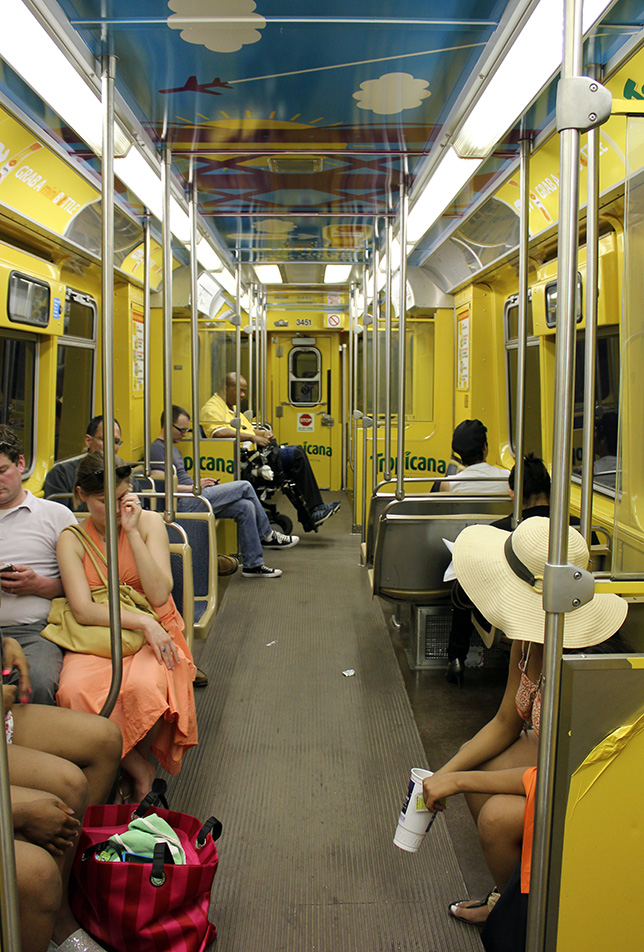
In a move to make Rachel Shteir feel more at home, the CTA is deep into the process of upgrading its fleet with new railcars that replace the (pun alert)long-standing forward-facing seats with the aisle-facing benches that have been the norm in New York City for over a century.

The new L car design is another lovely parting gift from the administration of Richard M. Daley. After purchasing zero new rolling stock since 1992, the CTA announced in 2006 that it would be purchasing 406 new rail cars at a cost of $577 million, with delivery to begin in 2009.
When the first new 5000 series cars actually began appearing in 2011 on the Pink, then the Green lines, they offered up smoother rides, ADA compliance, brighter lighting, security cameras, and nifty station maps where the dots representing the stations light up when a train approaches.  That didn't stop many riders from expressing strong negative reactions to the layout, to which the CTA responded with its usual raised middle finger.  The cars, it said, had been engineered to only accommodate aisle-facing seats - so shut up and take a seat, if you can find one.
In February, the CTA announced they were opening the bidding process to find a manufacturer for a new 7000 Series of "L" cars - 846 cars, at a cost of $2 billion.  As part of the process, the CTA has set up an on-line user survey, which you can access and take here.  ‘Do you prefer to sit or stand during your journey?’ it asks after getting past some preliminaries.  Then it's your preferred clinging strategy: pole, strap, seat back, or the person you apologize to after you use them to catch your fall.   Finally, it moves on to placement, starting with the old forward-facing seats, before moving on to 5000, mainly inward-facing seats.  14 screens of questions in all.

This is actually a lot more user input than the CTA has ever sought before. “This is the first design I am overseeing,” President Forrest Claypool  told the Trib's Jon Hilkevitch, “and we are going to do the type of research to get it right." Still, it's easy to fear the CTA is testing the waters for even more depressing changes, such as the painful-looking blue plastic benches pictured below . . .
Not that passenger comfort was ever Chicago transit's primary concern.  Charles Yerkes, the man who built the original L back in the 1890's,  once famously said, “The short-hauls and the people who hang on the straps are the people we make money out of.”  But not even Yerkes imagined he could get away with turning his riders away from the windows.  His original wooden cars established a basic layout that was still being followed in later decades . . .
Photo courtesy The Chuckman Collection
Those original cars offered 52 seats, a number that held pretty much steady for the better part of a century.  The new ones are down to 38.  By increasing standing room, the capacity of the cars is now estimated at 120 passengers, far above the CTA's own de-crowding goal of no more than 75 people per car.

There are, to be sure, a lot of people who think comfort is expecting way too much from the CTA. “If it gets you from point A to point B and you don’t end up dead when you’ve reached your destination then it’s done it’s job effectively,”  one vociferous defender of the new car design proclaimed.

Still, I think it's an issue worth raising. And I'm not alone. “I think as other modes of transportation become more comfortable, it’s a shame that the CTA is taking a step backwards with fewer seats. It reinforces the notion that transit is inherently uncomfortable,” Joseph Schwieterman, director of DePaul University’s Chaddick Institute for Metropolitan Development  told Carolyn Suhr of Medill Reports. At a time when we're trying to get more people to use mass transit, Chicago's ‘sell’ almost seems to come down to:  “The CTA - what other choice do you have?
photograph courtesy of The Chuckman Collection
Economics and logistics obviously have a major, quite possibly decisive role in this, but it's also about what kind of city we want Chicago to be.

New Yorkers pride themselves on taking in stride all manner of daily affronts and injuries that would send lesser urban dwellers fleeing to the suburbs like whipped dogs.  New York is so full of amazing things; it's just the price you have to pay.

Chicago has its own store of wonders.  If it doesn't match the Egyptian scale of New York, it also comes with a more relaxed idea of a city that can be vibrant and creative without so easily resigning itself to the kind of  ‘Little Murders’ dehumanizations that arise out of New York's staggering density.

For most of Chicago's history, the L was a great way to see the city.  For me, it was a daily, ever-changing classroom of the city's architecture and history.  Now, it's all about avoiding eye contact with the passengers sitting directly across from you, even as you enter into an intimate visual relationship with the crotches of those standing mere inches from your face.

The purpose of mass transit is to transport people, but the increasing dependence on subsidiary revenues often marginalizes the passenger. Are windows now just a surface to attach ads to, so that looking out is like viewing the world through cataracts?  Do trains exist for the passenger, or to provide advertisers an audience, even if it means leaving riders sometimes feeling as if they've been dropped into a vat of orange juice?
The designs that were the norm for the better part of a century carved small refuges of individual, private space within the uncaring anonymous enormity of the public realm.  There was almost a Noah's Ark vibe: two-by-two, husband and wife, mother and child, friends, lovers or your impromptu partner, just for the ride.  The oldest even had seats that pivoted direction, so a party of four could have its own facing space, chatting or perhaps playing a game of cards on the long trip into the city.  Now it's all about moving the widgets in and out with a minimum of friction.

You could make the argument that these are pretty petty complaints  You could observe that with our iPads and earbuds, we've already disengaged into our individual, virtual worlds.  But do we really need the CTA to reinforce this?  Chicago remains a city of marvels.  Is it unreasonable to want to be able to see them as they pass by?

In our Age of the Supply Chain, efficiency is the deity that brooks no appeal.  A train, after all, is nothing more than a machine to get us to where we want to go.  Yet it's also where we spend an hour or more of every working day.  When we look back on our lives, what carries the greater emotional weight: the destination or the journey?

Take the CTA survey here.

Thursday, November 08, 2012

At the CTA, you can rehab in any color - as long as it's white

click images for larger view
The CTA is in the middle of Red Ahead, a welcome $86 million upgrade of 10 Red Line stations - not total rebuilds, but extensive repairs and reconfiguration, with new lighting, doors and finishes.  All in all, this has been an attractive alternative to such money-pit projects as the estimated $200 million+ cost of renovating the Wilson station.  [The Chicago Sun-Times has recently been reporting on how money gushes like a geyser in the city's Public Building Commission.]
At Argyle, as in the other stations in the rehab, there are new, handsome glass-filled entrance walls renovated platforms and canopies, and a clean, open design, all accomplished, as in the other stations, during a fairly short six-week shutdown.

The only thing missing is color.  About 20 years ago, as part of renovation that cost all of $250,000, the Argyle station , which serves a neighborhood with a substantial Vietnamese, Cambodian and Chinese population, was repainted in colors associated in China with good luck and keeping away evil (red), and with longevity - also infidelity, jealousy and lust - take your pick (green).
The new Argyle is white, white, white.   Very nice, very generic.  Would it have cost that much more to give each station a bit of personality?  There are a lot of blank walls, so maybe the color will come from the $525,000 in artwork the CTA is currently considering for seven of the rehabbed stations, including Argyle.

Tuesday, September 25, 2012

CTA looking for 7 or so good artists: October 10 deadline for proposals for public art in 7 rehabbed CTA Red Line North stations

CTA rehabbed Granville Red Line station (click images for larger view)
 The question period actually closed yesterday, but artists have until 3:30 p.m., October 10th, to submit proposals for artworks to be installed along seven stations on the north branch of the Chicago Transit Authority's Red Line, which are, in sequence, undergoing at $81 million rehab.

Artwork on the CTA includes everything from, at the Brown Line Western stop, a slice of the Berlin wall . . .
To 50 works of arts from 41 artists on the Pink, Red, and Brown lines, including Jo Hormuth's Canopy Lights at Red Line 47th street . . .
. . . Jason Pickleman's MONT/ROSE: Area at Brown Line Montrose, and . . .
. . . Juan Angel Chávez and Corinne Peterson's Hopes and Dreams at Red/Roosevelt.  (The CTA has published a pdf of all the artworks._
The Red Line Granville stop was the first to shut down, this past June 1st, re-opening July 13th.  The century-old station had already had one gut rehab back in 1980, so the latest fix was a matter of repairing and restoring concrete and masonry, cleaning, repainting, and refurbishing the platform.  The end result is a bright open design, although the granite fascia - leftover from 1980? - is an incongruous element that weighs down the lightness.
More recently, the Argyle stop closed down for its facelift on August 24th.  Will the distinctive Chinese color palette survive?
Unlike the Brown Line stations, where the art was co-ordinated with the reconstruction of the stations, the Red Line project is a bit of an applique.  Artists are given a pre-configured tabula rasa to work with.  According to the press release, "Prior public art experience is not a requirement."  There's a $525,000 budget for the art works, paid for by the feds.  The stations are Lawrence, Argyle, Berwyn, Thorndale, Granville, Morse and Jarvis.  (You can find full descriptions and histories for each station on Graham Garfield's indispensable Chicago-L website. )

The budget for individual stations will range from $45,000 to $99.000.  There will be two steps to the judging process, with 25 artists selected as finalists, winners announced next February, and all art to be in place by September, 2013. You can read the CTA press release, with a link to the RFP here.

Tuesday, August 14, 2012

CTA's Attack of the Street Walruses

click images for larger view
 This is what $100 million looks like.  It's a rendering of the replacement 8800-square-foot mezzanine for the Red Line Clark and Division subway station, originally opened in 1943 and largely unrejuvenated ever since.  That's up from the $86.6 million price tag quoted in a CTA press release just this past January.  If the new station lasts as long as the old one, and assuming half of those using the station will be boarding and paying a fare, it will cost 50 cents for every one of the 4,000 per-day passengers over the next 70 years.  (The CTA is projecting usage will double.)   But then again, a CDOT flyer distributed by 42nd ward Brendan Reilly this past weekend quotes a cost of $41.3 million, so we've already made over half of the expense disappear.
As with the Chicago and, most recently, Grand stations on the Red Line subway, the contrast between the old, dank and dreary stations and their replacements is like night and day.  The platforms, while constrained to the original size, appear more spacious and welcoming, and the mezzanines are, in physical fact, vastly increased in size and openness.  Below ground, everything is sleek and modern.  It's only when you move above ground that you get this . . .
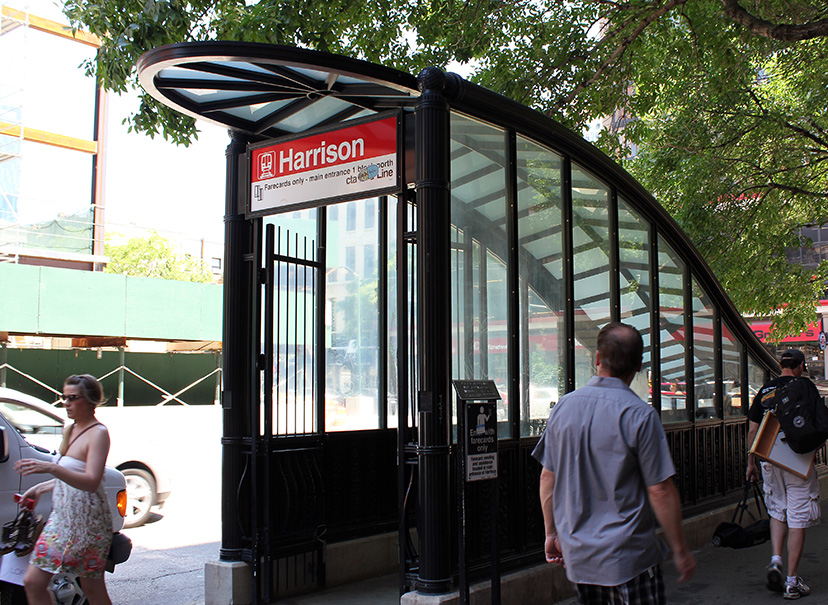
Call it Daley retro.  Word got out during the reign of Richard M. Daley that the mayor was partial to "traditional" design, and while the rap wasn't entirely deserved, the result was a lot of unnecessary pandering with such things as the Botero-limbed bus shelters designed by Robert Stern, and the street enclosures for escalators and stairs up from the subway.

The best that can be said about them is that they're lighter than the box they came in . . .
Other than that, could anything be more maladroit for a city that prides itself on its design?  Encountering one of these objects is like walking down the street and finding a giant walrus lounging on the sidewalk, loudly braying at passersby.

Is this really the best we can do?  As proven by the recently opened Ross Barney Green Line stop at Morgan Street, and this design concept for the intended Loop L station at Washington and Wabash . . .
. . . the answer is, clearly, no.  The way they dominate the sidewalk view, these subway entrances are more than just enclosures - they're emblems, and brazenly dishonest ones, at that.  They misrepresent the bright, streamlined design to be found in the actual station below.  In this "less is more" city, they're like giant billboards refuting Chicago's pretensions to architectural excellence.  On pain of fines, you're expected to clean up after your dog no matter how big the turds, but these huge, stinking - and inescapable - excrescences seem to enjoy blanket immunity. to plop at will.
At these prices, the CTA and CDOT need to step up to the plate.  Chicago deserves better.

Monday, June 25, 2012

Lonely Flowers at the Gravesite of the Abandoned Subway Station

click image for larger view
State and Washington
October 17, 1943 - October 23, 2006
buried alive with $300 million in TIF funds
in the never-opened "Superstation" beneath Block 37.
(former stairway entrance filled in with unkempt lawn)

Wednesday, February 15, 2012

Attack of the Hypothetical Fare Scenarios

click image for larger view
CTA survey seeks public input about "hypothetical fare scenarios" - headline of Trib story by Jon Hilkevitch

Dear beloved passenger: The CTA would like to have your opinion about possible new ways to assess charges for riding our trains and buses.  Be assured that no fare increases are currently under consideration.  (You should also be aware that there's a really nice bridge on Michigan Avenue we'd like to sell you.)  But just in case we'd ever, possibly, need to increase revenue sometime in what we're absolutely sure would be far, far into the future, we would like to get your opinion in ranking each of the following 250 "hypothetical fare scenarios" ("HFS's") in order of desirability . . .

$2.00 zoned fares for rides under 5 miles, $16.00 for not telling the cops you look suspiciously zoned out
$3.00 per bag
$.50 per escalator ride; $1.50 per working escalator ride
$2.25 for basic fare, 50 cents for transfers, $1.50 for oxygen
$3.50 if the driver sits in your lap.
$5.50 if said driver shifts energetically as the bus turns a corner
$7.50 per transcript of cell phone conversations of the deranged passenger sitting next to you
$5.00 "mystery aroma"-free section
$2.25 if you bring your own squeegee
$6.50 to harmonize with the motorman on "Rolling in the Deep" over the train intercom.
$4.50 to make up your own street names for the overhead message board
$1.00 to place a bet on whether or not that red-faced guy running like a fiend will have the doors close in his face as the bus pulls away
$4.95 for the What Subway Tunnel Location Am I Stuck In? iPad app.
$10.00 to replace "doors are closing" announcements with "you're going to be crushed like a bug!!!!"
$7.50 to allow you to kick everyone else out from under the heat lamps
$24.50 to be terrorized by Robert Shaw
$6.95 to let you amuse yourself by changing the Bus Tracker indicator from "approaching now" to "removed from service"
$4.00 for each bus not bunched up right behind the bus before it.
$16.50 to open a beer concession at the back of the car
25 cents if you can correctly identify the viscous substance on the seat next to you; $4.95 if you can't
$1.00 if you let us use your Link card to fill up the vending machines at headquarters
$2.00 surcharge for stopping within two feet of the curb
$6.00 to let you shake down other passengers for cigarettes
$2.00 if you share your cab with the driver when the bus runs out of gas.

please turn to page two . . . .


Tuesday, April 19, 2011

Forever Grand

 click images for larger view
It was originally supposed to be finished by 1998 at a cost of $15 million.  By 2005, the estimate was up to $29 million with work still not started - construction didn't actually begin until early 2008.  It's made a mess of the major intersection of Grand and State ever since.  The cost is now up to $67 million and it's slated to be finished by the end of the year, but I wouldn't bet good money on it. 

Yes, it's the CTA's Grand stop on the Red Line, and as you can see from the photo above, there's still a lot of work to be done amidst the subterranean complex of mains, conduit, and ancient Roman catacombs. 
In addition to the glacial work on the revamped mezzanine, which will be expanded an additional 2,000 square feet, the re tiling and vaulting of the platforms is lasting longer than it took Michelangelo to paint the Sistine Chapel, with commuters waiting for their trains amidst bare walls, plywood on the floor, and a lighting system of electrician's lamps, year after year.  It looked like this in June of 2009 . . .
and remained uncompleted sixteen months later, in October of 2010 . . .
As you can see from the new sections on display in the photo above, the reconstructed design, as it slowly unveils itself, is quite attractive, and the mezzanine should eventually look something like this . . .
The station originally opened in October 1943 as part of the new Howard subway line.  At the heart of the revitalized River North, Grand is now the 8th busiest station on the Red Line, with a daily load of 8,000 passengers.  If the reconstructed station lasts as long as the original,  it will cost about 34 cents for every passenger passing through its turnstiles over the next 68 years.

It could be worse.  The Red Line's Washington stop closed in 2006 for construction of a new "superstation" under Block 37.    Two years later, with no end in sight to escalating cost overruns, the city shut the project down, a money pit consigned to mothballs. Five years after it was "temporarily" shut down,  and now mutilated to integrate with the unicorn superstation, the Washington stop remains closed.  $300 million dollars of your tax dollars down the tube, with nothing to show for it.  Makes the Grand station's $67 million price tag look like a bargain, doesn't it?