Showing posts with label 150 North Riverside. Show all posts

Monday, October 12, 2015

Little Houses on the Lakefront: The four kiosks of the Chicago Architecture Biennial

click images to larger views
 What's an Architecture Biennial if you don't actually build stuff?  There are a number of full-up houses constructed inside the Chicago Cultural Center, but that wasn't enough.  The Chicago Architecture Biennial also seeks to colonize the Chicago lakefront with a series of four pavilions. The idea is to upgrade the poor quality of the 40+ small buildings that serve the vast numbers of people visiting Chicago's 20 miles of beaches and parks lining Lake Michigan.

As noted in a tweet from Trib Architecture critic Blair Kamin, the worst of these are fairly wretched . . .
While, in truth, a large number of others are not without their charm.
For the Biennial, however, none of the four kiosks are in their ultimate intended locations.  That's supposed to come next summer.  None of them are in or near the Cultural Center, either.

The farthest flung is at IIT, one of three schools that partnered with the Biennial, the Park District, and the City of Chicago in creating kiosks.  Call the Cent Pavilion, it's the work of Chilean firm Pezo von Ellrichshausen, the first winner of the Mies Crown Hall Americas Prize for Emerging Architecture (MCHAP), created by IIT Dean of Architecture Wiel Arets. The Cent Pavilion is described as . . .

. . . a 40-foot tower meant to convey silent and convoluted simplicity. It repeats the same angled design over and over, resulting in an opaque monolith. When its commercial function ceases at the summer’s end, the kiosk will complement the verticality of Chicago’s iconic skyline year-round. 
 At IIT, however, the tower is confined to its structure, sitting in front of Mies van der Rohe's iconic Crown Hall . . .
Instead of the ultimate stack of hat boxes, in this context it almost seems like an homage to the nearby smokestack of IIT's power plant . . .
The other two school-partnership kiosks are much closer to the Cultural Center.  Across the street, in fact, in Millennium Park, just off to the crowds taking in Anish Kapoor's Cloud Gate Sculpture.  Summer Vault, a partnership between UIC,  Paul Andersen of Independent Architecture and Paul Preissner of Paul Preissner Architects offer up the kiosk that's the closest match to the original concept.
. . .basic geometric shapes—a 12-foot-diameter barrel vault, a parallelogram, triangles—combined to create a curious, freestanding hangout within the park. The interior of the skewed vault is divided into two triangular spaces—one enclosed by expanded metal screens and doors, and one open to the air but still within the vaulting. This two-part plan allows for commerce and community to occur simultaneously. It also reflects the kiosk’s Persian origins as a 13th-century garden pavilion, while embracing its contemporary use as a seasonal commercial front and festive park retreat. Its openness allows year-round use, so that it remains active even in its retail slumber during the Chicago winter.
 
Interestingly enough, the built kiosk is currently the one closest to its original concept, and also the one the public has the most problem getting its hands around.
. . . possibly because there's no real activity in the kiosk right now, and because the metal screens that subdivided the kiosk seem a bit too fence-like.
Kids, however, seemed to have no problem in being drawn to exploring it.

In contrast, Summer Vault's neighbor, Rock, by Kunlé Adeyemi in partnership with The School of the Art Institute of Chicago is the least completed kiosk - an isolated series of fragments - and the most popular.   Ultimately, it's supposed to be a Fallingwater-styled construction cantilevered over Montrose beach . . .
For the Biennial, however, it's a collection of rocks of the type of rocks that have historically been Chicago's seawall against Lake Michigan, until the Army Corps of Engineers get holds of it and makes it all a smooth expressway.
Some of the rocks include spots of color from the unofficial paintings and graffiti that come when people use the rocks as a canvass.

At Millennium, what seems to have made the rocks hugely popular are their picture-taking potential, perfect for everything from selfies to family portraits.
Let the Army Corps beware - people love climbing on rocks.
The design of the last kiosk is the result of an international competition with a $75,000 first prize.  You can see the runner-ups here, and other entrants here.
The winner,  Yasmin Vobis, Aaron Forrest, Brett Schneider's Chicago Horizon, Ultramoderne . . .

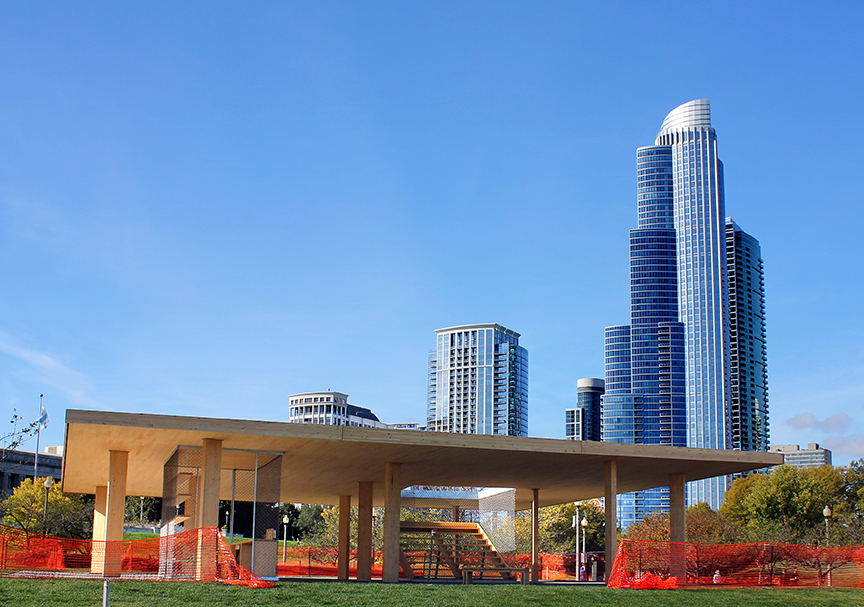
. . .  is a quest to build the largest flat wood roof possible within a limited budget. Using Cross-Laminated Timber, a new carbon-negative engineered lumber product, in the largest dimensions commercially available, the kiosk aims to provide an excess of public space for the Architecture Biennial and Chicago beachgoers.
This weekend, the plain wood and simple lines of kiosk, located on the Museum Campus just south of the Field Museum, was in competition with a cordon of orange plastic mesh, presumably there to protect from the hordes running and viewing Sunday's Chicago Marathon.
The 56-foot square structure currently is a bit surreal, with a set of stairs going nowhere.  Other renderings show visitors using the stairs to access the kiosk's hovering wood roof slab.
From the viewing platform, the roof becomes a new artificial horizon, shutting out the foreground and emphasizing the vertical Chicago skyline above an abstract floating plane.
The kiosks are scheduled to be on display through the close of the Biennial in early January.

Read More:

Carnival of Possibilities: A Photographic Tour of the Chicago Architecture Biennial


Sunday, August 02, 2015

Magic Fingers: The Most Spectacular Engineering Show in Chicago Right Now on Display at 150 North Riverside


click images for larger view
It will become much taller and much shinier by the time it's finished, but 150 North Riverside will never look quite as spectacular as it does right now.
Designed by  Goettsch Partners with Magnusson Klemencic Associates as structural engineers, on a site on the south branch of the Chicago River just after it splits in two, the building will eventually rise 54 stories and a height of somewhere around 700 feet.
The signature aspect of 150 North Riverside is the way the office floors cantilever out from the central core.  The first full-size office floor doesn't come until Level 8, 104 feet above the buildings plaza, freeing up space for part of a 1.5 acre park that surrounds the building and sits atop the Metra tracks running beneath the site to the west.  As it meets the ground, the building takes up only 25% of the site.
To achieve this openness, sloping columns begin at the 4th floor and rise up and out to support the perimeter columns of the tower's standard 27,000 square-foot floor plates.
Lifting those columns into place was among the last work of the bright red 300 foot-tall, Manitowoc 888 barge crane that has been floating in the Chicago river just next to the site since this past April.
photograph: Bob Johnson

On Friday, the crane hoisted Truss 8, the  massive 250,000 pound, 30 foot wide by 35 foot tall section into place along the south end of the building, captured on lunch hour by Kngkyle on SkyscraperPage.Com, which has it's own 60 page (and counting) thread on 150 North Riverside, with a lot of spectacular photographs.


As early as this week, the 888 crane will construct its own replacement, another crane that will lift materials up the tower as it rises, and then it will be deconstructed and floated away.
Eventually, as the skeleton is completed and 150 North Riverside grows its homogenous skin, the supporting cage of sloping columns will be hidden behind elegant glass.  For now, however, one of the most spectacular engineering feats in Chicago construction stands naked to your gaze.  For a time, you can see, ungloved, the outstretched fingers on whose tips 47 stories of curtain wall will rest.


 Read More:
The Art of the Pitch: Selling Goetsch Partner's 150 North Riverside to the Neighbors.
Giant Punch Stamp on the River?  First Renderings of 150 North Riverside Revealed


Sunday, September 07, 2014

Along Chicago's New Skyscraper Row: One Rises, One Descends, and One Just Spreads it Around

click images for larger view
Saturday seemed a good day to check out the progress and three large construction projects that have made the bend of the Chicago River big development central.

See the complete photo-essay, after the break . . .

Tuesday, January 07, 2014

The Art of the Pitch: Selling Goettsch Partner's 53-story 150 North Riverside to the Neighbors


150-Riverside from gene molchanov on Vimeo.

This Wednesday, January 8th at 12:15 p.m. at the Chicago Architecture Foundation, Steven M. Nilles and Joachim Schuessler of Goettsch Partners will be offering a preview of the firm's latest Chicago project, 150 North Riverside.   Details here.
click images for larger view
How do you sell a skyscraper?  If you're in the middle of Chicago's Loop, you don't, really.  You fill out the forms, talk to all the right people, get the approvals, find tenants, land the financing, and start the job.  If you're in an area you share with residential buildings, however, the process becomes a bit more complex.
42nd ward alderman Brendan Reilly consults with a constituent
If you have an alderman like the 42nd ward's Brendan Reily, who's fairly conscientious about such things, there are public hearings to bring developers and residents together, and often it's a clash between two very different cultures.  The developer inhabits the macro culture, populated by  accomplished specialists and connected insiders.  Residents inhabit the micro culture, reflecting personal experience and day-to-day, moment-to-moment concerns such as traffic, shadows, light and views.  When things get tense, developers, and the those in their wide, informal support structure, often paint those in the micro culture as NIMBY's, hidebound opponents of anything new or progressive, consumed by narrow self-interest.  And truth be told, some people at public hearings do exhibit a vision so constricted that a horse in blinders would look upon it with pity.
It is entirely reasonable, however, that not only those with big bucks and big plans, but the people who have created and sustained the communities that are about to be transformed also have their voices heard.  Sometimes what would seem to be obvious questions can evoke the best answers, and that was the case at a well-attended Reilly-sponsored late-summer public meeting at the Hotel Allegro, where residents got their first in-depth look at plans for a 53 story, 700-foot-skyscraper, 150 North Riverside, on a site next to and over Amtrak tracks that has been vacant for fifty years.
150 North Riverside is the maiden project of developer John O'Donnell following his 2010 retirement as CEO of the John Buck Company, where he had a 28-year history.  “This is a site I pursued,” said O'Donnell,  “for roughly a decade in my prior job.”  He seemed genuinely proud of his new baby, and
John O'Donnell
the presentation by his team was perhaps the best I've ever encountered, exceptionally well-prepared not just to pitch the preferred talking points, but anticipate community concerns.  (The one glaring exception was when an audience question about migratory bird collisions found O'Donnell's team taking on a deer-in-the-headlights look that suggested this was a topic that somehow had never come up in rehearsal.)

One audience member, a local businessman fashioning himself an amateur expert on real estate who had conducted his own extensive research, launched into an extended argument that, with office vacancy rates currently hovering around 17%, no anchor tenant yet announced, and only one  -DLP Piper - still in play and most likely headed to the already under-construction River Point tower, the most relevant question about O'Donnell's $450 million project was “Why?’

Rather than the polite, vague answers that would be the usual developer's response to such a query, O'Donnell, instead, turned to U.S. Equities' Drew Neiman. Neiman is another long-time (27 year) former Buck-ite.  In his new role at U.S. Equities, managing the leasing of 150 North Riverside, he offered a revealing look inside the mind of a developer as he calculates the odds on a project such as this . . .
The marketplace in general has about 145 million square feet in the CBD [Central Business District].  So we'll call that the denominator.  As you stated, the average vacancy - it depends upon the report - probably it can go anywhere from 13.3 to 14.5% vacant depending on who you talk to, and how they record vacancy and occupancy.  
If you would go to buildings that are similar to [150 North Riverside], we call those 
Drew Neiman
Class A+,  really technology robust type buildings.  That equates to about 10% of the total amount of square footage in Chicago, so of the 145 million, about 14 or 15 million are buildings similar to this.  Buildings that have been been developed since 2000.  So they've got floor-to-ceiling glass, 45 foot core to glass dimension, robust vertical risers for electrical and telecommunications.  These are buildings that are the next wave and the new generation. 
The vacancy rate of that 10% of what you call the cream-of-the crop, if you will, is between 3 to 5%.  That's 10% below the rest of the market.  That means that there is a demand for those type of buildings.  Every one of those buildings that have been built since 2000 has leased up.  The reason, as you state, [is] today corporations - including law firms, consulting firms - are all trying to fit more people into less space.  So they're consolidating, or in some cases you talked about even subleasing some space or giving it back.  Or if they can, relocate to a new building where they have a better floorplate, a more robust infrastructure that can handle their needs in less square footage.  And so as a result, there is a demand there.  This submarket is very healthy and there is a demand.
When pressed on whether the project had an anchor tenant in sight, Neiman was a bit more vague . . .
We can only reveal so much here tonight.  Let me just say this, that we wouldn't have proceeded and spent the money and done what we've done, if we didn't think that there was a demand with anchor tenants whose leases expire in 2016 , 2017, possibly even 2018.  And so we've done our homework and we know who's out there.  We're feeling very comfortable that this will be well received.
The questioner was right about DLP Piper.   In July, the firm announced they were moving to River Point, committing to 175,000 of that project's million square feet.  Neiman seems also to have been correct about 150 North Riverside.  Late last month, William Blair and Company announced they're planning to move to 150 North in 2017, taking up about a quarter (300,000) of O'Donnell's 1.2 million square feet.  O'Donnell is claiming construction will begin this coming summer.

There were also questions at the community meeting on 150 North Riverside's Design.  We'll be taking those up in our next post.

Read  More:

Giant Punch Stamp on the River?  First Renderings for 150 North Riverside office tower and park - Revealed and Considered.

Wednesday, January 01, 2014

150 North Riverside, Jeanne Gang on Radical Creativity, Achilles on the Auditorium, Vernon on Griffin and more: Just Posted! the January Calendar of Chicago Architectural Events

Once more into the breach, dear friends - we've just put up the January 2014 Calendar of Chicago
Architectural Events.

The year starts slowly but we still have dozens of great items in the first month of the New Year, beginning with representatives of Wiss, Janney, Elstner and Thorton Tomasetti discussing Hurricane Sandy and Coastline Rebuilding Efforts for the Structural Engineers Association of Illinois,

Lunchtime Wednesdays at the Chicago Architecture Foundation, it begins with building previews -on the 8th, with Steven M. Nilles and Joachim Schuessler of Goettsch Partners discussing 150 North Riverside, which has just landed its anchor tenant; and the 15th finds representatives from Solomon Cordwell Buenz and Loyola discussing the school's under-construction Institute of Environmental Sustainability.  Then on the 22nd, Julia Bachrach, Elizabeth Patterson and Frances O'Cherony Archer talk about the Chicago Historic Schools website, a fantastic new resource of images and information.  On the 29th, Chicago Chief Sustainability Officer Karen Weigert talks about Building a Livable, Competitive and Sustainable City.

Want more?  Christopher Vernon flies in from Australia to talk about Walter Burley Griffin, the
Oak Park Studio's Landscape Architect at Frank Lloyd Wright's Unity Temple on Thursday, the 9th, while Rolf Achilles takes on The Significance of The Auditorium Building for Landmarks Illinois in the structure's Murray-Green Library on Thursday the 16th.

On Wednesday morning, January 22nd, Jeanne Gang talks about Radical Creativity and Collaborative Design at The Executive's Club of Chicago's Women's Leadership Breakfast, while over at APA Chicago, Adam Rosa discusses A Tale of Two Neighborhoods: The HUD Choice Neighborhoods in Action on Tuesday the 28th.

New shows:  Chromatic Patterns for the Graham Foundation:
Judy Ledgerwood opens on the 23rd, while ArchiTech Gallery launches its new show, Alfonso Iannelli and the Studios, Saturday the 3rd.

There's lot more, so check out all the goodies on the January 2014 Calendar of Chicago Architectural Events.

Wednesday, August 28, 2013

Chicago Under Construction: The Park at River Point Makes Train Tracks Disappear

click images for larger view
For the better part of the past century, north from Lake Street was where the Chicago River began to again show its natural roots.  To the east and south, the river had long before a constructed ditch with towers on either bank often coming right to the edge.
At Wolf Point, however, and along the western bank, the river retained what at least appeared to be a natural shoreline, hugged by trees, shrubs and plants that arose free from the guiding hand of any landscape architect.  For those long decades, this assuming structure, just north of Lake Street, was the most ambitious building on the site . . .
All that's history now.  There are big plans for all those last empty sites along the river in the Loop.  No fewer than three buildings are planned for Wolf Point, and renderings of a new office tower at 150 North Riverside were unveiled just last month.

That brick Metra building - and the ramshackle wooden stairway leading down to the river -  is now only a memory, as another massive tower, River Point, is about to go up in their place.  It's been designed for Hines Interests by Pickard-Chilton, architects of the 60-story 300 North LaSalle, completed in 2009.  The actual building, to be set back from the river along Canal Street, has yet to break ground.
First the developer is creating a 1.5 acre riverfront park, for which they've shook down the city for a $29.5 million TIF subsidy.  (150 North Riverside, to be constructed on the other side of Lake, is also making a riverfront park part of their project, but without recourse to TIF money.)  The park at River Point is being built over the existing train tracks leading into Union Station.
On a chilly day back in April, a painter was already documenting the vanishing surface tracks clinging to the river.
Soon, the construction equipment was rolling into place.
Things begin, slowly and deliberately . . .
. . . cranes flew in on barges . .  .
. . . basic contours began to reveal themselves . . .
. . . and by July, there was no longer any mistaking but that this was the start of something big.

By August, there was enough green rebar in sight it might as well been St. Patrick's Day.
 The irregular riverbank has already been replaced with a new river wall . . .
 
. . . even as concrete walls quickly began to rise to support the surface of the new park, and swallow up the accustomed, almost lullaby sound of locomotive bells forever . . .
When it's all done, it will look something like this . . . 
Read More:
Hour of the Wolf: The Transformation of the Pivot Point of Chicago
First Renderings for 150 North Riverside office tower and park