Friday, March 03, 2006

God vs. Mammon on East Wacker


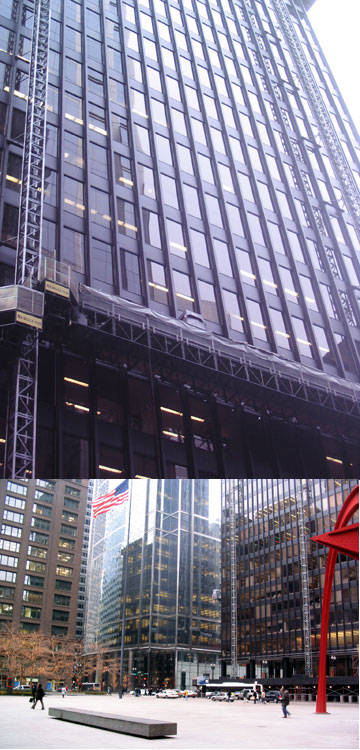
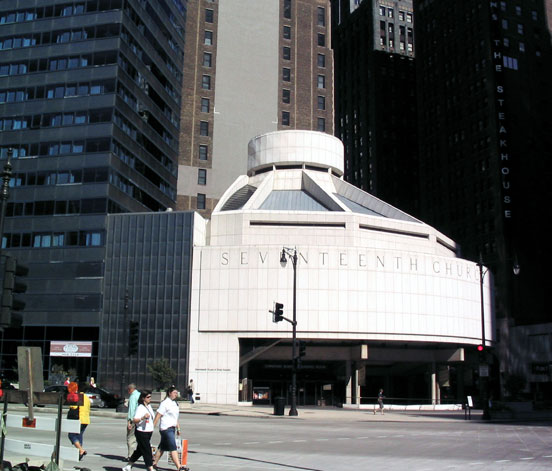
Harry Weese's 1968 Seventeenth Church of Christ, Scientist at 55 E. Wacker Drive is a perfect example of how it's often not the oldest architecture, but that closest to our time that's most in danger of destuction. It's not on the list of the Chicago Historic Resources Survey of important Chicago buildings, which doesn't anything built after 1940. The list was completed way back in 1995, and has yet to be updated, so that a masterwork like Bertrand Goldberg's Prentice Hospital remains completely unprotected. Northwestern Hospital and University have moved quickly to demolish old facilities like the neo-Gothic Wesley and Passavant Pavilions, and it's likely they've already signed Prentice's death warrant, and will dare anyone to stop them from carrying it out.

On February 17th, the Chicago Tribune reported that the developer who owns the 1928 Art Deco Chicago Motor Club tower has had problems redeveloping the property, and is looking to make the Church of Christ just around the corner part of a larger, more viable combined development parcel. According to reports, he's wooing church members to let me build over their church, or even demolish it.

Weese's church is far from perfect - the recessed, lower level garden tends to be little more than a dark moat, but Weese managed to use concrete to create a building that carries echoes of big-boned Gothic while being completely modern. The way its curving concrete facade turns the corner and its low exposed-ribbed, disc-topped dome counterpoints the angular skyscrapers all around it make Seventeenth Church of Christ one of the most graceful buildings on Wacker.

This Monday, March 6th, docomomo-midwest, the local chapter of the global organization dedicated to documenting and preserving modernism, is taking the bull by the horns by sponsoring a lecture by architectural historian Rolf Achilles. It's free for docomomo-midwest members, $8.00 for non-members. The lecture will begin in front of the curch at 55 E. Wacker, and continue in the offices of Perkins+Will in Mies van der Rohe's IBM Building, where you'll need a photo ID to enter.

You can make reservations via email.

Wednesday, March 01, 2006

What Becomes a Parking Garage Most?

There are two basic schools of thought regarding the design of parking garages. The first could be said to be the "honesty first" approach. Cars have minimal physical needs in terms of shelter, and no sense of aesthetics. The best garages, therefore, are like really big closets: we don't expect them to be beautiful - just an efficient place to store out stuff. In architecture, the homely, if frankly presented, can even gain our admiration. A good example would be Harry Weese's parking garage on South Federal, next to his striking Chicago Metropolitan Correctional Center, where he gives absolute minimalism his highly personal stamp. Bad examples, alas, abound, such as the huge and stupid garage behind 900 North Michigan, and the podium of just about any "plop architecture" condo tower you can name.

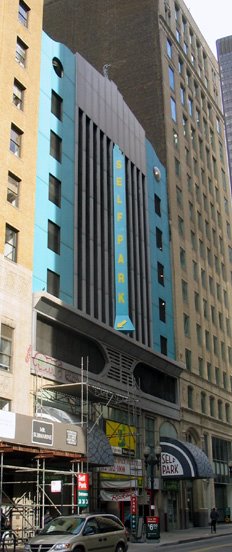
The second could be named the "silk purse" approach. A prime example would be Stanley Tigerman's witty self park on east Lake Street, but the variations are endless. At DeStefano+Partners' One South Dearborn, the cladding over the garage is lightened by a series of six-story high vertical glass louvers along Madison. Often, the ramp, itself, becomes the ornament countering the severity of the garage proper. Think of the spiral ramp at the John Hancock Building that provides a bravura counterpoint to the expressionless dead windows of the garage floors. At James Goettsch's 111 S. Wacker, the bottom of the ramp becomes a sculptural element in the ceiling of the lobby. At Ralph Johnson's Contemporaine, the exposed ramp becomes a stage set bit of urban theater.

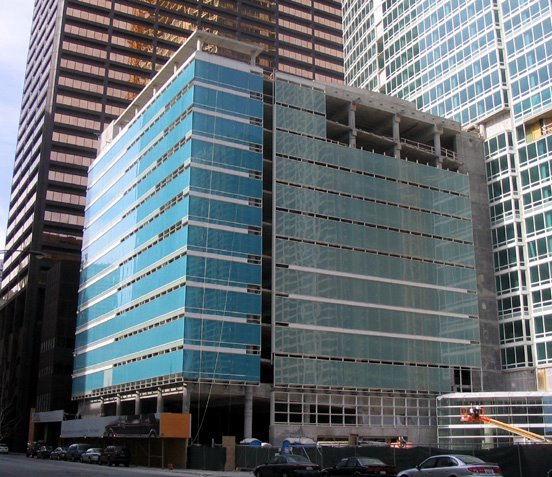
The garage for Solomon Cordwell Buenz's new condo tower, The Streeter,
on east Grand right next to another Harry Weese classic, the former Time-Life Building, may not be the same league, but it's a graceful solution. The structure is essentially a smaller bustle to the main building, and its' clad in two different tones of glass, tending toward turquoise along Grand, and a sea green along its eastern facade. Unlike the tower, where it's an insistently expressed grid of spandrels and mullions, the curtain wall on the garage reads as continous bands of glass along each floor, each topped out by white spandrel and/or short strip of clerestory windows. It provides a bright counterpoint to the warm Cor-Ten tones of its strong-boned neighbor to the west.

Tuesday, February 28, 2006

New issue of Edward Mazria's Architecture2030 E-News now online


Issue 1 of the on-line journal architecture2030 is now on-line, and includes a story on the Goddard Institute's James Hansen recent lecture, Is There Time to Avoid 'Dangerous Anthropogenic Interference' With Global Climate? architecture2030 is work of green architect Edward Mazria. Mazria will also be speaking, along with Sprawl: A Compact History author Robert Bruegmann at the AIA's two-day development conference March 9th and 10th.

And a late addition to the March calendar: This coming Friday, March 3rd at 7:30 P.M., the Rev. Dr. John Cook, former Divinity School Professor and Dean of the School of Sacred Music at Yale University as well as an internationally renowned expert will lecture on Housing the Sacred, Building the Protestant Church in America, at Winnetka Congregational Church.

Monday, February 27, 2006

From Mies' birthday to Walter Hood, Craig Dykers, Joseph Rosa, Lee Bey and beyond - nearly 50 events on March architectural calendar

Salute Mies van der Rohe with one of his signature martinis at his birthday party at IIT, hear lectures by Walter Hood, Brad Cloepfil, Craig Dykers, the Art Institute's new curator of Architecture and Design Joseph Rosa, and Lee Bey, dance the night away at fund-raising galas for the Chicago Architecture Foundation and the Landmarks Preservation Council as it salutes Los Weisberg. The March calendar of Chicago architectural events is bubbling over with almost 50 events, including a scheduling train wreck on March 2nd that includes not only the Mies celebration at IIT, but John Vinci talking about Pilgrim Baptist at CAF, and the announcement of first round winners in the Chicago Architectural Club's Learning from North Lawndale competition. Check it all out here.

Saturday, February 25, 2006

Becker discusses blogs, the internet, and the arts on Edward Lifson's Hello Beautiful Sunday morning


In cyberspace, even Max Reger has his own website. How have blogs and internet affected the arts? That's the question under discussion on this Sunday (February 26) morning's Hello, Beautiful, Edward Lifson's show on WBEZ 91.5 FM. Lifson has just started up his own blog, Teatro Lifson, and, still under the spell of the heady mania we all experience when we first realize we can be our own publishers, he's assembled a panel to discuss how blogging and the internet are - or aren't - changing the arts. It's scheduled to include Terry Teachout, drama critic of the Wall Street Journal, music critic for Commentary, and, with Chicago's Laura Demanski, creator of the About Last Night blog, Barbara Koenen, creator of the Chicago Artists Resource website, and myself. Will culture ever be the same?

The show runs from 10:00 to 11:00 A.M., CST. If you're not in Chicago, you can hear the program over WBEZ's streaming audio by going to their home page, and clicking on the Live Webcast in RealAudio link at the top of the page. Later in the week, the broadcast should also be available on the Hello, Beautiful audio library page.

Thursday, February 23, 2006

Mies' M & M goes C of A

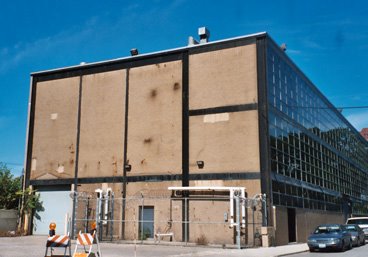
Last night, IIT Professor and architectural historian Kevin Harrington gave a highly informative lecture on Mies van der Rohe's Minerals and Metals Building. In the 1930's, Chicago's Armour Institute, soon to be renamed the Illinois Institute of Technology, brought Mies to Chicago to take over its school of architecture and design a new campus. It wasn't until 1942, however, that he was finally able to complete his first structure for the campus, the Minerals and Metals Building. Far less known than Crown Hall, it’s the building where Mies began to work out a new form architecture that would soon redefine modernism through the world. Recently, it’s been taken over by IIT’s rapidly expanding College and Architecture. I hope to soon write about Harrington’s lecture in greater depth. For the moment, here are some very informal photos to give you an idea of this unique building, whose two-story great hall hosted Wednesday night's lecture.


Wednesday, February 22, 2006

Sullivan & Wright's Charnley House seeks docents for tours


The Charnley-Persky House Museum Foundation is looking for individuals to undergo four weeks of training to become docents for tours of the historic 1891-92 Astor Street mansion. Topics covered in the Saturday sessions (1:00 to 4:00 P.M. each week) will include clients lumberman James Charnley and his wife, Helen, their architects, Louis Sullivan and Frank Lloyd Wright, a detailed walk-through of the house and an overview of the Gold Coast area. The fourth Saturday will switch to Madlener House, the current home of the Graham Foundation, which is also included in Saturday public tours of Charnley. Interested volunteers should contact William Tyre, Manager of Programs, at 312/573.1365 or via email.
Tuesday, February 21, 2006

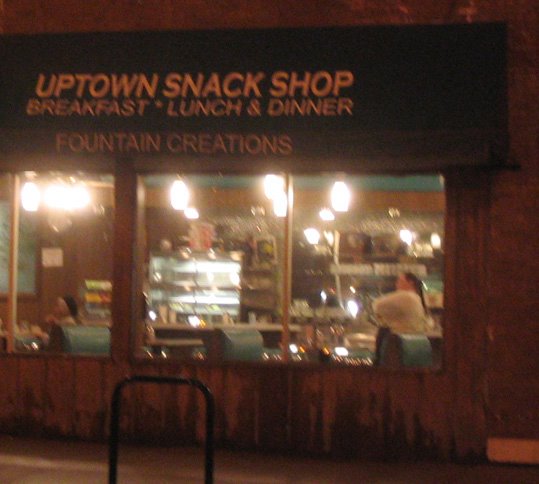
There Goes the Neighborhood - After 47 years, neighborhood gem Uptown Snack Shop is forced out of business

After 47 years in business, the Uptown Snack Shop, a neighborhood institution, was given 30 days notice to vacate, and will close this Saturday, February 25th. With a brand-new Borders, once-posh Uptown is struggling to cast off its long held status as a refuge for the city's poor, and the museum-quality Snack Shop has found itself in the way. Read all about it and see the photo's here.

Monday, February 20, 2006

Clueless Art Critic Rips ABC State Street Studio Signage

As a postscript to our post of February 9th, Tribune art critic Alan Artner has weighed in with an amazingly clueless piece ripping of the new ABC State Street studio LED, having apparently swallowed hook, line and sinker, without any evidence of independent thought, the station's PR declaring the 40 foot high video board a "sculpture" rather than signage. Artner bitches and moans how - surprise, surprise, surprise - it's not really a work of art, but a source of light pollution. Earth to critic: this is an entertainment district, not his empty idea of elysium. Artner is more than old enough to remember State and Randolph in their primes, when they were ablaze with gloriously over-the-top signage, such as the late, lamented marquee of the United Artists. The ABC concoction is a modern day counterpoint to the iconic Chicago theater sign and marquee, which is in no need of Artner's wagging finger to more than hold its own against the newcomer across the street.

Saturday, February 18, 2006

But Isn't Playing God the Whole Reason We're Here? Thoughts on Edward Lifson's oath for city planners, developers and architects


With Trump Tower now rising out of the ground and beginning to block the gorgeous, unobstructed view of Mies van der Rohe's IBM Building we've had since the old Sun-Times building was torn down, Edward Lifson, host of WBEZ's Hello Beautiful, who would had preferred to have had the view maintained with a open plaza, has been prompted to post on his Teatro Lifson blog his version of Hippocratic Oath, this time targeting city planners, developers, and architects.

Well worth a read, it's a highly idealistic call for modesty and urbanity. Some of the points - an obligation to the less fortunate (see: Archeworks), and the emphasis on the importance of craftsmanship, for example - draw on long Chicago traditions. (Although the way the Chicago architectural establishment invoked craftsmanship in their condescending trashing of Rem Koolhaas Student Center at IIT reminds me of a quote attributed to Goethe, "If the artist is not also a craftsman, the artist is nothing, but calamity: most of our artists are nothing but craftsmen.)

At Lifson's invocation, "Do not play at God!" I must draw the line. What is human life but trying to grasp within that fleeting intermission of an eternal sleep a taste of unfettered power and being? What is life for an artist or architect than to be able to think you've finally found the answers that have eluded everyone else, and, in the words of the poet:
To have squeezed the universe into a ball
To roll it toward some overwhelming question,
To say: "I am Lazarus, come from the dead,
Come back to tell you all, I shall tell you all" -
Only to have the world respond:
"That is not what I meant at all.
That is not it, at all."
The glory and the horror and architecture is how clearly it reveals our innermost aspirations, whether result be the Acropolis or Las Vegas. To ask a developer or an architect not to build is like asking a dog not to scratch. Our most natural impulse is to do what comes naturally (marketing to the reptillian brain, anyone?), and although it may be fought in finely tailored suits, in wood-paneled boardrooms, the battle to shape our built environment is a take-no-prisoners wrestle amongst both the most indolent and most aggressive elements of our deepest pysche.

That's just my initial take. There's much to think about in Lifson's oath. Check it out.

Tuesday, February 14, 2006

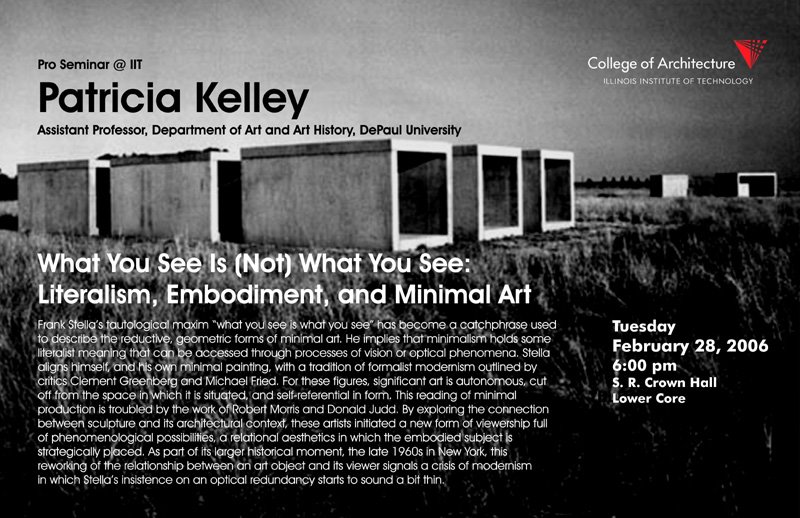
IIT lecture by Patricia Kelley among late entries to February calendar


What You See is (Not) What You See: Literalism, Embodiment, and Minimal Art, is the title of a lecture to be given at 6 P.M., Tuesday, February 28, 2006 at Crown Hall on the IIT campus of Patricia Kelley, Assistant Professor, Department of Art and Art History at Depaul.

As of this moment, you can also still make reservations to hear Robert Bruegmann talk about sprawl this Wednesday, February 15th, at 6:00 P.M. at the Chicago Architecture Foundation, on a panel that will also include John Norquist, former mayor of Milwaukee, and current President of the Congress for New Urbanism.

Monday, February 13, 2006

Waterview Tower - Class Conscious Facades?

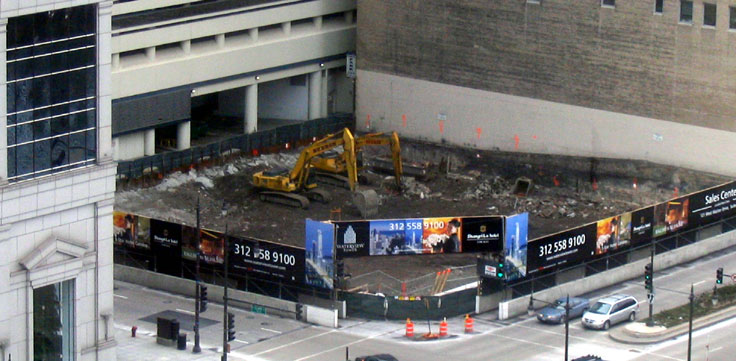
Work has begun on the site of what will be the Waterview Tower, an 82-story high mixed used development on newly reconstructed Wacker Drive at Clark Street, along the south bank of the Chicago River. In Sunday's Chicago Tribune, Blair Kamin writes of a twist in the design of the 1050 foot high tower, by Teng & Associates' Tom Hoepf, that leaves the upper stories resembling "a right triangle." Viewed from the east, the side of the big money of Michigan Avenue and Trump Tower, the building is a razor-thin 32 feet wide. Viewed from the west, from what could be called the "service entrance" side of the building facing the more workaday environs of the West Loop, it grows both wider, blunter and less graceful: less Twiggy, more Margaret DuMont. More wrapper, more views, more revenue.

It puts me in mind of another Tromp d'oeil building, Asbury Plaza at Dearborn and Chicago, which, viewed from the corner, conceals its 300 foot long bulk to appear as a bafflingly small, square tower.

From one rendering, it appears Waterview Tower's south facade will mediate with a certain amount of panache between the wide and narrow of the east and west facades. I'm probably more concerned about what appears to a tall, sheer blank wall along Wacker and Clark, above the retail, covering up the parking garage, which the floodlighting shown in the drawings may not be able to redeem from an oppressive street presence.

The slightly schizoid faces of Waterview Tower is actually a good personification of the way the project is trying to bring luxury to uncharted ground. The trains of the Loop elevated screech along their rails just a half-block south. Not that long ago, the area was home to the Shangri La, a soft-porn movie theatre torn down to make way for what is now the Renaissance Hotel. Now, Waterview Tower is to include the first Chicago outpost of the five star Shangri La hotel chain, as well as condo's that start at close to a million and just keep going up from there. Its being constructed on the last unbuilt parcel along West Wacker Drive, a surface parking lot that's been there for decades. It joins such skyscrapers as the Leo Burnett Building and 77 West Wacker, and probably puts a big red redevelop-me "X" on the C.F. Murphy's handsomely brutalist 55 West Wacker, a big building in 1968 that now finds itself a shrimp in a tank of giant lobsters.

What with Trump Tower, and Calatrava's Fordham Spire, it's astonishing there's still unquenched demand for this kind of king's ransom housing. Maybe after prospective owners work out their mortgage payments, the proximity to cheap public transportation will seem a major selling point.

Friday, February 10, 2006

OMA cooks up whole stack of Mies for Louisville


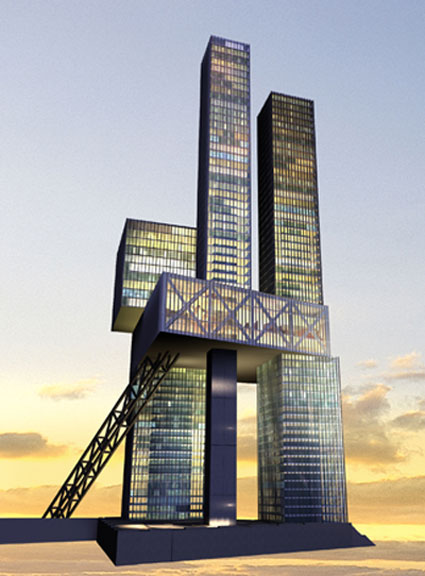
"I do not respect Mies," Rem Koolhas has written. "I love Mies . . . I do not revere Mies." Nowhere is this in greater display than in OMA's design, unveiled yesterday, for the $380,000,000 700 foot tall Museum Plaza in Louisville, whose upper reaches look like Koolhaas and OMA design partner Joshua Prince-Ramus took Mies' IBM and Seagram Buildings and stashed them atop a high shelf. Read all about it here.

Thursday, February 09, 2006

New ABC 7 State Street Studio Nears Completion in Historic Chicago Theater

It's long past the Fall 2005 opening that was anticipated at its groundbreaking last April, but ABC 7 Chicago's new sidewalk studio on State Street finally seems to be nearing completion. Within the past week, a 40 foot-high curving video panel has been illuminated with everything from the ABC logo to views of the lakefront and the city's landmark buildings. Read about it and see the pictures here.

Wednesday, February 08, 2006

A different view of classic Chicago skyscraper


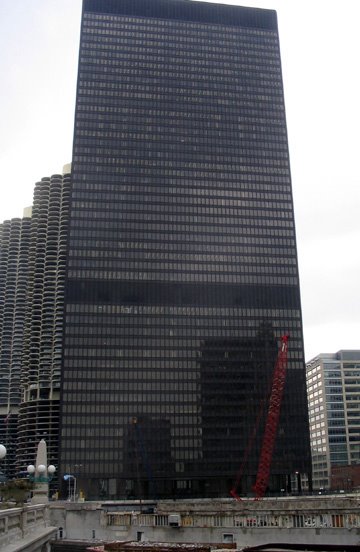
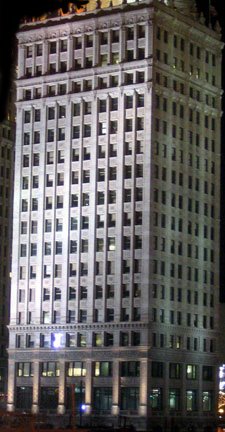
Here's an alternative view of a Chicgo landmark, a classic rectangular tower clad in glazed terra cotta, with a clear, almost Sullivanese articulation of its spare structure.

Tuesday, February 07, 2006

CAF offers up April tour of Vancouver


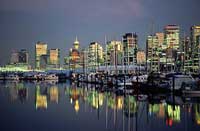
The Chicago Architecture Foundation is sponsoring a four-day study tour to Vancouver, Canada this coming April 27 through 30th. "Learning from Vancouver" has becoming a buzzword for everything from parks planning, affordable housing, and development that favors slender towers to keep openness in the skyline. This could be your chance to see firsthand whether the Vancouver mystique is reality or hype. Events will include tours and presentations by the city's co-director of planning and green architect Peter Busby, whose Brentwood transit station puts the CTA's innate conservatism to shame. (The former Busby & Associates firm is now a part of Chicago-based Perkins+Will). The $1,750 cost for the tour ($100 singles supplement), includes airfair, accomodations and meals. For information, contact Larren Austin at 312.922.3432 X 263, or check out the registration form online. The CAF will be offering another, weeklong tour to Rome this November.

Monday, February 06, 2006

MSI Highlights Black Creativity in Architecture


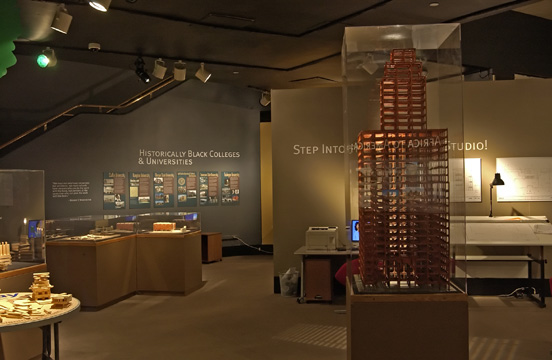
The Museum of Science of Industry's annual celebration of Black Creativity this year "highlights the contributions of African Americans and encourages deeper interest in, and understanding of, black culture and heritage." It's exhibition, Architecture: Pyramids to Skyscrapers, features the work of African and African-American architects, both past and present. It includes models and drawings of key buildings, as well as a showcase of projects from both high school and college students and professional architects. Throughout February, there are also weekly workshops that will bring students and teachers together with architects including Charles and Eben Smith, William Brazley, Jr., RaMona Westbrook and Larry Parkman. Wednesday morning, February 22nd, there will also be a symposium where high school and college students considering a career in architecture will be able to engage Africa-American architectural leaders in learning about opportunities in the field. Events are free with museum admission, but registration is often required. For full information, check out the attractively designed website. The exhibition runs through February 28th.

Sunday, February 05, 2006

Ry Cooder's ballads of Chavez Ravine


John Hill's Archidose blog has a great post on Ry Cooder's album Chavez Ravine, which recalls the almost idyllic working class Mexican-American neighborhood's destruction in the 40's and 50's in a Chinatown-like pursuit of money and power.

In this case, however, the motivator wasn't water but baseball. Even as long-suffering Dodger fans were enjoying their 1955 moment of triumph as the team won its first-ever World Series, owner Walter O'Malley was plotting to sell them out in favor of tapping into the money gusher that was mid-century California with a move to Los Angeles.

Plans for a public housing project with the achingly ironic name of Elysian Fields, whose architects included the legendary Richard Neutra, were deep-sixed, all the current residents evicted, and the neighborhood wiped off the face of the earth to make way the construction of the Dodger's Chavez Ravine stadium. It's a cautionary tale of the intersection of power, planning and architecture, especially timely in the light of the Supreme Court's recent decision to give cities carte blanche in using eminent domain in condemning people's home and businesses to turn them over to monied developers. The Archidose link's include one to Chavez Ravine: 1949, a book of photographs of pre-Dodger Chavez (example above-left). Check it out here.

Saturday, February 04, 2006

Tonight on WYIN - Founding Father Rescued from the Waxworks - Simon Russell Beale as John Adams


It's perplexing how the American Revolution, one of greatest dramas of human history, descends on film into a sort of Waiting for Guffman theatrics. America's founding fathers are inevitably reduced to pious icons, dimensionless ghosts moving through the treacherous, uncertain events of their day as if it were a sleep-inducing pageant.

A rare exception is the current PBS American Experience documentary, John and Abigail Adams, and the reason boils down to a single performance, that of Tony award-winner Simon Russell Beale as John Adams. Despite his pivotal role in arguing for and securing American independence, Adams is probably most often remembered as a rotund, would-be monarchist whose worked as a diplomat in Europe was overshadowed by Franklin, and who had the dubious distinction of being the first American President to be rejected for re-election, his one-term a biding-the-time break between the A-List administrations of Washington and Jefferson. It's Samuel Adams that gets the most airplay today, and that's through a beer commercial.

The PBS film, drawing heavily on the correspondence between Adams and his wife and collaborator Abigail, capably portrayed by Linda Edmond, is obviously intent of restoring Adams to his proper place in our history. It's capably done, but it's Beale, who's just taken over the role of King Arthur in Broadway's Spamalot, who makes the project transcend its genre.

He gives us a John Adams affording full measure to his irascibility, his stubbornness, his vanities and frustrations. Agitating for independence when others counsel moderation, struggling with the demands of diplomacy, watching as his Vice-President's role in the Senate is reduced from participant to onlooker, even pitching hay with the workers on his farm while in political exile, Beale makes Adams so visceral that it's as if you're standing beside him, feeling the heat radiating from his body and his energy displacing the air around you. You suddenly experience history, not as the usual inevitable progression seen through a thick, cloudy glass of history, but as a succession of lived moments - so familiar in our own daily lives - where nothing is certain, little settled, and achievement comes only from the constant anxiety, frustration and hope of human interaction. If John and Abigail were a feature film, Beale's work would be worthy of an Oscar.

Tonight, Saturday, February 4th at 9:00 P.M., you can catch a rerun of John and Abigail on Northwest Indiana's PBS outlet, WYIN, which is carried on many Chicago cable outlets. If you're home during the day or awake at odd hours, WTTW will be repeating the show at 1:00 A.M, 5:00 A.M, 9:00 A.M. and 1:00 P.M on Monday, February 20th. You can also order it is on DVD from PBS.

Thursday, February 02, 2006

Chicago Streetscene - January 28, 2006 - Expanded Bleachers under Construction at Wrigley Field


Lecture on Mies's First IIT Building added for February 22nd


Kevin Harrington, Professor of Art and Architectural History and IIT, and co-author, along with Franz Schulze of the latest edition of the book Chicago's Famous Buildings, will lecture on - and in the 1941 Minerals and Metals Building, the first structure to be built by Mies van der Rohe on the IIT campus. Although less famous than Crown Hall, the m&m marks the first time Mies used exposed I-beams as part of his architectural aesthetic, framing the plain brick infill on the short end of the building. m&m has recently undergone renovation, and provides additional space for IIT's burgeoning school of architecture. Harrington's lecture will be at 6:00 P.M., February 22nd. The Minerals and Metals Building is located at 3350 S. Federal on the IIT campus, a block west of Crown Hall.

Monday, January 30, 2006

Jeanne Gang, Franz Schulze, Archeworks Open House among 40 Events on February Architectural Calendar


The Chicago Architectural Clubs 2006 members show, Jeanne Gang lecturing on Through Material at the Archeworks Openhouse, Franz Schulze talking at CAF about the IIT Campus, Robert Brueggman discussing his book Sprawl, the story of the reconstruction of Jackson Park's Animal Bridge, a tour of Valerio DeWalt Train, an exhibition at the Graham Foundation at Golconde, and Engineers Week Expo are but a few of the more than 40 events on February's architectural calendar. Preview them all here.

Sunday, January 29, 2006

Field's Name to Get a Reprieve?


This week's Crain's Chicago Business has an interesting story by Sandra Jones on how Federated Department Stores, which acquired Chicago's the Marshall Field's department store chain last year, may be taking a second look at their plans to wipe out the Field's name and put all stores under the Macy's banner in September. According to Jones, Federated CEO Terry Lundgren was impressed on how shoppers were loading up on anything with the Fields name on it this past Christmas.

The fact that it took a run on Fields memorabilia to alert them to the fact that there's still equity in the Field's brand doesn't give me much confidence in Federated's powers of analysis, but we will see. To me, it would make sense, at least at the State Street flagship, to use a branding like "Macy's at Marshall Field's", with the Macy's name in smaller, supporting type. The store could still stock the Macy's branded merchandise, while allowing Fields on State to continue to maintain and trade on its historic, potent brand, with the same measure of independence reportedly afforded to the Macy's flagships on 34th Street in New York and Union Square in San Francisco.

Keillor Vivisects Levy

French philsopher-as-popstar Bernard-Henri Levy has been barnstorming the U.S. pitching his new book, American Vertigo, Traveling America in the Footsteps of Tocqueville, tangling with neocons like William Kristol and Francis Fukuyama and popping up on every talk show in sight, from Charlie Rose, to Jon Stewart, to Cooking with Martha. It's hard not to be carried away by Levy's peripatetic charm, but Garrison Keillor, a good Scandanavian like myself, is underwhelmed In the lead review of this Sunday's New York Times Review of Books (free subscription required), he dissects Levy's relentlessly facile observations as if they were a frog in biology class, with a distinctly American wit that from Mark Twain to Mike Royko and beyond has known how to dispatch nonsense with an ascerbic, cut-to-the-chase counterpoint.

Saturday, January 28, 2006

PBS to Mozart: You're Dead

Yesterday, January 27th, was the 250th birthday of Wolfgang Amadeus Mozart. The event has evoked its own backlash, such as a recent Arts op-piece that dismissed the composer's works as high-brow muzak, beloved for its bland, empty amiability, shriveling into dust in the shadow of true innovaters such as Haydn and Beethoven. Such an attack says more about the shallowness of the writer than of his subject.

If you've lived such a blinkered life that Eine Kleine Nachtmusik or a "music to make your baby smarter" CD means Mozart to you, you might be forgiven your ignorance, but to anyone who's ever been grabbed by the throat by those first, nervously unsettling string figures at the beginning of the great G minor symphony and never let go, Mozart's music is a full run journey that encompasses both the warmest sunshine of spiritial grace and the coldest recesses of our darkest soul. His worldview is hedonistic and humanistic, breaking through the brittle veneer of traditional morality to exult in life as lived - our darkest terrors, our insatiable lusts and venialities, our innumerable vulgarities, and, in the end, our most forgiving, generous and selfless aspirations to the divine.

To which PBS replies, "What DVD's does he sell?"

Last night, in Salzburg, the frigid evening was broken by the sound of the church bells ringing in unison throughout the entire city at the moment when Mozart was born, 250 years before. The event came at the intermission point of a concert by the Vienna Philharmonic, conducted by Riccaro Muti, and with soloists including Thomas Hampson, Cecilia Bartoli and Mitsuko Uchida. The magical evening was broadcast to televisions worldwide, except in the U.S., where it was not picked up by PBS or local outlets such as Chicago's WTTW, where programming is increasingly seen as the filler between pledge breaks. When will some broadcaster have the prescence of mind to create a pay-cable network that will finally allow PBS and its afilliates to devote their full attention to the geriatric rock stars, financial planners and self-help gurus that have become their truest love, and find a new home for the type of cultural programming that was such a key part of their original mission?

Thursday, January 26, 2006

Chicago Streetscene - January 20th, 2006

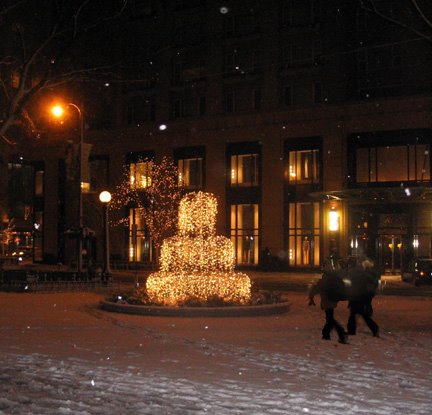
Water Tower Place Plaza at midnight, after a rare winter storm

Wednesday, January 25, 2006

Let's Win One for the Old Sod


Green Roofs for Healthy Cities, "Your Green Roof Infrastructure Industry Association," as they so unpastorally put it, has sent out a reminder that the deadlines are quick approaching for submitting projects for the three awards they will be presenting at their annual conference, to be held in Boston on May 11th and 12th. As far as I can tell, the contest is pretty much for the honor of the thing as a lazy reading of their website failed to turn up any mention of cash handouts. Last year, American Hydrotech's work for Chicago's Schwab Rehabilitation Hospital won for best "Intensive Institutional," and Terry Guen Design Associates won in the "Intensive Industrial/Commercial"(??!!) category for their work at Millennium Park.

The deadlines for submissions for the Green Roof Awards of Excellence is February 15th, and midnight, February 28th for both the Civic Award for "substantiated action (that) has advanced the public policy debate on green roofs," as well as for the Research Award, which "honors a person or research team who has made an outstanding contribution to the field of green roof research in North America.

Detailed information plus the usual PDF submission forms can be found online.

Tuesday, January 24, 2006

Architect Mazria starts up anti global-warming website architecture2030


Architect Edward Mazria, of the Santa Fe, New Mexico firm of Mazria Odems Dzurec, has started a new website, architecture2030.org, which attempts to harness the power architecture to reduce and reverse global warming. "The building sector is responsible for half of all U.S. global warming emissions annually," he says in an open letter posted on the site, "and our emissions are increasing at an alarming rate according to statistics from the U.S. Energy Information Administration. "

To keep global warming under 2 degrees centigrade, he proposes cutting in half the amount of fossil fuel used in construction, to increase to a 90% reduction by 2025 and reach effective zero - the abolition of the use of fossil fuel - by 2030.

The site includes an analysis of the effect of global warming on weather and health, as well as on plants and animals, including coral reefs. It quotes U.S. Energy statistics that buildings consume 48% of all energy, with the balance split between industry and transporation, and highlights over a dozen case studies of projects throughout the world, from Morphosis, Busby + Associates, Gensler, Mazria's own firm and many others, that demonstrate new strategies for energy conservation.

Architecture2030.org has the look of being the product of a one-man band, but a man of enormous industry and impeccible credentials. It includes a wealth of compelling information, creatively presented, that makes a visit more than rewarding.

Monday, January 23, 2006

Another Chicago Miniature Modernist Gem Bites the Dust

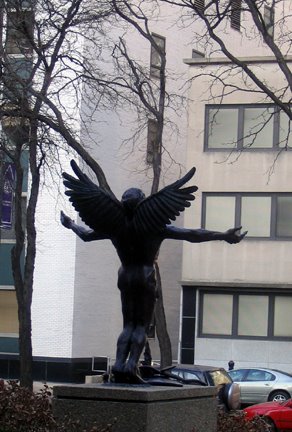
Episcopal Center of Chicago statueNot that long along, there was a 60's era mid-rise office building just off Michigan Avenue, designed by Skidmore, Owings & Merrill that, although largely unheralded, was one that firm's more graceful creations. It's lithe frame was not of steel, but of a rusticated poured concrete, and on the lobby floor there was a broad wall of handsome onyx set in bronze frames, so bright and rich that it looked almost eccentric, seeming to pop out like an effect in a 3-D movie beyond the austere visual framework of the building. The structure was demolished, without protest, for the 2004's 56 story 55 East Erie Condo tower.

Now, just a block north, another graceful piece of modernism, 1969's Episcopal Church Center, behind the historic St. James Cathedral, is about to meet a similar fate. Read about it, and see the pictures here.

Friday, January 20, 2006

Scandal Becomes Her


The twin corncob towers of Bertrand Goldberg's Marina City led off most of Chicago's local newscasts Wednesday night. The feds had indicted dentist Gary Kimmel, a longtime resident and condo association board member, for raking in $400,000 by leasing cars and renting out some of the nine units he owns to pimps running a prostitution ring.

There were quick glimpses of the undistinguished building on Erie Street where Kimmel has his offices, but a veritable orgy of shots of Marina City - as a backdrop for reporters on the sidewalk, glowing at night from across the river, and in slow pans rising up the tower shafts. One station dipped into its files for a long aerial shot that gave viewers the experience of flying directly over the towers, a Freudian dream metaphor that was far more explicit than anything else the reporting could convey about the sensual nature of the crime.

A whiff of scandal can be what gives a famous building its personality, even as it is seldom without victims. Very often, drugs and death are the meat the media feeds on. Think of John Belushi dying in a bungalow at the Chateau Maremont, or Chris Farley succumbing to a heart attack in his luxury condo in Chicago's John Hancock Building. The unspoken part of the allure of a hotel, from seedy to superdeluxe, is in it's potential as safe harbour for the illicit. ("What happens in Vegas, stays in Vegas.")

This is not altogether a bad thing. A building we know only intellectually is a dry, lifeless thing. Our urban architecture is evermore dependent on commoditized plans - we're as likely to refer to "our unit" as we are to "our home." Is this architecture the instigator of our conformity, or only the honest expression of our truest selves? At the same time, however, the endless, standardized repetition of space confers not only banality but anonymity, a door identical to all the other doors, behind which we can put aside the face we prepare to meet the faces that we meet. At least until a new Supreme Court says otherwise.

Dr. Kimmel's is a sordid tale: there's nothing good to be said about the violent exploitation of underage women. Yet, judging from the media coverage, it's the kind of thing for which we have an insatiable and compulsive appetite. With these new intimations of transgression, Marina City may take on a darker, more rawly visceral association that insinuates itself deep into the most reptilian chambers of our hearts.

Thursday, January 19, 2006

Last call for 2006 CAC Member's Show Entries

The end of this week marks the deadline for members of the Chicago Architectural Club to submit work for the group's 2006 member's show, which will go on display at ISpace beginning February 3rd. Club members interested in participating should RSVP to Sam Marts before January 20th.

Wednesday, January 18, 2006

Chicago Freedom Museum preps for April opening


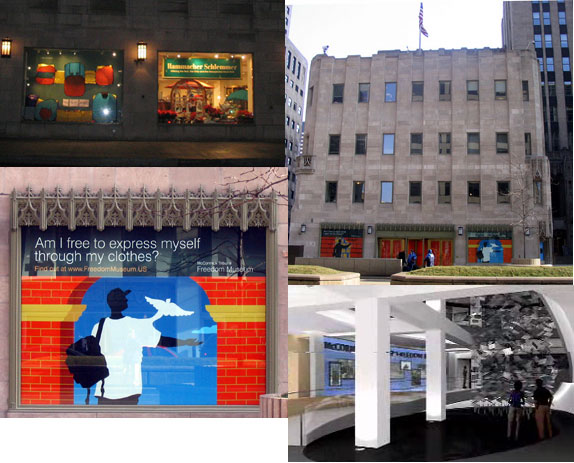
The McCormick Tribune Freedom Museum, located in the first two floors of the artifact-studded Tribune Tower annex most recently home to a Hammecher Schlemer store, is the final stages of construction. The 10,000 square foot facility, designed by VOA Associates and exhibit designers Gallagher and Associates, is shooting for an April opening. The museum hopes to offer free admission to school tour groups to educate and counter what may be a very tenuous understanding of our most basic freedoms - nearly one third of the students in a recent survey thought publishing articles about our government required advance permission. At a presentation sponsored by Friends of Downtown at the Cultural Center earlier this month, the museum's executive director David Anderson ran into resistance from his audience to the proposed standard admission fees of $7.00 for adults and $5.00 for children. The centerpiece for the museum's central rotunda will be a spiral sculpture by Peter Bernheim and Amy Larimer, 12151791 (the ratification date of the 1st amendment), a series of stainless steel plates, eventually to number up to 1,000, "hovering from vertical cables. Each plate depicts the text of a historical record of freedom."

Monday, January 16, 2006

Tuesday events for Michael Rock at CAC, State Senator Christine Radogno at SEAOI among late entries to January Calendar


On Tuesday, January 17th, State Senator Christine Radogno will appear at SEAIO's monthly dinner meeting, and 2 x 4's Michael Rock, whose graphics can be seen as a part of Rem Koolhaas's new Student Center at IIT, will give a "fireside chat" at ISpace for the Chicago Architectural Club.

Also added for later this month is Serving Up Architecture, a January 25th panel discussion at the Graham Foundation examining "the various and growing number of institutions and individuals that serve to bring architecture and architectural knowledge to the general public," will is slated to include John Russick, Curator, Chicago Historical Society, moderator Lynn Osmond, President, Chicago Architecture Foundation, Carol Ross Barney, Principal, Ross Barney and Jankowski Architects, Blair Kamin, Architecture Critic, Chicago Tribune, and Robert Theel, Regional Chief Architect, General Services Administration. That night also offers a lecture by Mark Linder at IIT, but a scheduled lecture by Waro Kishi at the Japanese Consulate has been cancelled. View the full calendar here.

AIA Award for Millennium Park Slights Uhlir, Plumps for SOM

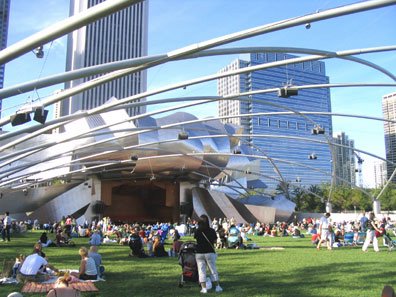
Blair Kamin has a good story in this Sunday's Tribune on how the AIA's 2006 Regional and Urban Design Honor Award recognizing Chicago's Millennium Park gives the biggest credit to Skidmore Owings & Merrill, which is kind of like an giving the award for the Mona Lisa to the guy who sold Da Vinci the canvas.

SOM's original plan was competent - and embalmed - a bland regurgitation of Burnham and Bennett's original Grant Park designs from the early part of the 20th Century, which, in all fairness, was exactly what the city was looking for at the time. As Kamin points out, its not SOM but the park's project director Edward K. Uhlir who deserves most of the credit for overseeing the transition of the park's design from derivative to spectacular. Uhlir was the ringmaster who choreographed a diverse set of powerful personalities from Cindy Pritzker to Frank Gehry to Mayor Daley to fund-raiser John Bryan to create an entirely fresh and new consideration of what a city park could be.

At a symposium at the time of the park's opening, Frank Genry, architect of the Pritzker Pavilion, the undeniable centerpiece of Millennium Park, set the record straight. "Adrian Smith (of SOM) was doing the park," Gehry related, "and he called me and asked if he would do a fish sculpture on either side of his proscenium. And I said no, I don’t do fish sculptures. And that was it. I didn’t hear from him again, and I forgot all about it. "

"And then these guys (Uhlir and company) called and came out to see me. Before they came they said it was for Grant Park, and I said I already told them I wouldn’t do the fish sculptures, and they said, no, no, we’ve got something else. They said they wanted me to design this thing in the park, a bandshell. Then I said, aw, come on, I don’t want to do a bandshell in the park . . . come all the way to Chicago to design a little bandshell. I said if you’re going to do a music thing you’ve got to make it substantial . I said if I’m going to do it, I’d like to like to design the relationship between the audience and the stage. I think that’s a magical thing when it works. They said, oh, you can do that. I said, gee, that’s great. They said, we’ll even throw in the bridge if you want to do it."

It was Uhlir's vision, direction and persistence that created what we know today as Millennium Park, not SOM.

If you want to see something interesting that SOM is actually doing, check out the press release sent out this week on Adrian Smith's entry into a competition for the proposed 69 story Pearl River Tower in Guangzhou, China, a design concept where the building would actually produce more energy that it consumes, by directing wind into the structure's mechanical floors to power wind turbines that supply electricity for the HVAC. "This is an iconic, high-performance building that is designed in harmony with its environment," the release quotes Smith as saying. "It is a skyscraper for a new age." The competition's winner, chosen from three finalists, is expected to be named next month.

Wednesday, January 11, 2006

Another deadening lump lands in River North

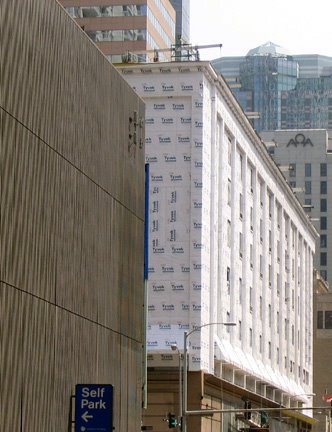
A Four Points Sheraton Hotel has just opened in a rehabbed garage/auto showroom just off Michigan Avenue. A building's got to be pretty bad if it looked a whole lot better when it was covered in Tyvek.


For a look at a building that adds something to the urban fabric rather than trying to kill it off, check out Archidose's entry on the Mercat de Santa Caterina in Barcelona, designed by the office of the late Eric Miralles.

Tuesday, January 10, 2006

Future City Competition Looking for Participants, Volunteers and Sponsors for January 28th Chicago Regional


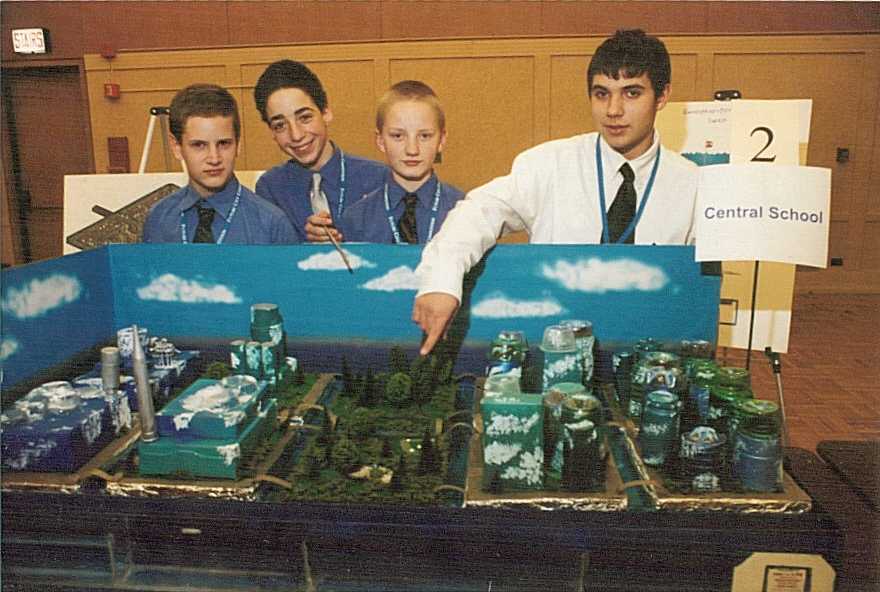
Sponsored by the National Engineers Week and locally by the Structural Engineers Association of Illinois (SEAOI), ISASCE and many other organizations, the Future City Competition serves 7th and 8th graders by introducing students to engineering with the popular Sim City software. Students design future cities with simulation software, build scale models, write essays and give oral reports on their city's design. The Chicago Area Regional Competition has begun and is looking for volunteers to help mentor, judge and sponsor the event, which will be held at UIC on January 28th The competition is occurring in thirty-seven city’s across the nation and provides the students with an exciting hands-on way to learn engineering, math and science with a personal, real world connection. Chicago has been the only city to compete every year since the program began. For more information or to receive information about signing up for the 2006 competition, email Don Wittmer or call 312-930-9119.

Monday, January 09, 2006

Kaddish for a Legendary Church


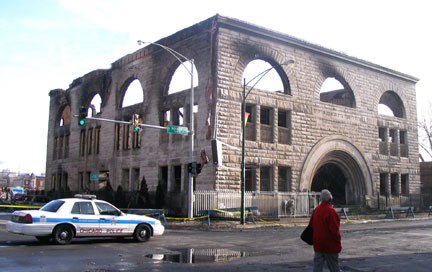
A raging fire guts Adler & Sullivan's 1891 K.A.M./Pilgrim Baptist Church in Chicago's Bronzeville neighborhood and, in silencing the rich echoes of over a century of human aspiration, offers a potent reminder of how architecture channels urban memory. Read about it and see the images here.

Friday, January 06, 2006

Small Victories Matter - a rehab at Washington College helps reclaim a Chicago Loop corner


The downtown Chicago corner where the Loop El turns from Wabash onto Lake has not had a happy history. On February 4, 1977, a rush hour train slammed into the back of the train ahead of it, causing three cars to plunge to the street and a fourth to dangle down from the tracks, killing 11 people and injuring 180.

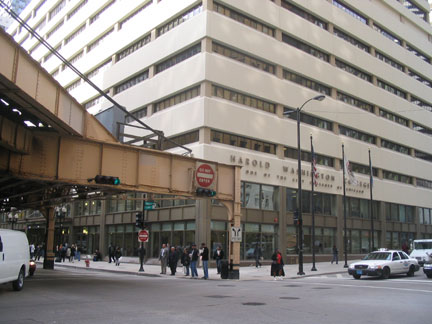
The corner's intervening years have been less lethal, but increasingly dispiriting, as its buildings grew increasingly dark and decrepit. The capper could be said to have been the construction of a new Loop College, later renamed in honor of the late Mayor Harold Washington, whose basic style was a kind of bomb shelter modern . . . a redesign by the Chicago architecture firm of Holabird & Root has blasted apart the bunker on the first two floors . . . read the full story - and see the photographs - here.

Wednesday, January 04, 2006

Learning from North Lawndale - competition deadlines pushed back


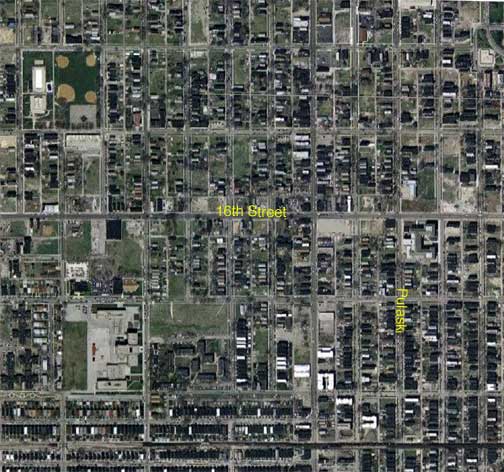
The Chicago Architectural Club's 2006 Burnham Prize Design Competition, Learning from North Lawndale - Defining the Urban Neighborhood in the 21st Century - has changed its deadlines. Pre-registration materials must be postmarked by February 10, 2006, and first round submissions are due by February 22nd. The new deadlines give participants an additional three weeks to prepare. The competition seeks proposals for the 5,000 vacant lots scattered throughout the North Lawndale neighborhood.

Tuesday, January 03, 2006

Renovation of Mies Federal Center Underway.


A $20,000,000 renovation is underway on the facade of the Dirksen Building, one of three structures designed by Mies van der Rohe for Chicago's Federal Center sited along both sides of Dearborn Street between Adams and Jackson.

"The facades are really not a curtain wall," said architect Paul Steinbrecher at a Chicago Architecture Foundation lecture on the project last April. "It’s a very custom designed building. " - read more about it and see more photos here.