Showing posts with label CTA. Show all posts

Wednesday, April 24, 2013

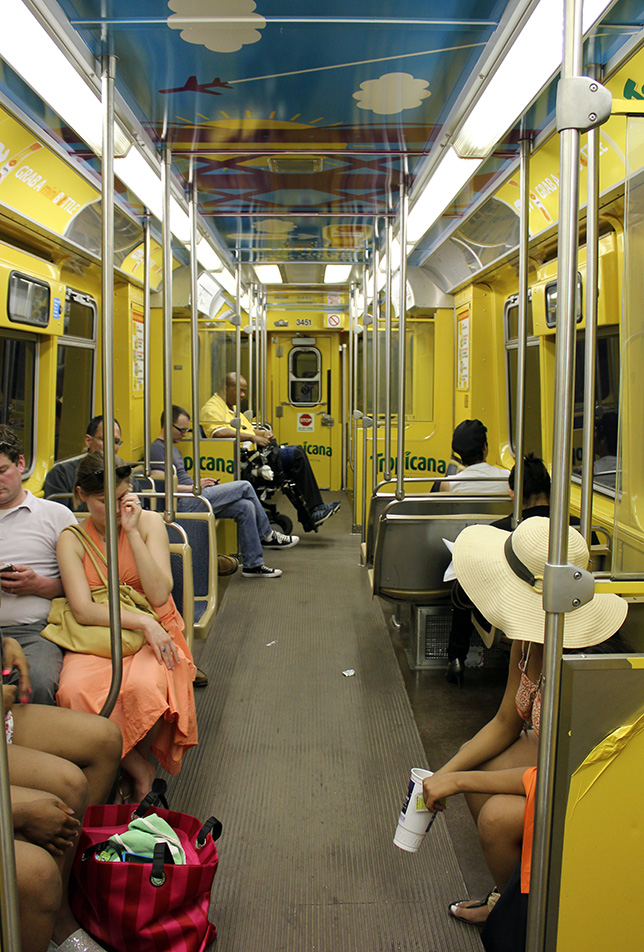
New CTA L cars may last for 40 years: do we really want to spend them staring into someone's crotch?

click images for larger view
Yes, the picture above is a bit of an exaggeration.  The CTA isn't actually planning to relieve overcrowding by putting riders into harnesses and speeding them along conveyor belts, after eviscerating us to reduce load weight.  At least not publicly. The CTA is, however, ramping up its commitment to another rider-unfriendly ‘innovation.’

In a move to make Rachel Shteir feel more at home, the CTA is deep into the process of upgrading its fleet with new railcars that replace the (pun alert)long-standing forward-facing seats with the aisle-facing benches that have been the norm in New York City for over a century.

The new L car design is another lovely parting gift from the administration of Richard M. Daley. After purchasing zero new rolling stock since 1992, the CTA announced in 2006 that it would be purchasing 406 new rail cars at a cost of $577 million, with delivery to begin in 2009.
When the first new 5000 series cars actually began appearing in 2011 on the Pink, then the Green lines, they offered up smoother rides, ADA compliance, brighter lighting, security cameras, and nifty station maps where the dots representing the stations light up when a train approaches.  That didn't stop many riders from expressing strong negative reactions to the layout, to which the CTA responded with its usual raised middle finger.  The cars, it said, had been engineered to only accommodate aisle-facing seats - so shut up and take a seat, if you can find one.
In February, the CTA announced they were opening the bidding process to find a manufacturer for a new 7000 Series of "L" cars - 846 cars, at a cost of $2 billion.  As part of the process, the CTA has set up an on-line user survey, which you can access and take here.  ‘Do you prefer to sit or stand during your journey?’ it asks after getting past some preliminaries.  Then it's your preferred clinging strategy: pole, strap, seat back, or the person you apologize to after you use them to catch your fall.   Finally, it moves on to placement, starting with the old forward-facing seats, before moving on to 5000, mainly inward-facing seats.  14 screens of questions in all.

This is actually a lot more user input than the CTA has ever sought before. “This is the first design I am overseeing,” President Forrest Claypool  told the Trib's Jon Hilkevitch, “and we are going to do the type of research to get it right." Still, it's easy to fear the CTA is testing the waters for even more depressing changes, such as the painful-looking blue plastic benches pictured below . . .
Not that passenger comfort was ever Chicago transit's primary concern.  Charles Yerkes, the man who built the original L back in the 1890's,  once famously said, “The short-hauls and the people who hang on the straps are the people we make money out of.”  But not even Yerkes imagined he could get away with turning his riders away from the windows.  His original wooden cars established a basic layout that was still being followed in later decades . . .
Photo courtesy The Chuckman Collection
Those original cars offered 52 seats, a number that held pretty much steady for the better part of a century.  The new ones are down to 38.  By increasing standing room, the capacity of the cars is now estimated at 120 passengers, far above the CTA's own de-crowding goal of no more than 75 people per car.

There are, to be sure, a lot of people who think comfort is expecting way too much from the CTA. “If it gets you from point A to point B and you don’t end up dead when you’ve reached your destination then it’s done it’s job effectively,”  one vociferous defender of the new car design proclaimed.

Still, I think it's an issue worth raising. And I'm not alone. “I think as other modes of transportation become more comfortable, it’s a shame that the CTA is taking a step backwards with fewer seats. It reinforces the notion that transit is inherently uncomfortable,” Joseph Schwieterman, director of DePaul University’s Chaddick Institute for Metropolitan Development  told Carolyn Suhr of Medill Reports. At a time when we're trying to get more people to use mass transit, Chicago's ‘sell’ almost seems to come down to:  “The CTA - what other choice do you have?
photograph courtesy of The Chuckman Collection
Economics and logistics obviously have a major, quite possibly decisive role in this, but it's also about what kind of city we want Chicago to be.

New Yorkers pride themselves on taking in stride all manner of daily affronts and injuries that would send lesser urban dwellers fleeing to the suburbs like whipped dogs.  New York is so full of amazing things; it's just the price you have to pay.

Chicago has its own store of wonders.  If it doesn't match the Egyptian scale of New York, it also comes with a more relaxed idea of a city that can be vibrant and creative without so easily resigning itself to the kind of  ‘Little Murders’ dehumanizations that arise out of New York's staggering density.

For most of Chicago's history, the L was a great way to see the city.  For me, it was a daily, ever-changing classroom of the city's architecture and history.  Now, it's all about avoiding eye contact with the passengers sitting directly across from you, even as you enter into an intimate visual relationship with the crotches of those standing mere inches from your face.

The purpose of mass transit is to transport people, but the increasing dependence on subsidiary revenues often marginalizes the passenger. Are windows now just a surface to attach ads to, so that looking out is like viewing the world through cataracts?  Do trains exist for the passenger, or to provide advertisers an audience, even if it means leaving riders sometimes feeling as if they've been dropped into a vat of orange juice?
The designs that were the norm for the better part of a century carved small refuges of individual, private space within the uncaring anonymous enormity of the public realm.  There was almost a Noah's Ark vibe: two-by-two, husband and wife, mother and child, friends, lovers or your impromptu partner, just for the ride.  The oldest even had seats that pivoted direction, so a party of four could have its own facing space, chatting or perhaps playing a game of cards on the long trip into the city.  Now it's all about moving the widgets in and out with a minimum of friction.

You could make the argument that these are pretty petty complaints  You could observe that with our iPads and earbuds, we've already disengaged into our individual, virtual worlds.  But do we really need the CTA to reinforce this?  Chicago remains a city of marvels.  Is it unreasonable to want to be able to see them as they pass by?

In our Age of the Supply Chain, efficiency is the deity that brooks no appeal.  A train, after all, is nothing more than a machine to get us to where we want to go.  Yet it's also where we spend an hour or more of every working day.  When we look back on our lives, what carries the greater emotional weight: the destination or the journey?

Take the CTA survey here.

Tuesday, April 16, 2013

Next Stop: BRT Stations - As Chicago Transit Moves Forward, Will Design Move Beyond Backward?

click images for larger view
This coming Friday, April 19th, is the deadline for the Question and Answer period for Chicago Architectural Club's 2013 Burnham Prize architectural competition Next Stop: Designing Chicago BRT Stations.
 Are we exhausted, or just older and wiser?

Once upon a time, great cities built epic infrastructure.  At the turn of the 20th century, this meant such boodler visionaries as Charles Yerkes creating Chicago's first ‘L’ system. By mid-century as government had taken over, it was O'Hare airport and the game-changing  expressways that carved up neighborhoods like so much deli meat.  In dreams begin nightmares.

In World War II, the U.S. Army Corp of Engineers coined a famous motto: “The difficult we do immediately. The impossible takes a bit longer.”  Today, shell-shocked by - what:  failure? decline? the death of the public realm? - our best answer too often seems to be a defensive, “We're working on it!”  New York City began digging a new Second Avenue Subway in 1972.  After numerous false starts, if they're really lucky, the first phase may open in 2016, 44 years later.
Sometimes, however, a little delay is a good thing.  It was enough to kill off enthusiasm for a Crosstown Expressway that would have slit open neighborhoods north to south throughout the city.  Similarly, delay seems to have also back-burnered an idea from the revised Chicago Central Area Plan, issued early last decade, that everyone seemed to have been swallowing hook, line and sinker: a West Loop Transportation Center that would burrowed commuters like mole rats down into no less than four subterranean levels beneath Clinton, at a hallucinatory low-ball estimated cost of $2 billion.

You don't hear much about the West Loop Transportation Center these days, especially after the CTA buried $320 million of your tax dollars under Block 37 in a “superstation” abandoned in 2008 when the CTA conceded it couldn't see any other light at the end of the tunnel than an all-consuming flame of never-ending cost overruns.

Less remembered was a Central Area Plan proposal for a new below-grade transitway from Michigan Avenue to Clinton, running under Monroe Street in a right-of-way the city had reserved for a new distributor subway back in the 1970's.  The estimated price tag of $200 million seemed a bit optimistic.

Now there's a new buzzword:  Bus Rapid Transit (BRT).  That's right: we don't need no stinkin’ electrification.  No tracks.  No expensive burrowing.  You simply seize lanes of existing streets and dedicate them to the exclusive use of buses.
Recently, the CTA entered this brave new world - gingerly - with the Jeffrey Jump, an express service that runs from Ogilvie and Union stations to 103rd street in as little as 46 minutes.  Most of the speed-up comes from limited stops and no stops at all along a seven mile segment from 11th to 67th.  The route has access to dedicated bus lanes only from 67th to 83rd, and only during rush hours.  Traffic signals have been reconfigured to favor the buses at just one intersection.
The CTA is now getting ready to bring BRT downtown, with its Central Loop East-West Corridor.  Instead of a Monroe Street transitway, the corridor will create a two-mile, BRT loop connecting the commuter stations to Michigan Avenue.   The CTA's proposal is really a kind of BRT-lite.  Only one segment - along Washington - will feature a dedicated bus lane.  The segments on Madison, Clinton and Canal will use “priority” bus lanes, shared with autos.  In a February press release, CTA President Forrest Claypool identified Washington and Madison as two of the agency's most heavily trafficked corridors, with buses running every three minutes at peak.   The release projects the new corridor, extending to Navy Pier, will eventually run 1,700 buses a day.
As part of the project - financed by $24.6 million from the feds and $7.3 in TIF funds - the CTA is acquiring a surface parking lot at Jackson and Canal for a transportation center that will include both a staging area for the buses and an underground passage to Union Station across the street.
Judged from the rendering above, the transportation center, cordoned off in a stitching of ugly concrete bollards, will be a very drab affair that wears its parsimony on its sleeve even as it kicks Chicago's design reputation into the gutter.
A new design competition has the potential to improve things. CDOT and the CTA have teamed up with the Chicago Architectural Club and Chicago Architecture Foundation for Next Stop: Designing Chicago BRT Stations, the 2013 Burnham Prize Competition seeking ideas not quite as dreadful as what we'll probably wind up with.  The competition offers a $3,000 first prize, $1,500 second, and $750 third.  Submission deadline is noon, May 13th; winners to be announced at CAF June 6th.  Registration is $90.00, $50.00 for students.  See all the details and download the brief here.

Entries must include concepts for three different BRT corridors.  That for Central Loop would be at Madison and Dearborn, and would expect to serve 4,500 riders a day, accommodating up to 40 them at a time.  A second would be for a Logan Square station along a projected Western Avenue BRT corridor, adjacent to the Blue Line stop - 3,000 riders a day, 30 at a time; a third for an Ashland BRT between 17th and 18th in Pilsen -  1,500 daily riders, 20 patrons capacity.  Goals include easy pedestrian access, pre-boarding fare collection, shelter from the elements, ADA compliance, sustainability, and - bien sûr - advertising, no doubt in remunerative abundance.

There's little doubt that the competition will bring in some very creative, well-researched proposals.  There's also little doubt that, given history, the odds are CDOT/CTA will completely ignore the results.

The last partnership between CAF and the CAC was a design competition, Future Prentice seeking reuse concepts for Bertrand Goldberg's landmark hospital building.  It got a fantastic response.  Architects from Chicago and throughout the world ponied up thousands of hours of their time, worth probably a million dollars or more, to come up with intensely researched, practical and frequently brilliant proposals that would have saved Prentice while supporting Northwestern University's long-term goals.   The operation was a great success.  Too bad the patient died.  Euthanized, actually, as Northwestern threw the portfolio of great ideas into the trash without a second look (or, most probably, even a first). 
CDOT and CTA have made no visible commitment to draw upon the Next Stop entries for their actual BRT station designs.  What do you want to bet that, in the end, the advertising component trumps all, and we wind up with the entire process controlled by JCDecaux, with stations offering only slight tweaks to their graceless, thick-limbed Robert Stern bus shelters that have proven much more effective in selling advertising than protecting commuters from winter winds, or contributing anything much beyond anonymous clutter to the visual quality of the Chicago's streets?

Cynical?  I confess, with apologies.  Nothing would make me happier than to be proven wrong.  In our current constrained economy, we can no longer afford to consign architectural competitions to being a mere PR stratagem, the results applauded and ignored, a purchased indulgence for mediocre design whose sting will afflict the city for decades to come.


Gratuitous Postscript:  CDOT isn't the only one who gets to dream.  When all those billion dollar proposals were floating around a few years back for an new, far outer Loop circle rapid transit line, I imagined my own circle line, one that linked Navy Pier to the hotels and offices of North Michigan, took the Carroll Street corridor to the Merchandise Mart, south to the Amtrak corridor through Union Station using lanes created by demolishing unused baggage platforms, down to the emerging Roosevelt Road residential/commercial district, across via the St. Charles Airway, south to McCormick Place and back north to the  Museum Campus and Millennium Park using the existing Metra corridor busway, and past Lakeshore East on the way back to Navy Pier.  Dream on.

Sunday, March 10, 2013

All Quiet on the Wells Street Front

click images for larger view
It's around 8:00 p.m. Sunday. We are still eight hours from the scheduled resumption of Brown and Purple Line service across the Wells Street bridge, just in time for the morning rush.
Yet an eerie silence has descended at Wells and Wacker. Save for a solitary workman, there was no sign or sound of activity on a site that has been buzzing with construction for the last nine days.
Is everything already in place?  I guess we'll find out tomorrow morning around 4:00 a.m., when the first train is supposed to cross a bridge that is now halfway towards its reconstruction, with another 9-day shutdown coming up later in April to finish the job by replacing the northern leaf.

Already, however, the end of the first phase has been commemorated by the ceremonial draping of a large sized pair of men's pants on the Wacker Drive balustrade . . .
To end, here are a few great aerial shots of the construction from our indefatigable correspondent Bob Johnson.


Read (and see more pictures):  The Bridge Beside the River Wells

Sunday, March 03, 2013

The Bridge On Beside the River Chicago - Reconstructing Wells Street

click images for larger view (recommended)
It was a slightly surreal sight.  This may be the only time you get to see the Wells Street Bridge running, not over the river, but parallel to it.
It's all part of a nine-day shutdown of the CTA service over the bridge, whose main span is being completely replaced in two 9-day stretches, between now and March 10 for the south leaf, and again in late April for north.  Here's how it looked before the south leaf was taken out, courtesy of this photograph from our indefatigable correspondent Bob Johnson . . .
photograph: Bob Johnson
The bridge has been closed to vehicular traffic since last November, a project that's expected to last a year.
“In nine days,” said Mayor Rahm Emanuel at a Sunday press conference at the site, “we're going to replace  a bridge that was here for the last 90 years.  Warren Harding was President then, and if I can say, not that great a President . . .”

According to the Historic Bridges website, the Wells Street Bridge, whose main span is 268 feet long, was dedicated on February 11, 1922.  Big Bill Thompson was mayor then, and if I can say, not that great a mayor, but for being a buffoon and a boodler and an enabler of Al Capone, he sure built a lot of important stuff.

CDOT Commissioner Gabe Klein noted that the bridge was last rehabbed in the mid-1950's:
Construction crews behind me will replace the trusses and all the steel framing for the lower level roadway and the upper level railway.  Also the guts of it, the mechanical and electric components will also be replaced.  This is a very historic bridge and those elements - the railings, the bridge houses, the major structural components - will be replaced but will retain the 1920's look of this bridge.
We have crews working around the clock, 24 hours on 12 hour shifts on an accelerated construction schedule that's designed to keep CTA service interruptions at a minimum and in fact last night, if you were out here and saw, they actually removed the leaf that they're working on and they're now prepping it to put that new leaf in that's out there on a barge.

This will actually be the first time that the city has replaced large sections of an active bridge that also carries CTA trains.

When this project is completed at the end of November, we will have extended the life of this critical piece of infrastructure by another 75 years or more.
“This is an incredible feat,” said Klein.  “It's really like performing open heart surgery on a living patient.”  Although trains were still running up to 10:00 p.m. last Friday, the construction crews, as Klein indicated, got the old leaf removed by the end of Saturday.
Forrest Claypool, Gabe Klein, Rahm Emanuel
The project is estimated to cost over $41,000,000.  Between Emanuel, Klein and CTA head Forrest Claypool, also at Sunday's media event, it was mentioned at least three times that the way this is being managed is saving $500,000.  “In the past,” explained Rahm,  “CDOT would have done the bridge; years later the CTA would have done the tracks.”  While Klein and Claypool were both too polite to correct their boss, I get the impression that the mayor may have been winging it here.  If the CTA didn't immediately put their tracks on the rebuilt bridge, how would their trains get across all those ‘years later’?
Tower 18, Lake and Wells
Claypool offered up the actual source of savings.  “The CTA will be using this opportunity,” he explained, “. . . to do track work here, along the Hubbard curve, as well at Tower 18, at Lake and Wells, where 5 out of every 8 trains in the system travel through each day, so it's a critical juncture for us and is an opportunity to modernize and repair it during this bridge reconstruction .  That will also save the taxpayers half a million dollars by doing the projects at the same time.”
It's also makes for a kind of big mess, especially this weekend and next, when not only the Brown and Purple lines that use Wells Street, but all the other lines - Green, Pink and Orange - using the Loop L will encounter significant obstructions.  Shuttle buses will be in place for Monday's commute.  There are all kinds of interesting variations.  Some Brown Line trains will run in the Red Line subway.  Some trains will terminate at Merchandise Mart.  Some trains will terminate at Chicago. Some trains go nowhere at all - they're just messing with you.  Check out the official CTA bridge-down website and place your bets.

“I'm not minimizing it,” said the Mayor.  “It is going to be an inconvenience .  You can't spin your way out of that.”  He also said it wouldn't stop him from his usual habit from using the CTA to commute to work a couple times a week.

“This is just one project,” said Claypool,  “amid four billion dollars of initiatives that the CTA under Mayor Emanuel's administration in the next few years to reconstruct the system and modernize it.  That includes everything from a new rail fleet to a new bus fleet to eliminating 70% of the slow zones on the system by 2015, which will provide relief to 85% of our riders.”

“We are in the process of now completing 20 million dollars of improvements on the Green Line, repairs and removal of slow zones in anticipation and preparation for the complete rebuilding of the Red Line south beginning in May.  We will be literally building a brand new railroad from 95th street to 22nd street, cutting 20 minutes off the daily commute of south side customers and enhancing service throughout the Red Line and throughout the system.”

Now if we can just get him to do something about all those forward-facing seats.  I'd feel a lot better about my time on the ‘L’ if I wasn't forced to spend it staring into someone's crotch.
Other current CTA projects include rebuilding Clark and Division, starting construction on a new Green Line stop near McCormick Place designed by Carol Ross Barney, and finishing the plans to replace the current Randolph and Wabash, and Madison and Wabash stops with a single ‘superstation’ at Washington. 
For right now, back at Wells Street, it may be something of a mess, but it sure makes for great urban theater.


UPDATE: Moonday, March 4th, P.M.  The new south leaf has been put into position . . .


Thursday, November 08, 2012

At the CTA, you can rehab in any color - as long as it's white

click images for larger view
The CTA is in the middle of Red Ahead, a welcome $86 million upgrade of 10 Red Line stations - not total rebuilds, but extensive repairs and reconfiguration, with new lighting, doors and finishes.  All in all, this has been an attractive alternative to such money-pit projects as the estimated $200 million+ cost of renovating the Wilson station.  [The Chicago Sun-Times has recently been reporting on how money gushes like a geyser in the city's Public Building Commission.]
At Argyle, as in the other stations in the rehab, there are new, handsome glass-filled entrance walls renovated platforms and canopies, and a clean, open design, all accomplished, as in the other stations, during a fairly short six-week shutdown.

The only thing missing is color.  About 20 years ago, as part of renovation that cost all of $250,000, the Argyle station , which serves a neighborhood with a substantial Vietnamese, Cambodian and Chinese population, was repainted in colors associated in China with good luck and keeping away evil (red), and with longevity - also infidelity, jealousy and lust - take your pick (green).
The new Argyle is white, white, white.   Very nice, very generic.  Would it have cost that much more to give each station a bit of personality?  There are a lot of blank walls, so maybe the color will come from the $525,000 in artwork the CTA is currently considering for seven of the rehabbed stations, including Argyle.