A daily blog on architecture in Chicago, and other topics cultural, political and mineral.
Click on the COMMENTS link under each post to join the discussion.
Showing posts with label Fulton Market Cold Storage Warehouse. Show all posts
Showing posts with label Fulton Market Cold Storage Warehouse. Show all posts
One day, we will probably get around to writing a major post. This is not that day. Instead, a couple of updates . . .
158 years of Chicago History, Quick Reduction.
click images for larger view
Above is a photograph of the 1855 John Russell house at the time we wrote it about it this past May. Below is what it looked like last Saturday.
Eric Nordstrom of Urban Remains obtained the salvage rights to the property, and spent many hours exhaustively exploring and documenting the historic structure, even discovering the original western gable all but perfectly preserved in the attic after an addition extended the house.
photograph courtesy Eric Nordstrom
Eric wrote more on his discoveries here, here and here, and he has a photo gallery on the house's erasure from Chicago's built fabric here.
Skin Transplant at Fulton Market Nears Completion
For a very different trajectory than that of the Russell House, we give you 1K Fulton. It began as this . . . .
The massive Fulton Cold Storage building, which dominated the Fulton Market food processing district since its construction in 1920. Things began to change, subtly at first, as Randolph Street west of the Loop began evolving as a strip of trendy restaurants, and residential, art galleries and boutiques began to infiltrate the rough, working-day environment of the Fulton Market District. Then the dam broke when the owners of Fulton Cold Storage saw the writing on the wall, moved their operations to the suburbs and sold their massive building to Sterling Bay, the developer that is acquiring more and more property in the district. In a bold stroke, Sterling Bay announced the rebirth of the building as 1K Fulton to design by architects Hartshorne Plunkard Architecture.
rendering: Hartshorne Plunkard
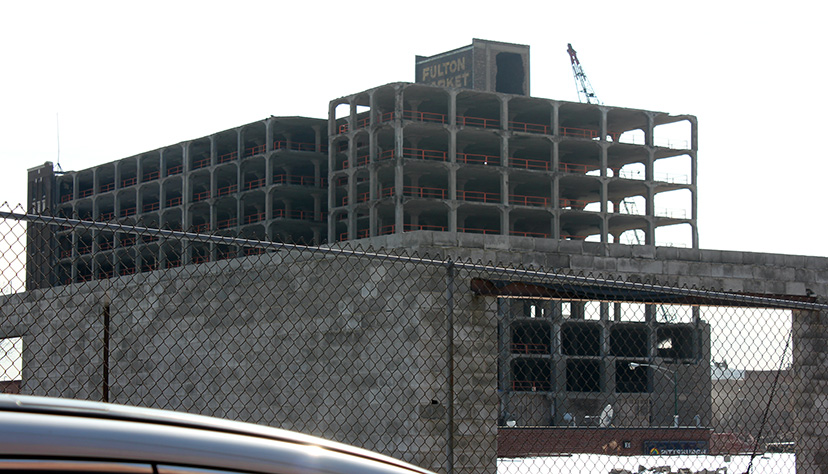
After defrosting decades of accumulated ice within the cold storage warehouse's interior, the original facades were demolished as the building was stripped to its concrete skeleton . . .
. . . and a completely new annex builing was constructed to the south. Last Saturday, the new facade was almost completely on the original Fulton Cold Storage, looking not dissimilar to the old, except that the original brick was now half-brick fused into a precast-panels.
The old terra-cotta ornament was replicated in a special concrete mix molded into the new panels.
The south wall of the old building has no middle piers, but is instead a continuous glass curtain wall, giving a clear view into the interior and the columns of the original structure, and mirroring the glass walls of the new annex building just to the south. (Inexplicably terminated on the ground floor with incongruous, Prairie-style brick piers.)
When over 500 Google employees will move to 1K Fulton next year, it will mark a tipping point of what is now a booming and rapidly changing Fulton Market District. In June, the Commission on Chicago Landmarks passed a proposal to make many of the approximately 125 buildings in the area a protected historic district, a move that is being fought by the district's long-term landowners, who appear torn between seeking to continue their businesses amidst a district in which they are increasingly outliers, and wanting to make sure no landmark restrictions lower the price they will get if a developer wants to knock down their building for another high-rise.
click for larger view
In July, the Chicago Plan Commission approved the Fulton Market Innovation District plan, designed to provide guidelines for ongoing development that preserves the area's historic elements within the high-tech Boom Town that is also “the city's last remaining market district.”
Crain's Real Estate Daily reported last week that Google is consolidating its Chicago office space, much of it at a Perkins+Will building at 20 West Kinzie, into 1KFulton (will the move come with renaming rights?), the former Fulton Cold Storage warehouse that has been stripped down to its bare bones awaiting the new facades of a Hartshorne Plunkard-designed retrofit. The developer, Sterling Bay, is proving itself one of the most adapt practitioners in Chicago right now, with the Google catch coming off Sterling Bay doubling its investment in little more than a year at 400 South Jefferson, the former lithographers loft building in the West Loop that, like Fulton Cold Storage, was stripped to its concrete frame and given new, more open facades as the headquarters of Hillshire Brands, the Sara Lee spin-off that returned to Chicago after a decades-long sojourn in the suburbs.
1K Fulton (Work. Eat. Chill. says their website) is the centerpiece of a rapidly gentrifying neighborhood marked by former lofts converted to residential and boutique hotels, and former industrial buildings to upscale restaurants, shops, and art galleries. Which, in turn, will eventually be replaced by Gap stores and Starbucks when the transition fully matures.
As you can see in the photos at the top of this post, the last vestige of 1KFulton's historic identity - the huge sign on the tower - has now been stripped away along with the brick on which it was painted. The Google move could be a game-changer, making Fulton Market a high-tech hub. Is it only a matter of time before the last meat packing, fish mongering and food processing businesses are completely crowded out and effaced from the district that they gave its name? In an increasingly virtual world, the actual retreats.
Is this the tipping point? Will its name soon be the only thing left of the blood and grit of an historic bare-knuckles district of the kind that cities once depended upon to sustain their more elegant veneers?
As far back as 2006, the New York Times travel section was touting Chicago's Fulton Market district for its side-by-side clash of meat packers and butter and egg firms that had been there for years with newcomer art galleries and trendy restaurants. For as long as anyone could remember - since 1920, to be exact - the neighborhood's iconic visual marker was the 12-story tall Fulton Market Cold Storage Warehouse.
The massive building was created by three owners of the 757-room Sherman House Hotel of 1911, which long dominated the block at Clark and Randolph that's now the site of the Thompson Center. On a full-block site in the Fulton Market district, architect/engineers Gardner and Lindberg designed a $1,250,000 reinforced-concrete structure with soaring, windowless walls trimmed with terra-cotta ornament. Three different rail lines passed just a block away, with one rail running directly to the warehouse's receiving area. The facility . . .
was opened in a most auspicious manner Tuesday, October 19. A large
representation of the trade with numerous other friends of the company
attended and were hospitably entertained at a buffet lunch following
which parties were made up and conducted by officials through the
spacious building.
It was originally intended to be just the first part of a $4,500,000 project that would ultimately encompass 10.5 million cubic feet and 888 tons of refrigerating capacity. That never happened. A lower, smaller building was eventually constructed to fill out the block, but Fulton Cold Storage's status as the center of the neighborhood remained unchallenged. According to historian Emily Lambert, “Almost everyone on the street brought product there and stored it when their coolers were full.”
And so, the great behemoth, with its name visible for blocks from the two-story tower at the top, stared down impassive and unmoved as one successive generation after another came, and then went. Until 2011. It was then that the building's owner Amit Hasak saw the writing on the refrigerated wall, and moved his cold storage operations to a more efficient single-story facility in Lyons, selling the Fulton Warehouse to Sterling Bay, a company that was then making a name for itself by stripping off the facades of the streamlined former lithography company building at 400 South Jefferson, down to the bare concrete skeleton, and rehabbing and reclading the structure as a new home for Hillshire Brands, the company split off from Sara Lee that was relocating from the suburbs to downtown.
400 South Jefferson
It was a critical and financial triumph for Sterling Bay, which bought 400 South Jefferson for $10 million, spent $50 million on the rehab, and then put it on the market for $100 million - all within little more than a year. Now Sterling Bay is repeating the process at a far bigger scale, converting Fulton Market Cold Storage to 1K Fulton (a play on the 1000 West Fulton address), “a state-of-the-art LEED certified office and retail building . . . The 10-story building will be annexed by a new six-story structure, creating flexible floor plates ranging from 38,500 to 71,000 square feet.” Column centers are 21 feet, with 12-foot-high ceilings on the top eight floors, and 14 feet on the first and second. Hartshorne Plunkard Architecture are the designers. Delivery date: 2Q2014.
To start, great timeless cocoons of ice had to be melted down and drained away. (You can see more remarkable photos of the process on the Perkins+Will blog here.) Then the crews from Heneghen (We Make Space) Wrecking rolled in to smash away those long-serving battlement-like walls, stripping the building, at least temporarily, down to pure structure.
It's an incredible sight. I'd strongly recommend you get down there to see it before it's covered up again, because, at least on two sides, the new facades, although practical, appear, at least at first glance, not especially inspired.
rendering: Sterling Bay Company
If you look at the rendering above, the two-story tower has completely disappeared. On the 1K Fulton website, however, there's a page promoting ‘signage opportunities’ on a rather pathetic, generic-looking stub perched on the roofline. A bit more exciting is this rendering of the west side of the old warehouse . . .
rendering: Sterling Bay Company
. . . encased entirely in glass, linked to the new annex building on what is now the undeveloped half of the block. If the execution follows the rendering, this transparent wall takes on the appearance of a reliquary putting the whole of the concrete skeleton's perfect geometry on permanent public display. What was once a hidden-away workflow of frozen carcasses in temporary repose dissolves into an epic street theater canvass of warm restless bodies, swaddled in the cells of a seemingly infinite grid of open loft space, bees within a high-tech honeycomb.