Showing posts with label Humboldt Park. Show all posts

Thursday, November 21, 2013

Ronan's Stackables: Erie Elementary Charter School's new addition

click images for larger view
Last Thursday marked the neighborhood open house for a new addition to the Erie Elementary Charter School designed by John Ronan Architects.  The school was founded in 2005 as part of former Chicago Mayor Richard M. Daley's Renaissance 2010 project to create 100  new schools.  It's run by the Erie Neighborhood House, a social service agency founded in 1870 to serve what was then the neighborhood's Ukrainian immigrant community.

Erie Elementary Charter opened in 2005 with 80 students in the century-old St. Mark's school building, about half a mile to the south.  In 2010, it moved to its present location at 1405 North Washtenaw.  That building dates back to 1960, when, with 21 classrooms and a 1,000 student capacity, it was constructed as a school for St. Fidelis Church across the street, which had been serving Humboldt Park's blue collar Polish Catholics since its opening in 1926.  In 1960's, the neighborhood began its transition to a Latino community.  Attendance declined, and after structural issues arose with the church building, it was demolished in 1968.  It's still a parking lot today.  Mass was moved to the cafeteria of the school, until  church and school were closed in 2006 and merged with St. Aloysius Parish.
image: Google Earth
An apartment building on the corner site just south of the school was demolished to make way for Erie Elementary's new 16,000 square-foot addition, built with $12 million of funding from the Illinois Jobs Now! program.  Ground was broken in April of last year, and construction completed in about a year and a half.  Ronan's new building packs a lot of program into a constrained site, and is expected to help support an increase in the school's capacity to 400 students. from Kindergarten to 8th grade.

St. Fidelis Elementary brought a bracing contrast of International Style modernism to its Humboldt Park neighborhood.  Fifty years later, it hasn't had much influence on the neighborhood.  Here and there, you'll new construction in a modern idiom . . .
 . . . but the historic traditionally-styled architecture has proven both resilient and inviting, especially when it's rehabbed and spruced up with a new coat of paint. . .
Now Ronan's more contemporary kind of contrast has nestled its way into this historic working-class community.  In the words of the architects, the exterior's pre-cast concrete panels, with a ground and polished finish, are “stacked like blocks to lend a playful character to this elementary school addition in Chicago that responds to the owner’s modest budget, . . . transforms an otherwise commonplace building component, and offers the institution a simple yet noble character.”
The carefully considered geometrics extend even to the alley entrance . . .
The playfulness of those “stacked blocks” also manage to play fast and loose with what the exterior seems to represent.  It reads as a double-height ground floor, topped by second and third floors and a cornice.
In the interior layout, however, the only double-height component of the ground floor is the reception area . . .
Image courtesy of John Ronan Architects
. . . surrounded by two floors of spaces.  On the first floor, there's a computer lab and an adult education/ large conference room.  On the second floor, a library . . .
Image courtesy of John Ronan Architects
. . . after school lounge, play and conference rooms.  What reads on outside as the second and third floors is, in fact, a double-height gymnasium . . .
Image courtesy of John Ronan Architects
. . . with a rooftop play area at the fourth level . . .
As you can see in these illustrations, one of the great things about Ronan's addition is the way those supersized-windows and rooftop openings bring the historic architecture of the surrounding neighborhood into the very contemporary interiors.  Outside and in, abstracted modern meets ornament-rich tradition to create a bracing, contrapuntal urban fabric interweaving the physical expression of successive moments in time.

Sunday, November 14, 2010

$9.9 million pays your Dewes, lets you get your Gründerzeit on

click images for larger view
When last I encounterd the 1896 Francis J. Dewes mansion at 503 West Wrightwood in 2007, the caryatids  bearing the ornate balcony above the entrance had been mummified in a protective plastic wrap, part of an exhaustive restoration by developer Fred Latsko, which included the cleaning and releading of the house's art glass by the Chris Botti studio.

Latsko took over the property via foreclosure about seven years ago, and combined the apartments into which it had split up into a single residence that he made his home.  One of Rod Blagojevich's last acts as governor was to erase Latsko's 1985 conviction for credit card theft, for which he had already received a pardon by then-governor James Thompson in 1985.  Latsko was behind a failed $15 million deal to acquire the Three Arts Club for conversion into condo's or a boutique hotel.  More recently, he bounced checks totaling $884,000 to City Hall covering development fees for the new Barney's store his firm built on Oak street. The checks were finally paid over two years later. Last month, the Irish bank that had financed the Barney's construction filed a  $93-million foreclosure suit.

Things do not appear to be going well for Latsko, who is reportedly also in the middle of divorce proceedings. In Sunday's edition, the Chicago Tribune has a story that Latsko is putting the almost 10,000-square-foot Dewes mansion up for sale.  Using a well-established marketing strategy, he's pricing it at $9.9 million. (See, if it were $10 million, you'd probably think it was expensive.)
The mansion was designed by architects Adolph Cudell and Arthur Hercz in what has been called the Gründerzeit style, which  became popular in Germany when unification and the victory over France in 1871 created an economic boom in which the expanded ranks of the wealthy aggrandized themselves with neo-renaissance and baroque architecture.  Although both on the National Register and a designated Chicago landmark, the AIA Guide refers to it as a confused "German confection" and Gene Shalit once sniffed, "this Dewes is a don't."

Francis J. Dewes, for whom the house was constructed in 1896, was born in Prussia in 1845, son of a brewer.  At 20, he emigrated to Chicago, where the massive German population made beer a big business.  He began as a bookkeeper at one brewer, and pushed himself up into positions of increasing responsibility.  Within just seventeen years he opened his own firm, F.J. Dewes Brewery, which eventually became the Standard Brewery company,

In 1909, as President of Standard Brewery, Dewes was found guilty of patent infringement  for using "infringing corks" not made by the manufacturer and creator of 1892 Crown Cork System of Bottling, "a system which has completely revolutionized the art of bottling," producing 2.5 billion corks in 1907 alone.  Co-defendant Max Greenberg . . .
carrying on business under the assumed name 'Spanish-American Cork Company' is . . . supplying imitation sealing devices . . . being exact counterfeits of the complaintant's . . . When called to his attention, Mr. Dewes gave assurance that it would stop; but further supplies of the infringing corks were soon after obtained and used. 
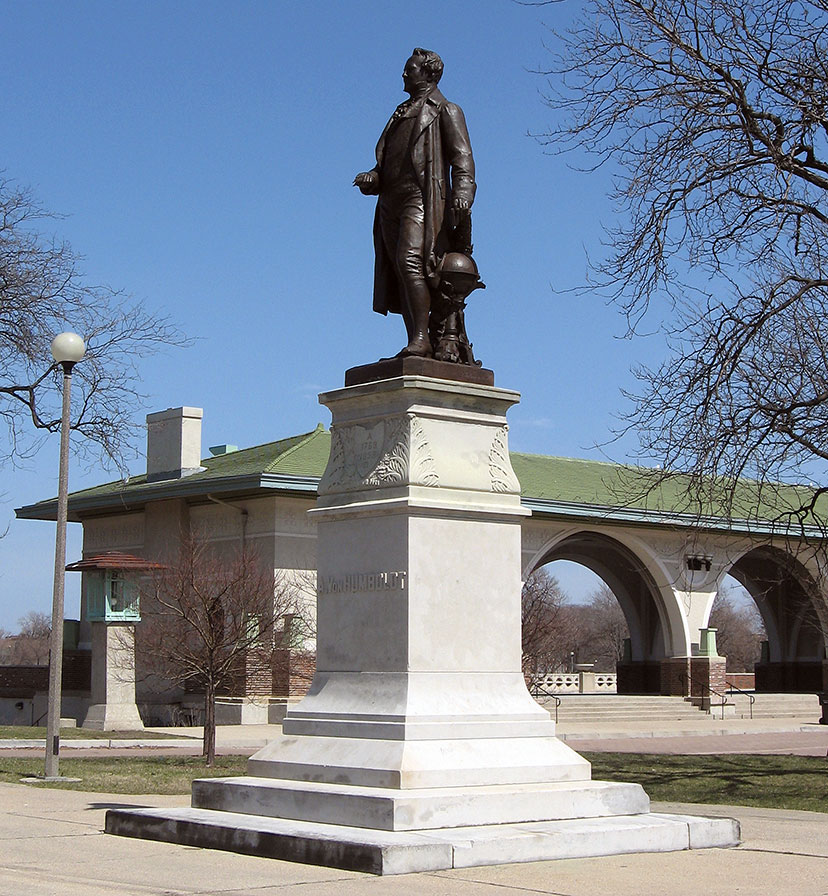
One profile of Dewes noted that "In the affairs of the German-American citizens of Chicago and the welfare of newcomers from the Fatherland he has always been conspicuous."  He funded the Dewes Lectureship in the History of German Civilization at the University of Chicago, as well as the statue of the German naturalist and geographer Alexander Von Humboldt found in the Chicago park named after him.

Dewes sold the house in 1921 to the Swedish Engineers Society, which kept it into the 1970's.  He died on December 21st, 1922. leaving behind an estate in excess of $1 million, which today would barely buy him a butler's pantry in his former abode.

Tuesday, September 21, 2010

Jens Jensen vs Michael van Valkenburgh: Park Designer Deathmatch! September 29th.

On one level, it's not really a fair fight, since Jens Jensen, though he lived to 91, has actually been been dead since 1951, but Jensen's legacy and idea's remain very much alive, so why not put them up against those of one of the today's most prominent park designers?
click images for larger view
This Thursday, September 23rd,  there will be a 7:00 p.m. screening of a new documentary, Jens Jensen: Harmonious World, at the Garfield Park Conservatory, 300 North Central Park.

Jensen was actually born September 13th in dat ole Dybbøl, Denmark, coming to the United States in 1884, but at 6:00 p.m., on Wednesday, September 29th, there'll be a 150th birthday blowout at the Jensen-designed Humboldt Park Boathouse, 1359 N. Sacramento.  Park District Historian Julia S. Bachrach will lecture on Humboldt Park: Jens Jensen's Living Laboratory, and BauerLatoza prinicipal and Commission on Chicago Landmarks member Edward Torrez will talk on The Boathouse Then and Now, and his firm's Driehaus-award-winning 2002 restoration.
Meanwhile, across town the same evening, also at 6:00 p.m., Michael Van Valkenburgh, who has been chosen to design the renovation of North Grant Park, will kick off the IIT College of Architecture's fall lecture series by discussing Recent Parks and Projects in the Public Realm.

It would have been great to hear these two men square off against each other - where's Dr. Brown's DeLorean when you need it?  - but unless you're able to teleport yourself, you're going to have to chose just one.  Both events are free and open to the public

And a reminder that this Saturday, September 25th is  Preservation Chicago's fall benefit at the spectacularly restored Sears Power House, now Charles H. Shaw Technology Center, including a silent auction for such goodies as 5 days/4 nights at a luxury Californian Tower Home, Power House Photos by Darris Lee Harris, Laura Lombardi Jewelry, and an original negative of a Richard Nickel photo of ornament from Louis Sullivan's Carson Pirie Scott building.

These events are among two dozen still to come in the last nine days of this month.  Check out all the details in the September Calendar of Chicago architectural events.