|
| click images for larger view |
Now another battle over Grant Park has erupted, with most of the same forces that rallied against the Children's Museum re-assembling to oppose another proposed new structure. This time, however, I seem to be finding myself on the opposite side. I want to explain why, and to put forward why I think this is a very different case from the one we faced back in 2007. I'll begin with a summary of the story so far, but if you want to skip right to my arguments, click here.
The Chicago Lucas Museum: whirlwind and backlash
A long time ago in a lost world far, far away, I remember my first encounter with Star Wars. It was at the premiere at the late, lamented Esquire in the Gold Coast, where George Lucas's Wagnerian sci-fi drama, with its John Barry production design oscillating between oppressively sleek and heroically derelict, played out within the high style of the Esquire's ocean-liner Art Deco elegance.
Although initial expectations were low, Star Wars became an immediate box-office sensation, and created the foundation both for the what would become the most successful movie franchise of all time, and for one of America's great personal fortunes.
Director/Producer/Industrial Light and Magician George Lucas is said to be worth $5 billion, and lately he's been struggling to find someone who will accept a large chunk of that wealth to create the Lucas Museum of Narrative Art - a/k/a the “Star Wars” museum. Lucas has just gone through a bruising four-year negotiation with the Presidio Trust in San Francisco to construct the museum in his home state, only to have the Trust rescind its offer of a site within the historic military base that became a public park in 1994.
Then on the last Wednesday in June, Sun-Times columnist Michael Sneed revealed that, after a whirlwind courtship by Mayor Rahm Emanuel, Lucas had committed at least $700 building to realize his vision in Chicago.

Over at The Reader, Ben Joravsky declares Chicago Doesn't Have to Rubber-Stamp the Lucas Museum, with Deanna Issacs adding The Lucas museum brings a vanity project to the lakefront. (The Reader demonstrated their commitment to reasoned debate by acompanying Isaac's piece with a Paul John Higgins image of a miniature Death Star looking to be at least 50 million square feet and 60 stories tall not on the Lucas site, but plopped into Lake Michigan like a decaying metallic sea slug.)
Long-time Emanuel political opponents from John Kass to Bob Fioretti see the museum as another club with which to hammer the mayor. Friends of the Parks has announced its opposition to the project, and has threatened to challenge it in court as a violation of the city's Lakefront Protection Ordinance. (It should be noted that the phrase frequently cited by museum opponents, “in no instance will further private development be permitted east of Lake Shore Drive” doesn't seem to appear in the actual Ordinance, but in a set of 14 administrative policy criteria. It should also be mentioned that, until 1994, the northbound lanes of Lake Shore Drive were east of both Soldier Field and the parking lot intended for the Lucas museum.)
Crain's Chicago Business political analyst Greg Hinz (or at least his headline writer) has painted the opposition as “Elitists on parade”, but that's too easy, a favorite trick of demagogue politicians such as Richard M. Daley, falsely mis-characterizing the apathy of the broad public as support while dismissing the activity of the inevitably far smaller number who care enough to get involved as suspect and invalid.
The Issues
No, the questions raised by the critics of Lucas Museum deserve answers. Is it legal? Shouldn't we fight for every opportunity to keep the lakefront open and clear? Is it nothing more than a vanity project? Is Rahm pulling another fast one in favor of West Coast campaign contributors who have anointed him Mayor Hollywood, Chicago chapter?
I'll let the courts handle questions of legality, but as to the the other questions, I believe the answers lead to seeing the Lucas Museum as, potentially, a very positive thing for Chicago. Let me explain why.
1. The Site
Chicago patron saint Daniel Burnham fought, with public opinion on his side, to construct the new Field Museum at Congress Street. He wanted to load up Grant Park with large and imposing Beaux Arts structures, lots of them. But when Montgomery Ward won his court battle to keep the park free of new buildings, the museum took advantage of the Illinois Central Railroad looking to unload some unused railyards south of Roosevelt to move the Field's location to what would come to be known, with the addition of the Shedd Aquarium and Adler Planetarium, as the Museum Campus.

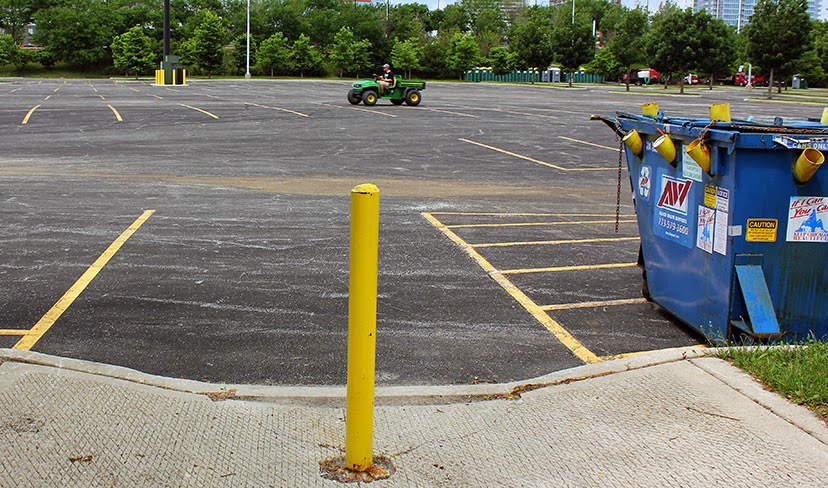
The Lucas Museum's contested territory is the 17 acres that's left, about three blocks between Soldier Field and McCormick Place. Take the time to look at it, and you'll see not an undiscovered jewel waiting to blossom, but a dangling participle of a space in search of a subject. Rahm should be given some credit in actually foisting this problem child off on Lucas.
 |
| click for larger view |


The parking lot has been there as long as I can remember. There's never been a viable proposal to get rid of it. And now we're arguing it's better to keep it here indefinitely rather than to take up a moneybag
II The Museum
The Lucas Museum is being slammed as a “vanity project,” an overblown shrine housing a substance-free assembly of kitschy personal memorabilia dedicated to a rich guy's ego. Truth be told, even with a nearly 300 page brief Lucas issued in support of the San Francisco version of the museum, details of exactly what makes up those 500k+ items claimed by the collection remain very sketchy.
 |
| John Tenniel, Alice with the White Rabbit for Alice's Adventures in Wonderland courtesy the George Lucas collection |
We know that it includes 35,000 books and periodicals, some going back to the 1800's. We know that it includes works from figurative artists like Maxwell Parrish, N.C. Wyeth, and even Norman “What, Me Worry?” Mingo. (You can see the official sampling of - count-em! - 17 images from the collection here.) We know that the museum's collection of the works of
Norman Rockwell contributed to a popular, extensively reviewed
exhibition, Telling Stores: Normal Rockwell form the Collections of George Lucas and Steven Spielberg.
We know that the collection fed exhibitions such as Star Wars: Where Science Meets Imagination, which had successful runs at 18 different museums, including the Museum of Science and Industry in Chicago. And we know that Lucas has excelled at creating exactly the kind of exhibition -whether it be Star Wars, Jurassic Park, the Muppets, Mickey Mouse or Jackie O's couture - on which, for better or worse, mainstream cultural institutions have become increasingly dependent for bringing visitors through their doors. If it's good enough for the MSI, good enough for the Field, why shouldn't it be good enough for us?
The museum's San Francisco pitch book includes this mission statement . . .
Exhibition and programming content will be diverse and dynamic and will: explore the history of American visual media and related topics and trends; investigate the cultural, creative and social significance of visual media in our world; educate about past and emerging technologies used in visual storytelling mediums; entertain art and film lovers of all ages; and inspire creativity and a great appreciation for the art of storytelling in our society.Could this be just a smoke-and-mirrors enticement to get the wolf into the door? Perhaps. But I'm intrigued by the uniqueness of the concept. There are science museums, and fine arts museums, and history museums. Why not a museum dedicated to storytelling, perhaps the most seminal aspect of human behavior? Sure, there's sex, but even there, doesn't it often get even better in the retelling? Forget movies and TV. What is Facebook and Twitter but places where we create posts telling stories about ourselves in text and pictures? And ultimately, what is architecture but an exercise in story-telling through structure. Just this week, Anna Bergren Miller has an interview on the Architect's Newspaper blog with Jahn's Francisco Gonzalez-Pulido about how “contemporary facade design neglects one of the building envelope's foremost responsibilities: storytelling.”
Personally, I've always found deeper meaning in the disturbing parables spun by Hitchcock's Vertigo than in anything I encountered in the George Lucas epics, but there's no denying that the myth-making of the Star Wars saga has resonated - and deeply - with a far larger global audience. Why is that not important?
Lucas may not currently have his ducks all in a row, but it strikes me that the subject of storytelling is more than deserving of its own museum. Just because it starts with a self-congratulatory saga of the storytelling in Star Wars doesn't mean it has to end there. With a reported $300 million endowment, the scope of the mission has the potential to blossom in important and compelling ways.
III The Architecture

In a city where even Mayor Rahm Emanuel extols its architectural virtuosity as a global calling card, something more is required.
The San Francisco iteration of the museum design included a plan by landscape architect Cheryl Barton that drew on a thorough study of native plants and flowers. A Chicago museum deserves the same level of research and imagination.

UPDATE: Shortly after this post ran, the museum announced that the museum would be designed by architect Ma Yasong, working in collaboration with Jeanne Gang Studio/Gang on site development. The renderings released of the design evoked still another firestorm of opposition to the museum's existence. You can see al the renderings on the museum's website here.
IV Trust But Verify
Opponents to the Lucas Museum have stressed that, contrary to our usual Chicago political process, we do not - and should not - rubber stamp this project. Although I support the museum, there are questions that should be answered before any final approval is given.
1. Where's the Check? Lucas has pledged somewhere between $700 million to - in some reports - a cool billion for his museum. Before we move forward, we need concrete documentation that the assets required to make his dream a reality are placed under the control of the museum.
2. Where are the Plans? As I mentioned before, a 289 page report was created to sell San Francisco on signing off on the museum. Chicago got a one-paragraph press release. Not enough. Not by a long shot. Although many of those pages were padding, the San Francisco document gives a very detailed account of the plans for the museum, its objectives its governance, its building and grounds. In Chicago, the plan seems securely locked in Rahm's brain. If no one knows the details, there's nothing to hang objections on, right? With $700 million in the budget, it's not unreasonable to expect the Lucas Museum to treat Chicago with the same respect it gave to San Francisco, come out from behind Rahm's coattails, and provide us with a detailed and specific public report of its intentions.
3. Where's the Architect? Chicago could do worse than the design Kahl came up with for San Francisco. We often have, but we always wind up hating ourselves in the morning. There's really only two choices:
a. continue to sully our reputation with another pathetic historical pastiche
or
b. man/woman up to our pretense of still being a city of global architectural importance and enlist our internationally-renowned talent to create a building and park of a level of innovation and boldness that will remind the world that Chicago still has it.
From the San Francisco building design and the scope of his collection, I get the impression that, as bold as he is as a filmmaker, Lucas' personal taste is almost Huntington Hartford-like, veering towards the conventional and conservative, but I'm fairly certain Chicago's great architects, as eloquent as they are talented, can bring him around.
4. Where's the Curatorial Firepower? Up until now, Lucas' various touring exhibitions appear to have been under the direction of in-house curator Laela French, who has done a very capable job. That's fine for a “Star Wars” museum, but if Lucas is serious about moving beyond that to creating a “Museum of Narrative Art” - and we should hold him to that pledge - something more is required. Before the museum is approved, we should expect the naming of an internationally-credentialed curator and staff of long and varied experience who can deliver the kind of fresh and innovative programming that will lead the museum to scholarly respectability and make good on its ambitious mission.
5. Where's the Accessibility? Right now, the Metra/Lake Shore Drive gulch cuts off the Lakefront all the way from Roosevelt Road (12th Street) to 31st street. The only pedestrian passages to the lake are walking through the McCormick Place complex, or taking an 18th street overpass that seems more about crowd control than efficient access, zig-zagging more than four blocks out of the way just to get across the Metra tracks. A new, direct bridge, at 18th or Cullerton, needs to be a part of the museum's design.
Conclusion
So what do we have to lose? An asphalt parking lot on a second-rate site, with zero views of the lake. What do stand to gain? Over 10 acres of new parkland and increased access to the lakefront promenade. If it' s done right, maybe a great new building. A popular and fun museum that will make Chicago a shrine to millions of Star Wars fans that, if we're determined - and a little lucky - evolves to realize its potential of becoming a important cultural institution with a truly unique focus.
There's a line between discernment and snobbery, and I fear that in the case of the Lucas Museum, Chicago's tastemakers are at risk of drowning in their own condescension. Can we take the discussion off auto-pilot and, rather than simply regurgitate the comfortable, accustomed arguments, look and discuss the project and its site with fresh eyes and open minds?