Showing posts with label Robie House. Show all posts

Saturday, June 08, 2013

Retro Saturday: Happy 146th Birthday, Frank Lloyd Wright! A Miscellany Portrait of the Reprobate ‘World's Greatest Architect’

click images for larger view

“I.K”, [Frank Lloyd Wright] said with almost no prelude. “I.K, I have been conventional too long! I am a genius, I know no conventions, a genius knows no law. A genius must and will live his own life. From today I cast aside conventions; from today I live my own life!” That was the gist of a ten or fifteen minute prattle, in which the words 'genius', 'life', 'conventions' were flung about like confetti at a carnival. At first, I thought that as usual architecture was on his mind . . . but the next day the papers carried as an item of news that our genius had 'eloped with the wife of a client.'
- from The Autobiography of Irving K. Pond: The Sons of Mary and Elihu
It's been said that Frank Lloyd Wright's greatest creation may have been himself.  Through many rocky decades, he clung to his self-image of ‘world's greatest architect’, and by the time he died at 91 in 1959, he had convinced most of the rest of us, as well.  On this day, June 8th, that would have been Wright's 146th birthday, the old scoundrel's sorcery remains as potent and inspiring as ever, so what better time than provide this highly selective, impromptu portrait from our writings down through the years . . .
The Night Frank Lloyd Wright Spent in Hennepin County Jail was a direct consequence of Wright's willful liberation from his second wife.

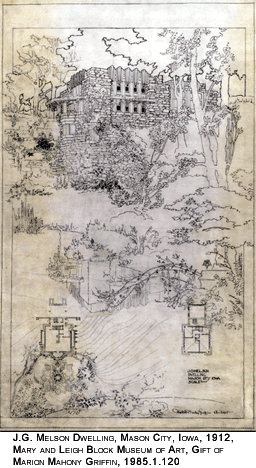
Frank Lloyd Wright and the Japanese Print - The Art Institute had a great show last fall displaying many of the Japanese prints Wright had collected early on and sold to sustain himself during the lean times.  Among the prints were some of the original spectacular Japanese-influence renderings that had helped made his work world famous, many of which came not from Wright's hand, but from that of his employee, the richly talented Marion Mahony . . .

Frank Lloyd Wright's Right-Hand Woman

Also last year, the indispensable Tim Samuelson, who currently has another great show, Modernism's Messengers: The Art of Alfonso and Margaret Iannelli, up at the Cultural Center, curated an overview of Frank Lloyd Wright's early work, centered on the time he spent as an employee of Dankmar Adler and Louis Sulivan.

Wright's Roots
 
Wrights Roots: Garrick Theater colors seen for first time in over a century
In May, a joint campaign was announced in which the Alphawood Foundation would contribute up to $10 million in matching funds towards the restoration of Wright's 1908 Unity Temple in Oak Park,, which, if successful, could also see ownership transferred from the Unitarian Universalist
congregation which originally commissioned the building to ownership by a new, endowed foundation.

Frank Lloyd Wright's Unity Temple among National Trust's 11 Most Endangered 

See Frank Lloyd Wright's Boiler!

Back in 2006, actor Peter Weller brought his own stamp to Wright in his portrayal in Richard Nelson's play at the Goodman Theatre, an interesting effort to capture Wright at his point of exile, the long, lean years between his early triumphs as his re-emergence as an architectural powerhouse in the 1930's.

Frank Lloyd Wright's Pacific Overture
Robocop channels Frank Lloyd Wright

The play also featured Harris Yulin as an alcoholic and exhausted Louis Sullivan, but when, during the play's run, a major American magazine created a list of 100 Influential Americans, Sullivan had a bit of revenge, coming in at position 59 to Wright's 76.

Koolhaas, Wright, Sullivan score in Overnights

Wright continues to be influential, as can be seen in Hyde Park, where Wright's Robie House . . .
. . . is both subtly mirrored and re imagined in Rafael Viñoly's Graduate School of Business for the U of C.
Rafael Viñoly talks Wright, new hospital, at the Logan Center for the Arts

And for dessert, a small Wrightian miscellany . . .

Frank Lloyd Wright archives won't be bleeding Art Institute Red

Frank Lloyd Wright Hits the Wall

Wright's dog house
 Let's Get Small - Frank Lloyd Wright's American System-Built Homes in Beverly
Psssst, hey - buddy!  Wanna buy the Larkin Building?


Tuesday, October 09, 2012

Rafael Viñoly talks Wright, new hospital, at the Logan Center for the Arts

click images for larger view
Architect Rafael Viñoly was at the University of Chicago last night, speaking in the Performance Hall of the new Tod Williams/Billie Tsien Reva and David Logan Center for Arts, about to open with its own Logan Launch Festival this Friday through Saturday.  (Normally, I'd link to the architect's website, but the Rafael Viñoly Architects url is currently popping up a malware alert, so here's a link to his Wikipedia entry.)

Viñoly gave a preview of the thinking behind the newly christened University of Chicago Center for Care and Discovery, a $700 million, 10-story, 1.2 million square foot facility scheduled to open early next year.  The design is based on a 31'6" x 31'6" x 18' basic module extruded out to a building that's 570 feet long, 180 feet wide, and 198 feet high.  The actual inpatient rooms are on the top three floors, just above an inset sky lobby, providing both patients and visitors views out over the rooftops of the University and, to the north, the complete Chicago skyline.

I hope to be writing a lot more about this structure as we near the opening.  (Right now I'm working on finishing up my interview/tour with Tod Williams and Billie Tsien of the Logan Center.) For the moment, we'll just give you a little bit of Viñoly talking about Frank Lloyd Wright's Robie House . . .
. . . which was brilliantly reflected in Viñoly's own design for the Booth School of Business, just across the street . . .
 Says Viñoly . . .
Architecture is the art of the specific. There’s nothing open-ended or undetermined in architecture. It’s not, as some people used to say in the early 70’s, an autonomous discipline. There couldn’t be anything less autonomous than architecture. There’s money involved, there’s uses involved, there’s science, technology, a number of things which are more exactly parallel to the kinds of instruments and use of information than to the mastery of the craft as it happens in traditional visual art.
I think that what is remarkable in Wright’s work is the fact that he wasn’t doing the Prairie Style simply as a stylistic approach. He was pursuing a research on a proportional system and overall a compositional system that wasn’t even actually invented up until that point. If you put that in context with what was happening in Europe, it’s also a completely different approach than what modernism was based on, which was in appropriating images and ideas from painting and from the traditional arts and try to create a reality, a new philosophy.
What the Robie House does is fundamentally investigate the one thing I think unifies all architecture, which is the phenomenally subtle play of proportions and scale.
Viñoly's lecture was sponsored by Frank Lloyd Wright Preservation Trust, and was an early event this this year's edition of the incredible Chicago Ideas Week.

Friday, November 19, 2010

Preservationists seek to protect Chicago Theological Seminary buildings as complex converts to a different religion

click images for larger view
The url of the new Chicago Theological Seminary Documentation website,  www.CTSthreatened.org, reflects concerns that the 1920's buildings designed by Herbert Riddle on the University of Chicago campus in Hyde Park will undergo major alterations when they are renovated as the new home for the recently formed Milton Friedman Institute for Research in EconomicsAnn Beha Architects is partnering with Gensler on the project.  The University of Chicago paid $44 million to purchase the buildings from  the 153-year--old CTS, which is constructing a new four-story, 75,000-square-foot facility, designed by Nagle, Hatray, Danker, Kagan, McKay Penney, across the Midway Plaisance at Dorchester and 60th.

According to a report on the Hyde Park-Kenwood Community Conference website,
The crux is that by pre-agreement between the University and CTS a goodly proportion of stained glass windows and some other artifacts will move to the new seminary or otherwise be taken out (future undetermined) and not used in the totally repurposed chapels. Historic areas will be respected, other parts will be redone within old masonry and some new construction for mechanicals, circulation, or a lecture hall will be created (not going outside the CTS footprint). Seminary Co-op Bookstore goes into new ample space (including reading space and a student-run cafe) in McGiffert Hall on Woodlawn. 58th Street will become more a connector, perhaps entirely pedestrian. Cost has not been determined and will not be until Beha architects are further into the design-- they have been researching and considering, including the real and size needs of the new uses. Some glass removal will start soon, full construction in 2012. the next public meeting will be after design process.
The Chicago Theological Seminary was also the entity that acquired Frank Lloyd Wright's Robie House and eventually announced their intention to tear it down "We are in the business to educate ministers, not to support a national shrine", was the comment of the seminary's business manager, as quoted in Jay Pridmore's excellent, The University of Chicago: An Architectural Tour. Robie House became the focus of one the earliest Chicago preservation battles, with Wright, himself, branding the proposed demolition a "special species of vandalism . . . a religious organization has no sense of beauty. You can't expect much from them."

The 180-foot high, 160-square-foot carillon tower was named after Chicago Daily News publisher Victor Lawson, who left the CTS $3.3 million at his death.  According to Pridmore,
The design is reminiscent of the parish church tower of Boston Stump (1520) in Esssex County, England. Closer to the ground, a graceful cloister has stones from religious sites around the world embedded in the wall. The chapel's windows are patterned after the stained glass in Chartres Cathedral.
Reports that the emptied chapel windows will be replaced by new stained glass depicting more contemporarily observant religious events, such as Milton Friedman bestowing "The Miracle of Chile" and F.A. Hayek freeing the serfs from their Social Security checks, remain unconfirmed.