Monday, October 05, 2015

Carnival of Possibilities: A Photographic Tour of the first morning of the Chicago Architecture Biennial


First of all, it's an incredible show.  The Cultural Center never looked so good.  As Margaret [McCurrey] said last night, this is a much better venue than in Venice.  I really am thrilled by the exhibition, by the energy of the catalog, the series of events that are going on and on and on for the next many weeks.  This show that emanates from Chicago is the beginning of a rebirth in a certain way of the energy that we have lost as architects in this city until now.

So said 85-year-old godfather of Chicago architecture Stanley Tigerman of the opening day of the first Chicago Architecture Biennial, a massively ambitious exhibition of the work and thought of over one hundred invited designers from more than 30 countries.  The theme of the Biennial, The State of the Art of Architecture, is actually crib of a 1977 conference organized by Tigerman as a shot-across-the-bow of the perceived icy grip of the followers of Mies van der Rohe on architectural practice and discourse.

In his generally upbeat review of the Biennial, Chicago Tribune architecture Blair Kamin called the range of work "uneven", with a "lack of thematic coherence that could have benefited from "a stronger curatorial hand."

To which I can only reply, "Praise God."  The last thing architecture in Chicago - or anywhere - needs right now is a curator's heavy thumb pre-digesting whose ideas are admissible, or straight-jacketing the anarchic world of contemporary architecture into a neat little box.

The strength of the Chicago Architecture Biennial is its catholicity.  Rightfully, co-curators Sarah Herda, Director of the Graham Foundation, and architect and author Joseph Grima did their due diligence of ensuring participants were at a high level of accomplishment, and then largely got out of the way.  Much like a Mahler Symphony is said to encompass the world, the first Chicago Architecture Biennial offers up the experience of encountering a universe of architecture, with all of its differences in outlook, technique and philosophy.  Some of it will astonish, some annoy, some appall.  But Herda and Grima attempt to give us the thing whole.  Their subset world may not be in perfect fidelity to the real thing, but it's an enthralling representation.

Over the next three months, until the Biennial's close on January 3rd, we hope to explore some of its most interesting installations in greater detail.  As an introduction, however, we're going to give you a photo portrait of our first impressions being one of the first persons to enter the exhibition shortly after its official opening at 9:00 a.m., Saturday, October 3rd.
click images for larger view
Approaching the Cultural Center from Washington Street, you find the Biennial spilling out beyond the building with John Ronan's installation, Leaf Lounge, enclosed in a six-foot hedge made up of wire-bound baskets of fallen leaves,where visitors can take a rest on the stumps of trees laid low by ash borer infestation.
You enter the lobby and confront the Cultural Center's grand stair.
It's a fall start.  Resist the temptation to climb it, as you will find the Cultural Center's showpiece Preston Bradley Hall has no exhibits.  Not knowing this, I mounted the stair, and I was taken aback to hear celestial voices rising far above me, as if from heaven.

What I found, however, was not an array of angels, but a rehearsal of the great Chicago Childrens Choir, whose offices are on the top floor.

As I made my way back down to the main floor, I heard music again, very dark, very seductive music, and began walking down the Michigan Avenue galleries to find it.
To my left, I encountered the locked doors to Bold: Alternative Scenarios for Chicago, a sub-exhibition curated by Iker Gill.  Blair didn't think much of it, but I found the entries, in turn, maddening, challenging, fascinating, and engaging.  I'll be writing more about it later.  The thing to know right off, however, is that part of the genius of Herda and Grima is how the Biennial gives lesser known architects their time in sun at the expense of big name firms that often dominate such exhibitions.  In fact, it's only in Bold that you'll see contributions from such mainstays as SOM, Krueck and Sexton, and Jahn.
Finally I found the source of the music.  Mass Studies+Hyun-Suk Seo from Korea is presenting a video, Zoom Out/Zone Out of 400 photographs of 39 built projects set to the iconic Bernard Hermann score for Hitchcock's Vertigo, with individual images of patterned details sometimes sent swirling like the rotating graphics of Saul Bass's title sequence.
You may not notice the black curtain along the right wall of this gallery.  Find it, and step inside, where you will find a number of cases filled with spiderwebs.  Tomás Saraceno invites you to contemplate the incredible constructive intricacies of the webs, "complex geometries suspended in air, each piece appears as a unique galaxy floating within an expansive infinite landscape."

From here, make your way back to the beginning, to the Randolph Street entrance, where you can rest in the foyer on the reused materials of Studio Albori's Makeshift . . .
To your left is the Biennial Bookstore, which has a generous selection of books and periodicals. (I picked up a copy of Hilberseimer's recently translated Metropolis-architecture that I didn't know existed.)  Here you can pick up Biennial T-shirts, pencils and erasers.  Most importantly, make sure you pick up a copy of the official Guidebook - nearly 180 lavishly illustrated pages - so fresh I could still smell the ink.  An essential resource and an irresistible bargain at $8.95.
Sharing the space is RAAF's The End of Sitting - Cut Out,  a sculpted alternative to the traditional seated desk (you do know standing is a much healthier way to work, right?
Returning to the foyer, you move into Randolph, Pedro and Juana's complete re-design of the Cultural Center's Randolph Square space, complete with adjustable pulleys, new lighting and stylish seating.
On either side under the stairs, an appropriate location for a crime-oriented presentation, is Studio Gang's Polis . . .
. . . showcasing the firm's usual exhaustive research in service for a highly creative reconception of the architectural presence of police in neighborhoods often beset with virulent gun violence.  We hope to be writing more about this as well.
Be prepared to encounter the occasional bridal party.  They are not an official Biennial exhibit, but a product of the Cultural Center's popularity as a wedding venue.
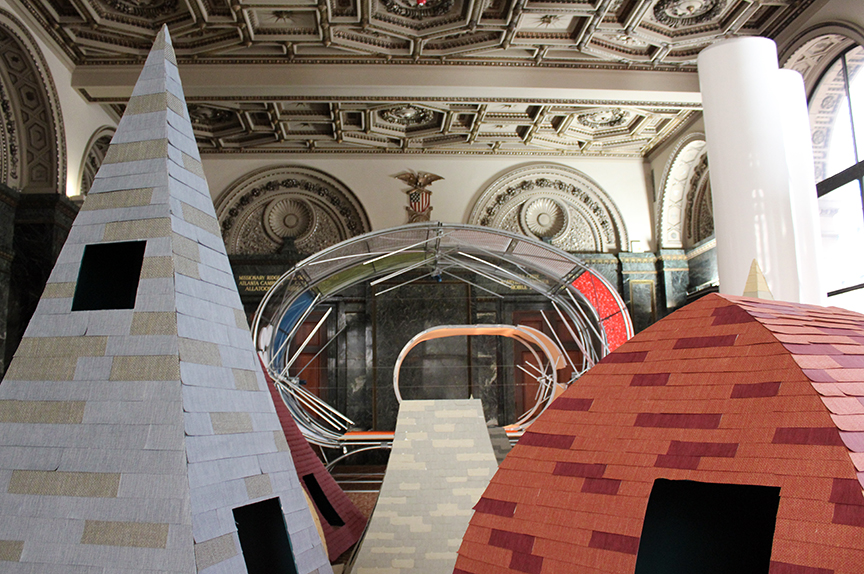
At the first landing of the stair, you encounter Atelier Bow-Wow's Piranesi Circus,  in the sealed terrarium named the Gertrude Bernstein Memorial Garden.  An intersecting assemblage of ramps, stairs, ladders, platforms and even a swing "not accessible to the general public but are rather for the use of circus performers - or for imaginary prisoners."
Again, Blair was underwhelmed by the "limp finished design", but in fact the Circus may be the visual linchpin of the entire exhibition.
Viewable at several different levels, the Circus both gives views into individual galleries and reflects their content, creating a complexity of different planes viewable at the same instant.
The constructed window wall of the second-level walkway provides an extra level of complication.
As Tigerman mentioned, the exhibit installations within the Cultural Center has turned one to be of the Biennial's greateststrengths.   Designed by Shepley, Rutan and Coolidge and completed in 1897 at a cost of $2 million as Chicago's central Public Library, the building's restored interiors are an almost overwhelming collection of grand spaces arrayed in luxury materials, richly ornamented, that includes Tiffany mosaics throughout.  They provide a brawny counterpoint to the spare, modernist character of the Biennial installations.

The G.A.R Hall along the north end of the 2nd floor was originally built as a museum and meeting space for the Grand Army of the Republic - Civic War veterans who were still very much a living presence at the time of the library's opening.  This may be the first time the hall has seemed almost stretched to capacity, with large scale installations such as Onishimaki+Hyakudayuki Architect's Children's Town . . .
The giant hanging tubes, looking like long fluorescent bulbs  of Maio's Floating: The Presence of the Present, Selegascano+Helloeverything's Casa A . .
 .
Always in the background are the views out the Cultural Center's tall windows, towards such visual landmarks as Frank Gehry's Pritzker Pavilion in Millennium Park . . . 
. . . the post-fire buildings on Randolph . . .
. . . and the stark Stone Container Building . . .  
. . . competing in its abstracted whiteness with Bureau Spectacular/Jimenez Lai's Furniture Urbanism . . . 
 The exhibition continues into the nearby Chicago Rooms . . . 
. . . where Pedro Reyes' People's United Nations: pUN was one of a number of exhibits undergoing its final fine-tuning.
Moving to the fourth floor, we find a way of turning a corner quite different from Mies's . . ..
. . . and in the massive bordello-red walled Yates Gallery, mock-ups of entire houses, with Tatiana Bilbao's Sustainable Housing, a 463 square-foot house that can be built for $8,000 on one end . . .
. . . and  MOS Architects Corridor House, built of modules that "approximate the dimensions of a standard corridors and of a sheet of plywood measure 5 x 10", on the other . . .
. . . between them a work at a mannerist inversion of scale, the miniatures of Sou Fujimoto Architects' Architecture is Everywhere, a sea of isolated stick pedestals holding everyday objects suggesting architectural structures . . .
In the hallway leading back to the foyer is Amanda Williams Color(ed) Theory, photos documenting Williams's exploration of the symbolism and power of color in repainting abandoned houses, often standing alone in abandoned landscapes throughout the city.
In the foyer, you'll encounter Fake Industries Architectural Agonism + UTS Indo-Pacific Atlas, a collage of 4,000 "that chart the intersections of media, capital flows, gentrification, and post-traumatic conditions . . . "
Underneath the top of the elegant soaring stair, in the land of the heavenly voices, you'll find Al Borde's House under Construction, which is just as the name describes.  If you want, you're supposed to be able to follow the progress on the firm's website.
So, some first impressions.  A small fraction of what there is to see and consider.   We hope you'll follow our subsequent posts, as we continue our profound contemplation both of what's inside the Cultural Center, and at the various remote sites that are also part of the Biennial.  Still better, you should check it out for yourself.  It's quite a trip.

Wednesday, September 30, 2015

Can a Boombox Activate Chicago's Orphaned Public Plazas?

click images for larger view
Two years ago, the administration of Chicago Mayor Rahm Emanuel issued a Request for Proposals for the adoption of 49 underused public places owned by the city.  The parcels are all across the city, and range in size from 41,000 down to 436 square feet, with an average of 8,600.  Some, like the Nelson Algren Memorial at Polish Triangle, are long-established public squares.  Others are little more than space underneath the concrete pillars of a raised expressway.

The response was underwhelming. According to a January, 2014 update by Trib reporter John Byrne, there were only four RFP filings - two major billboard companies, Lamar Advertising and CBS Outdoor, and boutique architecture firms Latent Design and architect Carmen Vidal-Hallet's EcoVidal Design.   City officials indicated a decision on whether any of the entrants would be selected would be made within the year.
Katherine Darnstadt (left)
Instead, it wasn't until this past April that Emanuel introduced an ordinance to create the Make Way for People public plaza program, a public/private partnership to be managed by Latent Design, the firm founded by architect Katherine Darnstadt that already has a long history of public space interventions, from a Mini golf course installed in parking spots along Milwaukee Avenue, to 2013's Blah Blah Blob!, an inhabitable, brilliantly colored fabric tent that set up shop both at Union Station and a later Activate! event next to the Chicago Theater.

Under Activate! Chicago, ten locations are to be activated during the first year, which ends next summer, including at least one for each of five geographic regions into which the city was divided. Another twenty are to be activated in the final two years of the contract.  The initial budget is a measly $50,000.  To put that into perspective, the newly redeveloped Northerly Island came in at about $2.40 a square foot. Divided among the 12.4 acres of the 49 Peoples Plaza sites, that $5,000 comes out to about 9 cents a square foot.  The cost of the new Riverwalk calculates out to $1,163 per square foot.
Last Friday, Chicago First Lady Amy Rule assisted in the ribbon cutting for Boombox, the first major public plaza program installation. ("First Friday" Activate! events also took place at Jackson and Homan and at Englewood Plaza at 63rd Street.) 
The location was Wicker Park's Mautene Court.  According to a report by DNAInfo/Chicago's Alisa Hauser the plaza at 1260 North Milwaukee was created in the 1970's in what was formerly a staging area for the garment manufacturing industry that dominated the district earlier in the 20th century.  The 175 square-foot kiosk, heated and permitted for retail and food service, was constructed out of a stripped-down shipping container.


Boombox / Between Startup and Storefront from LATENT DESIGN on Vimeo.

Darnstadt said the container . . . 
. . . came from the south side of Chicago. The company we purchased it from cut down a standard 8x20 for us and removed all four sides and then shipped it to our warehouse for construction. We constructed the Boombox about 75% in a warehouse, then disassembled it to flatbed truck [it] to the site for final install. We cleared underpasses by only an inch. Literally. The Boombox weighs about 5,000 pounds and the exterior panels are the backside of good old cheap Hardie board [a cement board siding]. The pattern is the result of the dying process. 
Opening night featured a performance by dancers from the Joffrey Ballet.  Hauser reports Darnstadt herself made use of the kiosk for her own office, with the first tenant is scheduled to be a pop-up library.  Negotiations are ongoing for a retail tenant during the holiday shopping season.
Described as a "new platform for Nomadic retail", Boombox rents for $500 a week, with lease periods of two weeks to three months.  Mautene Court should prove an attractive location, nestled next to Tocco restaurant along the trendy Milwaukee retail strip that mixes empty storefronts with hip retailers, restaurants and theaters.

Read More:

McPlazas? Privatizing Chicago's Orphan Public Spaces


Enter the Blob: Activate! Union Station

Monday, September 21, 2015

David Adjaye and a few close artist friends' offer up inspired debate over Architectural Grad Student's provocative Question

click images for larger view
 The first Chicago Architecture Biennial doesn't begin until October 3rd, but already things are already heating up with events relating to the opening last Saturday of the Art Institute's blockbuster exhibition, Making Place: The Architecture of David Adjaye.  Last Wednesday, the Tanzanian born, Britain-based architect was in conversation with exhibition curator Zoë Ryan, and on Saturday, Adjaye  and Ryan were back for a panel discussion, The Art of Architecture - David Adjaye's Collaborations with Artists. 
Other participants included Studio Museum in Harlem director Thelma Golden, artists Lorna Simpson, Chris Ofili and Chicago's own Theaster Gates, and Okwui Enwezor, director of Haus der Kunst in Munich, which co-curated the exhibition.
Lorna Simpson
It was an engaging discussion, which we hope to draw upon when we write further on this dazzling show, but for now I wanted to concentrate on what happened at the end of the main program when  a student at the University of Washington in St. Louis asked a question that immediately caused the panelists to sit up and take notice.
A rush of energy spread throughout the room and fueled deeply engaged responses from each panelist, which began with issues of race, moved on to the questions of how a young person makes their mark in an indifferent world, and ending with a a spirited exchange on the origins of creativity. I'm sure for most of my readers, this is shear TLDR, but I found the discussion fascinating enough that I'm recounting it here in my imperfect transcription.

This is the question from which it all began:

“I look around at the audience here, very different from what I experience at home in St. Louis, especially as one of the only Afro-American males in the graduate program at Washington in Art and Architecture."

“Just don't give up,” responded Adjaye.

“Well, I'm glad you say that, because that's what my question is pertaining to, everyone on stage and everyone in the audience. How could you suggest and offer information to young people to help them stay guided on the path to achieving their goals? Defying the odds, creating spaces for themselves in communities where there is no Theaster Gates, where there is no Thelma Golden to stand there and have a community of people around her to show that it's possible. I've lived in St. Louis for maybe seventeen years and it's quite detrimental to live in an environment that's so segregated. "

"What could you guys share with us to let us know that we can do this? And I'm not just speaking for myself but also for other current graduate students here in the audience."
Theaster Gates, David Adjaye,Zoë Ryan
Adjaye: You know, I think - and I congratulate you on going into a profession where you don't see role models, and you don't see other professionals. That says a lot about who you are.

"You on the stage. I can see you on the stage. I get to travel to Chicago or to New York as a graduate chancellors fellow for the university , I'm paid to be there. But I want to be at home, also. How can I help my home a cultural center for black people to know that it's OK?

Okwui Enwezor: When David and I started at the Royal College, it wasn't like a sea of black people . (laughter)

Adjaye: FYI - and there were no people on the stage either.

Enwezor: If you need to do it, do it on your own. Don't look for your posse, do you know what I mean? Just get on with it.

Adjaye: What is so important is that you are becoming or want to become someone who works in the built environment. You don't know how much of a purpose that is. Okay, I know that it's difficult when you're doing it. It's always difficult when you're at the front of a surge. Think of yourself as the tip of a spear, and kind of make an opportunity - manifest yourself in your community. Actually start to do things. I mean Theaster was not always Theaster Gates. He was a guy, just doing things.

(at this point Gates got a big laugh from panel and audience alike as he stood and mimed the transition from a stooped, close-to-the-ground early Theaster Gates to the ultimate straight-postured, fully-evolved "Theaster Gates")

He became Theaster Gates. Because he did things that people recognized. So, you know, the models are there. The models are there.
Lorna Simpson, Theaster Gates, David Adjaye
Theaster Gates: You know, also, I think there's something interesting to me between what Chris is saying and what David is saying . One part of the "get on with it" is what Black Brits told me when I came to London when I was very young, kind of talking about the challenges of being black in the United States.

I think that in a way because black Brits came to London with a kind of autonomy, the question of blackness or blackness in relationship to a white Brit, that was never really the kind of anxiety. There were other things like, I just need work. So there's a way in which black anxiety that we deal with or black trauma that not everybody has that same kind of psychological load. How do you start to shake off some of that psychological load so that you can just kind of get on with it? But shaking off that psychological load is actually the complex part and I don't know if there's anyone that can help - there might be tactics that can help you shake off the psychological load , but if you're the only . . .

I'll give the example of black girls at the Art Institute who want to talk about hair and white faculty members who don't want to talk about black hair, So if you're in those situations where . . . your autonomy isn't empowering , your autonomy is constantly being a kind of barged in upon by an oppressive force, I think that in those moments , that's where strength lives. That's where you gird up and you're like - I'm gonna talk about hair. And never neglect the potential power of your colleagues no matter who they are. In fact, there's fuel all around you waiting to help propel the work and that fuel ain't racial fuel. It's just diesel.
Chris Ofili, Thelma Golden
Thelma Golden: . . . you're sitting on the stage, and there are a whole lot of first and onlies, right? And in a certain way, exceptionalizing like that gets a little boring after a while, right?  Because you do have to get on with it. But I also think that what you understand is that when you're looking for community, and you're looking for support, for your ideals, to not think of it in a localized way.

We've been talking today about collaboration, and the professional relationships, but on this stage there is this huge personal relationships that have crossed different cities. London to New York, or to Munich, to Trinidad, back to Chicago, and finding the idea of community as not being local. Of being able to understand your vision and your aspirations in this wider group of people, who . . .  are there to support the sort of individual efforts, but also what are the mutual efforts, and the mutual ideals that we all might have.

Enwezor: I think that what is very crucial for any . . .professional, you have to begin by asking yourself what kind of contribution you want to make in your discipline. Whatever it is, it's really about your discipline.  The reason I became interested in David's work is not because he's a fellow West African. I think it's important that you begin with how do you contribute to your discipline? And at the same time, to reflect on the fact that when you ask that question, it's going to be an uphill battle.  I think it's a battle between the context and yourself . . . you have to learn most simply to be a guest, but also to be a host. And that means there's a kind of give and take in that sense.  Because if you start becoming a host, you start beginning to invent a world, an ecology of possibility.

So maybe the point is that you shouldn't really stay in your neighborhood . You should venture out, in that sense. And I think that doesn't mean that you cannot return. But I think you have to start at that possibility of uprooting yourself.  You have to imagine [that] cosmopolitan idea. Because that's how ideas travel.  That is how you enter into broader conversations, that's how you gain the benefit of really bringing your own world into the conversation.
Okwui Enwezor, Chris Ofili
Chris Ofili: I think that David's managed to find a practice that allows him to explore himself, in relation to the world, in relation to his own industry, in relation to his own possibilities. So I refuse to separate person from the work. I think it's like taking the air out a balloon and expecting it to go up.

I think that David is who he is and I think that if people chose to see that as an affliction, that's their problem.

Enwezor: That's actually not what I mean. My interest is that on the very highest level of practice, I'm interested in David's work. This other connection is also central in understanding the depth of that practice.

Chris: Well, OK, it's not an argument, but actually I feel quite strongly about it than you that in trying to understand what the work is, the root is through the person,

Enwezor: Oh, absolutely.

Chris: And I think that what we're seeing unfolding in time is a person in the form of architecture. That's my - maybe because I'm close to David - but that's what I see. That's the way I view it. I'm not saying this to you, but I think that there's a theoretical approach that can see it other ways, and separate those parts, but I can't.

Enwezor: I think it's an interesting point.  Nevertheless I don't see David's practice purely from an autobiographical lens. And I tell you what, because for me it's very interesting in the discussion about his relationship to African abstraction.  David is looking at this storehouse of references that people are not using. And he said, if people are not going to use it, I am going to use it. And of course, that has to do with his relationship to a place but that recognition is not writing an essay that is only autobiographical. It's to say there is a cultural archive, that has depth, that has incredible complexity. That you can take this cultural archive and be able to read it in a way that emerges to become a universal language.
And this is what, I believe, if you look at the building in Washington [The National Museum of African History and Culture], from this kind of naturalistic form of the Yoruban column that ends up in this abstraction of the bronze Corona, [it] is magical. And I think what I see there is not David's personality. It's his intellectual distillation of this thing happening.

Chris: Then why would you want to separate the personality from the intellect? I don't see the point. (laughter)