Showing posts with label Art Institute of Chicago. Show all posts

Friday, March 06, 2026

When a Museum Devours its Own: The Mortal Threat to Adler & Sullivan's Stock Exchange Trading Room

Eric Allix Rogers photo, courtesy Preservation Chicago

Here's the thing.  Great art museums are both amazing treasures and amoral empires.  Just ask countries like Benin, or Jewish families whose ancestor's art was looted by the Nazis.

To paraphrase George Carlin, erecting massive calling-card buildings lets museums find more space to display their ever-expanding stash of stuff.  Perhaps more importantly, they're a great way to rope in mega-donors, who gain far more lasting notoriety from having their names on a new wing than they ever could from even the most grandiloquent mausoleum.

Sometimes, however, unchecked ambition can tempt these esthetic empires into releasing their inner Mr. Hyde.  This week, Preservation Chicago announced Adler & Sullivan's Stock Exchange Trading Room as one of their Seven Most Endangered places for 2026.  Only hours later, The Art Institute of Chicago confirmed to Chicago Sun-Times architecture critic Lee Bey that they were, indeed, contemplating ridding itself of the Trading Room to make way for their wet dream of another mega-wing.

Turns out Preservation Chicago learned of this possibility a year ago, and decided not to go public with the news on the chance the museum might, by way of extended contemplation, come to its senses and let a putrid idea die a natural death.  Instead, spurred by a $75 million gift last year to jump-start a new building program, it's apparently blossomed into an idée fixe.

Put simply, this is nuts.  Suicidally, reputation-killing nuts.

First, some background: Adler & Sullivan's 1894 Stock Exchange was one of the greatest structures of the First Chicago School.  Despite that, despite being fully rented, and being the subject of an intense preservation battle, it was cleared for demolition, destroyed in 1972, and replaced by 30 N. LaSalle, a glass tower whose only distinction was that, after opening, some of its windows started popping out and crashing to the ground.  Most recently, it was used to grow vegetables.

As the bulldozers begin to circle, renowned Chicago photographer and preservationist Richard Nickel became obsessed with the keeping the memory of the building's beauty alive by salvaging as much of its striking ornament as possible.  The Trading Room was a particular revelation.

"I think it is sort of like a holy room," Nickel is quoted as saving in Richard Cahan's moving biography, They All Fall Down. "The more you are in here the more you are in awe of it."

As recounted by Cahan, when the Trading Room's drop ceiling was removed, the original design was revealed for the first time since a Depression-era modernization . . .

... with the gold-leafed column capitals, leaded art glass, and carbon filiament lamps showing, the room looked like it had when it was first built.

"Why do we just save the pieces?  Why don't we save the whole room?" Nickel asked.

His young co-worker - and, on this project, his boss - John Vinci thought the idea was insane, but soon came around.  "I was sick and tired of saving bits and pieces."

image courtesy Eric J. Nordstrom

The task was Herculean.  A double-height room, 100 by 75 feet, richly ornamented.  Intricate, beautiful wall stenciling.  Gold-leaf capitals.  Hundreds of art glass skylights.  The often damaged originals were carefully removed; the entire room meticulously notated.

For Richard Nickel, the Stock Exchange building brought him to the point of despair and exhaustion.  Then it killed him.  Early in 1972, a portion of the Trading Room collapsed and crushed him, ending his life even as it secured his legend.

The restoration and reinstallation at the Art Institute was an equally rigorous task.  As team leader John Vinci told Betty J. Blum for an oral history ...

we had to recreate everything below the drop ceiling including the baseboard and wainscot.

Recreating the stencils was especially arduous, "52 distinct hues in muted tones of gold, green and yellow."

John Vinci photograph, courtesy Eric J. Nordstrom

John Vinci photograph, courtesy Eric J. Nordstrom

In another oral history with Blum, architect Walter Netsch, who designed the building that would house the Trading Room, recalled thinking, "Wouldn't it make a great trustees' room ... I received a very recriminatory comment from Mary Block saying, 'Walter do you realize there are so many colors in that room, what can I choose to wear?'" Eventually, said Netsch, "the Art Institute was happy because they have this money-making spot to rent and show off."

image courtesy Eric J. Nordstrom

An early champion of the project, Art Institute curator David Hanks, called the original Trading Room "a work of art as important as any work at the art museum."  In 1977 the restored room was unveiled to great acclaim.  Then New Yotk Times architecture critic Paul Goldberger judged it "one of the finest interiors created before the turn of the century,"

John Vinci photograph, courtesy Eric J. Nordstrom

Back in 1894, the shimmering beauty of the Trading Room was probably visible for only a few months before unruly use and an endless procession of insensitive retrofits trashed it.  Restored and recreated, its splendor has endured, largely pristine, for just short of fifty years. The Art Institute raises the prospect of demolishing and reconstructing the Trading Room - AGAIN!!! - at some player-to-be-named-later somewhere else. Puh-leeze. The original project cost $1.5 million, back when that was real money.  Who is this Daddy Warbucks waiting in the wings to repeat the process at today's prices?

If the Commission on Chicago Landmarks is to rescue their recently compromised status as an entity promiscuously designating mediocre buildings like 30 North LaSalle just so connected developers can fleece taxpayers for massive tax breaks, they need to landmark the Trading Room, the Stock Exchange arch, and, possibly, McKinlock Court.  They need to be the antidote detoxing the Edward Hyde-like impulses two-facing the outwardly respectable alter ego of the civic jewel known as the Art Institute of Chicago. 

###


Monday, September 21, 2015

David Adjaye and a few close artist friends' offer up inspired debate over Architectural Grad Student's provocative Question

click images for larger view
 The first Chicago Architecture Biennial doesn't begin until October 3rd, but already things are already heating up with events relating to the opening last Saturday of the Art Institute's blockbuster exhibition, Making Place: The Architecture of David AdjayeLast Wednesday, the Tanzanian born, Britain-based architect was in conversation with exhibition curator Zoë Ryan, and on Saturday, Adjaye  and Ryan were back for a panel discussion, The Art of Architecture - David Adjaye's Collaborations with Artists
Other participants included Studio Museum in Harlem director Thelma Golden, artists Lorna Simpson, Chris Ofili and Chicago's own Theaster Gates, and Okwui Enwezor, director of Haus der Kunst in Munich, which co-curated the exhibition.
Lorna Simpson
It was an engaging discussion, which we hope to draw upon when we write further on this dazzling show, but for now I wanted to concentrate on what happened at the end of the main program when  a student at the University of Washington in St. Louis asked a question that immediately caused the panelists to sit up and take notice.
A rush of energy spread throughout the room and fueled deeply engaged responses from each panelist, which began with issues of race, moved on to the questions of how a young person makes their mark in an indifferent world, and ending with a a spirited exchange on the origins of creativity. I'm sure for most of my readers, this is shear TLDR, but I found the discussion fascinating enough that I'm recounting it here in my imperfect transcription.

This is the question from which it all began:

“I look around at the audience here, very different from what I experience at home in St. Louis, especially as one of the only Afro-American males in the graduate program at Washington in Art and Architecture."

“Just don't give up,” responded Adjaye.

“Well, I'm glad you say that, because that's what my question is pertaining to, everyone on stage and everyone in the audience. How could you suggest and offer information to young people to help them stay guided on the path to achieving their goals? Defying the odds, creating spaces for themselves in communities where there is no Theaster Gates, where there is no Thelma Golden to stand there and have a community of people around her to show that it's possible. I've lived in St. Louis for maybe seventeen years and it's quite detrimental to live in an environment that's so segregated. "

"What could you guys share with us to let us know that we can do this? And I'm not just speaking for myself but also for other current graduate students here in the audience."
Theaster Gates, David Adjaye,Zoë Ryan
Adjaye: You know, I think - and I congratulate you on going into a profession where you don't see role models, and you don't see other professionals. That says a lot about who you are.

"You on the stage. I can see you on the stage. I get to travel to Chicago or to New York as a graduate chancellors fellow for the university , I'm paid to be there. But I want to be at home, also. How can I help my home a cultural center for black people to know that it's OK?

Okwui Enwezor: When David and I started at the Royal College, it wasn't like a sea of black people . (laughter)

Adjaye: FYI - and there were no people on the stage either.

Enwezor: If you need to do it, do it on your own. Don't look for your posse, do you know what I mean? Just get on with it.

Adjaye: What is so important is that you are becoming or want to become someone who works in the built environment. You don't know how much of a purpose that is. Okay, I know that it's difficult when you're doing it. It's always difficult when you're at the front of a surge. Think of yourself as the tip of a spear, and kind of make an opportunity - manifest yourself in your community. Actually start to do things. I mean Theaster was not always Theaster Gates. He was a guy, just doing things.

(at this point Gates got a big laugh from panel and audience alike as he stood and mimed the transition from a stooped, close-to-the-ground early Theaster Gates to the ultimate straight-postured, fully-evolved "Theaster Gates")

He became Theaster Gates. Because he did things that people recognized. So, you know, the models are there. The models are there.
Lorna Simpson, Theaster Gates, David Adjaye
Theaster Gates: You know, also, I think there's something interesting to me between what Chris is saying and what David is saying . One part of the "get on with it" is what Black Brits told me when I came to London when I was very young, kind of talking about the challenges of being black in the United States.

I think that in a way because black Brits came to London with a kind of autonomy, the question of blackness or blackness in relationship to a white Brit, that was never really the kind of anxiety. There were other things like, I just need work. So there's a way in which black anxiety that we deal with or black trauma that not everybody has that same kind of psychological load. How do you start to shake off some of that psychological load so that you can just kind of get on with it? But shaking off that psychological load is actually the complex part and I don't know if there's anyone that can help - there might be tactics that can help you shake off the psychological load , but if you're the only . . .

I'll give the example of black girls at the Art Institute who want to talk about hair and white faculty members who don't want to talk about black hair, So if you're in those situations where . . . your autonomy isn't empowering , your autonomy is constantly being a kind of barged in upon by an oppressive force, I think that in those moments , that's where strength lives. That's where you gird up and you're like - I'm gonna talk about hair. And never neglect the potential power of your colleagues no matter who they are. In fact, there's fuel all around you waiting to help propel the work and that fuel ain't racial fuel. It's just diesel.
Chris Ofili, Thelma Golden
Thelma Golden: . . . you're sitting on the stage, and there are a whole lot of first and onlies, right? And in a certain way, exceptionalizing like that gets a little boring after a while, right?  Because you do have to get on with it. But I also think that what you understand is that when you're looking for community, and you're looking for support, for your ideals, to not think of it in a localized way.

We've been talking today about collaboration, and the professional relationships, but on this stage there is this huge personal relationships that have crossed different cities. London to New York, or to Munich, to Trinidad, back to Chicago, and finding the idea of community as not being local. Of being able to understand your vision and your aspirations in this wider group of people, who . . .  are there to support the sort of individual efforts, but also what are the mutual efforts, and the mutual ideals that we all might have.

Enwezor: I think that what is very crucial for any . . .professional, you have to begin by asking yourself what kind of contribution you want to make in your discipline. Whatever it is, it's really about your discipline.  The reason I became interested in David's work is not because he's a fellow West African. I think it's important that you begin with how do you contribute to your discipline? And at the same time, to reflect on the fact that when you ask that question, it's going to be an uphill battle.  I think it's a battle between the context and yourself . . . you have to learn most simply to be a guest, but also to be a host. And that means there's a kind of give and take in that sense.  Because if you start becoming a host, you start beginning to invent a world, an ecology of possibility.

So maybe the point is that you shouldn't really stay in your neighborhood . You should venture out, in that sense. And I think that doesn't mean that you cannot return. But I think you have to start at that possibility of uprooting yourself.  You have to imagine [that] cosmopolitan idea. Because that's how ideas travel.  That is how you enter into broader conversations, that's how you gain the benefit of really bringing your own world into the conversation.
Okwui Enwezor, Chris Ofili
Chris Ofili: I think that David's managed to find a practice that allows him to explore himself, in relation to the world, in relation to his own industry, in relation to his own possibilities. So I refuse to separate person from the work. I think it's like taking the air out a balloon and expecting it to go up.

I think that David is who he is and I think that if people chose to see that as an affliction, that's their problem.

Enwezor: That's actually not what I mean. My interest is that on the very highest level of practice, I'm interested in David's work. This other connection is also central in understanding the depth of that practice.

Chris: Well, OK, it's not an argument, but actually I feel quite strongly about it than you that in trying to understand what the work is, the root is through the person,

Enwezor: Oh, absolutely.

Chris: And I think that what we're seeing unfolding in time is a person in the form of architecture. That's my - maybe because I'm close to David - but that's what I see. That's the way I view it. I'm not saying this to you, but I think that there's a theoretical approach that can see it other ways, and separate those parts, but I can't.

Enwezor: I think it's an interesting point.  Nevertheless I don't see David's practice purely from an autobiographical lens. And I tell you what, because for me it's very interesting in the discussion about his relationship to African abstraction.  David is looking at this storehouse of references that people are not using. And he said, if people are not going to use it, I am going to use it. And of course, that has to do with his relationship to a place but that recognition is not writing an essay that is only autobiographical. It's to say there is a cultural archive, that has depth, that has incredible complexity. That you can take this cultural archive and be able to read it in a way that emerges to become a universal language.
And this is what, I believe, if you look at the building in Washington [The National Museum of African History and Culture], from this kind of naturalistic form of the Yoruban column that ends up in this abstraction of the bronze Corona, [it] is magical. And I think what I see there is not David's personality. It's his intellectual distillation of this thing happening.

Chris: Then why would you want to separate the personality from the intellect? I don't see the point. (laughter)


Sunday, July 06, 2014

Voyeur on the Roof - What was the Art Institute Thinking? And You?

Say what you will about those blockbuster exhibitions at the Art Institute, the folks behind AIC's marketing have become especially adept at finding imaginative ways to sprinkle their promotions throughout Chicago's cityscape.
click for larger view (recommended)
For Roy Lichtenstein: A Retrospective, the museum's school co-sponsored a competition that resulting in the entire upper reaches of a building along the Kennedy Expressway being transformed into a
giant mural of Chicago landmarks done up in the artist's signature Pop Art style.

For Impressionism Fashion and Modernity, entire double-decker buses were turned into canvases that drew you directly into a painting of turn-of-the-century society at play.
The Art Institute's current blockbuster is Magritte: The Mystery of the Ordinary, 1926-1938, running through October 13th.  It was drawing big crowds when I took it in on Saturday.  I recommend it if for nothing else than the experience of walking through the maze-like circuit of galleries in which it has been installed.

To promote the show, Chicago ad agency Leo Burnett has come up with an “Unthink” Magritte campaign that includes a mobile app and links the word to a host of different values in different iterations of the theme.  In addition to use usual appropriation of tour buses and trolleys, there's installations like these at the Chicago Avenue Red Line stop . . .
One variation of the theme, however, has been a little-known secret, not in intention but by design.  We're grateful to our indefatigable correspondent Bob Johnson, who uncovered the secret for us in these photos.
photograph: Bob Johnson
Can you see it?  In the right side of the photo, right next to the Metra tracks?  Let's get a little closer.
photograph: Bob Johnson
The larger part of the roof of the Art Institute's Morton Wing has been turned over to a striking Magritte seaside portrait of a seriously abstracted nude, with the inscription  “Unthink Voyeurism”.  Visible only to people in nearby tall buildings, birds, and passengers in low-flying planes, this has to be one of slyest, most surreal adverts ever.

Monday, May 12, 2014

Sea of Foam at Maggie Daley; Matt Urbanski explains it at the Art Institute Tonight

click images for larger view
When it's finished, sometime next spring, Maggie Daley Park will be something.  Everything from open meadow, to a climbing wall and skating ribbon.  You can find out all about it tonight, Monday, May 12th, at 6:30 p.m. in Fullerton Hall at the Art Institute, as Matthew Urbanski of the park's designer, Michael Van Valkenburgh Associates, talks about Chicago Parks: Landscape, Imagination, and the Livable City.
For now, however, the site is something completely different, but just as a remarkable. Looking out from the viewing platform that Frank Gehry's closed-off BP Bridge has become, you now encounter, as far as the eye can sea, a vast ocean of white, pillow-like dominoes.  These are the legos that will form the foundation for Maggie Daley's varied landscape.
They're made of of “Foam-Control EPS Geofoam” a lightweight polysystrene that will form the foundation for the varying-level landscaping.
According to a story by Tina Sfondeles in the Chicago Sun-Times, the material has already been used at Soldier Field and Daley Plaza, and it never dematerializes.  It's claimed to be waterproof, which is a big deal, as the previous park on the site Daley Bi-Centennial, including beautiful mature trees was torn up and thrown away because was water was leaking into the garage on which the park was built, necessitating everything being removed for a new sealing to be installed.
This will be the last time you can see them, the great waves of dominoes surging across the site, awaiting careful placement before they disappear before the earth.
The sea even has its own serpent coursing through it, in the person of the winding contours of the BP Bridge.
It's one of the great shows of the summer.  Enjoy it while you can.

Read More:

Valkenburgh on Daley Bi, North Grant Park (with video)
Reinventing Daley Bi

Goodbye Daley Bi; Hello Maggie Daley Park  - stripping North Grant Park bare


(Better) Performing Seals fine new home at Maggie Daley Park


Monday, January 20, 2014

Saturday, January 04, 2014

A Day At (and around) the Museum(s)

click images for larger view (highly recommended)


 Take the rest of the tour . . . after the break . . .

Monday, August 12, 2013

Refinding, Losing - and abusing- Louis Sullivan (Again) - Buildings Burn, Landmarks are Reborn, and an Essential Monograph goes Out-of-Print

Louis Sullivan - clicks images for larger view
It was supposed to be a celebratory year.  2006 was the 150th birthday anniversary of Chicago architect Louis Sullivan.  With his partner Dankmar Adler, he had created some of the most striking masterpieces of the first Chicago School.  Sullivan split with Adler after the economic crash that followed the 1893 World's Columbian Exposition, but even as his career entered a long, tragic decline, he continued to create astonishing works such as a series of small Midwestern banks, and the Krause Music store on Lincoln Avenue.
And there were a number of celebratory events, including the Chicago History Museum's Louis Sullivan at 150 website.  You could still see the restored spectacular theater of Adler and Sullivan's Auditorium Building . . .
and you could still shop at Louis Sulivan's Carson Pirie Scott . . .
But perhaps the most striking way Chicago choose to celebrate Louis Sullivan was to burn down three of his buildings in just a eleven-month span of 2006.
On January 6, Adler and Sullivan's 1890 Kehilath Anshe Ma’ariv Synagogue, which, as Thomas Dorsey's Pilgrim Baptist Church became known as the birthplace of Gospel Music, burned to the bare walls in a fire set off by a construction worker using an acetylene torch on the roof.
Then, on October 24th, a worker using an acetylene torch to take apart a boiler in the basement started another blaze that destroyed Adler and Sullivan's Wirt Dexter Building on Wabash.
The following month, one of the firm's last surviving residences, the George Harvey House, whose owner was reported to have wanted it demolished for a new condo development, burned to the ground in a suspicious middle-of-the-night fire.

Today, seven years after that trifecta of disaster, the Auditorium still stands, although its tower's backdrop is no longer the blue sky, but the blue of VOA's new dorm for Roosevelt University.
Carson Pirie Scott has almost received a major and welcome update.  Celebrating the death of the department store, Carson's shut its doors early in 2007 after over a century of doing business in Sullivan's landmark.   In 2001, Carson's had sold the building to developer Joseph Freed, and before running aground against the disaster that is Block 37, Freed had made Sullivan's building their calling card, with a $190 million investment that included Harboe Architects leading a team that restored Sullivan's intricate cast-iron ornament . . .
. . . and uncovering the ornament designing by Sullivan for an early 20th-century remodeling of 22 South Wabash . . .
Now renamed Sullivan Center, the former Carson's store has become something of a magnet for architecture and design.  It's currently the home for both Gensler Chicago and the School of the Art Institute and its Sullivan Galleries on the 7th floor.  Last year, the building was reborn as a handsome, two-level flagship for a flagship City Target, the retailer's concept for expanding beyond suburban malls into the center city.
Photographer Richard Nickel lost his life photographing another Adler and Sullivan masterpiece, the 1894 Chicago Stock Exchange Building, while it was being demolished in 1972.  The trading room, lovingly restored by John Vinci, was reconstructed at the Art Institute.  The great entrance arch was also saved and erected within a charming park at Monroe and Columbus, where you could actually walk through it . . .
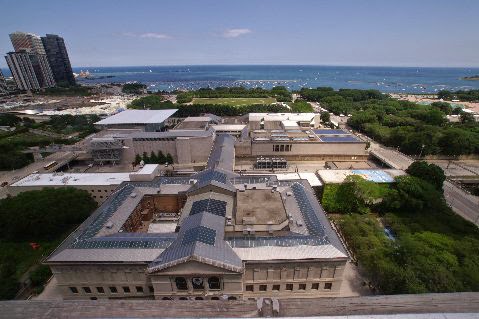
. . . until 2009, when with the construction of Renzo Piano's Modern Wing, the Stock Exchange arch was left like a garden gnome, stranded and inaccessible in the middle of a ditch-like flowerbed.
2010: The Year of Louis Sullivan

Then, four years after the official 150th birthday anniversary, four seminal events finally gave Louis Sullivan his due.
First, here was Louis Sullivan's Idea, Chicago cultural historian Tim Samuelson's masterful overview of the life and architecture of the great architect.  Designed by graphic artist Chris Ware, it made full use of the Chicago Cultural Center galleries with a a display of carbon filament lighting and supersize photos that gave you a real feel of what it must have been like to encounter the vanished buildings.  Unfortunately, Cultural Center shows don't get catalogs, so the only thing left of this great show are the memories and this eccentrically shot video . . .

At about the same time, the Art Institute of Chicago mounted Looking after Louis Sullivan, a striking collection of photographs by John Szarkowski,  Aaron Siskind and Richard Nickel.
April saw the debut of Louis Sullivan: The Struggle for American Architecture, Mark Richard Smith's labor-of-love documentary on the architects life and art.
To top it all off, in September of the year, we really hit pay dirt with the publication of The Complete Architecture of Adler and Sullivan, a landmark book that was an epic of scholarship and storytelling by Ward Miller, John Vinci and Tim Samuelson.  First the first time, there was a catalogue raisonné of every project Adler and Sullivan worked on, lavishly illustrated, including a large number of eye-opening color photographs.

Finally, the legacy of Louis Sullivan was here for everyone to see, for all time.

Well, not really.  Quite understandably, the first edition of The Complete Architecture of Adler and Sullivan sold out quickly.  It is now out-of-print.  Amazon.com lists copies from $450 to $1218.  Another dealer will sell you one for $3508.  2010 ended with the book being acquired, along with the other assets of The Richard Nickel Committee, by The Art Institute of Chicago.  There has been no second edition, and, so far, none has been announced.

Louis Sullivan: the Rodney Dangerfield of great architects.

Refinding, Losing (and abusing) Louis: