 Architect Thomas Hoepf talks about his new Waterview Tower, Northwestern University hosts a three-day seminar on green architecture, and Judith Paine McBrian celebrates Daniel Burnham - things may be shut down for the summer, but there's still over two dozen architecture-related events on the August calendar, including a full roster of dates from AIA Chicago and the Chicago Center for Green Technology. Preview the complete calendar here.
Monday, July 31, 2006
Shangri-La, Uncle Dan Burnham, and Chicago Green City among the events on August Architectural Calendar
Architect Thomas Hoepf talks about his new Waterview Tower, Northwestern University hosts a three-day seminar on green architecture, and Judith Paine McBrian celebrates Daniel Burnham - things may be shut down for the summer, but there's still over two dozen architecture-related events on the August calendar, including a full roster of dates from AIA Chicago and the Chicago Center for Green Technology. Preview the complete calendar here.

Wednesday, July 26, 2006
Chicago Streetscene - Pritzker Pavilion, Millennium Park
July 22nd, 2006
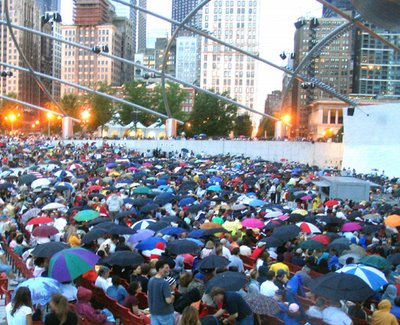
(It stopped raining for the second half of the concert, by the way.)
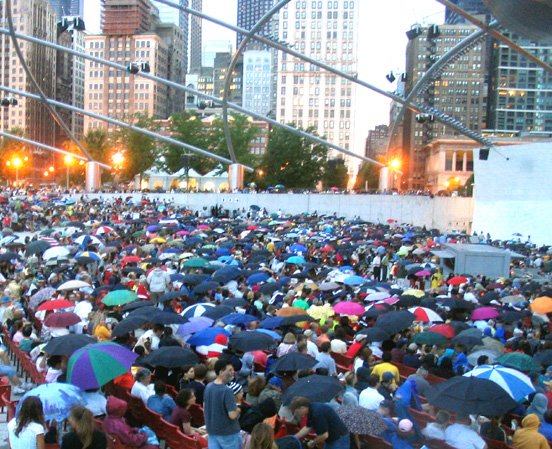
(It stopped raining for the second half of the concert, by the way.)
Monday, July 24, 2006
Blair Kamin's Boogers - and other great weekend reading
 "My Boogers Itch" may be the least likely phrase that you'd ever expect Chicago Tribune Pulitzer prize-winning architecture critic Blair Kamin to write. (But you weren't the least bit surprised to find me writing it, were you? I thought not.) Nonetheless, there it was in the lead of his fine Sunday article on city bus shelters and the latest scam to invade the city's streets - large signs engraved City Information at the top that offer up little more than another slew of billboards, including the aforementioned nasally afflicted caption for an ad for Cartoon Networks. The Tribune, being a paper of probity and reserve, declined to run a picture of the offending poster, substituting instead one featuring an artfully composed bottle on Heineken. I, on the other hand, having already established my credentials as a vulgarian, include here, for your intellectual edification, a photo of the actual billboard.
While I'd like to think that a billboard featuring a cartoon character with the blades of a blender up his nose represents a populist broadside against the high-toned pretensions of Cartier Jewelers, just a few steps away, it's more likely a product both of the way, as Kamin reports, everything is for sale in today's society (can naming rights for the mayor's shorts be far behind?), but also how, in our increasingly consolidated, globalized world, more and more decisions are based on sheer abstractions, by people - far, far away - who never come face to face with the consequences of their actions.
As Kamin reports, the city is getting $300,000,000 over 20 years for permitting the shelters to be erected. But the shelter part of the deal is merely a sideshow. The main event are the ads, because that's where the money is. The size of the ads drive the size of the shelters, and they're just too damn big. Kamin is too charitable on the actual design of the shelters, by architect Robert Stern - they're fat-boned and coffin-lidded. On the broad sidewalks of Michigan Avenue, the effect is more tolerable, but plopped down on normal-width streets like Chicago, Dearborn or Grand, the one-size-fits-all shelters (can't make the ads smaller, you know) hog the sidewalks and become a charmless obstruction to the visual flow of the street and to normal pedestrian traffic.

Another compelling read from over the weekend:
Sun-Times architecture critic Kevin Nance has an eloquent piece on Gunny Harboe's restoration of the long-lost cornice of Louis Sullivan's Carson Pirie Scott store on State Street. The blunted replacement made the building look more Corbu than Louis, but the light, flowering columns that again support the open arcade that defines the roof are the perfect complement to the rich ornament framing the shop windows at the building's base, and bring back the organic unity of Sullivan's brilliant concept. An added plus - unlike the Tribune, which still rarely runs a story's photos on the web, Nance's article includes a couple of great illustrations. (log-rolling alert: Nance also includes a gracious reference to my recent Reader article on Adler & Sullivan's Harvey House, but that's not really why I'm recommending it. I think you'll agree it's a fascinating read.)
Be sure to catch these two articles over the next few days, before they disappear into paid-archive hell.
Tuesday, July 18, 2006
The Two Brads (Lynch and Pitt) on Rebuilding New Orleans
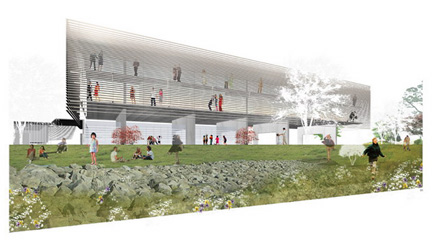 An entry from Brad Lynch of the Chicago architectural firm of Brininstool & Lynch was named Monday as one of six finalists in Global Green USA's Sustainable Design Competition for the rebuilding of New Orleans after its devestation last year by Hurricane Katrina. The competition was co-sponsored by actor and architectural activitist Brad Pitt, who also chaired a jury that included, among others, Walter Hood, Thom Mayne and Marion Weiss.
The competition's goal is to "demonstrate sustainable solutions for the redevelopment of New Orleans." Entrants were asked to submit two boards, the first for a 12-unit family housing structure with "community center features." The second was for a site plan in New Orlean's Holy Cross neighborhood near the levee and Mississippi River, including the placement of six single-family homes.
Global Green USA gets credit for putting the boards for all six finalists up on their website at the same time the first stage selections were announced. (As of today, you have to register to with an email address to see them, which also allows you to cast a vote for your favorite. There's a placeholder on the site for where a gallery of competition finalists may appear later.)
The large competition boards, however, are posted in web resolution, which makes the text and much of the details illegible, leaving us dependent on the jury's comments for descriptions of the projects. The buildings in the entry from Brad Lynch are praised as being "simple yet sensible," and the concept, itself cited for its "creative ideas about energy generation placing solar electric arrays on a barge in the adjacent Mississippi river" and for how "the design raises the living areas off the ground" in anticipation of possible future flooding. Lynch is up against national heavyweights such as Frederic Schwartz - who draws on the tradition of the areas traditional "shotgun" layout for homes, and uses solar chimneys to draw out heat via natural convection - as well as three other firms with roots in New Orleans.
Next week, a kickoff meeting for the competition's final phase will bring together the winning designers with local architects and community groups "to create a plan for selected areas in different neighborhoods of the city," including single-family housing and a community center. The final jury is scheduled for August 30th.
Monday, July 17, 2006
What Do You Give Louis Sullivan for his 150th Birthday - How About One Less Surviving Building?
 One of the few remaining buildings by Dankmar Adler and Louis Sullivan, and probably their last surviving wood-frame structure, may soon disappear. The 1888 house, designed for insurance tycoon George M. Harvey, is at 600 W. Stratford Place in Lakeview, less than a block from Lincoln Park and Lake Michigan. According to advocacy group Preservation Chicago, owner Natalie Frank recently told Alderman Helen Shiller she was about to apply for a demolition permit. Will the house be saved by being designated an official Chicago landmark, or demolished for still another stack of condo's? See all the photos and read all about what is shaping up to be a classic battle between clout and culture here.
Tuesday, July 11, 2006
And Triple Points for Requiest?
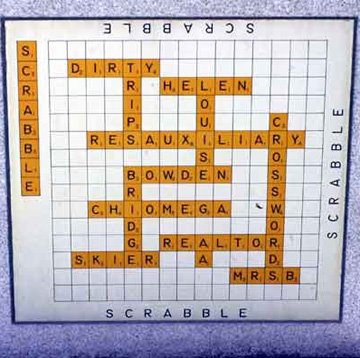 A new web site, A Grave Concern, devotes itself to the Town of Main Cemetery in Park Ridge, Illinois, chartered all the way back in 1858. Much like Graceland or Oak Woods in Chicago, cemeteries are something of a touchstone of urban history in that they tend to survive generation after generation even after everything around them is changing. Town of Main's earliest burials reflected the area's status as a center of German immigration. The website page devoted to monuments offers up several photos of the different types of markers, from benches, to boulders, to pyramids, and this rather unique headstone fashioned after a Scrabble board.
Monday, July 10, 2006
Architreasures Jewels in July
 Via the Chicago Architectural Club, here's a last-minute addition to the July calendar. This Wednesday, July 12th, Architreasures will hold a fundraiser celebrating its 10th Anniversary with its Jewels in July event at the Garfield Park Conservatory, 300 N. Central Park Avenue, from 6:00 to 10:00 P.M.
Tickets are $75.00 in advance, $100 at the door. Food, drink, and a silent auction will be featured, and the group's Gems of the Community Awards will be presented to architect Peter Landon, The Puerto Rican Cultural Center, and the Richard H. Driehaus Foundation. Architreasures brings together "architects, artists, educators and urban activists with community groups, students and neighborhood organizations" to come up with ideas for redeveloping Chicago neighborhoods. Call 773/776.1040, or Hoopla Communications at 773.486.6920 for tickets.
Thursday, July 06, 2006
Lane Bryant - Urban Menace?
Wednesday's Chicago Sun-Times carried a bizarre story by Steven Patterson on how the charming suburb of Oak Park, home to Frank Lloyd Wright and Unity Temple, has blocked plus-size retailer Lane Bryant from leasing a store in a new downtown building. Village President David Pope is quoted as saying the village wanted "a more broad-based retailer" for the site.
Putting aside the triple-entendre pun in Pope's statement - he just doesn't seem to be the kind of guy able to engage in such wordplay deliberately - the incident raises the question, "What????!!!!!" Is Lane Bryant peddling crack? Pimping its customers? Soaking its clothes in trans-fats? (For those outside Chicago, our own fair city, fresh from banning foie gras in its restaurants, is now being hectored by another headline-junkie alderman to pass an ordinance banning the use of all trans fats, as well.)
Why did Oak Park do it? Just because it can. It previously owned the property, and retains veto power over potential tenants. To have a decision actually make sense or adhere to some clearly defined standard would be too much to ask. Could this be Oak Park's strategy to win the war against obesity - ban the retailers that sell the larger sizes?
Long-departed native son Ernest Hemingway once famously remembered, “Oak Park is a neighborhood of wide lawns and narrow minds." It's comforting to see Pope and his cohorts keeping up the old traditions.
Putting aside the triple-entendre pun in Pope's statement - he just doesn't seem to be the kind of guy able to engage in such wordplay deliberately - the incident raises the question, "What????!!!!!" Is Lane Bryant peddling crack? Pimping its customers? Soaking its clothes in trans-fats? (For those outside Chicago, our own fair city, fresh from banning foie gras in its restaurants, is now being hectored by another headline-junkie alderman to pass an ordinance banning the use of all trans fats, as well.)
Why did Oak Park do it? Just because it can. It previously owned the property, and retains veto power over potential tenants. To have a decision actually make sense or adhere to some clearly defined standard would be too much to ask. Could this be Oak Park's strategy to win the war against obesity - ban the retailers that sell the larger sizes?
Long-departed native son Ernest Hemingway once famously remembered, “Oak Park is a neighborhood of wide lawns and narrow minds." It's comforting to see Pope and his cohorts keeping up the old traditions.
Wednesday, July 05, 2006
From Tragedy to Farce at Freedom Tower
 What is a Freedom Tower made of? Pure spin. Perhaps never before has a project been so encased in rhetoric, and never has that rhetoric turned out to be so feebly incapable of obscuring the bankruptcy of the ideas beneath.
Read about how this project, conceived after 9-11 with the highest optimism, is limping towards its sad, diminished conclusion.
Tuesday, July 04, 2006
Newsweek Consigns the Great Cities of the World to History's Dustbin (Or Do They?)

While last week's U.S. edition of Newsweek was content with putting Brad Pitt on its cover along with other of the 15 winners of its new "Giving Back Awards" recognizing those devoted "to helping others", the International edition focused on an exhaustive and provocative appraisal of current state of world urbanism.
It leads off with an essay by Rana Foroohar declaring that for great cities like London, Tokyo and New York, "their day is over," and that the future belongs to metropolises with less than a half-million people. (Half of today's city dwellers already reside in them.). However, there's a lot more to the issue than just the lead article, and in another piece, "The Ten Most Dynamic Cities", there, among not-yet household names like Florianopolis, Brazil and Goyang, Korea, are don't-know-they're-dead-yet Munich, Moscow, and - surprise, surprise, surprise - London. Which would seem to indicate that, despite Foroohar's proclamations, 200,000 houses and a Wal-Mart may not a civilization make.
But then, again, there's the obligatory Panglossian apologia for sprawl by the seemingly inevitable Joel Kotkin, but that, too, is balanced with another piece by Richard Florida that argues that the impetus for growth and innovation comes not from big cities or small cities, but from "New Megalopolis" type agglomerations like the Boston-Washington or Chicago-Pittsburgh corridors, that combine both. There are also a host of other articles on everything from China's Golden Cities, to Tailing the X-Commuter, profiling what is claimed to be the fastest growing category of commuters: those who spend at least 90 minutes - each way - traveling to and from work.
It's a shame that this series wasn't given similar prominence in Newsweek's U.S. edition. Do the editors believe our attention begins to drift whenever the subject is anything other than the world within our own borders? Whatever - this issue is a great piece of journalism, and it's well worth your checking out on-line.
Monday, July 03, 2006
July Events Offer Up Architectural Taste of Chicago
 July is a lot more than just Taste of Chicago. There's still a lot to do, as far as architectural events in Chicago. While a number of institutions - CAF, the Architecture and Design Society of the Art Institute, the University of Illinois at Chicago - are deep into summer hibernation, the schedule still includes Archeworks' open house, a Grant Part Advisory Council symposium on the proposed Renzo Piano bridge linking the Art Institute to Millennium Park, Friends of Downtown's session on new visions for Navy Pier, Timothy Gilfoyle talking about his new book on Millennium Park at the Newberry Library,and the Landmarks Preservation Council lunchtime lecture on Post-war suburban housing. The Chicago Center for Green Technology, and AIA, which is offering member tours of a number of architectural studios, including those of Zoka Zola, and a afternoon session with Wiss Janny Elstner on the stabilization of the walls of the fire-ravaged Pilgrim Baptist Church, are still going great guns. Fried dough is all well and good, but don't pass up the more intellectually satisfying offerings. Check it all out here.
Friday, June 30, 2006

Wednesday, June 28, 2006

Tuesday, June 27, 2006
Steven Brubaker's University Center of Lake County
 Word from architect Steven Brubaker that he is now in private practice after a long association with HOK, Inc. ,which was in the news last year for their design of the the new Wrigley Global Innovation Center along the Chicago River on Goose Island.
Brubaker's and HOK's University Center of Lake County in Grayslake this part March received the Thomas H. Madigan Award for Outstanding New Construction in Illinois from the Illinois Capital Development Board. The 90,000-square-foot facility, which serves as a Distance Learning Center for a consortium of 17 educational institutions, sited on a prairie, features two brick and concrete blocks, one housing a conference center, the other, classrooms, at either end of a winding steel and glass courtyard. According to Brubaker, the brick facings insulate against northern winds, while the central commons "opens south to the sun."
Among Brubaker's other projects is a new Technology Building for the College of Lake County, recently completed, with a satellite classroom building currently under construction. Brubaker has also recently been selected to design two new buildings for Moraine Valley College, and is teaching a second-year Master's studio at IIT.


Monday, June 26, 2006
Office in a Bucket - (Wasn't That a Song by Sting?)
 Courtesy of the Liquid Treat newsletter, here's news of the latest innovation from London's Inflate, a company dedicated to creating "inflatable structures of all scales". Office in a Bucket is just what the name implies - an inflatable nylon office, conference room or "chill out area" that comes in its own portable bucket. (Batteries not included.) Simply plug it in and watch it expand like some maniacally fast-rising dough. As if life in a cubicle wasn't tenuous enough, now your boss can literally take the wind out of your idea by simply disconnecting a power cord. Oh, and it's perfect for free range chickens, as well. Not to be outdone, The Pleasure Chest is reportedly commissioning Specialty Retailer in a Plain Paper Sack.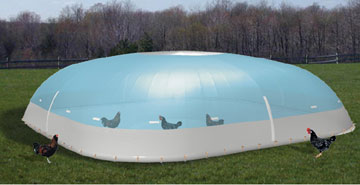
Saturday, June 24, 2006
Two great stories make TIF's and patents the stuff of high drama
As I write this early Satursday aftertoon, the sun is shining, so get out and enjoy. Weather forecasters, however, are predicting it will grow dark and rainy, and if you're forced indoors, it's as good a time as ever to take on some great reading on a couple of disturbing topics.
The TIF Scam - The Chicago Reader's Ben Joravsky has another great article on how the Chicago's burgeoning tax increment financing districts are turning into a vast, corrupt quagmire that put the patronage hiring scandals currently hogging the front pages to shame. Originally designed to subsidize the revitalization of depressed areas, TIF's have become a giant - and legal - patronage system with billions of dollars at its disposal. Just last week, the Daley administration PR machine was greasing the skids for a renewal of the Central Loop TIF, currently siphoning off about $90,000,000 in property taxes a year, by announcing TIF's would help fund a billion dollar plan to construct 24 new Chicago schools.
As Joravsky explains, not only is this spending on tax-exempt properties a complete corruption of TIF's original purpose to encourage private development and expand the tax base, it is also a cynical shell game that still leaves the city's schools with hundreds of millions of dollars less than they would have received if the TIF's were abolished.
But wait, there's more!
Joravsky exposes how the corruption has now also captured state finances. Accordingly to Joravsky, the TIF's have lowered the city's tax commitment to schools below a mandated state threshhold, which the State of Illinois then makes up for, by Joravsky's estimate, to the tune of $112,000,000 in 2004.
So let's summarize:
1. TIF's, created to subsidize private development to expand the tax base, are now funding public development that pay no taxes.
2. TIF's, meant to be a temporary solution, are so addictive to politicians that not one is currently scheduled to be phased out.
3. Taxpayers get to pay for the TIF's twice, once through their property taxes, and then again through their state income taxes when the state steps in to reimburse city schools for property tax revenues lost through the TIF's.
4. Because of this shell game, politicians continue to cynically claim that they haven't raised taxes.
The New Ideas Trust - The current Business Week's cover story is an eye-opening look at the Intellectual Property empire currently being built by Microsoft's former head tech guru Nathan Myhrvold. It starts out bright and shiny and positive as it describes a brainstorming session where Myhrvold has brought together some of the most brilliant minds in the country to come up with ideas on how surgery can be improved. Then the camera pulls backs, and we see that everything they say is being monitored by a bank of patent lawyers, who snatch the ideas like so many soap bubbles in the air to transform them into patents that will be owned by Myhrvold's company, Intellectual Ventures. According to Business Week, Myhrvold has a billion dollar war chest with which he's already bought up thousands of patents.
This makes Myhrvoid the world's biggest patent troll. A patent troll is a company that holds or buys up patents which it has no intention of using - Myhrvoid proudly tells Business Week his company manufactures nothing - but uses the dormant patents to shake down companies, who may well have also come up with the same idea on their own, and who actually DO want to manufacture the products or create the services that are improved by the ideas in the patent. Think of SCO's spectacularly unsuccessful, but still damaging, effort to shut down Linux with patent troll litigation. Think also of the U.S.'s amazingly broken patent system, which hands out patents promiscuously for obvious business processes such as Amazon's patent for one-click shopping, where your credit number is remembered so you don't have to reinput it on subsequent visits.
Can a big lobbying push to extend the lives of patents be far behind? Big media companies have already eviscerated copyright law. Originally, copyright law was to make sure authors were compensated for their work. Authors, of course, have a mortal life; corporations, defined as "persons" under the law, do not. Even when corporations die, their assets merely get subsumed by another, succeeding corporation. Barring a complete collapse of society, corporate personhood is immortal. What our Founding Fathers defined as a "reasonable period" for copyright has been turned into perpetual ownership by a Congress hijacked by industry lobbyists. Under the current law's provisions, not a single work created after 1923 will enter the public domain until 2019, if then.
"Not invented here" used to be a slam at inept businessmen who couldn't recognize any good idea unless it came from within. "Only invented here" is the dark promise of Myhrvoid's brave new world - a single company that monopolizes invention, converting every possible idea into a patent that they have the exclusive rights to, which they then sit on until they can sue some company who actually has made a commitment to make the innovation real (Myhrvoid denies this is his intent, but 30% of his employees are patent lawyers), or, as is actually happening, he shakes down corporations for $50,000,000 (for now) "contributions" to be assured they won't be sued by his company. Can anyone believe that such an "Ideas Trust" will do anything other than constrict, perhaps fatally, America's capacity to innovate and compete?
To bring a famous quote from Al Capone up to date, "When I separate a guy from his money with a baseball bat, it's called extortion. When a lawyer does it, it's called Intellectual Property."
The TIF Scam - The Chicago Reader's Ben Joravsky has another great article on how the Chicago's burgeoning tax increment financing districts are turning into a vast, corrupt quagmire that put the patronage hiring scandals currently hogging the front pages to shame. Originally designed to subsidize the revitalization of depressed areas, TIF's have become a giant - and legal - patronage system with billions of dollars at its disposal. Just last week, the Daley administration PR machine was greasing the skids for a renewal of the Central Loop TIF, currently siphoning off about $90,000,000 in property taxes a year, by announcing TIF's would help fund a billion dollar plan to construct 24 new Chicago schools.
As Joravsky explains, not only is this spending on tax-exempt properties a complete corruption of TIF's original purpose to encourage private development and expand the tax base, it is also a cynical shell game that still leaves the city's schools with hundreds of millions of dollars less than they would have received if the TIF's were abolished.
But wait, there's more!
Joravsky exposes how the corruption has now also captured state finances. Accordingly to Joravsky, the TIF's have lowered the city's tax commitment to schools below a mandated state threshhold, which the State of Illinois then makes up for, by Joravsky's estimate, to the tune of $112,000,000 in 2004.
So let's summarize:
1. TIF's, created to subsidize private development to expand the tax base, are now funding public development that pay no taxes.
2. TIF's, meant to be a temporary solution, are so addictive to politicians that not one is currently scheduled to be phased out.
3. Taxpayers get to pay for the TIF's twice, once through their property taxes, and then again through their state income taxes when the state steps in to reimburse city schools for property tax revenues lost through the TIF's.
4. Because of this shell game, politicians continue to cynically claim that they haven't raised taxes.
The New Ideas Trust - The current Business Week's cover story is an eye-opening look at the Intellectual Property empire currently being built by Microsoft's former head tech guru Nathan Myhrvold. It starts out bright and shiny and positive as it describes a brainstorming session where Myhrvold has brought together some of the most brilliant minds in the country to come up with ideas on how surgery can be improved. Then the camera pulls backs, and we see that everything they say is being monitored by a bank of patent lawyers, who snatch the ideas like so many soap bubbles in the air to transform them into patents that will be owned by Myhrvold's company, Intellectual Ventures. According to Business Week, Myhrvold has a billion dollar war chest with which he's already bought up thousands of patents.
This makes Myhrvoid the world's biggest patent troll. A patent troll is a company that holds or buys up patents which it has no intention of using - Myhrvoid proudly tells Business Week his company manufactures nothing - but uses the dormant patents to shake down companies, who may well have also come up with the same idea on their own, and who actually DO want to manufacture the products or create the services that are improved by the ideas in the patent. Think of SCO's spectacularly unsuccessful, but still damaging, effort to shut down Linux with patent troll litigation. Think also of the U.S.'s amazingly broken patent system, which hands out patents promiscuously for obvious business processes such as Amazon's patent for one-click shopping, where your credit number is remembered so you don't have to reinput it on subsequent visits.
Can a big lobbying push to extend the lives of patents be far behind? Big media companies have already eviscerated copyright law. Originally, copyright law was to make sure authors were compensated for their work. Authors, of course, have a mortal life; corporations, defined as "persons" under the law, do not. Even when corporations die, their assets merely get subsumed by another, succeeding corporation. Barring a complete collapse of society, corporate personhood is immortal. What our Founding Fathers defined as a "reasonable period" for copyright has been turned into perpetual ownership by a Congress hijacked by industry lobbyists. Under the current law's provisions, not a single work created after 1923 will enter the public domain until 2019, if then.
"Not invented here" used to be a slam at inept businessmen who couldn't recognize any good idea unless it came from within. "Only invented here" is the dark promise of Myhrvoid's brave new world - a single company that monopolizes invention, converting every possible idea into a patent that they have the exclusive rights to, which they then sit on until they can sue some company who actually has made a commitment to make the innovation real (Myhrvoid denies this is his intent, but 30% of his employees are patent lawyers), or, as is actually happening, he shakes down corporations for $50,000,000 (for now) "contributions" to be assured they won't be sued by his company. Can anyone believe that such an "Ideas Trust" will do anything other than constrict, perhaps fatally, America's capacity to innovate and compete?
To bring a famous quote from Al Capone up to date, "When I separate a guy from his money with a baseball bat, it's called extortion. When a lawyer does it, it's called Intellectual Property."
Friday, June 23, 2006
Archidose's John Hill Joins New Partnership
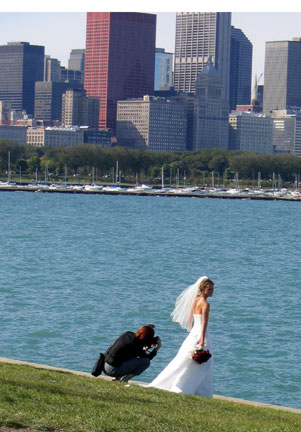
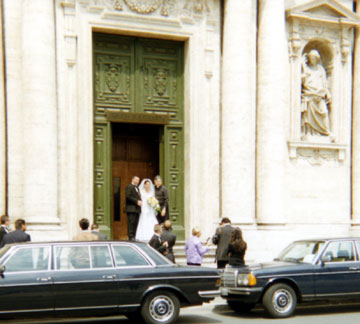
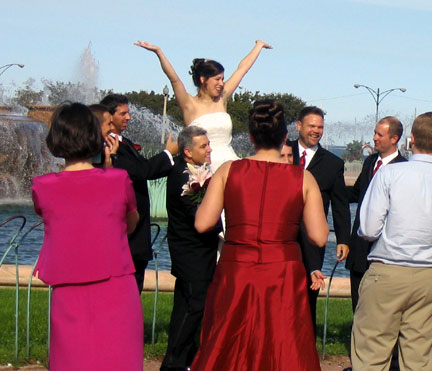
"Gettin' Hitched" was the title of today's entry on John Hill's essential Archidose blog. The architect is off until July 4th for, I hope, an extended honeymoon. Since the papparazzi have yet to come up with photos of the happy couple, we extend our best wishes with this selection of architectural backdrop wedding pictures, from Rome, the lakefront, Michigan Avenue, and Buckingham Fountain.




Thursday, June 22, 2006
Out of Time at the Wrigley Building?
 Look, ma, no hands! For the last several weeks, the Wrigley Building's famous clockfaces have been denuded of both big and little, reportedly removed for their own protection during the tower's renovation. We wish them a speedy return, but for now, at least at the foot of the Mag Mile, it's pretty much any time you care to imagine.
Wednesday, June 21, 2006
Marquee Value
 Five years ago, within the Chicago city limits, Helmut Jahn couldn't get a doghouse built. He may have been creating landmark works all across Europe and Asia, but in his home town, he remained a prophet without honor. Then came State Street Village, the stunning dorm complex he designed for the IIT campus, which opened in 2003. Last year, 600 North Fairbanks, his first condo highrise in Chicago was announced, and it's now begun to rise on its Streetville site, just south of the Schatz Building, which in the 1930's through 1960, was home to the fabled Chez Paree night club.
 For the $100,000,000 600 North Fairbank's developers, Urban R2 Developent and Schatz Development, the architect has come up with a classic Jahn design: a sleek, curtain-walled 41 story, 451-foot-high tower, where the condos are placed over a lobby and 11 floors of parking that progressively cantilever, story-by-story, up to the larger floorplate of the residential portion of the building.
What's also interesting is how prominently Jahn figures in the marketing. The website features several videos of the architect talking about the project, as well as a mini-portfolio of his other buildings. At the construction site, there's another interesting sea change. Usually, on those big billboards listing the credits, the name of the architect is fairly inconspicuous, buried amidst the names of contractor and subcontractors. In contrast, the street signage at 600 North Fairbanks puts the Jahn name front and center. In some ways, it's just a case of Chicago catching up with New York, where the involvement of high profile architects such as Richard Meier has been used to help move units with multi-million dollar price tags. At 600 North Fairbanks, the signage heralds not just Jahn, but what it calls "pure modern vision."
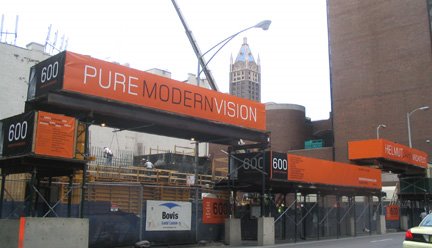
Is cheesy historicism's stranglehold on architectural design in Chicago finally about to be broken?
Monday, June 19, 2006
111 South Wacker Wins Awards from IALD, SEAOI
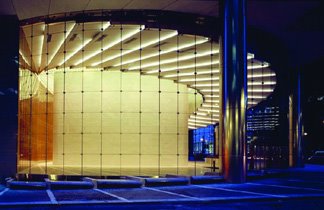 111 South Wacker, the new John Buck building designed by Goettsch Partners that, along with Pei Cobb Freed's Hyatt Center just across the street, seems to marking a resurgence in quality skyscraper design in Chicago after a long drought of abominable concrete condo towers, has garnered not one by two recent awards, from both the International Association of Lighting Designers, and the Structural Engineers Association of Illinois. Read all about the engineering challenges 111 South Wacker faced, and see the pictures, here.
Subscribe to:
Posts (Atom)