Showing posts with label University of Chicago. Show all posts

Wednesday, April 23, 2025

The remarkable story of the University of Chicago's Accelerator Building


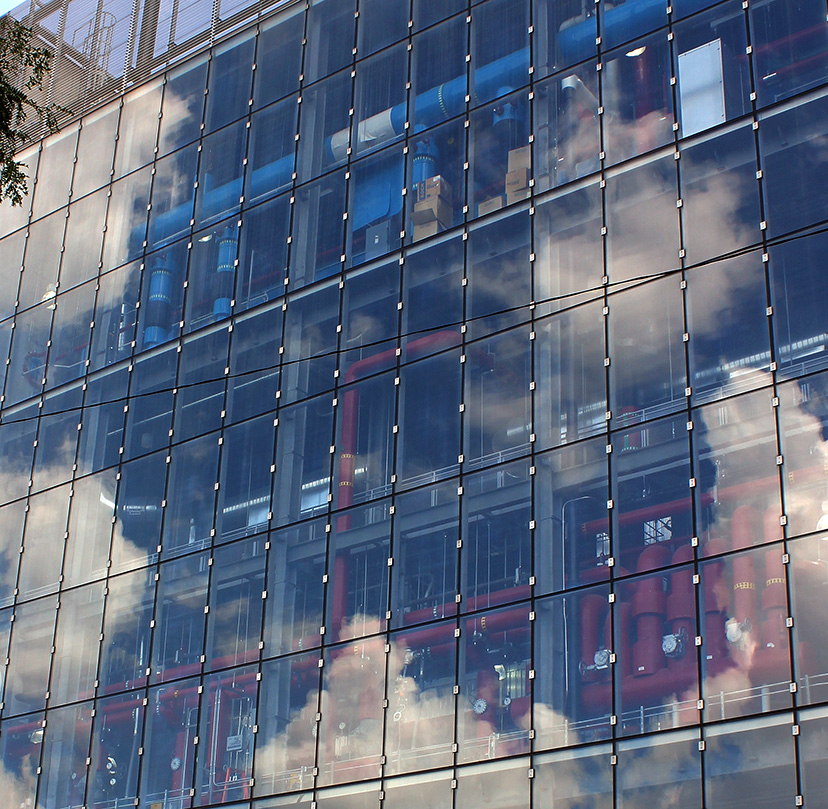
I always loved the clean concrete elegance of Hausner & Macsai’s High Energy Physics Building at the University of Chicago, but I never took pictures of its massive, more anonymous neighbor


Now, as both structures are about to be ground into dust, I’ve finally learned what an absolutely amazing story Schmidt, Garden & Erikson’s 1949 Accelerator Building held inside.


Enrico Fermi and crew may have created the “first controlled generation of nuclear power” across the street, memorialized by a Henry Moore sculpture, but Fermi actually spent a lot more time in the Accelerator, custom-built for him, to house what was at the time the most powerful atom smasher in the world.

The Accelerator Building’s spectacle was all internal: a massive four-story open space with a 100-ton crane to do the heavy lifting. Here anything could happen, from smashing atoms, to building telescopes, to housing 20 tons of dinosaur fossils or a swimming pool for crocodiles.

Walking by, who would imagine what wonders were to be found within those abject facades so staid they almost made the huge thing seem invisible. Now, the kind of bunkered concrete and stone that was the fashion of the post-war-paranoia time is considered almost antiquity when it comes to styling.


Their replacement, the new $170,00,000 Science and Engineering Building by HDR and Allison Grace Williams, reflects the fashion of our own day, two huge intersecting blocks, a festival of glass in standard office-building-meets-lab-podium aesthetic.


Wednesday, April 03, 2013

Ronald Reagan Wrecked

click images for larger view
The great Lee Bey is reporting today that the University of Chicago is currently demolishing the apartment building where Ronald Reagan lived as a small boy.  DNAinfo.com Chicago,  which also has some nice photos, is saying the University promises to put up a plaque.

The structure was already cast in the deep shadows of Rafael Viñoly's hulking new Center for Care and Discovery (translation: it's a really big hospital).  When I wrote about this last December, it was less about history and more about the way that the U of C is super-densifying its campus at the expense of any sense of community or human scale.


Read: Say Goodbye to Ronald Reagan's Apartment: The Supply-Chaining of Hyde Park

Thursday, October 11, 2012

The Reveal: Tod Williams and Billie Tsien's Reva and David Logan Center for the Arts at the University of Chicago

click images for larger view (highly recommended)
The Reva and David Logan Center for the Arts has its official opening this weekend with a Launch Logan Festival, Friday through Sunday, October 12-14, and an October 12th program Beware the Stairs are Always Moving: a conversation with Architects Tod Williams and Billie Tsien, 6:00 p.m. in the Logan Center's Performance Hall.  Read our profile of the building and its architects here.

 “I think in life it's generally true,” said architect Tod Williams, “everything's pushing to the more broadly based and generic, kind of universal answers.  I think that's the trend of the moment, and I think there's certain places, certain institutions, and people that go against that.  We go against that.”
He was responding to my question about architecture in the era of the supply chain, where it's all about maximizing efficiency through standardization and scale . . .
We had the opportunity to tour the this stunning new building, the Reva and David Logan Center for the Arts with its architects, Tod Williams and Billie Tsien last Friday, and the result is this photo-essay.   Williams and Tsien talk to me about about how the building came about, how it works, and the challenges they faced in getting it done.  Images, in abundance.

Read:  The Reveal: Tod Williams and Billie Tsien's Reva and David Logan Center for the Arts at the University of Chicago


Wednesday, August 08, 2012

Portrait of a City at Warp Speed: The Eighth Greatest Film Ever? Man With a Movie Camera at Doc Films tonight


The ten highest ranked movies of the just released 2012 edition of the British Film Institute's once-a-decade poll of The Top 50 Greatest Films of All Time is pretty much a list of the usual suspects: Rules of the Game, Tokyo Story, Sunrise, Passion of Joan of Arc, etc.  The big news was dethronement of long-time Number 1 Citizen Kane with Alfred Hitchcock's Vertigo.  Discuss among yourselves.

An even greater jump, however, was a film that went from 27 in 2002 to number 8 this year.  Dziga Vertov's Man With a Movie Camera is a wildly ambitious 1929 silent documentary that is nothing less a picture of what it is to be alive as captured through documenting a day in a great city (in this case mostly Odessa, but some other cities used, as well.)  Coupled to long stretches of conventional montage are bursts of the avant garde techniques that would come to define cutting edge cinema: multiple exposures, jump cuts, freeze frames and more.
Streetscapes, storefronts, racing trains, planes, trams and fire trucks a beautiful woman dressing, trams emerging from their sheds, shooting galleries, dancers, symphonies, posters, advertisements, a walking tripod -  all the forms of urban human life, and all the stages birth to death.  In 68 minutes.

And we also see both endpoints of the story - the intrepid cameraman as he seeks and sets up his shots, and the audience watching him on film as he shoots film while riding a motorcycle.
It's a remarkable study of architecture inhabited.  Not the carefully composed hero shots of individual buildings, but the fabric of buildings placed within a city, engaging with the human beings who designed them, and use them, if only as a backdrop,  Vertov's restless camera often moves through the streets just as we as pedestrians move through the streets. 
While you can view the entire film on You-Tube, tonight you also have a rare opportunity to see Man With a Movie Camera as it was meant to be scene, on a large screen - where the images of buildings can scale life-size - and with an audience, so you can be a spectator in a theater watching an audience in a theater watch Vertov's film.  It screens tonight at 7:00 p.m. at doc films. in the Max Palevsky Cinema at Ida Noyes Hall at the U of C, 1212 West 59th.  $5.00.

Tuesday, May 22, 2012

Some views of the new Logan Center for the Arts - architects Williams & Tsien at Art Institute Panel Thursday

click images for larger view
Tod Williams and Billie Tsien, architects of the new Reva and David Logan Center for the Arts, will be part of a panel discussion on University of Chicago Architecture taking place this Thursday, May 24th, from 6:30 to 8:00 p.m. at Rubloff Auditorium at the Art Institute of Chicago.  Also participating will be architects James Carpenter and Ana Beha.  The event, sponsored by the Art Institute's Architecture and Design Society, will be moderated by Steven Wiesenthal, FAIA.  Tickets are $15.00 for the general public; $10.00 for members, $5.00 for students.  Information and registration here.

There are still nearly a dozen items still to come to check out on the May Calendar of Chicago Architectural Events.


Saturday, December 31, 2011

Ricardo Legorreta, who brought back the sun to the U of C's Gothic gray, dies at 80

 click image for larger view
A brief obituary here.  A sampling of his work here.  My photoessay on the Max Palevsky Residential Commons at the University of Chicago here.

Wednesday, August 17, 2011

Helmut arrays stern Walter with Stars at the U of C

click images for larger view
The Joe and Rika Mansueto Library (Murphy/Jahn, 2011) reflects on the Regenstein Library (SOM, Walter Netsch, 1970) . . .
. . . while a student studies a pop-up book . . .
. . . and Henry Moore, in the person of Nuclear Energy, gazes impassively on.

Sunday, April 24, 2011

Chicago Under Construction: The Logan Arts Center at the University of Chicago

click images for larger view
It's about midpoint along towards its scheduled completion next Spring, but the basic contours of the Tod Williams Billie Tsien designed Reva and David Logan Center for Creative and Performing Arts at 60th and Drexel are already becoming apparent.  The tower is reaching its full, 155-foot height.  (According to Emporis, a stipulation in the original plans for the Rockefeller Memorial Chapel down the street mandated that no structure on the campus ever exceed its 207 foot height.)
Currently clad in bright yellow gypsum sheathing, the long, lower expanse of the 170,000 square-foot project stretching almost down to 61st looks like the beginnings of a Walmart superstore, but the two-story space behind it will eventually host a wide range of functions from studios, classrooms, shop, a gallery, and no less than three auditoriums, including a 450-seat performance hall at the southeast end of the building.
Landscaped courtyards will buffer the structure from the landmark Lorado Taft home and studio, just to the east, with another lawn, even larger than the performance hall's footprint, separating that auditorium from the Ingleside Avenue.  Huge blocks of feta cheese are being assembled for further soundproofing.
The 11-story tower, itself, amidst numerous classrooms and practice rooms, will host even more auditoria: a screening room, performance spaces - one for dance, one for theater - and what promises to be a spectacular "performance penthouse" at the top, with the building cracking open to the northwest like a giant-yoked, rectangular egg to create a rooftop terrace.

Schuler Shook  are the theatre consultants; with Kirkegaard (the audio people, not the philosopher - at the U of C, you can never be sure) handling the acoustics.  Severud Associates are the structural engineers, Hargreaves Associates the landscape architect, Holabird and Root the local associate.

When it's all done, it should look something like this.
You can find a lot more information about the project, including a video of Tsien and Williams discussing their design,  and a live webcam,  at the U of C's  Logan Center website, here.

Sunday, November 07, 2010

Robots take over - from diapers.com to Helmut Jahn's Mansueto at the U of C


October 7, 2010 - Business Week cover story:  What Amazon Fears Most: Diapers - a story on how roving,  merchandise-picking robots have let diapers.com drive down costs and beat Amazon at its own game.
And if Amazon wanted a diaper war, an all-out price and delivery-time smackdown? "I would like that," said Bharara. "I would definitely take that challenge."
November 5, 2010 - Business Insider - Amazon Nukes Diapers.com in Price War on how Amazon is selling diapers below cost to counter diapers.com. (Microsoft vs. Netscape, anyone?)
November 6, 2010 - Amazon to Acquire Diapers.com for $540 million - ah, the joys of predatory capitalism. 
Diapers.com major weapon was a Mobile Fulfillment System (MFS) from Kiva Systems. hundreds of intelligent, bright orange moving platforms that grab pallets of product and bring them to human pickers fulfilling customer orders.
click images for larger view
The University of Chicago's new Mansueto Library, designed by Helmut Jahn and currently under construction with a Fall, 2011 completion date, is going a similar route, having hiring Milwaukee's HK Systems to deploy an Automated Storage and Retrieval System (ASRS) to create a state-of-the-art Automated Library System (ALS).
 The soaring cranes you see here under wraps will automatically retrieve requests from the 3,500,000 volumes kept in a forest of soaring, untouched-by-human-hands stacks filling the huge, 50 foot deep bunker beneath the reading room under Jahn and Werner Sobek's massive glass dome shaped like the world's largest contact lens.
 You can view a slow-loading video of how it works here.

The Library of Congress is denying reports that it is responding by developing an even faster, more advanced system, based on state-of-the-art teleportation technology from Star Trek Industries, which will allow readers to obtain a book just by thinking about it, enabling the LoC to outperform the Mansueto's delivery times by several minutes to a week and squeeze them out of the entire high-end storehouse of knowledge market.

We hope to writing a lot more about the Mansueto later. For now, there's a video of a great tour we took this past summer with Senior Project Manager Mike Natarus.

Tuesday, April 20, 2010

Cobbgate Scandal: U of C Biological Laboratories reluctantly puts failed experiments on permanent display

Some of the residents of the gate for the Hull Biological Laboratories, which Henry Ives Cobb donated to the University of Chicago shortly before he was dumped as campus architect. (click on the photos for a larger view)
The specimen depicted in the top photograph above shows the results of early attempts to use seaweed protoplasm to secure dental implants.

The middle photograph is a memento of a three-year program, initiated by students, to fully diagram molecular transmutations and the potential for replication arising out of French kissing, abruptly terminated by the administration after it was discovered that the instructor was not, as claimed, Dr. François P. McCarthy of the Sorbonne, but Fifi Dessay of the Trocadero Theater on south State Street.

The bottom photograph is a specimen from still another experiment studying the breakdown of complex organisms into prokaryotes through the cryogenic freezing of faculty members at the exact moment they learned they had been denied tenure.

And as for Henry Ives Cobb? In total dejection after his firing, the architect grew violent, and was discovered by police using a large kitchen knife to chop neighborhood chickens into little pieces. As his anger grew, his list of his victims expanded: pork bellies, tomatoes, eggs, avocado - several types of lettuce - until he inadvertently created the salad that would secure him a greater, more enduring fame than he would ever enjoy as an architect.