 Is it just me, or do the helmeted Art Institute lions - if you don't see the team logo - look a bit like an homage to the 1968 Democratic convention?
Monday, June 14, 2010
2010 or 1968?
Is it just me, or do the helmeted Art Institute lions - if you don't see the team logo - look a bit like an homage to the 1968 Democratic convention?

Saturday, June 12, 2010
The Red and the Black: Hey, Mies - Here come the Hawks!
In case you might not have heard, this past Friday, the city of Chicago celebrated the Chicago Blackhawks' ending a nearly half-century drought to win this year's Stanley Cup.
This year, the city had sought to avoid the massive crowds that overflow downtown streets after the annual Fourth of July fireworks by using budgetary concerns as an excuse for cancelling the event and breaking it up into smaller shows out in the neighborhoods. The Blackhawks' dramatic win confounded those intentions. Whether City Hall bureaucrats find it inconvenient or not, mass gatherings - of celebration or protest - on a scale that balances out that of the massive structures around them, are one of the key things that define a truly great city, as opposed to an emptied-out metropolis: the sense of sharing and ownership of the city among the citizens, themselves.
Done, not under the cover of a July night but in broad daylight, the Hawks celebration was a show of Chicago's enduring power and potential made flesh.
These two photos from our indefatigable correspondent Bob Johnson depict the extraordinary sight of seeing jammed streets along the city's riverfront running red with hundreds of thousands of Blackhawk fans, wearing their team colors, cheering as a parade of double-decker buses carrying Hawks players glided through their midst along a narrow vein of cleared payment that closed up solid with bodies as soon as the end bus carrying the Stanley Cup passed by. click images for larger view (recommended)
 Mies van der Rohe's skyscrapers are
 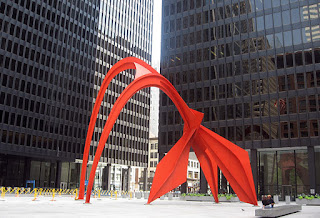 like a Model-T Ford - you could have them in any color you wanted, as long as it was black (or bronze, if you were particularly flush). Mies's dark towers impart a serene, sober dignity. At the Federal Center, there's counterpoint in Alexander Calder's flaming red Flamingo, a perfect complement. Mies's darkness makes Calder's brightness almost burn into your retina; while the color of the sculpture only deepens your apprehension of Mies's rich monochrome.
 click images for larger view (recommended)
 Mies van der Rohe's skyscrapers are
  like a Model-T Ford - you could have them in any color you wanted, as long as it was black (or bronze, if you were particularly flush). Mies's dark towers impart a serene, sober dignity. At the Federal Center, there's counterpoint in Alexander Calder's flaming red Flamingo, a perfect complement. Mies's darkness makes Calder's brightness almost burn into your retina; while the color of the sculpture only deepens your apprehension of Mies's rich monochrome.
Neither Mies's Crown Hall on the IIT campus or the IBM, now known as 330 North Wabash, have any such relief. They are absolutely pure in their palette,
 and better for it. Every so often, however, a brief event dirties them up, in the best possible sense. Back in the 1950's, it was Duke Ellington and his band stomping and shaking the windows of Crown Hall, where this summer silver pillows are floating as part of an installation of Andy Warhol's Silver Clouds that runs through August 1st.
And Friday, it was the IBM's turn, as a ten-story-high red Blackhawks banner took over the southeast corner of of Mies's black tower, to the delight - and no small bit of awe - of the parade of passersby and hordes of shutterbugs.
 For a brief time, the street was transformed. The static structure added Venturian layers of meaning: an iconography of the region's native American history, it's repurposing into the culture of the replacing white settlers, its abstraction into a commercial symbol. And on top of that, the sudden contrast of textures: soft versus hard, chromatic verus monochrome, the static probity of enduring structure enlivened by a red burst of human enthusiasm. Street theater of a city living in the fullness of its senses.
Friday, June 11, 2010
Lucien Lagrange and Bruce Graham - the not so odd couple, at an appreciation of SOM's master architect at CAF
 When you think of Bruce Graham, the master architect who died this past March at 84, Lucien Lagrange is probably not the architect whose name next comes to mind. Working with uber-engineer Fazlur Khan, Graham created some of Chicago's greatest architectural icons, including the Willis (aka Sears) Tower, the tallest building in the world at
  the time of its construction, and the John Hancock Center, the romantic, tapering tower that sets Gershwin playing in my head every time I catch a glimpse of it out my window. Lucien Lagrange, despite such accomplished forays into modernism as his spiky Erie on the Park, is best known for vaguely classicist designs that have endeared him to his clients, if not the critics, and placed him among the city's most successful architects.
However, Graham and Lagrange shared a strong link, one that will explored at what promises to be an exceptional event at the Chicago Architecture Foundation next Wednesday, June 16th, Remembering Bruce Graham, where Graham's legacy will be discussed by a panel including Lagrange, author Franz Schulze, who refers to Graham as "the Burnham of his generation", and Richard F. Tomlinson of Skidmore, Owings & Merrill, the firm that was Graham's home base for nearly four decades, and where Graham quickly became Tomlinson's mentor when the younger architect joined the firm in 1972.
While the Provence-born Lagrange was studying architecture at Montreal's McGill University, he came to Chicago in 1968 seeking a summer internship, and, after not getting a position with the firm of Mies van der Rohe, wound up at SOM. In his second week there, his drafting skills got him assigned to working as a designer for Bruce Graham and Fazlur Khan, just as the Hancock Center was moving
 towards completion. "I really started to understand steel through their teaching." Lagrange has written. "They were incredible people with visions of buildings and structure."
Although known for structures with simple, strong and striking visual profiles, Graham was acutely aware of the kinetic aspect of architecture. "Architecture," he said, "is in the design of space, both interior and exterior. So it's much more closely related to dance than it is to painting or sculpture."
Remembering Bruce Graham takes place from 6 to 7:15 p.m, Wednesday, June 16th, in the Lecture Hall Gallery at the Chicago Architecture Foundation, 224 S. Michigan. $5.00 for non-members, $10.00 non-members, and you can still register on-line here.
Thursday, June 10, 2010

Wednesday, June 09, 2010
What Lies Beneath: The Architecture and Design of Fritz Lang's Metropolis
Metropolis is playing at the Music Box Theatre, 3733 N. Southport, through Thursday June 17th. It should not be missed.
 The shining temples we build for our cities, sacred or commercial, serve both as reflection of our hopes and cover for our darkest desires. Nowhere has this been more forcefully - and entertainingly - expressed than in Fritz Lang's delirious 1927 film masterpiece, Metropolis. A consideration of the film's spectacular architecture - images, in abundance - here.
Tuesday, June 08, 2010


Sunday, June 06, 2010
Mayor Daley's Camera Surveillance Program goes ophthalmological
 Continually pressed to find new ways to stretch revenue dollars in a troubled economy, Chicago Mayor Richard M. Daley has turned to an innovative team, made up of artist Tony Tasset, scientists at MIT'S Moureau Genetics Labs and legendary intelligence intercept expert Harry Caul. to create a cheaper, more economical alternative to the placement of thousands of cameras throughout the city to prevent and prosecute crime.
The first prototype of their creation, Eye, will be unveiled July 7th at Chicago's Pritzker Park. Thirty feet high, it will be able to see everything going on in a 20-block radius, both on the street and in building interiors, including washrooms if you forget to close the door. A fiberoptic central retinal artery connects to Chicago police headquarters, with a subsidiary thread instantly streaming especially embarrassing video captures directly to YouTube.
"Obviously we expect deterrence to be as much a factor here as documenting crimes," said city spokesperson Angelica Lee. "We think potential perpetrators will think twice having this humongous orb looking over their shoulder, or maybe just be so creeped out all they'll want to do is lie down and try to make the nightmares stop."
The cost of the project had been underwritten by Lancôme L'Extreme, which is also contributing the mascara for the Eye's lash. Murine will be donating the 27 gallons of drops required each day to avoid Eye irritation from State Street's exhaust and pollution. Should Eye actually water, however, or shed tears over the sadder aspects of the humanity passing by, all liquid will be collected and recycled to water heaven.
A second battery of conventional cameras will be set up watching Eye 24 hours a day to make sure no one pokes it with a sharp stick.
The project is already the object of strenuous protests from PETOBP (People for the Ethical Treatment of Out of Body Parts), who claim that keeping Eye open, all the time, forced to perpetually bear witness to the horror of mankind, is in fact a subset of the Ludovico technique, and therefore a form of torture.
The project is not to be confused with I!, a different MIT Moureau Labs collaboration, this time with John Mayer, which resulted in the creation of a 30-foot-high throbbing shaft, mounted on a flatbed truck that can be rushed to quell riot scenes by sucking rioters' raging testosterone out through their pores, or, should that fail, just using the shaft to beat them senseless.
Saturday, June 05, 2010
Chicago Streetscene: All Brides Must Jump!
 She's just upholding the law. It's a federal law, actually.
Friday, June 04, 2010

Thursday, June 03, 2010
You can make APTWGLC tour of Wright's S C Johnson campus happen
. . . or not. Apparently, there's a lack of waxy build-up, visitor-style, in Racine. The Western Great Lakes chapter of the Association for Preservation Technology sent out an email  saying they weren't getting much of a response for their scheduled Wednesday, June 9th, 2010 tour of Frank Lloyd Wright's S.C. Johnson & Son campus in Racine, Wisconsin, which will include a film at 12:45 p.m, a presentation on recent restoration projects by Brett E. Laureys of Wiss, Janney, Elstner at 2:00, followed by tours of the buildings.
It's $15.00 for members; and $25.00 for non-members, with 4 CEU Learning Units offered. They're looking for 10 confirmed participants by tomorrow, Friday, or the tour will be cancelled. You have to get up to Racine on your own but, still, this looks like a great event, so if you can make it, RSVP via email by Friday. The tour you save may be your own. More info here. (photograph of S C Johnson administration building © by Jeff Dean, courtesy Wikipedia.)
 saying they weren't getting much of a response for their scheduled Wednesday, June 9th, 2010 tour of Frank Lloyd Wright's S.C. Johnson & Son campus in Racine, Wisconsin, which will include a film at 12:45 p.m, a presentation on recent restoration projects by Brett E. Laureys of Wiss, Janney, Elstner at 2:00, followed by tours of the buildings.
It's $15.00 for members; and $25.00 for non-members, with 4 CEU Learning Units offered. They're looking for 10 confirmed participants by tomorrow, Friday, or the tour will be cancelled. You have to get up to Racine on your own but, still, this looks like a great event, so if you can make it,
 RSVP via email by Friday. The tour you save may be your own. More info here. (photograph of S C Johnson administration building © by Jeff Dean, courtesy Wikipedia.)
Wednesday, June 02, 2010

Monday, May 31, 2010
Pecha Kucha, remembering Bruce Graham, SEAOI awards, Ross Barney, Schulman's Chicago Modernism and 40+ more- Chicago architectural events for June
 The more fortunate of you may be contemplating your annual sojourn to the south of France, but for the rest of us there's no time Toulouse for architectural events in Chicago for June. It all starts out Tuesday, with Pecha Kucha Volume 14, also the location of AIA Chicago's First Tuesday's Happy Hour, followed by VOA's new Roosevelt U Tower at CAF on Wednesday, with John Edel discussing agroponics in old factory buildings for Urban Habitat Chicago that evening. On Thursday, there's Archeworks daylong seminar Infrastructures for Change, Preservation Chicago's Jonathan Fine at the Cultural Center for Friends of Downtown at lunch time. This year's Excellence in Structure Engineering Awards revealed at the Structural Engineers Association of Illinois annual banquet at the John B. Murphy Auditorium on Saturday, going up against two hour musique concrète performance by Lionel Marchetti especially designed for the Graham Foundation's Madlener House ballroom. And there are five more events just this week.
On the 10th, At Home: The British Invasion! with be considered by a panel at CAF, where there will also be a remembrance of Bruce Graham with Lucien Lagrange, Franz Schulze and Richard F. Tomlinson on the 17th. Principals from Architectuuer Lokall discuss Architecture and Policy in the Netherlands at AIA Chicago on the 14th. Glessner House museum offers its annual tour of the mansions of Prairie Avenue on Sunday, the 13th. Keith Bringe of the Chicago Art Deco Society delivers this months Landmarks Illinois Preservation Snapshots lecture at the Cultural Center on the 17th, and Carol Ross Barney discusses her work on the Chicago Riverwalk at AIA on the 23rd. The Open Hand Studio brings architects and designers together with community non-profits in a June 29th Meet and Match.
Summer reading? We got books and authors coming out of our ears. Samuel Roche and Aric Lasher discuss their Plans of Chicago at CAF lunchtime on the 9th, where the following week on 16th, Mary Beth Raycraft discusses his translation of Madame Léon Grandin's A Parisienne Discovers Chicago: Impressions of the City and the World’s Columbian Exposition. OWP/P Cannon Design's Kerry Leonard talks about The Third Teacher: 79 Ways You Can Use Design tojavascript:void(0) Transform Teaching & Learning at AIA Chicago on the 18th. And at CAF's June 23rd lunchtime lecture, Chicago Bauhaus & Beyond's Gary Gand lectures on Julius Shulman: Chicago Mid-Century Commission, a book of photographs the group commissioned for what would be the legendary photographer's final book project.
Soon it will officially be summer, and things will begin winding down. But for now, there's nearly 50 events to choose from on the June calendar. Check them all out here.
Sunday, May 30, 2010
Saturday, May 29, 2010
Beyond the Carping: Archeworks Infrastructures for Change Takes on the Great Lakes; plus Archeworks goes to Venice Biennale
OK, so we finished congratulating ourselves on Daniel Burnham's 1909 Plan of Chicago with the close of last year's centennial celebration. Where do we go from here? Chicago's alternative design school Archeworks is looking to find at least some of the answers this coming Thursday, June 3rd, with  their day-log Infrastructures for Change Symposium at the CMAP offices in the Willis Tower, co-sponsored by the Metropolitan Planning Council and Openlands.
The symposium "will be structured around three urban challenges facing Chicago and cities everywhere in the 21st Century: shrinking economies, health crises, and ecological security." The focus is on the region's greatest natural resource: the water of the great lakes. The goal is to "initiate a new blueprint for action toward imagining and inventing a 21st Century Great Lakes Model for global city building," with three panels:
Information about the symposium, including bio's of all 16 speakers and participants, here. Early registration ($75.00) has been extended through June 1st, and you can register here.
Archeworks co-directors Martin Felsen and Sarah Dunn know their water. As principals of one of Chicago's most innovative architectural firms, UrbanLab, their Eco Boulevards concept won the History Channel's 2006 City of the Future Competition. Their Growing Energy/Water: Using the Grid to Get Off the Grid, co-developed with Archeworks, won the $100,000 Latrobe Prize from AIA for the most innovative research project of the past two years. And this week is shaping up as a busy one for the team. Not only is there the Thursday symposium, but on Tuesday, the winner of the $100,000 2010 Buckminster Fuller Challenge will be announced, in which UrbanLab's Growing Water has been named one of six finalists.
And if that's not enough, Archeworks is also going to this year's Venice Biennale. They're one of a team of seven participants creating, for Atlanta's High Museum, the exhibition Workshopping: An American Model of Architectural Practice, which "explores the role of the trans-disciplinary collaborations in architecture, spotlighting seven architecture projects with a focus on research and social engagement." This year's Venice Biennale opens August 29 and runs through November 21. The watery city, perpetually threatened with being swallowed up in the sea, should be a natural setting for Felsen, Dunn, Archeworks and their whole aquatically obsessed crew.
 their day-log Infrastructures for Change Symposium at the CMAP offices in the Willis Tower, co-sponsored by the Metropolitan Planning Council and Openlands.
The symposium "will be structured around three urban challenges facing Chicago and cities everywhere in the 21st Century: shrinking economies, health crises, and ecological security." The focus is on the region's greatest natural resource: the water of the great lakes. The goal is to "initiate a new blueprint for action toward imagining and inventing a 21st Century Great Lakes Model for global city building," with three panels:
- Panel 1 | Crises are Avoidable
- Panel 2 | Designing Urban Catalysts
- Panel 3 | Investigating Long-Term Strategy - Case Study: "What the Carp?" - "Can carp become catalysts for re-designing a city? Drawing from the carp case example, panelists will discuss 21st Century goals for improving Chicago’s
 waterway systems that address invasive species, water supply and storm water management. "

Information about the symposium, including bio's of all 16 speakers and participants, here. Early registration ($75.00) has been extended through June 1st, and you can register here.
Archeworks co-directors Martin Felsen and Sarah Dunn know their water. As principals
 of one of Chicago's most innovative architectural firms, UrbanLab, their Eco Boulevards concept won the History Channel's 2006 City of the Future Competition. Their Growing Energy/Water: Using the Grid to Get Off the Grid, co-developed with Archeworks, won the $100,000 Latrobe Prize from AIA for the most innovative research project of the past two years. And this week is shaping up as a busy one for the team. Not only is there the Thursday symposium, but on Tuesday, the winner of the $100,000 2010 Buckminster Fuller Challenge will be announced, in which UrbanLab's Growing Water has been named one of six finalists.
And if that's not enough, Archeworks is also going to this year's Venice Biennale. They're one of a
 team of seven participants creating, for Atlanta's High Museum, the exhibition Workshopping: An American Model of Architectural Practice, which "explores the role of the trans-disciplinary collaborations in architecture, spotlighting seven architecture projects with a focus on research and social engagement." This year's Venice Biennale opens August 29 and runs through November 21. The watery city, perpetually threatened with being swallowed up in the sea, should be a natural setting for Felsen, Dunn, Archeworks and their whole aquatically obsessed crew.
Wednesday, May 26, 2010


Tuesday, May 25, 2010
Valkenburgh on Daley Bi, North Grant Park
Monday night saw the first of four meetings held by the Chicago Park District to solicit ideas for the renovation of North Grant Park, which includes the Daley Bicentennial Plaza site into which the Daley administration is hell-bent on cramming an illegal building for the Chicago Children's Museum.
The scope of the community input was immediately sharply curtailed by rules laid down by Chicago Park District director of planning and development Gia Biagi:
1. The entire park must be destroyed because the underlying parking garage is having leakage problems and the only way to fix it is to remove every vestige of the current park. This is another example of how private/public partnerships designed to benefit the city in fact cede control of the public sector to private interests. Chicago has already lost control of its streets through the parking meter deal. Now a public amenity - a 30 acre park - has to be destroyed to appease the needs of the private owners of the garage underneath.
2. It must be assumed that the Children's Museum will be built. This despite fundraising for the new building, which is now estimate to cost upwards of $150,000,000, has basically ground to a halt. The bad economy, not inaccurately, is cited by museum officials, but fundraising has undoubtedly also been depressed by the fact that it will have to take place in an environment where corporations will find their contributions won't automatically buy them friends among the general public, but may, indeed, tarnish their reputation among those who oppose the museum - which in all independent polls includes a large majority of Chicago residents. A large number of enraged activists which will make sure such contributions are widely publicized.
One good move is the Park District's hiring of renowned landscape architects Michael Valkenburgh Associates to design the replacement park. From their presentation, it is clear that they get it. They understand, as Grant Park Advisory President Bob O'Neill does not, that parks that are more than just cramming in as much programs and buildings as possible. Unfortunately the video I offer her - shot in my patented combination of horrific camerawork and hacksaw editing - covers only the beginning of Valkenburgh's excellent presentation. (I need to get a bigger storage card - or a Canon Ti,) You can see a portfolio of their work here.
Valkenburgh's presentations can also be heard as the three remaining Park District community input sessions, which was worth attending:
- Wednesday, May 26 at South Shore Cultural Center, 7059 S. Shore Drive
- Wednesday, June 9 at Broadway Armory, 5917 N. Broadway Avenue
- Thursday, June 10 at Garfield Park Conservatory, 300 N. Central Park Avenue
Monday, May 24, 2010
Today: Modern Architecture in Cuba at noon, Children's Museum site revamp at 7:00 pm
Another two events added to the calendar for today, May 24th:
At noon, Professor Julio César Pérez Hernández, Harvard University Loeb Fellow '02, President, Cuban Chapter of CEU, will lecture on Modern Architecture in Cuba in room 14 in Crown Hall at IIT, 3360 S. State. Hernández will also be lecturing on Preserving the Magic and Poetry of Havana at CAF Tuesday evening at 6:00 p.m. At noon on Tuesday, Craig Dykers of Snøhetta will deliver a noontime lecture on the firm's work, again in room 14 at Crown Hall.
And at 7 p.m., at the Spertus Institute, there will the first of a series of public hearings for the North Grant Park Renovation Project, aka jamming a children's museum into Grant Park. Michael Van Valkenburgh Associates will unveil the latest designs for the site.
  According to Crain's Greg Hinz, fund-raising for the museum, which has negotiated a short-term renewal of its lease at Navy Pier, continues to go nowhere. "So how can you develop, "says Hinz, "a plan when perhaps the largest element in it is uncertain? Just asking."
On Wednesday the 26th, Jeanne Gang will lecture at Fullerton Hall for the Architecture and Design Society of the Art Institute. The month closes on Thursday the 27th with a lecture by Roberta A. Mayer at the Driehaus Museum/Nickerson Mansion on Lockwood de Forest and the East Indian Craft Revival.
There are still a dozen great events on the May calendar. Check them all out here.
At noon, Professor Julio César Pérez Hernández, Harvard University Loeb Fellow '02, President, Cuban Chapter of CEU, will lecture on Modern Architecture in Cuba in room 14
 in Crown Hall at IIT, 3360 S. State. Hernández will also be lecturing on Preserving the Magic and Poetry of Havana at CAF Tuesday evening at 6:00 p.m. At noon on Tuesday, Craig Dykers of Snøhetta will deliver a noontime lecture on the firm's work, again in room 14 at Crown Hall.
And at 7 p.m., at the Spertus Institute, there will the first of a series of public
 hearings for the North Grant Park Renovation Project, aka jamming a children's museum into Grant Park. Michael Van Valkenburgh Associates will unveil the latest designs for the site.
  According to Crain's Greg Hinz, fund-raising for the museum, which has negotiated a short-term renewal of its lease at Navy Pier, continues to go nowhere. "So how can you develop, "says Hinz, "a plan when perhaps the largest element in it is uncertain? Just asking."
On Wednesday the 26th, Jeanne Gang will lecture at Fullerton Hall for the Architecture and Design Society of the Art Institute. The month closes on Thursday the 27th with a lecture by Roberta A. Mayer at the Driehaus Museum/Nickerson Mansion on Lockwood de Forest and the East Indian Craft Revival.
There are still a dozen great events on the May calendar. Check them all out here.
Sunday, May 23, 2010
Plaza of the Americas to get renovation: Wrigley next, please, please.
 Is that the slight hint of a smile I see on the face of the statue of savior-of-the-Mexican-Republic Benito Juárez? On Saturday, 42nd ward alderman Brendan Reilly announced via his weekly newsletter that reconstruction of the Plaza of the Americas, where the statue makes its home, will begin on Monday.
(photo courtesy Brendan Reilly, Phil Levin, GNMAA)
Reilly takes credit for negotiating "the final terms of a $750,000 public-private agreement for the reconstruction project and on-going maintenance of the plaza," which is on Michigan Avenue, above Hubbard Street. Co-signatories to the agreement are the Chicago Department of Transportation and National Association of Realtors, whose headquarters building forms the plaza's northern border.The alderman says the project, which is to include structural repairs, resurfacing, improved lighting, new landscaping, and restoration of the plaza's fountain, "will be completed at no cost to Chicago taxpayers. Because we have confirmed NAR is legally responsible for the condition of the Plaza, the Alderman focused his efforts on holding NAR to their obligations and working to foster a partnership with them moving forward. Alderman Reilly is grateful to NAR for taking ownership of this project and committing $750,000 to cover all of the above-mentioned work. "
A long-closed walkway that reaches from the western end of the plaza and extends all the way to Wabash appears to have completed, awaiting only the the bureaucrats swarming to take the credit at its re-opening.
 Now let's hope Alderman Reilly can now work his magic on the even more decrepit plaza next door, between the Wrigley Building and Wrigley Annex.
I would argue that its repair is even more essential. The Plaza of the Americas leads to the spiky narrow walkway pictured above. The Wrigley Plaza, in contrast, is the Mag Mile gateway at the end of what is now one of Chicago's grandest promenades, stretching all the way back to Marina City and Mies's IBM Building. It's where pedestrians reach the perimeter of the magnificent new Trump River Walk, only to be dumped into a dark slum of a covered-over fountain and deadly gray concrete that lies between the elegant terra cotta of the two Wrigleys stinking like a dead mackerel.
 Earlier this month, the Trib's Blair Kamin had an excellent piece contrasting the Trump and the Wrigley, and revealed that - surprise, surprise - the plaza is actually owned by the city, which is responsible for, and has clearly all but abandoned, its maintenance. Two days later Kamin reported CDOT has "begun discussions" with Wrigley about improvements. Kamin quoted CDOT spokesman Brian Steele as adding "no firm plan, timetable or funding sources are set."
How encouraging. It sounds like the kind of statement bureaucrats make to bid time until everyone forgets about the problem, making it go away. William Wrigley is no longer a Chicago company. Two years ago, global candy and gum powerhouse Mars bought it for $23 billion. Wrigley was traditionally a major philanthropic presence in its home city. Mars has been invisible. If it has any interest in not being typecast as a neglectful absentee landlord, this would be a good time to step up to the plate.

Sunday last day for Delestowicz-Wierzbowski open studio show
Today is the closing day for this weekend's showing of the latest work by artist Lora  Delestowicz-Wierzbowski, whose murals include From Sea to Shining Sea, commissioned for what's billed as the world's largest truckstop, along Iowa 80. Today's showing will include the in-progress mural that she is painting for a Joplin Missouri Truck Stop. The show concludes Sunday, May 23rd, from noon to 5:00 Bridgeport Art Center/East Bank Storage; 35th and Racine, 4th floor.
 Delestowicz-Wierzbowski, whose murals include From Sea to Shining Sea, commissioned for what's billed as the world's largest truckstop, along Iowa 80. Today's showing will include the in-progress mural that she is painting for a Joplin Missouri Truck Stop. The show concludes Sunday, May 23rd, from noon to 5:00 Bridgeport Art Center/East Bank Storage; 35th and Racine, 4th floor.
Thursday, May 20, 2010
Private gardens in the sky: Public squalor on the ground
Walking down Washington this week, I noticed this lovely private garden atop the beleaguered and largely empty Block 37 mall on State Street.
 There is not a square inch of public greenspace in the Block 37 development. This is what the public gets:
 This is the entrance to the Washington Red Line station, which has been "temporarily" closed since 2006 for construction of the pedway under Block 37. The pedway opened last November; the station remains shuttered. All that's left is this scarring, incomprehensible ugliness, put on public display.
Exactly what could the purpose of this noxious, unfinished concrete block bisecting an already narrow stair except, perhaps, to let the bureaucrats give the bird to the passerbys? It's like the entrance to King Tut's tomb, the sealed route to a burial chamber holding a quarter billion dollars of taxpayer's money, squandered on a "superstation" for an express service to O'Hare that doesn't exist and for which there was never a plan to make it exist. Construction was halted and the station sealed after officials conceded that the project was massively overbudget and no one had any idea how much more cash would have to be dumped into the pit to make it usable.
And it's the gift that keeps on giving. Every year there's $5 to $10 million in debt service payments on the bonds the CTA floated for a station that may well never open. Anywhere else, it's the kind of the scandal that would have driven a mayor from power. In Chicago, the city of sheep, it's business as usual.
The only visible remnant of the fiasco is this stairway. Call it the TIF memorial.
 There is not a square inch of public greenspace in the Block 37 development. This is what the public gets:
 This is the entrance to the Washington Red Line station, which has been "temporarily" closed since 2006 for construction of the pedway under Block 37. The pedway opened last November; the station remains shuttered. All that's left is this scarring, incomprehensible ugliness, put on public display.
Exactly what could the purpose of this noxious, unfinished concrete block bisecting an already narrow stair except, perhaps, to let the bureaucrats give the bird to the passerbys? It's like the entrance to King Tut's tomb, the sealed route to a burial chamber holding a quarter billion dollars of taxpayer's money, squandered on a "superstation" for an express service to O'Hare that doesn't exist and for which there was never a plan to make it exist. Construction was halted and the station sealed after officials conceded that the project was massively overbudget and no one had any idea how much more cash would have to be dumped into the pit to make it usable.
And it's the gift that keeps on giving. Every year there's $5 to $10 million in debt service payments on the bonds the CTA floated for a station that may well never open. Anywhere else, it's the kind of the scandal that would have driven a mayor from power. In Chicago, the city of sheep, it's business as usual.
The only visible remnant of the fiasco is this stairway. Call it the TIF memorial.
Subscribe to:
Posts (Atom)