Showing posts with label Chicago Tribune. Show all posts

Wednesday, November 18, 2015

Apple Founds Foster Home on Pioneer Court

Source: Chicago Department of Planning and Development,
via the Chicago Tribune (click images for larger view)


Late Thursday evening, Chicago Tribune architecture critic Blair Kamin released five renderings presented to the Chicago Department of Planning and Development for the long-rumored new Apple Store in Chicago's Pioneer Court along the north bank of the Chicago River just east of Michigan Avenue.
Source: Chicago Department of Planning and Development,
via the Chicago Tribune
Apart from a bravura free-standing glass staircase, the original Chicago store, opened in 2003 at the start of Apple's retail juggernaut several blocks to the north,  placed more emphasis on sustainability than spectacle.   The proposed new 20,000 square foot store, in contrast, would be more in line with the company's current vogue for epic architectural expressions.  According to Kamin's report, it was designed by the world-renowned firm of Foster + Partners.  It  would have a 6,500 square foot footprint, and redefine the relationship of the plaza to the river.
Currently, that link consists solely of a elegantly curved but constricted winding staircase.  In Foster's design, it's replaced by wide Spanish steps more in the line with the larger staircases found along the newer portions of the riverwalk to the east.  The huge roof over the glass-walled structure would cantilever in all directions but, perhaps most importantly, would stretch beyond the edge of the plaza to shelter the river walkway below.  In the renderings it has the appearance of wood, but would actually be reinforced with carbon fibre.
Pioneer Court's current rather anonymous riveredge would be replaced by a calling card 32-foot curtain wall, horizontally segmented between a 14-foot section above plaza level, and an 18 foot section beneath.  From the riverside view, it reads as a cutaway section of a one-story structure and its capacious basement.
Source: Chicago Department of Planning and Development,
via the Chicago Tribune
Strangely enough, the new store would be something of a return journey for Pioneer Court, constructed in the 1960's.  The site is said to have once held the residence of early settler Jean Baptiste Pointe Du Sable in the 1770's, and later the larger riverfront factory of the Jap Soap Company, which stretched north also to the doors of Tribune Tower and turned out 50,000 tons of soap each year.
image courtesy The Chuckman Collection
After an interim period as a surface parking lot, Pioneer Court was constructed in 1965 to link Skidmore Owings and Merrill's new Equitable Building to Michigan Avenue.   A cleaner version of the Apple proposal, a large Miesian entrance pavilion was part of the original design, bringing people down into the retail arcade beneath the plaza.
Chicago Tribune archive photo
Pioneer Court was redesigned in 1992, removing both the entrance pavilion and the fountain, inscribed with the names of 25 Chicago Pioneers that gave the plaza its name.

By being placed along the southern edge rather than centered on the plaza, the Apple Store, even as it strengthens the relationship to the river, unbalances the geometry of the plaza.  The plus side is that there would still be a large open area to the north of the store, which could continue to be home to such spectacular, if controversial installations as J Seward's Johnson God Bless America, a supersized version of Grant Wood's American Gothic . . .
. . . his even more infamous Forever Marilyn . . .
. . . and to events like 2013's edition of Diner en Blanc . . .
It would be good to get a better idea of what the inside of Foster's design will look like - there are no interior views among the five renderings accompanying Kamin's story - but from what we can see now, the Apple Store at Pioneer Court looks to be a pretty good deal both for the plaza and for creating a stronger, more generous civic linkage to the river at the beginning point of the Mag Mile.
Source: Chicago Department of Planning and Development,
via the Chicago Tribune
More:
Photo Courtesy The Chuckman Collection

A Short History of Pioneer Court, its Shortfalls and Potential

Sunday, August 30, 2015

Junkspace Museum on Mag Mile: Victory Monument for The Architecture of the Age of the Supply Chain

And you thought the Verizon store was bad?

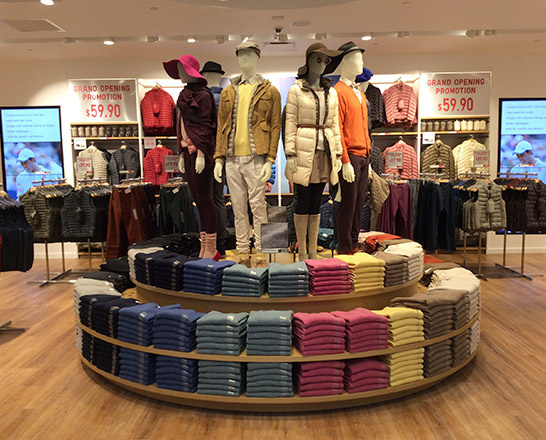
This is the rendering accompanying a Saturday report by the Trib's Gregory Karp on the 60,000 square-foot Chicago flagship store for Japanese retailer Uniqlo. This is the latest addition to 830 North Michigan, just north of the Water Tower.  And this, again courtesy of the Trib, is where we started, back in 1949.
Believe it or not, this is the same building as in the rendering.  It's been a long trip.

Mies van der Rohe saw his architecture as the expression of the industrial epoch of his time.  As Miesian minimalism evolved, however, the great tsunami of construction bearing his influence, if not his approval ("What went wrong?" he asked near the end.  "We showed them how to do it.") became an expression of a much larger movement, the Age of the Supply Chain, which stretches all the way back to the beginning of the Industrial Revolution.  Its core values are the creation of wealth through the mass manufacture and distribution of cheap goods through consolidation, standardization and the minimizing of human labor.

And so Mies's elegant towers grew into glass box office warehouses, huge floor plates, hermetically sealed, going from offices, to cubicles to extruded benches to cram the largest numbers of workers into the least volume of space.  The elegant department stores that let consumers feel they were part of the elevated classes were killed off by big-box retailers, massive warehouses with bare metal shelving and product stacked on pallets.  Local stores that were pillars of the community are replaced by standardized, numbered outlets of huge national chains. Bricks-and-mortar retailers across entire categories - books, records, video rentals and the like - were all but wiped out by on-line behemoths, Amazon above all, as the physical product is replaced by streaming digital files.  To paraphrase Keynes, "We are all warehouses now."
click images for larger view
There are exceptions - Target's rescue of Louis Sullivan's Carson Pirie Scott store is a prime example - but they are exceptions, a boutique cream-off-the-top to the larger world of supply-chain consumption.  The evolution of North Michigan Avenue is a prime example.

After the opening of the Michigan Avenue Bridge, the former Pine Street became the city's premiere upscale shopping street, with retailers flocking to the lower floors of a succession of 1920's classically-styled Art Deco buildings, personified by architect Philip Maher's 1928 Chicago's Woman's Athletic Club.
 That wasn't enough, however, for real estate developer Arthur Rubloff, who was determined to take it to the next level, turning Michigan Avenue into the "Mag Mile".

As described in a 1947 Chicago Tribune report . . . 
The over-all architectural plan for the "mile" proposes medium-height buildings on Michigan Avenue for shops and stores and taller structures at the rear for office buildings, hotels and apartment buildings.  Landscaped promenades would run between the avenue buildings and the taller structures, enhancing the "openness" of the development and avoiding the "canyons" of the closely built downtown section.
 Rubloff said more than $25,000,000 in private capital has been earmarked so far for the various projects.
The Great Fire-surviving Chicago Water Tower would get to stay, within what would be the Mag Mile's only real public square, but . . . 
The city's pumping station on the east side of the avenue would be replaced by a civic hall of music, a landscaped outdoor swimming pool-skating rink, and a subterrean parking garage for 1,500 cars. Another underground parking area for 3,000 cars is suggested for construction under the lake shore playground, extending eastward from the armory [current site of the Museum of Contemporary Art] on Chicago Avenue to Lake Shore Drive.

"All plans for development of the area," Rubloff says, "hinge upon provision of adequate parking space."
And the building that is to be Uniqlo's new Chicago flagship was where Rubloff's first began to become reality.  On January 5th of 1947, the Tribune reported . . .
Alfred Shaw, of Shaw, Naess and Murphy, Chicago architects and engineers, has been comissioned by Bonwit-Teller, Inc. of New York City, to design the new store of that organization to be built at the northwest corner of N. Michigan av. and E. Pearson st.
The 45,000 foot site, purchased for $575,000, included the old Senator Charles Farwell home and stables, which evolved into apartments in which a young Bertrand Goldberg made his home in what the architect described as commune-like conditions.
John and Charles Farwell mansions, behind Water Tower, along Pearson;
image courtesy The Chuckman Collection


Shaw said Walter Hoving, whose corporation owned Bonwit-Teller, Inc., told him he wanted the new store building to be the finest of its kind in the country . . ."It will be six stories and probably will cost about 2 million dollars", Shaw said.  "Completely air conditioned, lighted by the newest methods, and equipped with the latest in modern merchandising, it will be an outstanding addition to the city's retail store facilities"  The exterior probably will be of Indiana limestone to harmonize with buildings to the north and west.

When excavation began the previous December, the AP reported that . . .
Instead of the usual show windows, frontage on both streets will be covered with plate glass, enabling passersby to look directly into the main floor.  There will be no street displays of merchandise.
The actual building, as shown in a Chicago Tribune illustration shown near the top of this post, seemed to have dropped the continuous plate glass, but was still the epitome of restrained elegance when it opened on August 24, 1949.   An extensive history on the indispensable website Forgotten Chicago says the windows had white marble surrounds.  The selling areas were more like salons, with merchandise displayed sparingly, as if it consisted of museum pieces.  All but four of the fitting rooms that lined the perimeter of the second floor had windows overlooking Michigan Avenue or the Water Tower.
When the John Hancock Center was completed just up the street, Bonwits moved to a new flagship there in 1969.  It's been pretty much downhill for its former store ever since.  An additional floor was added, and the building reconfigured by Solomon Cordwell Buenz into a fairly brutal concrete box, with a continuous skylight and a sequence of squared buttresses at the top.  West coast high-fashion retailer I. Magnin became the new anchor tenant in 1971.  I Magnin was purchased and run into the ground by Macy's, which closed the store in 1992.  Bonwit Teller was sold for $100 million to an Australian corporation in 1987, which quickly ran it into the ground with a misguided expansion effort that resulted in liquidation of the chain and closing of the John Hancock store in 1990.

Michigan Avenue retailers fought the coming of discounter Filene's Basement to the upper floors of 830 North Michigan, fearing its impact on the street.  They lost. In addition to Filene's, a Borders book superstore took over the lower floors.  On the lowest two floors, Shaw's original facade with its large central window on Pearson was replaced with a continuous curtain wall putting the Borders interior on full public display.  It wasn't long before all the other area bookstores - Kroch and Brentano's, Waterstones, Rizzoli - were out of business.  Borders, itself, proved less the wave of the future than a big-bang blowout death of the bookstore.  The chain was eventually liquidated and closed its Michigan Avenue store early in 2011.  Filene's was eventually liquidated and closed up shop early in 2012.  All that liquidation - it sounds a bit like a series of Stalinist purges.

The fears of those traditional Michigan Avenue retailers were fully justified.  The death of Borders and Filenes haven't stopped fast fashion discounters from taking over the Mag Mile.  A Zara flagship had already opened on Michigan a few blocks down in 2009.  The Borders space was taken over the Topshop in 2011.  An H&M outlet opened just a few doors north in a space originally occupied by FAO Schwarz.  And now there's Uniqlo. 

Nabbing Uniqlo for its upper-floor space represents a major coup for General Growth Properties, which in 2013 purchased the entire building, which also houses Columbia Sportswear and a Ghiradelli Chocolate shop, for $166 million, when nearly half of its 126,000 square feet of space was empty.  The General Growth folk must have treated themselves to a really expensive lunch the day they unloaded that second-class space to Uniqlo.

Uniqlo, of course, is determined to make it first class space.  USA CEO Larry Meyer is quoted as saying "We're spending a fortune" to get it all ready for the October 23rd opening deadline. The company is a leader in what is called fast fashion retailing, getting designs to market quickly, using the most innovative supply chain techniques.  The company also talks of reconceptualizing interactive purchasing in a way that revives bricks-and-mortar retailing.  Shoppers will be encouraged to use the Uniqlo smartphone app while shopping in the store.

Founder Tadashi Yanai built the Uniqlo chain - and a $24 billion fortune that's made him the richest man in Japan - out of his father's suit business, opened in 1949 in Yamaguchi.  The first Uniqlo store opened in Hiroshima in 1984.  In Japan, the chain became known more for cheap prices than quality or fashion.   For its global expansion, Uniqlo is working to make itself not just cheap, but cool.

In a Wall Street Journal interview, Uniqlo U.K. CEO Takao Kuwahara commented "Our competitor is Apple.  At Apple, as at Uniqlo, the customer service and the customer experience is all important. "

For its design director, Uniqlo brought in Naoki Takizawa, former head designer at Issye Miyake.  In an interview for a 2012 Fast Company profile of Uniqlo, his vision seems Miesian-minimalist.  "The only things that stay are the things you need: it has to protect you from the rain, and the heat has to escape"

According to a Huffington Post report, Uniqlo's emphasis on standardization is relentless.  Employees must dress entirely in black, pass a garment folding test, memorize "Six Standard Phrases" and hand back credit backs with both hands.  Each store should look the same.  All displays must run from light to dark.

The number of styles is minimized - fabric over fashion - creating the kind of huge orders that give Uniqlo added leverage when negotiating with suppliers.  No seasonal fashion themes, increasing product shelf life.  Instead, color choices are maximized - 50 colors of men's socks.
We've yet to set the interior of Uniqlo's Chicago flagship, but it won't be hard for it be an improvement.  The Tribune report describes the multi-story escalator whisking shoppers to their store  in just 85 seconds as "a signature element of Uniqlo stores", but in reality it's an ongoing necessity.  For previous tenant Filene's, 830 North Michigan was their "Basement" in the sky, hard-to-rent upper floor space connected to Michigan Avenue via a sliver of a ground floor entrance, just wide enough to accommodate escalators and elevator.

Uniqlo's most visible contribution to the Chicago architecture is glazing over the upper floors of 830 North Michigan, giving the store maximum presence in the view down the Mag Mile past the Water Tower.  If the actual facade is anything like the rendering, the design doesn't seem to have a brain in its head, other than a few massively overdeveloped cells devoted to Sellah, Sellah, Sellah.  What was once one of the most elegant buildings on the Mag Mile has devolved into a chaotic series of stackables, each going their own way: the dark facades of Topshop, the hyperactive glazed cells of Uniqlo, and the lingering remnants of SCB's buttresses.

Every last inch of Shaw's original design has been destroyed.  In place of a graceful expression of upper-crust elegance, we have a Screaming Mimi pastiche.  Uniqlo built its huge Tokyo flagship in the dense Ginza district, with its blazing Times Square signage, and it's bringing the same kind of energy to the Michigan Avenue.

Things change.  Although exuberance isn't really a substitute for quality, these are the choices we made, and here are the results. They have their own attraction. Few will remember, much less miss, what was lost.  Welcome to the new Fab Mile, at the junction of Times Square and Blade Runner.

Read More:

Lump of Coal in Chicago Architecture's Holiday Stocking: Verizon lands with a Thud on the Mag Mile


Addendum:  Uniqlo and supply chain labor

One thing we haven't discussed is the role of supply chain process design in growing a company like Uniqlo.  To keep costs low, manufacturers roam from country to country in search of the cheapest labor.  Bad things often happen.

When it comes to issues of social responsibility, Uniqlo has often chosen to go its own way.  It initially declined to sign the Bangladesh Safety Accord, committing 80 major manufacturers to standards of safety and fairness after a 2012 garment factory fire in Dhaka killed over 100 workers, with another 1,000+ perishing in a Dhaka factory building collapse the next year.  (Fast Retailing is now listed among the companies on the Accord's signatories page.)
Uniqlo CSR (Corporate Social Responsibility) has its own extensive website, with increasingly lengthy and detailed annual reports. In search of lower labor costs, the company's manufacturing has spread from China to lower-wage states such as Vietnam (52 cents an hour wages in the city, 36 cents rural), and to Bangladesh (21 cents an hour).
from Uniqlo CSR report
For fiscal 2011, Uniqlo inspections found major to severe labor violations in 82 of the 188 factories monitored, with a goal of 100% compliance by 2015.  In 2012, when 229 factories were audited, 83 major to severe violations were found.  By 2014, the company was reporting the monitoring of 332 factories, with a total 149 major or serious violations.  Only 7 instances of violations were severe enough for a contract with an individual manufacturer to come under immediate review, and while the report states "Contracts were terminated with factories that showed no improvement", I could find no figure for the number of contracts actually involved.

Uniqlo's manufacturing expanded to Cambodia, In April of this year, the group Human Rights Now reported substandard working conditions there as well.   CSR responded with promises of enhanced workplace monitoring.  It also pledged to improve conditions at its own plants in China, where another NGO, Hong-Kong-based Students and Scholars Against Misbehaviour, documented major workplace violations in a report issued this past January.  Even with all this, third-world manufacturing remains a world where even the definitions of reform seem to infer abuse. Uniqlo's own Cambodia inspection report defines "evidence of long working hours" as "24 consecutive hours of work."

To be sure, these are conditions that are pandemic throughout the entire global garment industry. Especially in the U.S., prosperity is based on exploiting our seemingly insatiable appetite for ever-cheaper goods.  As consumers, we trade free access to low prices for a a committed incuriousity about how the sausage is actually made.

Sunday, March 22, 2015

Lucas Museum: Not Dead Yet?

Buried deep in the Sunday Trib, in the  business section, is a Front Page story from Melissa Harris

The proposed Lucas Museum of Narrative Art, which has practiced a bunkered omertà for the past nine months as controversy swirls all around it, may be stirring.  Harris reports that architect Ma Yansong "remains at work on more detailed drawings, which may include meaningful revisions . . . " 

For that sentence to be anything more than an empty PR holding action, what's needed now is not, as Harris proposes, a call from George Lucas to Mike Madigan.  That kind of backroom, insider horse trading is what got the museum in trouble in the first place.  What's needed is transparency and public engagement. 

When a job is at risk, architects can make coherent revisions to their concepts and renderings overnight.  After a nine-month disappearing act, the "remains at work" statement fed to Harris sounds less like a world-class architect than a high school student buying time to finish an overdue term paper.   While Friends of the Parks, Blair Kamin, and various other opponents hell-bent on running Lucas's project out of town remain formidable opponents, at this point, the Lucas Museum remains its own worse enemy.
Above is a photograph of the parking lot museum these opponents are battling to protect.  I hope to be writing an update on that effort - and its implications for Chicago, its lakefront, and its role in world architecture - soon.  For now, since little has changed from last July other than the overheating of the rhetoric, my original post provides a thorough overview of the potential, pitfalls and controversies of bringing the Lucas Museum to Chicago.

The Heresy: Why Chicago Should Welcome the George Lucas Museum

Sunday, May 18, 2014

Of $300 million pork barrel Roller Coasters and the Sweet Scent of Chocolate in the Chicago Air - why newspapers still matter

click images for larger view
The prognosis for newspapers, especially in Chicago, is deeply problematic.  The Sun-Times continues to throw parts of itself - including a lot of talented people - overboard, just to scrap together enough cash to get through another day, while over at the Tribune, the company is stripping its namesake newspaper of assets and loading it up with debt just before pushing it out as an independent company, a stripped vessel pitched on treacherous seas.
apologies, as always, to Stanley Tigerman.  Related story here.
What makes it more painful is when you see what newspapers, even ones in diminished states, offer what no web-based news aggregator can or ever will.   For the moment at least, both papers still have crack investigative teams that uncover scandals and outrages and campaign - often successfully - for reforms.  For example, this Sunday's edition of the Sun-Times, which wouldn't let the Koschmann case be buried, tells us how corrupt former Cook County President Tod Stroger has again found his way onto the public payroll, while  on the art's beat there's also a great profile on the restoration of historic Thalia Hall and a Hedy Weiss' QandA with Mary Zimmerman.
Thalia Hall
Over at the Trib, there's another Zimmerman interview from Jennifer Weigel, plus David Kidwell's The man who knew everybody, a great profile of John Bills, the machine fixer charged with rigging the bidding for Chicago's Red Camera contract, plus an overview of the life and work of improv master Mick Napier.
We hope to be writing later this week on Rahm Emanuel's plan to slum up Lakeview with a tornado-like path of destruction for a third-of-a-billion dollar roller-coaster Brown Line overpass just north of Belmont, but in today's Trib, Blair Kamin has beaten me to the punch with a detailed analysis on why this is such a bad idea.
Last but not least, I've written about the wonderful Blommer Chocolate plant before, but today Phil Rosenthal has a great piece Inside Blommer Chocolate, giving us a look at the previously off-limits factory, and detailing the history of a 75-year-old Chicago institution that fended off a hardball campaign by mega-conglomerate Cargill to acquire it, remaining a family-run business that handles 45% of all cocoa beans processed in the United States.  An entire new residential neighborhood has grown up around the handsome, light-colored brick plant at 600 West Kinzie, including a new park just across the street.  Blommer remains an unique part of the character of Chicago, wafting the faint aroma of chocolate throughout River North whenever a new batch is being made.
The aroma used to be a lot stronger, and drift a lot wider, before the EPA teamed up with NIMBY's to have it classified as a health hazard, as I wrote about in A Bureaucrat Triumphs and a Little Bit of Chicago Dies.
I also wrote about the new park, which, I argued six years ago, should be officially renamed the Chocolate Park.

Sunday, August 11, 2013

Great Sunday Reading: Kogan on Graceland, Borrelli on Complexity and Contradiction at The 606

The Trib's architecture critic Blair Kamin gets a run for his money with two great pieces by his colleagues in this Sunday's edition.  (You can see the stories in the print edition, or via free digital subscription on the Trib's website.)
click images for larger view
Rick Kogan on Graceland
First up, Rick Kogan has a great story on Graceland Cemetery, and the restoration by Bill Bickford of Holabird and Roche's 1888 arts-and-craft chapel.  Kogan reports that the cemetery could well become the final resting place of legendary film critic Roger Ebert, which would extend Graceland's role as a sort of Pantheon for important Chicagoans.  Especially architects - Graceland's got everyone from Daniel Burnam to John Wellborn Root, Louis Sullivan, Bruff Goff, Marion Mahony Griffin and Mies van der Rohe  In 2007, a new memorial was dedicated to William Lebaron Jenney, a century after his ashes were scattered over the cemetery.
ReadGraceland, and restored chapel, a wonder to behold.

Christopher Borrelli on The 606
Even better, however, is Christopher Borrelli's consideration of The Bloomingdale Trail, now rechristened, as we wrote about Friday, The 606.  Borrelli faces head-on what is, in the end, the key question about the project:  when you take a rotting piece of real infrastructure and transform it into a public park, do you wipe out the very identity that make the place worth saving?  

And make no mistake, the Trail exists, even today.  As Borrelli relates, although every single one of them are illegal trespassers, the Trail attracts a large number of people who see past the broken glass to walk, jog, and even practice yoga while enjoying the Trail in its very distinctive current state . . .
The old Canadian Pacific rail, which hasn't been used in decades and runs along Bloomingdale Avenue (hence the trail's name), has rusted into chocolate autumn browns. The dark wooden tracks running beneath those rails have splintered. And the ground, littered with broken stones and glass shards, sprouts tufts of lilting greens and long grasses and sporadic fields of dandelions, is so dense in places you wonder if, given a few more decades of unimpeded neglect, a prairie could return to the West Side.

Standing on the Bloomingdale Trail feels like standing inside a Terrence Malick movie.
It is a ruin, and it is real.  What will replace it, in the words of the Trust for Public Land's Beth White, is “a giant, seamless artwork.”  Borrelli counters that it's already art.  “But it's not safe,” is Ms. White's reply.

And there's the rub.  The 606 is a Haussmannian-scaled intervention.  It involves not only the gentrification of the 2.7 mile rail line, but the replacement of a great deal of existing artwork such as the charming dog murals at Churchill Park.
Those interventions happened over time, neighborhood by neighborhood.  Although designed for variations, and with substantial community input, The 606 is a unitary, imposed design which, most likely, will speak less about the Chicago out of which it arose than the Chicago the leadership would like it to become.

Today, Paris wouldn't be Paris without those broad boulevards Haussmann smashed through the crowded older city.  On the other, hand Paris would also not be Paris without the narrow streets of the maze-like districts that survived the transformation. 

What I really like about Borrelli's take on The 606 is how he gets the complexity of architecture, and how its inextricably intertwined with culture, commerce, politics and life as it's lived day-to-day, moment-to-moment.  He has an acute awareness of the larger issues that sometimes eludes Kamin, who often seems most comfortable treating buildings as autonomous objects.
As I wrote on Friday, the new name The 606 is indicative of the pervasive, generic leveling that is a hallmark of our supply chain economy.  The new Bloomingdale Trail, assuming it delivers on its promise, will be a handsome new civic amenity, but, as Borrelli observes . . .
How do you sand down the rough edges of a place like this and make it accessible to the entire community without removing the raw beauty that makes the place so unusual and memorable?

ReadOn the Trail of Art

Also:


Thursday, April 11, 2013

Grossman and Kent's Final Word on how Chicago's Good-Old-Boys network rallied to Wreck Prentice

click images for larger view
It's the Chicago Tribune story that the Chicago Tribune would rather you not read.

The paper's Ron Grossman and Cheryl Kent have done a bang-up summary of the clout-ridden process that doomed the landmarking of Bertrand Goldberg's Prentice Hospital.  If you're one of the Trib's pathetic handful of digital subscribers (half that of the Sun-Times), you can read it.   For anyone else, it's carefully stuck behind their paywall.

Even if you don't read the Trib, it's well worth picking up  a copy today. (Try not to be shocked by the fact that the Trib just raised the price a whopping 50%, to $1.50.)  When politics get in the way doesn't really include anything we haven't written before in our own copious coverage of the battle for Prentice, but it fleshes out the details and mechanics of how the good-old-boys-network that runs the city - of which the Trib, which shilled relentlessly for Prentice's destruction, sees itself as a key member -  circles the wagons to support its own, in this case  Northwestern University, who has turned their substantial chunk of Streeterville into a kind of high-tech colonial plantation where the rules that constrain all the rest of us don't apply and truth is whatever they want it to be. 

Grossman and Kent document how Chicago's Department of Housing and Development simply dumped facts and figures they got from Northwestern into their report calling for Prentice's demolition.  Nothing was vetted or substantiated.  The Commission willingly became part of Northwestern's propaganda machine.
from left: Rafael Leon, Ernest Wong, Andrew Mooney, James Houlihan
In its portrait of Landmarks Commission Chairman Rafael Leon, the article is especially damning. ”I personally don't know all the details,” Leon told them, “We believe Northwestern.”  Leon was part of a cynical remaking of the Commission by Mayor Rahm Emanuel that dumped four commissioners and stuffed the body with connected associates, none of whom were architects, in direct violation of the directives of the Landmarks Ordinance.  Among them was former Cook County Assessor James Houlihan.  According to Grossman and Kent, he's also a senior consultant with a firm that brags about lobbying the city on behalf of over 25 clients.  Christopher Reed, the only commissioner to vote against demolishing Prentice, quit. “I was disgusted,” he told Grossman and Kent, “The process was hijacked by City Hall.”

Grossman and Kent underscore the uselessness of these appointed bodies.  As with the Plan Commission - which began as independent entity - the concept is that they provide an essential check on city government, representing the larger public in objectively vetting important city actions.  That role has long since been abrogated.  They have become rubber stamps that never - and I emphasize never - do anything other than follow the scripts they've been handed by the mayor.  At a time when the city is closing schools for lack of money, a Landmarks Commission that is nothing more than an expensive extension of the mayor's PR office is a pointless luxury we can no long afford.  Keep the staff; abolish the Commission.

Read:
Landmarks Commission Unanimously Votes Itself Completely Useless
A Modest Proposal: Abolish the Commission on Chicago Landmarks
An Open Letter to Mayor Emanuel on Bertrand Goldberg's Prentice Hospital


Sunday, August 26, 2012

Crain's, Chicago Tribune add their voices: Prentice Should be Saved

click images for larger view
The headline in this week's Crain's Chicago Business sums it up succinctly:  Prentice should remain part of Chicago skyline.  The editorial rebuts Northwestern University's current full-press PR campaign to convince the public that, even with a two-block square lot across the street that has been nothing more than a chain-linked gravel pit for over three years, the University has no alternative but to destroy Bertrand Goldberg's spectacular 1975 Prentice Hospital.
"In our view, the university hasn't made the case that the structure can't be preserved," says the editorial, and it notes that "Northwestern hasn't even retained an architect, which creates the prospect that the city could trade this gem for yet another utilitarian edifice on the medical campus."

That point is tellingly reinforced over at the Chicago Tribune by Cheryl Kent, who, with Ron Grossman, is taking over the paper's architecture beat from Pulitzer Prize-winning critic Blair Kamin while he's away on a fellowship.  Kent chose to use her debut piece in her new role to counter the Trib's editorial board's gleeful pandering to Northwestern's lust to trash Prentice into dust.
"Northwestern," writes Kent, "has inadvertently provided proof of Prentice's uniqueness by way of its mediocre replacement, the new Prentice, a boilerplate building that is inhuman in scale and tedious in design."  

Has the Trib buried Kent's piece?  It carries an August 24th dateline, but unless I'm blind - always a possibility - I was unable to find it in the print editions of Friday, Saturday or Sunday. (Maybe it'll be in tomorrow.)  The title of the webpage Why Prentice should be saved, is much less ambiguous than the vague headline. 

Kent lays out the truth that Prentice meets at least three - probably four- of the criteria required for designating a structure an official Chicago landmark, and calls out Northwestern for its power play politics, "If Prentice is demolished, it will be for reasons other than its worthiness as a landmark."

This is a key point often overlooked.  To Northwestern, this is not about a building, it is about power.  Northwestern is at the top of Chicago's power elite.  It does not like to be challenged.
Its public advocacy campaign to destroy Prentice is so sloppy and factually challenged that it seems almost half-hearted.  (The Chicago Sun-Times David Roeder calls it, "an embarrassment for a school of Northwestern's caliber.")  Northwestern wants it gone.  That should be enough.  

More importantly, Northwestern has deliberately subverted having a debate on Prentice in the forum where it would be most appropriate:  The Commission on Chicago Landmarks.  

In June of 2011, the matter of Prentice made its way onto the Commission's agenda. As Kent demonstrated, if any Chicago building meets the criteria, it's Prentice, and any neutral debate would most probably result in Prentice's designation - and protection - as an official Chicago landmark.  Northwestern, of course, can't have that.  So they used their clout to have the matter pulled from the agenda, and have kept it off, month after month, ever since.

According to a report in Skyline, when preservationists who are a part of the Save Prentice coalition tried to  bring up Prentice at the Landmarks Commission  meeting earlier this month, Commission Chairman Rafael Leon cut them off.  "At the appropriate time, then you can make your statement."  And when, actually, would be that time?  "I don't know, to be honest."  Even as Commissioner, Leon apparently has zero control over his own agenda; he just follows orders passed down by the Department of Development.

For 15 months, the administration of Chicago Mayor Rahm Emanuel, has enforced an official omerta on the fate of Prentice.  What actually have they been talking about?  Wars have been settled in less time.   Are they really talking at all, or is Northwestern simply deploying its clout to make sure there is no talking? 

In June, the Martin Schnitzius Cottage got the Landmarks Commission nod for official designation.  Now well into the second year, Bertrand Goldberg's Prentice Hospital can't even be discussed.  It may be classic Chicago politics, but that doesn't make the city's subversion of due process to placate clout-heavy Northwestern any less of a scandal.
image: Landmarks Illinois


Wednesday, February 15, 2012

Attack of the Hypothetical Fare Scenarios

click image for larger view
CTA survey seeks public input about "hypothetical fare scenarios" - headline of Trib story by Jon Hilkevitch

Dear beloved passenger: The CTA would like to have your opinion about possible new ways to assess charges for riding our trains and buses.  Be assured that no fare increases are currently under consideration.  (You should also be aware that there's a really nice bridge on Michigan Avenue we'd like to sell you.)  But just in case we'd ever, possibly, need to increase revenue sometime in what we're absolutely sure would be far, far into the future, we would like to get your opinion in ranking each of the following 250 "hypothetical fare scenarios" ("HFS's") in order of desirability . . .

$2.00 zoned fares for rides under 5 miles, $16.00 for not telling the cops you look suspiciously zoned out
$3.00 per bag
$.50 per escalator ride; $1.50 per working escalator ride
$2.25 for basic fare, 50 cents for transfers, $1.50 for oxygen
$3.50 if the driver sits in your lap.
$5.50 if said driver shifts energetically as the bus turns a corner
$7.50 per transcript of cell phone conversations of the deranged passenger sitting next to you
$5.00 "mystery aroma"-free section
$2.25 if you bring your own squeegee
$6.50 to harmonize with the motorman on "Rolling in the Deep" over the train intercom.
$4.50 to make up your own street names for the overhead message board
$1.00 to place a bet on whether or not that red-faced guy running like a fiend will have the doors close in his face as the bus pulls away
$4.95 for the What Subway Tunnel Location Am I Stuck In? iPad app.
$10.00 to replace "doors are closing" announcements with "you're going to be crushed like a bug!!!!"
$7.50 to allow you to kick everyone else out from under the heat lamps
$24.50 to be terrorized by Robert Shaw
$6.95 to let you amuse yourself by changing the Bus Tracker indicator from "approaching now" to "removed from service"
$4.00 for each bus not bunched up right behind the bus before it.
$16.50 to open a beer concession at the back of the car
25 cents if you can correctly identify the viscous substance on the seat next to you; $4.95 if you can't
$1.00 if you let us use your Link card to fill up the vending machines at headquarters
$2.00 surcharge for stopping within two feet of the curb
$6.00 to let you shake down other passengers for cigarettes
$2.00 if you share your cab with the driver when the bus runs out of gas.

please turn to page two . . . .


Thursday, February 09, 2012

The Death of the Newspaper: Here, Let me Help

 click images for larger view (and apologies to Stanley Tigerman)

I knew it was coming.  The announcement was made last fall.

Still, it was with a bit of rue that I opened my home delivery bill from the Chicago Tribune to find that charges have more than doubled - up 122%, the latest brainstorm from company management, and proof that gross stupidity didn't leave the building with Sam Zell.  No explanation on the bill, just a message about how much I must be enjoying the "additional 40 pages of weekly coverage,"  every one of those pages costing me more than a nickle each.  What a bargain.  Somehow I don't recall the Trib dropping the rates when they shrank the physical size of the paper several times over the last decade or so.

If any more proof were needed of the complete contempt in which the Tribune holds its subscribers, consider this:
  • You can't cancel your subscription via mail.
  • You can't cancel your subscription via email.
  • You can't cancel your subscription on the Tribune website.
When I tried to log on the website, I was told that my email - the same email at which the Tribune has been sending me bills the last eight years - was "not found.  Please try again.  Your frustration amuses us no end."

When you call the 800 number printed on the bill, you go into automated response hell.  "Let me look up your account.  Is your address .................  three.....zero......zero?" What? That's not my address.  It's the street number.  Should I just press "1" for yes and take my chances?

OK, I guess that's what they wanted. The automated voice instructs "If you wish to discontinue you service, Press 4." With a complete lack of confidence that anything good will come out of it, I press 4,  only to find that at the Tribune, not even being an automaton exposes you to working overtime.  A different automated voice scurries on to say, "Please call back during normal working hours." 

Which apparently will be another grim experience I'm not looking forward to.  On a website called Customer Service Scoreboard, Chicago Tribune customer service is ranked 425 out of 525 companies, qualifying it for the official designation "Terrible".  Comments posted:147 negative, 1 positive.

The negative replies get a canned response titled "Official company reply".  Which doesn't exactly raise your expectations, for good reason . . . 
Good afternoon, my name is Autumn Smith, and I am an employee in the Client Services dept at the Chicago Tribune.

Although our main call center is in the Phillippines . . .
What follows is a series of a graphic customer descriptions of what you have in store for you when you talk to one of those hapless folk at outsource central in Manila, whose English is reportedly somewhat tentative and who will apparently try to bargain with you if you say you want to cancel, and commit only to "taking your request", which may or may not actually be honored without a second or third follow-up, and possibly the sacrifice of your first born male child.
I was brought up at the end of the golden age of newspapers.  As a kid, I read all three of Chicago's dailies (somehow, Chicago Today, the aereated aftertaste of Hearst's old Herald American, never struck me as a real newspaper.) I couldn't even wait til the day of publication. Late every afternoon, I would walk to the corner newsstand to pick up the "Bulldog" edition of the Trib and Sun-Times, already carrying the next day's date.

Even today, I don't subscribe to the Sunday Trib.  I don't buy the Sun-Times on Sunday.  I can't wait.  I buy them as soon as they hit the newsstands Saturday morning, the same way that even though I
I've read every edition in the history of Crain's Chicago Business, I've never subscribed, because I can't wait until Monday or Tuesday for a paper I can buy Saturday afternoon. Which I do, along with the Sunday New York Times, pretty much every week, at one of Chicago's last surviving newsstands, at Chicago and Michigan.  Call me sentimental.
So now we get to watch the death throes of the very idea of a vibrant city newspaper, as the last survivors flail on their way to the graveyard.

Like pretty much every daily, the Trib killed off their book section years ago, shifting it to an anemic handful of pages in its Saturday edition, when a lower readership means not having to print quite as many copies of pages hardly anyone reads.  Now, the Trib's killing off even that, creating a Printers Row book section to be sold as a separate publication at $99.00 a year, about what I pay per year for the New Yorker and New York Review of Books combined.  The Reader's Michael Miner had a great piece on Thursday on a single Tribune article all but completey devoid of any curiousity as to the basic facts of the story being reported.

Removing content and doubling prices.  Making customer service an obstacle course. It's as if the sales staff at the Trib are all graduates of the class, "Marketing for the Suicidal."

It wasn't that long ago that publishing a city's dominant newspaper was thought of as a license to print money.  Now it's the way to burn through it.  It's the classic tale of challenges ignored as engorged margins became an addiction, of cluelessness, arrogance and desperation racing each other down a quickening whirlpool of dissolution.

You could get angry, but it doesn't seem worth the bother.  There's nothing you can do about death. It's just sad.

Time to move on.
 Why does the above shot remind me of the chamber pot scene in Visconti's The Leopard?