Showing posts with label Frank Lloyd Wright. Show all posts

Sunday, November 09, 2014

Urban Spectacle in Clout City: The Harriet Rees House's $8 million Move

click images for larger view
 In 1888, wealthy widow Harriet F. Rees had architects Cobb and Frost build her a mansion on Prairie Avenue, Chicago's "Millionaire's Row".  She lived in it for only four years before her death, so she didn't get to see her posh neighborhood abandoned by Chicago's 1% for Potter Palmer's new Gold Coast along the lakefront four miles to the north.  She didn't see what was once the city's most desirable neighborhood transformed into a raw manufacturing and industrial district.   By the time the house was designated an official City of Chicago landmark in 2012, it was a lonely presence amidst the lofts and scrap yards around it.
It was also in the way of one of Mayor Rahm Emanuel's most favored, if questionable, projects: a new sports stadium for DePaul University.  And so it had to go.  If this was the project of one of the city's clouted real estate developers, the Rees house would already be rubble.  Fortunately, it fell under the purview of two of Chicago's greatest money laundering systems - the TIF program and McPier - which are staggeringly adept at transforming general tax revenues and fees due the city into free-spending private mega-projects with massive fat contracts for all the usual suspects.

On Saturday, the Harriet F. Rees house sat in anticipation at a rotated angle to its original siting.  And if you're around 21st and Prairie on Tuesday (or Wednesday - reports vary) you can watch the spectacle of the 762-ton house being moved to a vacant lot a block and a half to the north.  According to an excellent report by Dahleen Glanton in today's Chicago Tribune, the house now sits on 29 remote-controlled hydraulic dollies with 232 wheels. Steel beams enwrap the building to keep it from falling off.  A pathway of nine-inch stone has been placed atop the asphalt roadway to facilitate the move. The home's 200-ton coach house was already moved last month.
Bulley and Andrews was hired by McPier for the project, with engineering firm Thornton Tomasetti also playing a major role.
 A Chicago landmark saved rather than demolished - it's a great success story.  So why do I have this nagging pain  in the pit of my stomach?  As with pretty much everything McPier is involved with, the Rees house move is a massive money pit.  According to Glanton, the move is costing $6 million.  The plot it's being move to cost $1.9 million.  And the house's current owners are being paid $450,000 in compensation for their substantial inconvenience.     That's right, dear taxpayers - we are paying over $8 million to move a house that we don't even wind up owning.

The Harriet F. Rees house is worthy of its landmark designation, but it is not in the same league as the Louis Sullivan/Frank Lloyd Wright designed 1891 Charnley-Persky house, now home to the Society of Architectural Historians.  Charnley-Persky suffered major damage earlier this year from a burst sewer pipe, and it's been putting together a successful campaign to fund the needed repairs. $5,000 from the Driehaus Foundation,  Another 5,000 from Alphawood.  A $10,000 challenge grant from Cynthia and Been Weese.  So far, $36,000 has been raised.   You can donate online here.
The Harriet Rees house is a middle-grade landmark by a prominent Chicago architectural firm.  Charnley-Persky is a masterpiece by two of the most important architects in the history of design.  It just doesn't have a sugar daddy like McPier.  In Chicago, even when it comes to preserving our priceless architectural legacy, it's still not what you are, but who you know.

Despite its continuing pretensions of being a global player in the art of architecture, Chicago remains, in many ways, a provincial cow town.  In this post, I've discussed how that plays out in the architecture of our past.  Later this week, I hope to be writing about the Lucas Museum, and how it plays out into our future.

Sunday, June 08, 2014

Frank Lloyd Wright at 147: Still dead, still omnipresent

Evans House, Chicago, Frank Lloyd Wright, architect
Sunday is his birthday.  Still another year has passed, and Frank Lloyd Wright is still undiminished in fame, reputation, controversy and commercial viability.  Did you know . . .
click images for larger view
 - That it was just two years ago that we demolished the house on east Cedar where Wright lived after Taliesen had been burned down by an insane servant who axed to death Wright's mistress and five others?

 - That the mistress who lived with Wright on the house on Cedar would become his second wife, and would eventually cause Wright to be jailed in Minnesota on charges of infidelity?

 - That Wright, as a nipper of an architect in the employ of Louis Sullivan and Dankmar Adler, was said to have chosen the names of the composers on the panels on either side of the Auditorium Theater's proscenium?  (Which of these things don't belong with the hours? Hint: Alfred Hitchcock)

 - That Wright's collection of Japanese prints, in many of which you can seen some of the origins of his style, formed the foundation of the Art Institute's own holdings?

 - That Wright's first employee was the talented but largely forgotten Marion Mahony, who created the signature rendering style that would serve as a trademark and poster for Wright's work?
We've written a lot about Wright - it's the law - and we've republished the links below, but for now, here's a reminder that the Prairie Style wasn't Wright's exclusive personal possession, as evidenced in the above photograph of the 1915 Miller House in the South Shore community, the only surviving Chicago commission by the immensely talented architect, John van Bergen.


click images for larger view

“I.K”, [Frank Lloyd Wright] said with almost no prelude. “I.K, I have been conventional too long! I am a genius, I know no conventions, a genius knows no law. A genius must and will live his own life. From today I cast aside conventions; from today I live my own life!” That was the gist of a ten or fifteen minute prattle, in which the words 'genius', 'life', 'conventions' were flung about like confetti at a carnival. At first, I thought that as usual architecture was on his mind . . . but the next day the papers carried as an item of news that our genius had 'eloped with the wife of a client.'
- from The Autobiography of Irving K. Pond: The Sons of Mary and Elihu
It's been said that Frank Lloyd Wright's greatest creation may have been himself.  Through many rocky decades, he clung to his self-image of ‘world's greatest architect’, and by the time he died at 91 in 1959, he had convinced most of the rest of us, as well.  On this day, June 8th, that would have been Wright's 146th birthday, the old scoundrel's sorcery remains as potent and inspiring as ever, so what better time than provide this highly selective, impromptu portrait from our writings down through the years . . .
The Night Frank Lloyd Wright Spent in Hennepin County Jail was a direct consequence of Wright's willful liberation from his second wife.


Frank Lloyd Wright and the Japanese Print - The Art Institute had a great show last fall displaying many of the Japanese prints Wright had collected early on and sold to sustain himself during the lean times.  Among the prints were some of the original spectacular Japanese-influence renderings that had helped made his work world famous, many of which came not from Wright's hand, but from that of his employee, the richly talented Marion Mahony . . .

Frank Lloyd Wright's Right-Hand Woman

Also last year, the indispensable Tim Samuelson, who currently has another great show, Modernism's Messengers: The Art of Alfonso and Margaret Iannelli, up at the Cultural Center, curated an overview of Frank Lloyd Wright's early work, centered on the time he spent as an employee of Dankmar Adler and Louis Sulivan.

Wright's Roots
 
Wrights Roots: Garrick Theater colors seen for first time in over a century
In May, a joint campaign was announced in which the Alphawood Foundation would contribute up to $10 million in matching funds towards the restoration of Wright's 1908 Unity Temple in Oak Park,, which, if successful, could also see ownership transferred from the Unitarian Universalist
congregation which originally commissioned the building to ownership by a new, endowed foundation.

Frank Lloyd Wright's Unity Temple among National Trust's 11 Most Endangered 

See Frank Lloyd Wright's Boiler!

Back in 2006, actor Peter Weller brought his own stamp to Wright in his portrayal in Richard Nelson's play at the Goodman Theatre, an interesting effort to capture Wright at his point of exile, the long, lean years between his early triumphs as his re-emergence as an architectural powerhouse in the 1930's.

Frank Lloyd Wright's Pacific Overture
Robocop channels Frank Lloyd Wright

The play also featured Harris Yulin as an alcoholic and exhausted Louis Sullivan, but when, during the play's run, a major American magazine created a list of 100 Influential Americans, Sullivan had a bit of revenge, coming in at position 59 to Wright's 76.

Koolhaas, Wright, Sullivan score in Overnights

Wright continues to be influential, as can be seen in Hyde Park, where Wright's Robie House . . .
. . . is both subtly mirrored and re imagined in Rafael Viñoly's Graduate School of Business for the U of C.
Rafael Viñoly talks Wright, new hospital, at the Logan Center for the Arts

And for dessert, a small Wrightian miscellany . . .

Frank Lloyd Wright archives won't be bleeding Art Institute Red

Frank Lloyd Wright Hits the Wall

Wright's dog house
 Let's Get Small - Frank Lloyd Wright's American System-Built Homes in Beverly
Psssst, hey - buddy!  Wanna buy the Larkin Building?


Saturday, January 11, 2014

Rural Studio, Wright's Chicago Years, Sullivan's Auditorium, Vale's Purging, Ronan's Poetic Iterations - More for January!

Okay, so now that we've gotten past the the freeze and the flood, maybe it's time again to venture and check out some great new items we've just added to the January Calendar of Chicago Architectural Events.

On Monday, the 20th, there's a fundraiser at Revolution Brewing for the Rural Studio, founded by Samuel Mockbee  and D.K. Ruth, this year celebrating its 20th anniversary, observed with an evening of Pecha Kucha-style talks.

We've got two new events for Thursday, January 23rd.  At the Arts
Club, the newly renamed Frank Lloyd Wright Trust (can a Sherman act be far behind?) will sponsor a cocktail reception and panel discussion, Frank Lloyd Wright's Chicago Years with David Bagnall, filmmaker Tim Sakamoto and David van Zanten, with the Trust's CEO Celeste Adams moderating.

Meanwhile, over at the  Cindy Pritzker Auditorium at the Harold L. Washington Library, Lawrence Vale will talk about Transforming Public Housing and his new book, Purging the Poorest:  Public Housing and the Design Politics of Twice-Cleared Communities.

This coming Thursday evening, January 16, Barbara Geiger will be talking about Evanstonian Daniel H. Burnham and the 1893 World's Columbian Exposition in a lecture titled The Devil Comes to Wilmette, at the Evanston History Center.  Earlier in the day, art historian Rolf Achilles will be discussing The Significance of The Auditorium Building, for Landmarks Illinois, at the building's Murray-Green Library.

On Wednesday the 15th, lunchtime at Chicago Architecture Foundation, representatives from SCB and Loyola will provide a Building Preview: Institute of Environmental Sustainability.
And if that's enough, we've also added a new exhibition, Iterations: John Ronan's Poetry Foundation, at the Art Institute of Chicago.

The snow is melting; the sidewalks clearing -   liberate yourself!  Escape from cabin fever with the dozens of great things still to come on the January Calendar of Chicago Architectural Events.

Tuesday, July 30, 2013

Wim de Wit, Ilianna Kwaske, Placemaking, Emotions and Planning, Pop-ups, Pruitt-Igoe, and an Ancient Roman architect in a modern Japanese bathhouse - it's the August calendar!


It takes more than those 60-degree dog days of summer to shut down Chicago.  We've got nearly thirty great items for you this month on the August Calendar of Chicago Architectural Events.

The month starts fast and furious on Thursday, August 1st with a Gallery Tour of the Architecture of the Art Institute, the opening reception of the Pop-Up Gallery show of AIA Chicago's 2013 Small Project Awards, an AIA Chicago tour of the Chicago Family Health Center in Pullman, and a session on Placemaking: Reimagining the Urban Environment at the Chicago Center for Green Technology.

You say you like the movies?  We've got your mini-film festival right here, with a showing on July 31 and another in August of the Korean romance hit, Architecture 101 at the Cultural Center, which will also host two showings of Thermae Romae, in Japanese (and Latin!) about Lucius, an architect in imperial Rome, who suddenly finds himself in a present-day Japanese public bath, where he learns things about the spa culture that he takes back to him when he returns to ancient Rome.  Complications and hilarity reportedly ensue. 

Should your tastes be less light-hearted, you can turn to tragedy when the Graham offers a screening of the documentary, The Pruitt-Igoe Myth: An Urban History.

Other highlights this month include Dr. Ilianna Kwaske talking about Behind Closed Doors: The Psychology of our Domestic Spaces at the Museum of Contemporary Art, while the Ukrainian Institute of Modern Art offers a panel discussion, Design Education at the Institute of Design with alumni from the institution founded by Moholy-Nagy in 1946.

There'll be not just one, but two Frank Lloyd Wright Preservation Trust lectures, with Wim de Wit at the Pritzker Auditorium at Holabird and Roche's Monroe Building talking about An Architectural Love Affair: Dutch Modernists and The Work of Frank Lloyd Wright, and David Bagnall discussing From Artistic to the Prairie Home: Domestic Interiors of Chicago's Gilded Age at Fourth Presbyterians Gratz Center, site of CAF's  Behind-the-Scenes: Divine Design with Gensler Architects, Fourth Presbyterian Church.

Later this month, the German American Chamber of Commerce will be sponsoring a Smart City Business Conference at a yet to be disclosed location, while at APA Chicago, the UIC's Charles Hoch will discuss Emotions and Planning.  Bring your own blue blanket to calm yourself down.

Bargaining, Anxiety, Anger, Acceptance and Anticipation - you'll experience all five stages as you maneuver your way through the delights of the August Calendar of Chicago Architectural Events.


Tuesday, June 18, 2013

Creation and the Politics of Gender: Modernism's Messengers - the Art of Alfonso and Margaret Iannelli

 Alfonso and Margaret Iannelli -click images for larger view
The new show at the Chicago Cultural Center, Modernism's Messengers: The Art of Alfonso and Margaret Iannelli, echoes two current controversies - immigration and gender in artistic partnerships - in telling a fascinating story with two compelling, parallel hooks: rediscovering the work of sculptor and artist Alfonso Iannelli, and uncovering the vital, often inseparable role that his wife, Margaret Iannelli, played in its creation.

To begin, the story of Alfonso Iannelli is a portrait of the American immigrant experience.  Late in the 19th century, his shoemaker father had left Andretta, Italy to seek his fortune in the United States, and a few years later was secure enough to bring over the rest of the family, including ten-year-old Alfonso.  Soon, Alfonso was studying art in New York, and in 1906 he became an apprentice to Gutzon Borglum, the sculptor who would later go on to create Mount Rushmore.

(click to watch on YouTube in a larger window)

According to the Tim Samuelson, Chicago's official Cultural Historian and the curator of the exhibition, young Alfonso was ripe for assimilating Borglum's philosophy, which was all “about the idea that America has to to find its own artistic voice.”

“Iannelli,” says Samuelson, “was very much an advocate of collaboration in all things, that society was full of strong individuals who work together to create a harmonious society.  He believed in the idea of democracy.  I think this all came out of his immigrant experience - the freedom of the individual to create out of himself, but then the ability of the individual to have interactions with like-minded individuals.”
By the time Iannelli decided his future lie in the Great American West and moved to Los Angeles, Margaret Spaulding was already there.  Another transplant from New York - she was born in Mount Vernon in 1893 - Margaret's family settled in L.A. in 1903.  “Even as a teenager,” says Samuelson, ”she was getting every foreign fashion and art magazine that she could. ”  By the time she was 16, she was teaching art, and shortly thereafter had carved out a career as an illustrator for fashion advertisements.  She continued her outside work even as she joined Alfonso's L.A.  studio in 1913.
“Margaret talked,” says Samuelson, “in a breathy voice and the men would be mesmerized by this beautiful blonde, dressed in these stylish clothes and talking about art in a whisper.”

The Iannelli Studios had gotten a commission to do posters - at $5.00 a piece - for the Orpheum vaudeville theater in downtown Los Angeles.
“The earliest posters,” says Samuelson, “were done on tinted cardboard, starting in 1912.  You see how they were made to read as a panel.  They had to crank these out, but they made these studies.  They knew what acts were coming and so they would try to plan to make sure that when they were placed in the cases the posters would relate to each other.”
It was a job ‘perfectly suited to Alfonso Iannelli's desire to put modern art in highly visible public places.  The posters conveyed the spirit and energy of the performers, instead of simple caricatures.’

The posters got the attention of Frank Lloyd Wright's son, John, and in 1914, Alfonso accepted an invitation to come to Chicago to work with Wright on Midway Gardens, at 60th and Cottage Grove.   During the five months he was away, Margaret continued work on the posters, and the designs began to show more of her artistic influence. “ She was looking at Art Nouveau,”, says Samuelson.  “She was looking at Secession.  Especially if you look at the Orpheum posters, there's nothing that's Wrightian in those at all.  If there was an article in The International Studio on Japanese art, she tore it out and she'd file it away.  The whole use of line and negative space, it's very much that.”
Alfonso Iannelli, studies for Midway Garden sprites
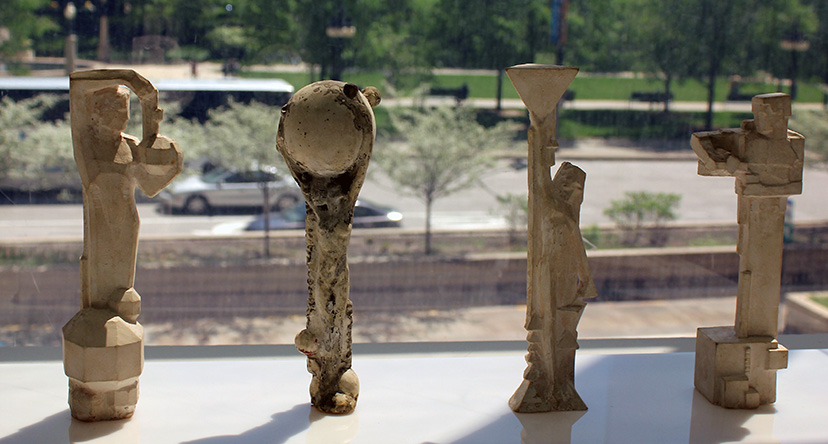
Meanwhile, back in Chicago, Alfonso was working with Wright to create what the long-vanished Midway Gardens remains most famous for today - its striking ‘Sprite’ sculptures.  Several of the originals, plus a group of studies, are on display at Modernism's Messengers.  The Sprites are displayed on a raised platform that gives you a good idea of their original relationship to the viewer.

“They were never on the ground,” says Samuelson. They always looked down at you.”
“This one had a mast that came out of the concrete, and cubes of glass, kind of like those light fixtures at Fallingwater, and the light bulbs would stagger up.  They called this one the totem.  In an early description, it's also called the gift-giver, that it's greeting you and bringing you cascading flowers in a vase.  Midway Gardens was an experiment in merging art and culture.  Of course, it quickly went broke.”

The downturn at the start of World War I saw the gardens sold in 1916 to Edelweiss Brewing
Margaret Iannelli
click for larger view
Company, which converted Midway Gardens into a beer garden. “They painted the sculpture.  The gift-giver, instead of looking like she was bringing you flowers, was painted to look like she was bringing you foaming beer steins.”

The changes - and cheapening - gained only a temporary reprieve.  Not even an appearance by the legendary Pavlova could save Midway Gardens from the ravages of Prohibition.  It was demolished in 1929, bankrupting in the process two demolition companies who had underestimated the solidness of the construction, “Wright actually said he was happy to see it go.”

When the work at Midway Gardens was published, Iannelli was appalled to discover that Wright claimed all the credit for the sculptures himself.  A contentious correspondance ensued, resulting in a rupture that precluded any further collaboration.  When Alfonso returned to Los Angeles, however, the Orpheum posters ‘displayed a new aesthetic of geometric complexity deriving from Alfonso's experiences with Frank Lloyd Wright.  Flat geometric areas of solid color predominated the designs, often contrasting with areas of gold and jet black.’  While both Ianelli's embraced strong geometries in their work, that of Alfonso tends to be harder and more abstract.  Margaret's have more of a pulse of life.
On Valentine's Day, 1915, Margaret and Alfonso were married in Santa Ana.  Soon afterward, they moved to Chicago, setting up their studio at the top of Holabird and Roche's Monroe Building on Michigan Avenue.  By the time the Iannelli's, now with two children, moved the studio for a final time, to Park Ridge, Margaret was showing signs of mental illness. 
At times she would erupt into episodes of rage.  Periods of intense productivity alternated with times when she could make nothing at all.  On occasion she would disappear for days.
After a major breakdown in 1923, Margaret was institutionalized, first at a sanitarium in Wisconsin, then on farms in the northwest suburbs of Chicago.  She continued to take on projects, but she never fully recovered, finally being committed to Elgin State Hospital in 1929, where she would remain 38 years - more than half her life.  Her last works were a series of colorful illustrations for the hospital newsletter, painstakingly created by running the pages through the mimeograph once for each color.  The last known issue to include her work was in 1948.  “Details of Margaret's last nineteen years remain sealed in the medical records of the institution.”  She died, two months after breaking her hip, on November 29, 1967.  No one claimed her body.  She was given a pauper's burial in an unmarked grave.
It's uncertain if she even had known of Alfonso's death two years before.

After Margaret was institutionalized, Alfonso began to take on studio assistants, including Edgar Miller, Bruce Goff, and Ruth Blackwell, who would also become his new life companion.  His studio remained active during the 1930's, with a lot of work at the 1933/34 Century of Progress Exhibition. There were also the theaters - the Catlow in Barrington, and Pickwick in Park Ridge- but as the thirties came to a close, work dried up.  (Be sure not to miss the arrow pasted on one of the Cultural Center gallery's high windows, pointing to the view towards Iannelli's last major commission.)

“The irony” says Samuelson, “is he was trying to be the voice of modernism, but to the new voices in modernism - the Institute of Design and Moholy and the movements of the 20th century -Iannelli's work was much too figurative.  They were taking modernism into an entirely another direction.”

“In the end,” Samuelson says, ”there weren't many people seeking him out in the studio, and then suddenly he becomes the spokesperson for the Prairie School.  Instead of people coming to discuss the new trends and the philosophies of modernism and life, almost everyone was coming to talk to him about Frank Lloyd Wright and 1914.”  His last known poster was for an exhibition of the work of Adler and Sullivan at the historic Pilgrim Baptist Church, the former K.A.M Synagogue that burned to the bare walls in a 2006 fire.
When he died in 1965, Iannelli's ashes were buried anonymously in a Park Ridge cemetery.  He became news again in 2011, when his former design studio was threatened with demolition.  It was saved at the last moment when it was purchased by the Kalo Foundation and has now been preserved as The Iannelli Studios Heritage Center.

2013 is a year of discovery for the Iannelli's.  In addition to the show at the Cultural Center, next month will see the publication of Alfonso Iannelli: Modern by Design, a lavishly illustrated monograph by David Jameson.


Samuelson is a master storyteller, and in the Iannelli's, he has a great story to tell.  First, the Americanization of Alfonso - how, even before he came here, he was shaped by American culture, and soaked up its values and reshaped them with his own work.  And then, Margaret's story, which the Pritzker Prize's announcement that it will not redress its slight of Denise Scott Brown makes especially timely.  Samuelson's wall text lays out the story of Alfonso and Margaret in compelling and illuminating detail.  Hints are placed as to who was the dominant designer in certain works, but the observer is also often left to decide for themselves.

There is no question that the backstory of the rediscovery of Margaret and her role in the work of the Iannelli Studio lends a special poignancy to the exhibition.  Ultimately, however, the art must stand for itself, and here, it does.  This would be a great show even if the walls were bare of text.

It's a very sweeping display of many types of work, from graphics to sculpture, architectural renderings and ornament, illustrations, advertisements, furniture and even Iannelli's industrial work, including a patented design for a blender's glass container.
Tim Samuelson and appliances designed by Alfonso Iannelli
I don't want to oversell it.  We're not rediscovering a lost Picasso or Rodin, but as they said of Dvorak, if  the Iannelli's aren't necessarily at the top of the food chain, they are still second-rate artists of the first order.  In itself, their work is pleasurable to encounter.  In fostering an understanding of the history of early 20th-century art and architecture in Chicago and America, Modernism's Messengers: The Art of Alfonso and Margaret Iannelli is deeply rewarding.

Modernism's Messengers: The Art of Alfonso and Margaret Iannelli, in the 2nd floor Chicago Rooms of the Chicago Cultural Center, continues through August 27.


Friday, April 19, 2013

Mies: "I am not a polygamist" - so says the Digital Public Library of America

click images for larger view
 Yesterday at noon,  the Digital Public Library of America came online for the first time.

According to Harvard Librarian Robert Darnton in the New York Review of Books . . .
The Digital Public Library of America . . .  is a project to make the holdings of America’s research libraries, archives, and museums available to all Americans—and eventually to everyone in the world—online and free of charge

How to think of it? Not as a great edifice topped with a dome and standing on a gigantic database. The DPLA will be a distributed system of electronic content that will make the holdings of public and research libraries, archives, museums, and historical societies available, effortlessly and free of charge, to readers located at every connecting point of the Web.
So, at least in its initial iteration, the NDPL isn't creating new digitized content itself, but is, instead, a kind of digital clearinghouse, drawing on already existing resources.  It looks to pick up where Google's failed Google Book Search project, and allows you to search a massive - and growing - collection of sources from a single interface..

I decided to take it through its paces.  A search for ‘Chicago’ came up with nearly 20,000 items.  Not surprisingly, a large number of those items came from the digitized collection of the University Library of the U of I, Champaign/Urbana.   One of the first interesting things I came across, once I had decided to forgo, at least for the moment, 1909's The Higher Fungi of the Chicago Region,  was Marian Ainsworth White's The Book of North Shore, from 1910, a collection of photographs of the mansions that lined Sheridan Road in Rogers Park before they were almost all demolished for the current canyon of residential towers, including Frank Lloyd Wright's house for Oscar Steffens at 7631 North Sheridan, constructed in 1909, which had a long life as the King's Arms restaurant before being razed in 1963.
From the University of Utah's J. Willard Marriott Library, there's a set of 1911-12 photographs by Taylor Woolley of Frank Lloyd Wright's original Taliesen under construction. From the U.S. Department of Labor collection, there's a 1920's photo of Oak Street beach overrun with bathers . . .
There are any number of books published to take advantage of the 1893 World's Columbian Exposition . . .
and a snuff box with the Agriculture Building on its cover . . .
There are books that compile information on hundreds of Chicago companies which long ago disappeared from existence . . .
From eighty years before the monorail at Disney World, there's the Forsyth Elevated Suspension Railway.  Labeled a “radical departure’, it appear to have never left the station.
. . . and, from the National Archives, we have the paperwork surrounding Mies van der Rohes emigration to America, including the certificate of arrival on August 29, 1938 aboard the SS Europa, and his Declaration of Intention to become a citizen, in which Mies attests that he is neither an anarchist nor a polygamist . . .

His Petition for Naturalization, including his oath of allegiance, is signed in spare and clear Miesian style . . . 
The DPLA has been structured as an open platform, encouraging developers to create apps that interact with the metadata in new ways.  There are only two apps listed on the site currently, but one of them, Search DPLA and Europeana, allows you to search, in one place, not only the DPLA but Europeana,  which includes millions of digitized items from European museums, libraries and other collections.   Stay tuned.