Showing posts with label Louis Sullivan. Show all posts

Wednesday, December 30, 2015

Death and Transfiguration: Louis Sullivan and Richard Nickel Dangerous Years

click images for larger view
(all images from Richard Nickel Dangerous Years,
courtesy Cityfiles Press


Richard Nickel Dangerous Years What He Saw What He Wrote,  Hardcover: 264 pages. $60.00 (Online Price: $50.00, including tax and shipping.)
Ultimately, you buy a book about Richard Nickel for his beautiful, often haunting photographs, and the new book Richard Nickel Dangerous Years: What He Saw and What He Wrote doesn't disappoint.  It includes scores of images never
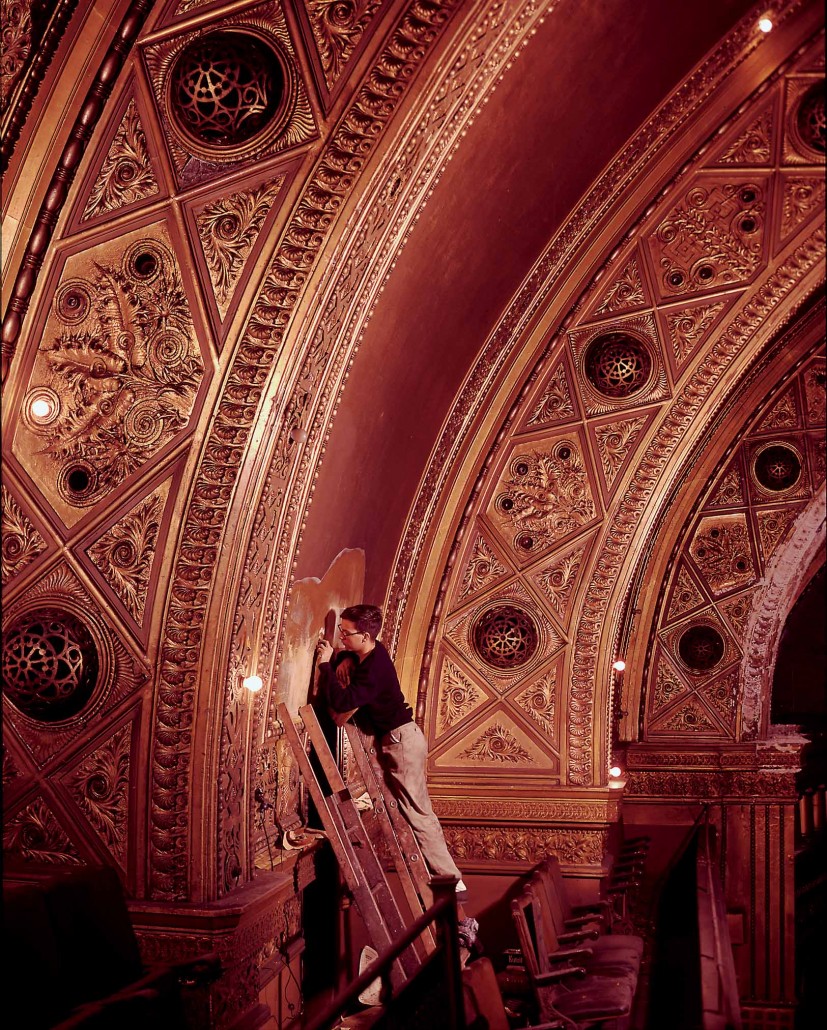
before published, some - like the photo at the top of this post of a very young John Vinci working on bringing Adler and Sullivan's crown jewel, the Auditorium Theater, back from death's door - in gorgeous color.  If you came out of Christmas with some gift cash or cards, and if you love architecture or Chicago or both, this is an essential volume you'll want to add to your library and pull down from the shelf to revisit again and again. 
Dangerous Years is much a portrait of the artist and his times as a collection of Nickel's photographs.  Authors Rich Cahan and Michael Williams have taken an almost reliquary approach to their new book, including not only the pictures of the buildings, but reproductions of the documents of Nickel's life.   Press clippings, postcards, lists, drafts, angry letters -mundane objects that manage to make the period feel vitally alive - a "To Whom it May Concern" letter written by the Institute of Design's Crombie Taylor to help Nickel get access to buildings; a Western Union telegram from Mayor J. Daley about a meeting in City Council chambers "to discuss the pending demolition on the Garrick Theater building . . . "
Not all that long after he described himself as "completely stupid", there's a piece of lined three-hole punch paper where Nickel explores in a series of small drawings the thought process behind Sullivan's ornament.  There are daily itineraries,  Notes that Nickel took of his 1957 interview with Frank Lloyd Wright  "In his opinion, L.H.S got everything from Adler, [and] if it had not been for Adler, Sullivan might never have made the grade of 'Master'".

There are photos of Nickel himself, an unremarkable-looking man in glasses of unexpressive countenance, often dressed in white t-shirts.  
Dankmar Adler residence
The feeling went into the images he captured, the now classic photographs of a world in anguished death throes, proud and beautiful old buildings spurned and forgotten, hemorrhaging rubble as they await obliteration . . . the gaping maw of the sanctuary of Burnham and Root's Church of the Covenant, split open like a cracked egg. 

There's also revealing images of buildings, not in the usual idealized isolation, but in their actual context, including a photograph of Frank Lloyd Wright's under-construction Price Tower rising out of a abject streetscape with a gas station and used car dealership in the foreground, the perspective placing both Wright's skyscraper and the gas station's vertical sign in a visual equivalency.   There are photographs documenting both the grounds and the cottage Louis Sullivan built for himself in Ocean Springs, Mississippi, destroyed by Katrina in 2005.

You want there to be a take-away, some inspirational message to be drawn.  But history always confounds.  And what is history?  The expression of power through people and events.  And the story of Richard Nickel is a time capsule of a shifting paradigm moment in American urbanism, in deep concentration on the city's South Side.

Richard Nickel and the Remaking of Post-War Chicago
In the 1940's, postwar Chicago had another word for the city's architectural heritage: The Slums.  As Afro-Americans poured into the city during the war, they formed a burgeoning "Black Belt" that swelled to take over former white neighborhoods east of the railroad tracks on Chicago's South Side.

It was among the twenty-three square miles the city had designated as "blight", said to threaten another 56 square miles adjacent, altogether more than a third of Chicago's land mass.    The feds had the money, and the city had the plan:  destroy it - all of it.  Create a tabula rasa for new development so destructed that it reminded a visiting Englishwoman of London after the German bombing raids.

Much of what was destroyed only grew into being slums; proud old buildings built for the middle and upper class, now deteriorated through neglect and misuse.  Within a single half-mile, there were 19 houses designed by the firm of Louis Sullivan and Dankmar Adler for wealthy Jewish families.

In booming turn-of-the-century Chicago, Burnham and Root and Holabird and Roche were the architecture firms of power, getting the big commissions for the huge office buildings that would come to define the Chicago School of Architecture.  They were the brains and the muscle.  Adler and Sullivan were the heart.  Most specifically Louis Sullivan, the iconoclastic genius who had no problem combining high commerce with high art, expressing the compressed energy tightly contained within the new commercial buildings into spectacular ornament bursting forth from the plain facades.

By the mid 20th-Century, however, Miesian modernism had begun its triumphant ascent, and Sullivan was out of fashion, an antique.  He had died in 1924 in a hotel room made out of a broom closet, a broken alcoholic, reduced in his final years to not especially lucrative commissions for small-town banks, works nonetheless so exquisite that their veneration increases down to our present day. 
Mid-Century Chicago had neither the patience nor the interest for such curiousity.  To the planners, what a building had been - or could be again - was unimportant.  All that mattered was securing their antiseptic visions for the future: pristine towers rising from sprawling gardens - or parking lots.
Rothschild Building (demolished)
What took place en masse on the South Side was also taking place in Chicago's commercial core, building by building.  Chicago's globally recognized architectural heritage was being decimated landmark after landmark for new, often numbingly mediocre towers.   Or worse.  Adler and Sullivan's spectacular Garrick Theater building, which combined an auditorium with a soaring early skyscraper, was proposed to be destroyed for a parking garage.

Into this mix came a young man born in Chicago to working class second-generation Polish Americans - his father drove a delivery truck for the Polish Daily News.   Like most young men of the era, Richard Nickel joined the army after high school, and afterwards returned to Chicago with a Rolleiflex camera he bought while serving in occupied Japan.  He enrolled in the Institute of Design, founded by László Moholy-Nagy, a refugee from the famed Bauhaus in Germany.

Nickel learned photography from Aaron Siskind and Harry Callahan.  Eventually he would earn both bachelor's and master's degrees.  Around 1953, he was asked to join a Siskind project to create "a 'definitive' study of the architecture of Adler and Sullivan. Nickel probably didn't realize it at the time - he described himself as having "no feelings about architecture - knew nothing about Sullivan - in shirt, was completely stupid", but joining that class would define - and control - his short life.

The study was shopped around to potential publishers as a book, The Complete Architecture of Adler and Sullivan.  But the records of the firm had been destroyed, the scope of the work unknown, with individual buildings disappearing almost weekly.  Although he would never complete the book, Nickel threw himself into the research, scouring old architectural magazines and engaging building owners in correspondence.
Obsession or habit, Louis Sullivan became Richard Nickel's life.  And it began to go beyond documenting to advocacy.  Almost single-handedly, Nickel jump-started the architectural preservation movement in Chicago, organizing picket lines protesting the demolition of the Garrick.  He developed relationships with owners and wreckers to salvage ornament from buildings being bulldozed, often in physically hazardous circumstances, often only with the help of an equally young John Vinci and Tim Samuelson.

Nickel became a ruthless archivist, forcing himself to rise again one lost battle after another.  He broke through a sixteen-foot wall of an Adler and Sullivan building under demolition to get at a vault he was told might contain photographs and blueprints.  Finding only real estate plans instead, he remarked, "The story of my life, struggling over nothing."  Nickel lost the battle to save the Garrick, but the city created the Commission on Chicago Landmarks to make sure it didn't happen again.  And then let it happen again when it cleared the way for the destruction of another extraordinary Adler and Sullivan masterpiece, the Stock Exchange Building.  Nickel wanted to save things, but his most enduring work is a necrology.  He created a photographic documentary on the willful destruction of a city's history.

--------------------------------------------------------------------

Attention to Nickel seems to take on a kind of Brigadoon quality.  Every few years a new book appears, and then disappears from sight.  Cahan's acclaimed 1994 biography, They All Fall Down: Richard Nickel's Struggle To Save America's Architecture, is listed on the publishers website as "out of stock".  CityFile's 2006 Richard Nickel's Chicago: Photographs of a Lost City is listed as "sold out", with new copies on Amazon going for multiples of  the cover price.

Most egregiously, Nickel's magnum opus, The Complete Architecture and Adler and Sullivan has proved to be something of a phantom itself.  Left by Nickel for others to complete, it was finally published in 2010, and soon sold out.  At the end of that year the book, along with the rest of Nickel archives, was acquired by the Art Institute.  Not unlike keeping Seurat's La Grande Jatte out of sight in the basement, the Art Institute, with an endowment of nearly a billion dollars, continues to allow one of the essential monographs on American architecture to remain out-of-print (new copies at Amazon.com are priced from $700 to over $1,000.)

The story of Richard Nickel has become a passion play on the divide between our ideals and how we actually live our lives.  It's become almost a narrative of ritual sacrifice, the story of a working class schlub who unlocked the secrets of the sublime and knew its servant, Sullivan, better than anyone else, but who, in the end, simply chose to know the wrong things, and was cast adrift in a world where all the best people - the rich and powerful and the far larger number of us who aspire to be both - prudently chose to learn the right things, the practical market driven things that make Nickel's obsession, however admirable, ultimately naive and pathetic.
 At a point of despair, Nickel, whose love of the water had led him to become an accomplished sailor, quotes from Benjamin Britten's opera Peter Grimes, where the old sea captain Balstrode, sympathetic but wise to the ways of the world, advises Grimes, driven mad from the pressures of his own nature hounded by the venal, uncomprehending mob, on what is now the tormented fisherman's only way out . . .

. . . lose sight of land, then sink the boat. D'you hear? Sink her.

That was Richard Nickel's life.  His struggle.  He had his time, and then it ended.  And now we have his work, his obsessive work, that has grown in importance and recognition, and finds a kind of apotheosis in the remarkable, poignant, often deeply personal images of Richard Nickel Dangerous Years.

-----------------------------------------------------

"Stock Exchange is a scandal and a tragedy beyond words . . ."  Nickel had written. He worked for three months on rescuing the great Trading Room, painstakingly restored and rebuilt by John Vinci inside the Art Institute of Chicago, a stunning ghost of almost unbearable beauty,  a perfect shrine unmoored from meaning.

And then, in early 1972,  Nickel wrote to Samuelson a startling confession, "I'm afraid our days of adventuring, salvaging, avoiding the cops, etc. in the cause of Sullivan will soon terminate.  For me anyway, since I plan to marry Carol sometime this spring summer . . ." At age 43, Nickel had fallen in love, to 33-year-old Carol Ruth Sutter. "She's crazy about me and I figured the least I could do was reciprocate."  A newer, freer, more domestic Nickel emerged from the decades of obsession.  A new person appeared to be coming into being.

But not before one last excursion to the Stock Exchange to retrieve more ornament.  The demolition workers who watched him enter the building were the last to see him alive.  Reported missing the following evening, it would take over a month before his body was found under rubble that had collapsed into the structure's basement.

For us, the meaning of Richard Nickel's life is the amazing body of work he left behind.  For Richard Nickel, did it all boil down to that sliver of grace when he finally found love?


Read More:


Phantoms: Richard Nickel's Chicago

An Epic Journey - and the Architecture Book of the Year: The Complete Architecture of Adler and Sullivan

Sunday, November 09, 2014

Urban Spectacle in Clout City: The Harriet Rees House's $8 million Move

click images for larger view
 In 1888, wealthy widow Harriet F. Rees had architects Cobb and Frost build her a mansion on Prairie Avenue, Chicago's "Millionaire's Row".  She lived in it for only four years before her death, so she didn't get to see her posh neighborhood abandoned by Chicago's 1% for Potter Palmer's new Gold Coast along the lakefront four miles to the north.  She didn't see what was once the city's most desirable neighborhood transformed into a raw manufacturing and industrial district.   By the time the house was designated an official City of Chicago landmark in 2012, it was a lonely presence amidst the lofts and scrap yards around it.
It was also in the way of one of Mayor Rahm Emanuel's most favored, if questionable, projects: a new sports stadium for DePaul University.  And so it had to go.  If this was the project of one of the city's clouted real estate developers, the Rees house would already be rubble.  Fortunately, it fell under the purview of two of Chicago's greatest money laundering systems - the TIF program and McPier - which are staggeringly adept at transforming general tax revenues and fees due the city into free-spending private mega-projects with massive fat contracts for all the usual suspects.

On Saturday, the Harriet F. Rees house sat in anticipation at a rotated angle to its original siting.  And if you're around 21st and Prairie on Tuesday (or Wednesday - reports vary) you can watch the spectacle of the 762-ton house being moved to a vacant lot a block and a half to the north.  According to an excellent report by Dahleen Glanton in today's Chicago Tribune, the house now sits on 29 remote-controlled hydraulic dollies with 232 wheels. Steel beams enwrap the building to keep it from falling off.  A pathway of nine-inch stone has been placed atop the asphalt roadway to facilitate the move. The home's 200-ton coach house was already moved last month.
Bulley and Andrews was hired by McPier for the project, with engineering firm Thornton Tomasetti also playing a major role.
 A Chicago landmark saved rather than demolished - it's a great success story.  So why do I have this nagging pain  in the pit of my stomach?  As with pretty much everything McPier is involved with, the Rees house move is a massive money pit.  According to Glanton, the move is costing $6 million.  The plot it's being move to cost $1.9 million.  And the house's current owners are being paid $450,000 in compensation for their substantial inconvenience.     That's right, dear taxpayers - we are paying over $8 million to move a house that we don't even wind up owning.

The Harriet F. Rees house is worthy of its landmark designation, but it is not in the same league as the Louis Sullivan/Frank Lloyd Wright designed 1891 Charnley-Persky house, now home to the Society of Architectural Historians.  Charnley-Persky suffered major damage earlier this year from a burst sewer pipe, and it's been putting together a successful campaign to fund the needed repairs. $5,000 from the Driehaus Foundation,  Another 5,000 from Alphawood.  A $10,000 challenge grant from Cynthia and Been Weese.  So far, $36,000 has been raised.   You can donate online here.
The Harriet Rees house is a middle-grade landmark by a prominent Chicago architectural firm.  Charnley-Persky is a masterpiece by two of the most important architects in the history of design.  It just doesn't have a sugar daddy like McPier.  In Chicago, even when it comes to preserving our priceless architectural legacy, it's still not what you are, but who you know.

Despite its continuing pretensions of being a global player in the art of architecture, Chicago remains, in many ways, a provincial cow town.  In this post, I've discussed how that plays out in the architecture of our past.  Later this week, I hope to be writing about the Lucas Museum, and how it plays out into our future.

Saturday, January 11, 2014

Rural Studio, Wright's Chicago Years, Sullivan's Auditorium, Vale's Purging, Ronan's Poetic Iterations - More for January!

Okay, so now that we've gotten past the the freeze and the flood, maybe it's time again to venture and check out some great new items we've just added to the January Calendar of Chicago Architectural Events.

On Monday, the 20th, there's a fundraiser at Revolution Brewing for the Rural Studio, founded by Samuel Mockbee  and D.K. Ruth, this year celebrating its 20th anniversary, observed with an evening of Pecha Kucha-style talks.

We've got two new events for Thursday, January 23rd.  At the Arts
Club, the newly renamed Frank Lloyd Wright Trust (can a Sherman act be far behind?) will sponsor a cocktail reception and panel discussion, Frank Lloyd Wright's Chicago Years with David Bagnall, filmmaker Tim Sakamoto and David van Zanten, with the Trust's CEO Celeste Adams moderating.

Meanwhile, over at the  Cindy Pritzker Auditorium at the Harold L. Washington Library, Lawrence Vale will talk about Transforming Public Housing and his new book, Purging the Poorest:  Public Housing and the Design Politics of Twice-Cleared Communities.

This coming Thursday evening, January 16, Barbara Geiger will be talking about Evanstonian Daniel H. Burnham and the 1893 World's Columbian Exposition in a lecture titled The Devil Comes to Wilmette, at the Evanston History Center.  Earlier in the day, art historian Rolf Achilles will be discussing The Significance of The Auditorium Building, for Landmarks Illinois, at the building's Murray-Green Library.

On Wednesday the 15th, lunchtime at Chicago Architecture Foundation, representatives from SCB and Loyola will provide a Building Preview: Institute of Environmental Sustainability.
And if that's enough, we've also added a new exhibition, Iterations: John Ronan's Poetry Foundation, at the Art Institute of Chicago.

The snow is melting; the sidewalks clearing -   liberate yourself!  Escape from cabin fever with the dozens of great things still to come on the January Calendar of Chicago Architectural Events.

Monday, August 12, 2013

Refinding, Losing - and abusing- Louis Sullivan (Again) - Buildings Burn, Landmarks are Reborn, and an Essential Monograph goes Out-of-Print

Louis Sullivan - clicks images for larger view
It was supposed to be a celebratory year.  2006 was the 150th birthday anniversary of Chicago architect Louis Sullivan.  With his partner Dankmar Adler, he had created some of the most striking masterpieces of the first Chicago School.  Sullivan split with Adler after the economic crash that followed the 1893 World's Columbian Exposition, but even as his career entered a long, tragic decline, he continued to create astonishing works such as a series of small Midwestern banks, and the Krause Music store on Lincoln Avenue.
And there were a number of celebratory events, including the Chicago History Museum's Louis Sullivan at 150 website.  You could still see the restored spectacular theater of Adler and Sullivan's Auditorium Building . . .
and you could still shop at Louis Sulivan's Carson Pirie Scott . . .
But perhaps the most striking way Chicago choose to celebrate Louis Sullivan was to burn down three of his buildings in just a eleven-month span of 2006.
On January 6, Adler and Sullivan's 1890 Kehilath Anshe Ma’ariv Synagogue, which, as Thomas Dorsey's Pilgrim Baptist Church became known as the birthplace of Gospel Music, burned to the bare walls in a fire set off by a construction worker using an acetylene torch on the roof.
Then, on October 24th, a worker using an acetylene torch to take apart a boiler in the basement started another blaze that destroyed Adler and Sullivan's Wirt Dexter Building on Wabash.
The following month, one of the firm's last surviving residences, the George Harvey House, whose owner was reported to have wanted it demolished for a new condo development, burned to the ground in a suspicious middle-of-the-night fire.

Today, seven years after that trifecta of disaster, the Auditorium still stands, although its tower's backdrop is no longer the blue sky, but the blue of VOA's new dorm for Roosevelt University.
Carson Pirie Scott has almost received a major and welcome update.  Celebrating the death of the department store, Carson's shut its doors early in 2007 after over a century of doing business in Sullivan's landmark.   In 2001, Carson's had sold the building to developer Joseph Freed, and before running aground against the disaster that is Block 37, Freed had made Sullivan's building their calling card, with a $190 million investment that included Harboe Architects leading a team that restored Sullivan's intricate cast-iron ornament . . .
. . . and uncovering the ornament designing by Sullivan for an early 20th-century remodeling of 22 South Wabash . . .
Now renamed Sullivan Center, the former Carson's store has become something of a magnet for architecture and design.  It's currently the home for both Gensler Chicago and the School of the Art Institute and its Sullivan Galleries on the 7th floor.  Last year, the building was reborn as a handsome, two-level flagship for a flagship City Target, the retailer's concept for expanding beyond suburban malls into the center city.
Photographer Richard Nickel lost his life photographing another Adler and Sullivan masterpiece, the 1894 Chicago Stock Exchange Building, while it was being demolished in 1972.  The trading room, lovingly restored by John Vinci, was reconstructed at the Art Institute.  The great entrance arch was also saved and erected within a charming park at Monroe and Columbus, where you could actually walk through it . . .
. . . until 2009, when with the construction of Renzo Piano's Modern Wing, the Stock Exchange arch was left like a garden gnome, stranded and inaccessible in the middle of a ditch-like flowerbed.
2010: The Year of Louis Sullivan

Then, four years after the official 150th birthday anniversary, four seminal events finally gave Louis Sullivan his due.
First, here was Louis Sullivan's Idea, Chicago cultural historian Tim Samuelson's masterful overview of the life and architecture of the great architect.  Designed by graphic artist Chris Ware, it made full use of the Chicago Cultural Center galleries with a a display of carbon filament lighting and supersize photos that gave you a real feel of what it must have been like to encounter the vanished buildings.  Unfortunately, Cultural Center shows don't get catalogs, so the only thing left of this great show are the memories and this eccentrically shot video . . .

At about the same time, the Art Institute of Chicago mounted Looking after Louis Sullivan, a striking collection of photographs by John Szarkowski,  Aaron Siskind and Richard Nickel.
April saw the debut of Louis Sullivan: The Struggle for American Architecture, Mark Richard Smith's labor-of-love documentary on the architects life and art.
To top it all off, in September of the year, we really hit pay dirt with the publication of The Complete Architecture of Adler and Sullivan, a landmark book that was an epic of scholarship and storytelling by Ward Miller, John Vinci and Tim Samuelson.  First the first time, there was a catalogue raisonné of every project Adler and Sullivan worked on, lavishly illustrated, including a large number of eye-opening color photographs.

Finally, the legacy of Louis Sullivan was here for everyone to see, for all time.

Well, not really.  Quite understandably, the first edition of The Complete Architecture of Adler and Sullivan sold out quickly.  It is now out-of-print.  Amazon.com lists copies from $450 to $1218.  Another dealer will sell you one for $3508.  2010 ended with the book being acquired, along with the other assets of The Richard Nickel Committee, by The Art Institute of Chicago.  There has been no second edition, and, so far, none has been announced.

Louis Sullivan: the Rodney Dangerfield of great architects.

Refinding, Losing (and abusing) Louis:

Tuesday, December 11, 2012

Out from the Sidelines: The Autobiography (and Confessions) of Irving K. Pond

click images for larger view

I.K”, [Frank Lloyd Wright] said with almost no prelude. “I.K, I have been conventional too long!  I am a genius, I know no conventions, a genius knows no law.  A genius must and will live his own life.  From today I cast aside conventions; from today I live my own life!”  That was the gist of a ten or fifteen minute prattle, in which the words 'genius', 'life', 'conventions' were flung about like confetti at a carnival. At first, I thought that as usual architecture was on his mind . . . but the next day the papers carried as an item of news that our genius had 'eloped with the wife of a client.'
         - from  The Autobiography of Irving K. Pond: The Sons of Mary and Elihu
Reading the history of the Chicago School of architecture through the eyes of Irving K. Pond is like experiencing Hamlet through Rosencrantz and Guildenstern.  The expected players - Frank Lloyd Wright, Louis Sullivan, Daniel Burnham, etc. - are all there, but the glow of inevitable historical triumph has been stripped from their beings, leaving them looking as grasping, pretentious and duplicitous as the far less immortal souls with which they shaped their era.  If history is written by the winners, The Autobiography of Irving K. Pond is the revenge of one of history's losers.

Except, of course, Irving K. Pond, is no loser, other than, perhaps, in posterity.  With his younger brother Allen, he was one of the most important practitioners of Chicago architecture's first Golden Age, as certified by no less than the self-proclaimed “World's Greatest Architect”.  At the opening of the new City Club Building in 1910, Frank Lloyd Wright declared that America had produced but three creative architects: Louis Sullivan, Wright himself, and “the Ponds, Irving and Allen.”
City Club/John Marshall Law School
 If you're looking for a Holiday gift for a true Chicago history and/or architecture buff, you can't do better than The Autobiography of Irving K. Pond.  I'm not going to oversell it.  It's not great literature, or a compulsive page-turner, but as a portrait of Chicago and its architects by someone who stands on the other side of  the myth-making, it's as tasty as a box of chocolates, and just as addictive.
Northwestern University Settlement House
Plus, as Forrest Gump famously observed, “You never know what you're going to get.”  In the case of The Autobiography, it's the frank life story of very different kind of individual, with one major obsession Pond waits until his 80th year to disclose. He remembers how - still an infant in his perambulator - he was fascinated by the view of a young boy walking on the path ahead of him . . .
I could definitely see there was no right leg . . . He seemed not a creature of the earth . . . I never have been able to trace anything of a sexual nature in the phenomenon; but from my earliest boyhood I had had a feeling that if ever I married. my life companion physically, at least, must and would be similarly conditioned..  Is it unnatural, then, that throughout my life, a child of either sex, or a beautiful woman minus a leg, more particularly a right leg, and moving easily and rhythmically  on a crutch, or one with a foot so drawn up as to be little or not at all in evidence below the skirt, should fascinate me and attract me with strange and irresistible forces?
Flash forward twenty years.  Pond, coming to Chicago from his birthplace of Ann Arbor Michigan to take a temp job in the office of family friend William Lebaron Jenney, soon lands himself a permanent position with architect Solon Bemen just as the 26-year-old Bemen gets the once-in-a-lifetime commission of designing an entire city: a company town for sleeping car magnate George Pullman built on 4,000 acres 13 miles south of Chicago's center.  In 1883, with the town well on its way to completion, young Pond leaves to make the usual Grand Tour of Europe, finding himself on Christmas Day in the church of Santa Maria Maggiore , where his eye is arrested by a striking figure slowly making her way down the aisle . . .
As the young woman walked, or rather seemed to float rhythmically down the aisle, I could see no right foot, for that leg was shortened and she was wearing a shoe with a light metal extension which in the shadows was little or not at all in evidence.  I said to myself, “There goes the future Mrs. Pond.”
For the next three days, Pond returned to the church, trying to work up the courage to talk to this enchantress.  On the fourth, he found that she had returned to California.  He corresponded with her for  years before finally becoming engaged to her in 1889, an engagement which then lingered on year after year - “her father needed her!” - until “I suggested that our engagement might have been a mistake and that it would, perhaps, be better ended.” The poor woman, Pond informs us, never married.
I have reason to believe, through observation and experience, that this fascination exerted upon certain males by abnormality in one of the opposite sex, works equally the other way about, and that among women there are those to whom the physically exceptional in men makes a similar and equally potent appeal.
Irving Kane Pond, 1912
Flash forward, again, to 1929. Allen Pond has just died.  Irving,  recently turned 72, marries Katherine de Nancrede, who he has known for forty years, since the time Katherine had injured her leg in a youthful swimming accident.  The use of a crutch during her long recovery led to complications that resulted in Katherine eventually deciding to have her right arm amputated.  There's a Rosebud-like reveal of what may have been the origin of Irving Pond's fixation, but I won't ruin it for you here.

As an architect, Pond always kept himself far removed from the avant-garde mainstream.  Frank Lloyd Wright, according to Pond, “has succeeded to Sullivan's throne and now holds the scepter. Never in my life have I been a hero worshipper-- never have I been willing to let some man, whom the mob acclaims, do my thinking and lay out a course for me.”

Pond wrote of Louis Sullivan as someone, “like myself, [who was] ill content to let his life flow forever between the restraining banks of hard and fast convention,” but he was quick to add, “I never counted myself one of the so-called Chicago School . . . ”  When a member of that Pantheon finds his way into Pond's pages, you can pretty much bet they're about to be taken down a peg.
Pullman Water Tower, courtesy Pullman Museum
According to Pond, the first true skyscraper was not Jenney's 180-foot-high 1885 Home Insurance Building, but the nearly 200-foot-high water tower Solon Bemen constructed at Pullman five years before.  The first building to give true expression to the steel frame was not Sullivan's Wainright - “a distorted Palladian Composition if there ever was one” - but the North American Building at State and Monroe by Holabird and Roche, even if it wound being an inferior reworking of the design Pond originally submitted to the developer.
Amanda Apartments
If you surmise from this, however,  that The Autobiography is the book of a bitter old man, you'd be wrong.  Irving K. Pond, in his book as in life, is an engaging and utterly charming companion, introducing the reader to all the best people: Lorado Taft, Julius Rosenwald, Harriet Monroe, Isadora Duncan, as well as giving life to others of the time who now survive only as names attached to buildings:  Wirt Dexter and Frank Gunsaulus, to name just two.
Albany Park/Korean Bethany Presbyterian Church
Pond was a dedicated participant in amateur theatricals, especially good in Shakespeare.  In 1885, he was one of the organizers of the Chicago Architectural Sketch Club, which lives on to this day as the Chicago Architectural Club.  Unlike his more sickly brother, Irving Pond always prided himself on his acrobatic prowess.  For his seventieth  birthday, he invited the press up to the roof of the YMCA building to record him going through his regular exercises, including handstands and airborne somersaults.

What might be mistaken for churlishness in The Autobiography is instead, I would submit, an impatience with the kind of Wrightian grandiloquence that bangs the drum as much to enthrall as to enlighten.  The greatness of a Sullivan or a Wright - or a Niemeyer - is predicated on immodesty, on the malcontent compulsion to remake the world.  Pond lacked that bravura gene and the poetry that goes with it.  Wright is the splendid, hungry beast bringing charm and menace to the party in equal measure.  Pond is the gentle craftsman remembered for the pleasure of his company - in person and in his buildings.
American School of Correspondence,
photo courtesy University of Chicago Medical Center
“The Ponds”, writes David Swan in the book's preface, “sought to create a modern American architecture without rejecting architectural stylistic traditions, but simplifying them through the emphasis of geometry and the inherent quality of building materials and construction.  In that regard, the Ponds were strongly influenced by the Arts and Crafts movement, with the emphasis on honest materials used honestly.”
For the better part of a century after its completion, Pond's book was available only on microfilm held at the American Academy of Arts and Letters.  Finally in 2009,  as edited by David Swan and Terry Tatum, it was issued as a handsome paperback.  Swan has augmented Pond's original, very small selection of illustrations with 350 photographs and drawings.  There's also a comprehensive list of buildings and projects.
Northwestern University Settlement House
The Autobiography of Irving K. Pond is not only an invaluable reference work documenting the work of one of Chicago's most important, if least remembered, architectural firms, but a memoir that is at once both as charming as its author, and an eyewitness report, skewed in fascinating ways that may change the way you look at things, of some of the most seminal decades in Chicago architecture.

As he concludes the meditation on his life, on family, friends and adversaries now mostly dead, battles long forgotten, buildings demolished, Irving Pond again turns to Shakespeare, to Prospero's speech near Tempest's end . . .
You do look, my son, in a moved sort, 
As if you were dismayed: be cheerful, sir. 
Our revels now are ended. These our actors, 
As I foretold you, were all spirits, and 
Are melted into air, into thin air: 
And, like the baseless fabric of this vision, 
The cloud-capped towers, the gorgeous palaces, 
The solemn temples, the great Globe itself, 
Ye all which it inherit, shall dissolve 
And, like this insubstantial pageant faded, 
Leave not a rack behind. We are such stuff 
As dreams are made on, and our little life 
Is rounded with a sleep . . . 

Finished May 9, 1939.

Irving Kane Pond, aged 82, died on September 29th of that year.
The Autobiography of Irving K. Pond: The Sons of Mary Elihu.  Edited by David Swan and Terry Tatum, with an introduction by Guy Szuberla.  Hyoogen Press, Oak Park, IL  588 pages. $40.00.