Saturday, March 10, 2012

Community Clean-up Day to Save historic Shepherd's Temple- tomorrow, Sunday, March 11

Postscript: see Lee Bey's report including photos from the Sunday cleanup.  The building will be in court again today, Monday, March 12th.
photograph: Lee Bey (click images for larger view)
from the email from Preservation Chicago . . .
New Legal Team Could Spare Historic Shepherd's Temple from the Wrecker's Ball
Abundant Life World Outreach, the church's owner, has hired K&L Gates LLC as their new legal team and they are diligently working to vacate the demolition order of the building. One of the conditions of the court is to clean and board up the church.

Join community residents and other stakeholders for: 
Shepherd's Temple
Community Clean up Day
Sunday, March 12, 2012
2:00 PM
3411 W. Douglas Boulevard
Chicago, IL

Bring your boots, work gloves, rakes and shovels and help save Shepherd's Temple from the wrecker's ball. Join your friends and neighbors in helping to preserve one of the jewels of North Lawndale. Built in 1913 as Anshe Kenesses Synogogue, the building has served as a church since 1962. In 1965 Martin Luther King spoke on its steps.
We've written before about the this North Lawndale building, forgotten until a city demolition order was issued late last year.   That spurred Chicago architect Carey Wintergreen, Lawndale activist Valerie F. Leonard and others to launch an eleventh-hour campaign to save the building, including a petition drive and trips to court to have the order stayed, as a solution to saving the structure can be saved.  A detailed analysis report from Hasbrouck, Peterson, Zimoch Sirirattumrong refutes city claims that the structure is any danger of collapse.
photograph: Eric Allix Rogers

In an excellent article by Sharon Lurye in the Chicago Weekly online, historian Robb Packer recounts that Anshe Kanesses was built by Russian Jews as the first and largest of dozen of synagogues that would eventually be constructed on to the west side to serve Lawndale's 125,000 Jewish residents.  Lurye's story also has a great set of images by Eric Allix Rogers, so it's worth checking out.  Rogers has an even more exhaustive photographic documentation on the current state of building here on his excellent blog reallyboring.net which, despite its title, is a wonderfully interesting personal journal of his photographic journey through Chicago architecture.

As you can see from the photos, the structure is in a very grave state of disappear, but it still offers up remnants that speak eloquently of its former beauty.  The memorial tablets you see in the photo were found by Wintergreen and his associates "jammed behind a steel ladder leading to the roof." They've since found a new home at Adas Yeshurun Anshe Kanesses Israel in West Rogers Park.

Much of the heritage of North Lawndale has already been lost.  This is the graceful former home to the Hebrew Theological College  at 3448 West Douglas Boulevard.
Abandoned for years, it was demolished in 2010.

Wintergreen has talked about making Good Shepherd's a museum documenting the Chicago campaigns of Dr. Martin Luther King, Jr, who lived in at a nearby building at 1550 South Hamlin - now also demolished - in 1966, and often spoke at Good Shepherd's.

A true city is a continuity, a history carried through its buildings into the current day, where the present the and future can continue to draw on a vibrant legacy of the past, of a continuous chronicle of how previous generations thought, act and built to meet the challenges of their time.  The building at 3411 West Douglas embodies that continuity to the highest degree. Golda Meir attended services  there when it was Anshe Kanesses Israel.  Martin Luther King, Jr. spoke there when it was Shepherd's Temple.  If it's allowed to vanish, it's not just the record of the city's past that will be diminished, but the richness of the Chicago's future.


Friday, March 09, 2012

The Invention of Dreams - The Themes of Martin Scorsese's Hugo - Part I

click images for larger view
I love poetry, just not in the station.- the Station Inspector
As I've written before, Martin Scorsese's film Hugo has captured my imagination more than any film I've seen in a very long time.  Although it had more Academy Award nominations - 11 - than any other film this year, and won 5 in technical categories, it's been written off as a visually sumptuous, charming fairy tale.  And that it is.  But I think Hugo is much more.  I think it will eventually be seen in the same category as such films as Vertigo, North by Northwest, and Bringing up Baby, perceived as little more than well-crafted entertainments at the time of their release, but now recognized as work of arts with exceptional thematic depth.

I find Hugo to be an astonishing film, far richer and far more complex than the press coverage would indicate.  To me, Hugo is an incredible meditation, asking more questions than it answers, on the relationship between time and art, imagination and the everyday, and the manufactures of man and how they redefine and reshape our humanity.

Judge for yourself.  Hugo has just been released on video, but this week - perhaps for the last time - you can still see Hugo as it's meant to be seen, in 3D and on a big screen - at the AMC River East and a handful of other multiplexes throughout Chicago.  Try to catch it while you still can, and feel free to write an abusive comment if you're disappointed.  In any event, I'd recommend that if you intend to see the film, you hold off reading the following discussion until afterward.  You have been warned!, as says the Lorax.

I've been wrestling with the meaning of Hugo since I first saw it last November.  It's time to lay out my cards.  It's almost midnight, so I won't finish tonight, but let's at least start . . .

----------------------------------------------------------------
"Time . . .," mutters the shambling drunkard Uncle Claude, as he contemplates his stopwatch, ". . .  my time is . . . 60 seconds in a minute, 60 minutes in an hour.  Time is everything . . . everything",  he says as he stands with Hugo beside the grave of his father.

You can't mistake time as the overriding theme of Hugo.  Young Hugo Cabret's face is first seen from behind the great clock of the Gare Montparnasse, watching the goings-on of the great railroad station through the empty space where he has removed the numeral "four".  We first see the old man at the toy booth as Hugo observes him from behind another clock.  When the old man - we'll eventually learn he's actually the famed French film pioneer Georges Méliès - looks up, the reflection of the round clock face briefly replaces the iris of his eye.   Time is everywhere.  Even during the climatic scene at the old man's apartment, if you listen closely, you'll hear a clock quietly ticking throughout.

Time as we know it today is largely a creation of the railroads so central to Hugo.   Setting departures and arrivals down to the very minute, and the creation of standard time zones, were essential to publishing dependable train schedules, the literature of a new age.  It brought a new level of precision to a conception of time that, down to our own time, has become a pervasive bedrock to experiencing our lives.

Time is Hugo's job.  He lives behind the walls of the great station, in a forgotten apartment and steampunkt maze of passageways, ladders that includes  a corkscrew chute straight out of Lady from Shanghai.

In flashback, we see a scrubbed-clean Hugo living a modest middle class life with his widowed clockmaker father, Jude Law, who one day brings home an incredible automaton, a mechanical figure shaped in human form, such as the "Draughtsman-Writer" built by Henri Mailardet in 1800.  In the 19th century such mechanisms were a mainstay of many of the best magician's acts.  The special trick of the automaton in Hugo, with its metallic, humanoid head reminiscent of the robot in Fritz Lang's Metropolis, is the ability to write, but its incredibly complex internal clockworks is in shambles.  Hugo's father promises that together they can fix it, solve it.  He contemplates a heart-shaped keyhole at the base of the automaton's neck.  "Another complication," he says, ". . . another mystery."  "That makes you happy," observes Hugo.
Hugo is polishing the automaton when Uncle Claude (Ray Winstone) bursts into the apartment. "There's been a fire.  Your father's dead," he announces unceremoniously, sweeping Hugo away so quickly that the only thing he takes with him is the automaton, the last link to his father.  After training Hugo to help him wind the station's many clocks, Uncle Claude disappears, and that job becomes Hugo's alone.  Hugo is completely alone.  He steals food from the cafe, and clockwork parts from the old man in the toy booth to help bring the automaton back to life.
Waiting room, Union Station, Chicago
Railroad stations - like airports - are best known as places of anonymity, but out of the anonymous, cattle-like stream of commuters, Hugo (Asa Butterfield) lives vicariously, an orphan flaneur, by observing his impromptu "family" of the station's permanent residents: the faithful doberman Maximillian, sidekick to the menacing Station Inspector (Sascha Baron Cohen), who papers his office walls with mug shots of the orphans he's captured in the station, who pines from afar for the flower seller Lisette (Emily Mortimer), the cafe keeper Madame Emillie (Frances de la Tour), the News agent Monsieur Frick (Richard Griffiths) who pines for Madame Emillie, the stern but kindly bookseller Monsieur Labisse (Christopher Lee), the old man at the toy booth, and his young godniece Isabelle (Chloë Grace Moretz), who soon becomes Hugo's comrade in arms.

Inevitably, time marries to motion.  Orson Welles once famously described making a motion picture as "the biggest electric train set a boy ever had."  Nowhere has this been more dramatically demonstrated than in Hugo's spectacular opening shot, created by Industrial Light and Magic.  The first sound we hear, over the Paramount logo, is the chugging of a locomotive, followed by the faint sound of ticking clockwork.  The first thing we see is the movement of that clockwork, a massive and intricate interlocking collection of giant gears around a central drive shaft.  The drive shaft morphs into the Arc de Triomphe, and the clockwork into Paris itself, the headlights of traffic on the boulevards radiating out from the sun -  Place de l'Étoile,-  soon abstracting into sheer pulses of light streaming through the city like corpuscles of blood through the arteries of the human body.  Motion is the measure of life.

A blogger unimpressed with Hugo cited the fact that, despite the story being set in Paris, the major players almost all speak with British accents, and that in Hugo the art form is referred to as "movies" - an American term - rather than "film", the appropriate European counterpart.

Really, though, which is most appropriate?  "Film" refers to the physical medium.  "Movies" refers to the most central characteristic of the form - it moves.   It moves continuously.  For the first time in history, the seamlessness of human consciousness is replicated in art.  Suitably, the book from which Hugo and Isabelle first learn the origin of the drawing made by the repaired automaton has as its title The Invention of Dreams, by René Tabard (Michael Stuhlbarg).  "If you've ever wondered where your dreams come from," Méliès , in a flashback, tells Stuhlberg as a child transfixed as he watches the production of a film set beneath the sea, "you look around.  This is where they're made."
Might the way we dream today actually be different from the way we dreamed before the movies?  Could our prolonged exposure to cinematic montage affected how our unconscious parses out the experience of life during our sleeping hours?


Midnight strikes. Time, Time . . .  More later . . .

Wednesday, March 07, 2012

Private Emotions, Public Spaces - focus: Sharon Hayes, at the Art Institute through Sunday

focus: Sharon Hayes, the first museum-based exhibition of the New York based performance artist, closes this Sunday, March 11th at the Modern Wing of the Art Institute.
click images for larger view
It consists of three parts.  An Ear to the Sounds of Our History, from 2011, is a series of visual "sentences" drawing from  a huge collection of album covers from the "Spoken Word" genre centered around the 60's and 70's.  In the Near Future, from 2005-2009, uses 13 projectors covering all four walls of the gallery with a rotation of over 300 images of a single protester holding a sign for causes mostly already lost, such as the ERA and Vietnam War, in public spaces in cities from New York to Warsaw to Paris.

Sharon Hayes's work, as you might imagine, is overtly political, but its greatest interest, at least to me, is in the intersection of individual expression amidst the anonymity of public space.  In Parole, shown through multiple video screens of varying size, actress Becca Blackwell, mute but with an incredibly expressive and empathetic face, is the listener, the reflection of the expression, whether it be sitting at a desk in a small office, or walking through great public spaces such as London's Trafalgar Square with a boom microphone capturing Hayes declaiming a passionate letter to an absent lover.

In another, office-based video, U of C Professor Lauren Berlant analyzes the low status of sentimentality among academics.  Exhibition curator Lisa Doring writes that Hayes's inclusion of Berlant's analysis "is a reminder that politics, history, and even academia are inextricable from desire and love, a nation that lies at the crux of the artist's practice . . . "
courtesy: Tanya Leighton Gallery, Berlin

What interested me in Parole above all else, however, is the exploration of the relationship between public (and private) space and the emotional potency of the individual.   In that small office, Blackwell mutely coaxes a man, back is to the camera, into reading an intensely impassioned text, but in the context of that small room, sitting only inches away from Blackwell's inquiring face, the man defuses the power of the text by speaking the words in a flat, measured tone, as if reading a recipe.  This is his defense.  This is how defends himself from the possibility of being swept up - manipulated? - into a visceral, emotional expression.


In Trafalgar Square, Hayes is dealing with a huge public space, one made for rallies and mass congregations, where protesters grab a microphone to amplify their voice to the true scales of their passion, but where, on a common day, the massive square serves to deaden people much as dispersed, immobilized atoms push the cold towards absolute zero.  People come and go, or loiter lazily, largely oblivious to the architectural pretensions of their surroundings. Even as they pretend to ignore it, the sound of Hayes's voice cuts like a knife through the miasma of neutered feeling.
courtesy: Tanya Leighton Gallery, Berlin
All the more so in a constricted shopping street in Istanbul: a woman declaims Hayes's text in Turkish with such blazing intensity that it spills out beyond the usual unseen, apostrophizing frame of art, into an energy field engulfing, by chance, those randomly passing, emotion coursing like an electrocution through a circuit of complete strangers.

 
The human body moves through the public space in several ways.  Primarily, we are moving ourselves to an intended destination, led almost without thinking through the furrows of the urban fabric, closed off and in our own thoughts, as are most of those around us, the cell phone increasingly the virtual world walling us off from the one we actually inhabit.

Then there are those who are with others, talking, laughing as they walk together, providing a parallel soundtrack to the stream.  And there are those that actually distort the boundaries of the public space of pedestrian movement, shouting to someone in the distance, or even chasing each other playfully (let's hope) down the street.
There are those who consciously choose that urban fabric as a backdrop for their ceremonies, creating a collateral street theater.

Then there are those who choose to bear witness by making themselves a nest in the architecture, both as groups engaged in a social action . . .
. . . and, lastly, as lone voices,  declarations of private psyches into a public realm where the standard response is to avert one's eyes  . . .
 
. . . the content a product of conscience, the obsession the manifestation of an inner wound.  In this time of the Internet and social media, where the confessional is but a keystroke away, is it bravery or insanity to assert an individual human body, its exhaled speech or expectant silence, against an unhearing streetscape and the unending stream of human animals, minds vacantly insisting on being somewhere else?

focus: Sharon Hayes runs through this Sunday, March 11th in
Galleries 182-184 of the Modern Wing of the Art Institute of Chicago, 111 South Michigan.

Monday, March 05, 2012

Tuesday logjam - Craig Dykers, Pecha Kucha 5th anniversary, The Cathedral of Christ the Light

Yeah, we're still working on the March 2012 Calendar of Chicago Architectural Events, but we wanted to give you a heads-up on this week. 

Monday the 5th brings opening day of the two-day conference Getting it Done II - Building Strong Communities in a Changing World, at the Sheraton, while Tuesday the 6th brings a cornucopia including Craig Dykers  of Snøhetta at the Art Institute . .  .

. . .  Pecha Kucha Chicago observing its 5th Anniversary with Volume 21 at , including Luftwerk, the creators of the recent dazzling Luminous Field at the Cloud Gate sculpture . . .

. . . and SOM's Eric Long discussing The Cathedral of Christ the Light in Oakland at the Structural Engineers Association of Illinois dinner meeting at the Cliff Dwellers.  On Wednesday the 7th, Matt Wylie of Eckenhoff and Saunders and founder/President Bruce DuMont discuss the new home of the Museum of Broadcast Communications lunchtime at CAF.

We're just beginning, but we've already got nearly two dozen items on the March Calendar.  Check' em out, and then come back Tuesday for a lot more.

Sunday, March 04, 2012

On Chicago's birthday, 175 years of history on just one corner: the Tremont, George Pullman, and Ira Couch

 click images for larger view

Today, Sunday, March 4th, is the 175th birthday of Chicago, incorporated on this day in 1837.  If you hurry, there's a celebration at the Chicago History Museum from noon to 4:00 p.m.  Cake from Bleeding Heart Bakery at 1:00, and at 3:30 a panel discussion with Rick Kogan, Ed Burke, Laura Washington and Bill Savage. And at dusk, such landmarks as the Willis Tower, Hancock Center, Merchandise Mart, Union Station and Trump Tower will have special lighting.  Look for "Chicago 175" at the slope-toped 150 North Michigan, and "175" at Blue Cross/Blue Shield.

As for us, we thought we'd trace a bit of Chicago's history from just one corner, Dearborn and Lake.

The 1875 Lakeside annual directory of the City of Chicago includes an Chicago Business Directory of 1839.  It takes up only nine pages, and on the second we find of name of
Couch, Ira, hotel keeper, corner of dearborn and lake streets
His name lives on in Couch Place, a former street that is now an alley between Lake and Randolph.  Couch, born in New York, moved to Chicago the year before incorporation, in 1836.  A licensed tailor, he soon sold his shop on Lake Street and leased the Tremont House, on the northwest corner of Dearborn and Lake, filled today by the residential tower 200 North Dearborn (formerly also the site of the Commercial Hotel.)  Across the street was the shop of Lewis Isbel, Chicago's second Afro-American barber, whose clientele included such luminaries as Abraham Lincoln, U.S Grant, and Stephen Douglas. 
The Tremont House was Chicago's first freestanding hotel, an upgrade from the previous lodging options at one of the city's three inns - Billy Caldwell's Tavern, Miller's Tavern, and the Sauganash, in and around Wolf Point, where a parking lot for the building formerly known as the Apparel Center stands today, and where the Kennedy family plans to build three new skyscraper towers.

Within three years, the Tremont House burned down in Chicago's first major fire, on October 27th, 1839, which destroyed 17 buildings on Lake Street valued at $65,000.  "This naturally awakened the people to the advantage of insurance, and the business for that year increased very rapidly."  So, by the time the replacement hotel, built across the street on the southeast corner, burned down again, in 1849, there were hopefully insurance proceeds to help rebuild.  The Tremont soon became known as the leading hotel in the West.
courtesy Chicago History Museum
"The second floor of the first Tremont House because home to Chicago's first billiard hall in 1836, and was the favorite hangout of an itinerant criminal named John Stone, who in 1840 became the city's first executed criminal, having been convicted of the rape and murder of a Mrs. Lucretia Thompson."  In it's early days, sportsmen would set themselves on the hotel's steps and shoot ducks on the surrounding marshland.
 Raising the Briggs House, courtesy Chicago History Museum
A young George Pullman secured his fortune in February and March of 1861 by raising the Tremont six feet higher, out of Chicago's muck, using five hundred men to raise five thousand jackscrews, inch by inch, so that none of the Tremont's guests, including U.S. Senator from Wisconsin Timothy O. Howe, realized the building the inhabitated was moving with them in it, unless they noticed that the number of steps to the entrance kept increasing.  Pullman would make the Tremont home to the first offices of the Pullman Sleeping Car Company, which would go on to revolutionize long-distance travel, leading Pullman to create one of the world's foremost communities in the town of Pullman, and instigate one of America's most contentious and violent periods of labor strike with the 1894 Pullman strike. 

It was from the balcony of the third Tremont House, in 1858, that Stephen Douglas announced his campaign for the United States Senate.  According to the Chicago History Museum's excellent The Great Chicago Fire: Web of Memory website. . .
In Lincoln, Douglas, and Slavery:  In the Crucible of Public Debate, David Zarefsky describes the evening of July 9, when Douglas launched his campaign with a speech from the hotel’s balcony.  Lincoln, in Chicago for the opening session of the United States District Court, was in attendance.  When he heard Douglas attack his “House Divided” speech as endorsing radical abolitionism, Lincoln announced that he would appear at the hotel the following evening, as he did, to respond. 
 And it was at the Tremont that the defeated Presidential candidate Douglas, who often stayed at the hotel, died suddenly on June 3rd, 1861, less than three weeks after the attack on Fort Sumter that marked the beginning of the great Civil War.

 In 1855, hotelier John Drake, whose son built the Blakestone and Drake hotels we know today, had secured a one-quarter interest in the Tremont, and soon owned it outright.  When the structure burned to the ground in the Great Chicago Fire of 1871, Drake made the Michigan Avenue Hotel, at Congress and Michigan, the only hotel on the near South Side not destroyed by the flames, the temporary Tremont.
image courtesy Chicago History Museum
The last Tremont House, six stories tall and designed by Chicago's first architect John Van Osdel,  opened in 1873  In 1902, it became home to Northwestern University's law, dental and business chools.  The structure was demolished in 1937, replaced by a parking garage that was itself replaced in 1987 with the Theatre District Self-Park, where every floor was named after a Broadway musical.  Sportsmen no longer congregate: the only ducks to be found in the environs Tremont's former site are when the Goodman programs Ibsen.
And Ira Couch?  He's still around, although he died of "complications of disease caused from sudden cold" while on winter sojourn among "Cuba's sunny isle of fruits and flowers".  The balconies of the Tremont were draped in black. Eighteen months later, his remains were interred in the $7,000 family tomb, designed by Van Osdel, in the City Cemetery.  Weighing one hundred tons, it required eight horses to set into place.  When the graves in the cemetery were removed in the 1870's to create Lincoln Park, it was estimated it would cost $3,000 in 1877 dollars to move the Couch Tomb, and so it remains there - with the remains of Ira Couch - to this day.

Ira Couch was here a year before Chicago's 1837 incorporation.  Maybe he'll be one of the few things left after the glass towers crumble, the raised streets collapse to the terrain's normal level, and Chicago otherwise disappears from memory.


Thursday, March 01, 2012

Landmarks, Ty Tabbing on State Street today - March calendar . . . soon

 click images for larger view
Spring was in the air Wednesday - for all about two hours.  What better time not to do necessary work?   So, the March calendar isn't quite ready yet.  I forgot to feed the cat and he gnawed away the "M" key on my keyboard.  I don't think it agreed with him, 'cause when he thew up, it was only an "N". Maybe the rest will come out later.

But I digress.

So here's a heads-up that today, Thursday, March 1st, the Commission on Chicago Landmarks holds its monthly meeting at 12:45 p.m. in the City Council chambers, 121 North LaSalle, Room 201-A, marking still another month of being missing-in-action on the most important preservation issue currently in play in Chicago:  protecting Bertrand Goldberg's iconic Prentice Hospital from Northwestern's determination to destroy it for an empty lot.

Over at the Millennium Room at the Chicago Cultural Center, 78 East Washington, at 12:15 p.m., Friends of Downtown puts on its monthly brown bag luncheon lecture (white bags also ok, clear plastic, no - nobody wants to have to look at all the stuff you're about to eat).

Ty Tabbing of the Chicago Loop Alliance will "present a talk on the history and the remake of State Street over the past two decades, including the removal of the mall."  Tabbing had written to us last November, when we had some rude things to say about the Alliance's Lightscape project, that the Alliance's Pop-Up Art program, using the windows of empty storefronts as temporary galleries, was still a going concern, and he's proven true to his word.

Pictured at the top of this post is a Pop-Up display of Scott Williams "past and present screen printed posters that have a heavy r&B/soul feel.  His posters have gained a cult following here in Chicago."  It's on display 24/7 in the street-level windows of the long-empty Holabird and Roche Century Building at 202 South State, owned by the Federal government.  With the new canopy and display windows, the GSA has turned what was once a derelict corner with rotting scaffolding into a handsome Loop amenity.

There's also, Artists Without Borders, the work of Liz Miller and Baltazar Castillo in the windows of the former Borders store at 150 North State.  I was looking at the work in one of those windows when a guy came up to me - "Hey, I see you looking at this.  You know, I was in the alley across the street over there by the theater and I looked down and I saw this piece of wood and it was shaped just like a dagger.  It looked just like this art in the window here, see?  I was thinking of just laying it down in front of the window, but then I said, nah, that wouldn't probably be right."

But I digress.

And now . . .

. . . a beaver with a stick . . .
from  the exhibition, Loop Value: The How Much Does it Cost? Shop, at the Chicago Architecture Foundation, 224 South Michigan

So I have to go back to the calendar now, or maybe just lie down.

Monday, February 27, 2012

Getting Chicago Culture's Light out from under the Bushel - One Word, Benjamin: Streaming

If you're one of the people who actually check out my monthly calendars, you know - both of you - that there's always a wealth of great lectures, forums and presentations going on.  Like fireflies, they light for a moment and then disappear.  If you live anywhere else in the world other than Chicago, or if you just couldn't make it downtown that day, well, too bad for you.

It took cultural institutions a long time to figure out that whole internet thingy.  And they're still catching up to basic idea that public events needn't be disposables.

At one time, the Graham Foundation was making its lectures available online, but that seems to have fallen by the wayside  To best of my knowledge, the great Art Institute creates custom-made videos, but no streaming.
click images for larger view

Now, the Chicago Architecture Foundation has taken the reins and gone where its more monied brethren have dared not tread.  I knew that last Wednesday's CAF lunchtime lecture with Lesley Slavitt of Roosevelt University and VOA's Christopher Groesbeck discussing the school's spectacular new dorm building was likely to be a good one.  Unfortunately, I couldn't get away (and it sounds like they had a full house), but, picking up on a CAF Facebook post, I was pleasantly surprised to discover that I could also take in the lecture on my computer as it streamed live.
It wasn't anything fancy - just a single camera covering both the speaker and the projected slides, and there was, truth to tell, some major audio distortion problems - but it meant that even those who couldn't be there in person didn't have to miss out.  More to the point, a recording of the lecture is now available on the CAF Facebook page to anyone in the world via on-line streaming.

The technology - in this case via Ustream - isn't expensive.  In its basic form, including ads, it's actually free.  Surely Chicago's other great cultural institutions can afford free.  For a bit more money and effort, you could load the slides beforehand and actually show them in full screen with occasional cuts to the speaker.  You can go High Def or have multiple cameras.  You can even do green screen effects.  Think Alison Fisher lecturing on Bertrand Goldberg while appearing to be hanging by her thumbs off a Marina City balcony. (ok, maybe some bells and whistles you don't really need). 

The point is that the technology is manageable and it's inexpensive.  How long before Chicago's major institutions transcend the 20th century and enter the 21st?

The Chicago Humanities Festival is already on the ball, posting YouTube videos of many of its lectures, including such speakers as Dan Savage, playwrights Tony Kushner and Sam Shepard, as well as the lecture by Jeanne Gang you see below.

Tonight, Tuesday, February 28th, the Chicago Architecture Foundation is offering the latest in its series of Chicago Debates: Beating the Odds: Designing a Casino for Chicago - Lakeside Resort or Bling Bingo in a Box, an all-star event moderated by Edward Lifson with Cook County Board President Toni Preckwinkle, the Reader's Mick Dumke, CNU's John Norquist, Kimbel Goluska and Dennis Judd.  (Apologies for the montage below.)
 It starts at 6:00 p.m., it's free with registration, and it's at the fabulous Chicago Theater.  If you can, you should go.  If you can't, the CAF is streaming it for you, off of their Facebook page.  There's no link for it yet, but I'm betting there will be by 6:00 p.m. Tuesday.

If the CAF and CHF can do it, why not everyone else?  Chicago's riches shouldn't be a local secret.  They should be available to the world.


Wednesday, February 22, 2012

Erleichterung im Winter

click images for larger view
It's been there,  inverted subversive flowering from the dead branches of Winter, since just before December's longest night, and, as the endless chill darkness finally begins to ebb, blushes our impatience for Spring.
A collaboration between the GSA, Portraits of Hope, and young artists from Comer Children's Hospital at the U of C, and Kenwood Academy, in the empty building at 212 South State.

Monday, February 20, 2012

Mies to Stop Flowing at IBM lobby?

 click images for larger view
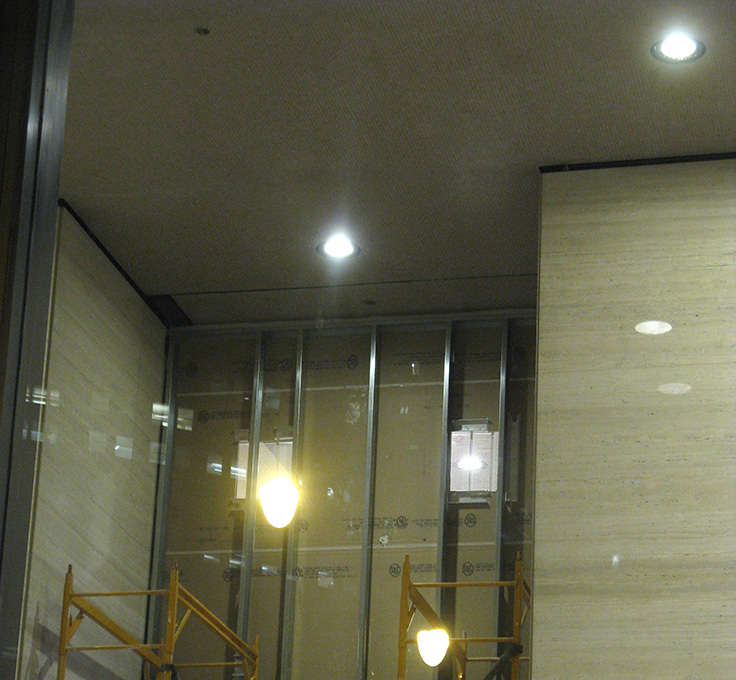
The architecture of Mies van der Rohe is all about openness and sweep, but try to tell that to the current owners of his classic IBM Building, now known by its address, 330 North Wabash.

The preliminary report from the Commission on Chicago Landmarks. issued just before the property became officially designated, referenced "first-floor lobby interior" as one of the structure's historical and architectural features meriting protection.  Apparently something got lost in the translation.  On Monday, I took these pictures of metal framing and drywall going up to partition off the north end of the lobby, where doors and windows have been covered in brown paper to avoid prying eyes.  The Landmarks Commission has been reviewing and approving multiple noncontroversial renovations to 330, mostly on the upper tenant-occupied floors, but also including the recently completed accessible ramp to the plaza off of State and a future additional canopy for the hotel finally going into the space.  I was unable to find any authorization of this construction in the most recent permit review reports.
In December of 2010, Hong-Kong based Great Eagle Holdings announced that they had acquired floors 2 through 13 of 330 N. Wabash for a new 216 room Langham Hotel.  The office portion of the structure is also doing well, on track to being 84% leased after recently landing some major new tenants, including the American Medical Association, in a deal - according to Crain's Chicago Business - that includes naming rights to the building.
Please, someone tell me these new lobby walls are only temporary protection, or that the drywall will be replaced with glass, but I fear they look a little too solid to be anything less than permanent.  Give it a decade or two and another owner will rediscover the value of putting it all back to Mies's original vision.


Creative Placemaking, 5 Big Ideas, North Grant Park Revised, plus Lifson on Prentice, Uhlir on Netsch, Aquilino, Doug Reed - lots more for February

Yeah, I know - I thought we'd be done by now, too, but I was wrong.  We've just added several great new items to the February Calendar of Chicago Architectural Events.

This Thursday, the 23rd, in the Millennium Room on the 5th floor of the Chicago Cultural Center, the Great Cities Institute is sponsoring Creative Placemaking: How, Why, Outcomes, presenting the results of a national scan of successful creative placemaking efforts. On Tuesday the 28th at the Chicago Hilton and Towers, the Local Initiatives Support Corporation Chicago will present Building the 21st Century City: 18th annual Chicago Neighborhood Development Awards, with Rahm Emanuel scheduled as keynote speaker, and an afternoon forum 5 Big Ideas for the 21st Century City.  And on Wednesday the 29th, at the Daley Bicentennial Fieldhouse, the Grant Park Advisory Council will both be electing officers (who knew?) and presenting the latest revisions from Michael van Valkenburgh for the North Grant Park Renovation Project.

From Edward Lifson discussing Those Mysterious Curves of Bertrand Goldberg's endangered Prentice Hospital at Häfele on the 23rd, to moderating a session of CAF's Chicago Debates - Beating the Odds: Designing a Casino for Chicago on the 28th, to Roman Catholic Art and Architecture and VOA's Roosevelt Tower, Marie Aquilino at the Graham, and Doug Reed at Crown Hall, all this Wednesday the 22nd,  

Rebecca Graff on Urban Archeology at Charnley-Persky, and a lecture and booksigning for Barbara Lanctot's A Walk Through Graceland Cemetery at Glessner House, all on Thursday the 23rd, Merritt Bucholz at IIT on the 27th, and the Structural Engineers Association of Illinois all-day seminar on Wind Loading and Wind Engineering on Tuesday, the 28th, and a Wednesday, the 29th crammed with Connecting Digital and Physical Space at DePaul, Randolph Tower at CAF, Ed Uhlir on The Legacy of Walter Netsch at the Cliff Dwellers, and a Pocket Guide to Hell at Gallery 400 . .  .

There are still over two dozen great items to check out on the February Calendar of Chicago Architectural Events.