Sunday, July 13, 2014

Celebrating Millennium Park's 10th Anniversary - with the bark off

click images for larger view
This Wednesday marks the 10th anniversary of Chicago's Millennium Park.  It's a cause for celebration, and I definitely want to join the party, with multiple posts as the week goes on.  But  while it's considered bad manners to raise touchy subjects on such occasions, I'm going to start by taking up a few of them, as the critics at the Chicago Tribune seem less interested in reasoned assessments than in breathless schoolgirl prose that makes it look like they've taken on a side job writing PR brochures.

In his piece, Millennium Park's impact on summer classical scene, Trib Music critic John Von Rhein  praises (rightly) the acoustics of the Pritzker Pavilion, but can't be bothered to mention the people who designed it.  (For the record, it was Oak Park's Rick Talaske).
Von Rhein also is spot-on in comparing the adventurousness of the Grant Park Music Festival at the Pritzker compared to the increasing marginalization of the CSO presence at Ravinia.  Then, inexplicably, he starts winging off on how “there no longer is a major price differential between a a ticket the CSO at Ravinia and a seat in the reserved section of Pritzker Pavilion”.  He argues that 25 bucks gets you a seat (not very good) in the pavilion at Ravinia, with lawn seats - most of which have a very poor view of the stage - at only $10.00, less than the $100.00 Grant Park charges for the best guaranteed seats for 5 concerts.  Really? 

Von Rhein is willfully blinding himself to the most basic fact of the Grant Park Music Festival.  It's free.  At Ravinia, there are zero free seats, none, zilch, nada. At the Pritzker, the bulk of the seats in the pavilion - and the entire lawn - are free.  It is a free music festival in which some seats are allocated to contributors.  Von Rhein's truly bizarre non-sequiter can only be explained as a sop to Ravinia, a major Trib advertiser.
More egregious is the puffery of Trib architecture critic Blair Kamin.  Despite a seasoning of "and so are they all honourable men" disclaimers, Kamin's piece reads less like as an architectural analysis than a real estate report.  While writers most often don't compose their own headlines, the one attached to Kamin's piece pretty much sums up its perspective: Millennium Park: 10 years old and an economic boom  - Chicago's dazzling urban space also proves a good investment.
Kamin dismisses the massive overruns that took the parks cost to nearly half a billion dollars, comparing the original budget to a Ford Fiesta and the final to a Ferrari.  In fact, the additional costs of the park, many of them traceable to rework of hasty construction rushed along by then Mayor Richard M. Daley's underlings to make the original turn-of-the-century opening date, were a canary-in-the-mine-shaft warning that no one cared to heed, of Daley's burgeoning fiscal mismanagement, which would flower unimpeded in the parking meter fiasco, his corrupt TIF system skimming billions from the city's general tax revenues, the financial sinkhole of destroying the Michael Reese campus in an inept quest for the 2016 Olympics, and the use of gimmicks such as interest-rate swaps that are now threatening to backfire to the tune of $200 million.  The story of Millennium Park shows what made them all possible, but, hey, Millennium Park is great, so we get to stay stupid.  Who wants to look behind the curtain, right?

Kamin quotes one of those risible academic studies (or TIF reports) that starts with a conclusion and then back pedals to assemble data in support, inferring that without Millennium Park, $2.4 billion of development would never have happened, and Chicago itself would have sunk to the bottom of Lake Michigan.  But why stop there?  Shouldn't we also credit Millennium Park for all those new residential towers in River North, Streeterville, and the booming Fulton Market district?

Kamin writes how Millennium Park was “praised as a departure from the 19th century model of parks as nature-inspired refuges from the industrial city's polluted air and packaged streets,” as if that concept were some kind of antiquated relic rather than continuing to be an essential resource for any dense city.
The downside of Millennium Park is the idea that every successful urban park now has to be some sort of manufactured fun factory, which, itself, is a distortion of MP's high level of artistic achievement and sense of balance (see: Lurie Gardens).  Its most immediate influence in Chicago was the way it encouraged Richard M. Daley to follow up MP by trying to ram a new museum into the protected “Open, Clear and Free” park just west of Millennium Park.  If he had not been thwarted, we would be seeing a lot more construction cranes above Grant Park right now, and that wouldn't be a good thing.

Millennium Park sucks in the bodies - nearing 5 million a year - and spins off money, which makes it a media darling, but equally important, I would argue, is the kind of community resource that's to be found in recent neighborhood parks such as Palmisano in Bridgeport or Bartelme on the West side, or the new Maggie Daley Park currently under construction on the site where Daley wanted his museum. Millennium Park had minimal influence on these new parks, and they're all the better for it.
As I wrote just after it opened, the triumph of Millennium Park is founded in “shear consumerist delight”.  Both Anish Kapoor and Jaume Plensa's contributions arose out of strong aesthetic conceptions, and while the strength of their ideas may well filter down subconsciously to visitors, the fundamental payback is how the public has taken to the Crown Fountain as an urban water park, and to Cloud Gate as a funhouse mirror prophetically custom-made for selfies. 

The triumph of Millennium Park is being plotted on an economic scorecard.  That's only fitting in this, our Age of the Supply Chain, where a value that cannot be monetized or reduced to a mathematical construct has no valid existence.  It's the lie that distorts and hollows out our humanity.  I'm as much a sucker for numbers as the next guy, but I think that what's most interesting about Millennium Park is to be found beyond that lazy and accustomed scorecard, in the realm of sensual experience and emotion, and it's what I hope to address - however imperfectly - in subsequent posts. 

Monday, July 07, 2014

The Heresy: Why Chicago Should Welcome the George Lucas Museum

click images for larger view
Seven years ago, I spent a lot of time writing in opposition to then Mayor Richard M. Daley's shameless blitzkreig to force a new building for the Chicago's Children Museum into a part of Grant Park mandated by law to be kept “Forever Open Clear and Free.”  Thankfully, the combination of strong organizing, mayoral overreach, and an economic crash coupled to the museum's singular ineptitude at fund-raising effectively quashed that plan. I've also written against Argo Tea's appropriation of Connors Park.  I'm not real big on private interests taking over land held in trust for the greater public.

Now another battle over Grant Park has erupted, with most of the same forces that rallied against the Children's Museum re-assembling to oppose another proposed new structure.  This time, however, I seem to be finding myself on the opposite side.  I want to explain why, and to put forward why I think this is a very different case from the one we faced back in 2007. I'll begin with a summary of the story so far, but if you want to skip right to my arguments, click here.

The Chicago Lucas Museum: whirlwind and backlash

A long time ago in a lost world far, far away, I remember my first encounter with Star Wars.  It was at the premiere at the late, lamented Esquire in the Gold Coast, where George Lucas's Wagnerian sci-fi drama, with its John Barry production design oscillating between oppressively sleek and heroically derelict, played out within the high style of the Esquire's ocean-liner Art Deco elegance.

Although initial expectations were low, Star Wars became an immediate box-office sensation, and created the foundation both for the what would become the most successful movie franchise of all time, and for one of America's great personal fortunes.

Director/Producer/Industrial Light and Magician George Lucas is said to be worth $5 billion, and lately he's been struggling to find someone who will accept a large chunk of that wealth to create the Lucas Museum of Narrative Art - a/k/a the “Star Wars” museum.  Lucas has just gone through a bruising four-year negotiation with the Presidio Trust in San Francisco to construct the museum in his home state, only to have the Trust rescind its offer of a site within the historic military base that became a public park in 1994.

Then on the last Wednesday in June, Sun-Times columnist Michael Sneed revealed that, after a whirlwind courtship by Mayor Rahm Emanuel, Lucas had committed at least $700 building to realize his vision in Chicago.
While the Chicago Sun-Times was a lonely voice in support of the museum, opponents quickly circled the wagons.  A major opposing voice was the Chicago Tribune, which is especially ironic, as it was its publisher Robert McCormick, more than anyone else, who sullied the lakefront through his insistent lobbying to commandeer what should have been public park land for his vainglorious pursuit of a convention center he envisioned - correctly - would be his memorial.  That despoiling prize long secured, however, the paper now feels free to shed crocodile tears and sniff George Lucas museum doesn't belong on Chicago's lakefront, with Trib architecture critic Blair Kamin chiming in with Lucas' museum a risk for Chicago's lakefront. 

Over at The Reader, Ben Joravsky declares Chicago Doesn't Have to Rubber-Stamp the Lucas Museum, with Deanna Issacs adding The Lucas museum brings a vanity project to the lakefront. (The Reader demonstrated their commitment to reasoned debate by acompanying Isaac's piece with a Paul John Higgins image of a miniature Death Star looking to be at least 50 million square feet and 60 stories tall not on the Lucas site, but plopped into Lake Michigan like a decaying metallic sea slug.)

Long-time Emanuel political opponents from John Kass to Bob Fioretti see the museum as another club with which to hammer the mayor.  Friends of the Parks has announced its opposition to the project, and has threatened to challenge it in court as a violation of the city's Lakefront Protection Ordinance. (It should be noted that the phrase frequently cited by museum opponents, “in no instance will further private development be permitted east of Lake Shore Drive” doesn't seem to appear in the actual Ordinance, but in a set of 14 administrative policy criteria.  It should also be mentioned that, until 1994, the northbound lanes of Lake Shore Drive were east of both Soldier Field and the parking lot intended for the Lucas museum.)

Crain's Chicago Business political analyst Greg Hinz (or at least his headline writer) has painted the opposition as “Elitists on parade”, but that's too easy, a favorite trick of demagogue politicians such as Richard M. Daley,  falsely mis-characterizing the apathy of the broad public as support while dismissing the activity of the inevitably far smaller number who care enough to get involved as suspect and invalid.

The Issues

No, the questions raised by the critics of Lucas Museum deserve answers.  Is it legal?  Shouldn't we fight for every opportunity to keep the lakefront open and clear?  Is it nothing more than a vanity project?  Is Rahm pulling another fast one in favor of  West Coast campaign contributors who have anointed him Mayor Hollywood, Chicago chapter? 

I'll let the courts handle questions of legality, but as to the the other questions, I believe the answers lead to seeing the Lucas Museum as, potentially, a very positive thing for Chicago.  Let me explain why.

1.  The Site
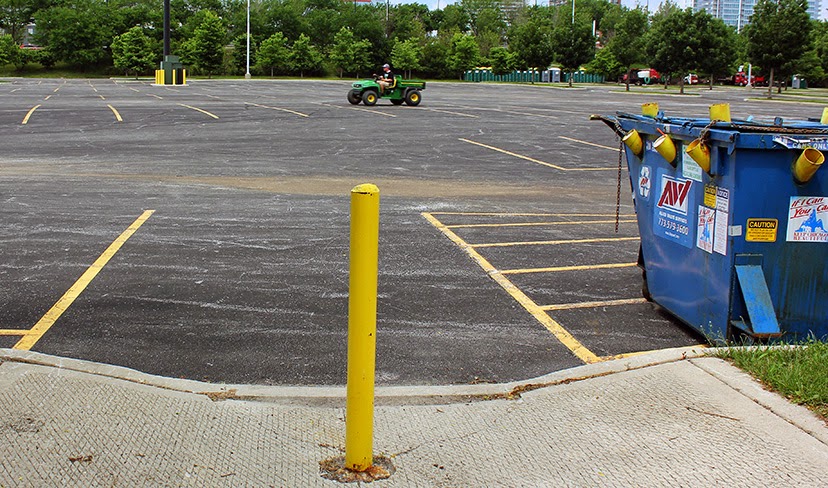
You already know that the site has, up until now, never been anything but several square blocks of asphalt, a surface parking lot best known as the location for hosting tailgate parties before Bears games. It should also be remembered that the Museum Campus came about not as a campaign against development, but as an escape valve to keep the lakefront to the north clear and open.

Chicago patron saint Daniel Burnham fought, with public opinion on his side, to construct the new Field Museum at Congress Street.  He wanted to load up Grant Park with large and imposing Beaux Arts structures, lots of them.  But when Montgomery Ward won his court battle to keep the park free of new buildings, the museum took advantage of the Illinois Central Railroad looking to unload some unused railyards south of Roosevelt to move the Field's location to what would come to be known, with the addition of the Shedd Aquarium and Adler Planetarium, as the Museum Campus.
In 1924, the massive, colonnaded stadium Soldier Field opened just south of the Field.   in 1960, the original bunker-like McCormick Place opened on the lakefront just a couple blocks south of Soldier Field.  After that building was mercifully put out of its misery by a massive 1967 fire, McCormick Place was was rebuilt on the same site to a far more open and elegant design by Gene Summers.  In 1986, a huge new addition pushed the McCormick Place complex another block north, while in 1997 an even larger building pushed the encroachments nearly two blocks further to the south.

The Lucas Museum's contested territory is the 17 acres that's left, about three blocks between Soldier Field and McCormick Place.  Take the time to look at it, and you'll see not an undiscovered jewel waiting to blossom, but a dangling participle of a space in search of a subject.  Rahm should be given some credit in actually foisting this problem child off on Lucas.
click for larger view
Not only is the proposed museum site walled in to the north and south by huge lakefront structures, to the east it is all but completely separated from the rest of the city by a double-slum whammy of the industrial Metra Tracks side by side with a Lake Shore Drive just as it turns into a limited access expressway.  The westward vista of the southern third of the parking lot is towards the butt end of the massive McCormick Place North.
Yes, you say, but what about those pristine lake views?  Well, here's the thing.  There aren't any.  What you actually look out at is the boat parking lot that's Burnham Harbor and, beyond it, Northerly Island.
At no point does this site give a clear view of the lake.  You can get a pretty clear idea of the situation from the following cross-section photo, harbor to the left, parking lot to the right . . .
From the north, a museum building will have to be pretty tall to be visible at all.  Grant Park's Sledding Hill keeps it completely out of view . . .


The parking lot has been there as long as I can remember.  There's never been a viable proposal to get rid of it.  And now we're arguing it's better to keep it here indefinitely rather than to take up a moneybag rube's benefactor's offer to get rid of it once and for all with a building awash in new parkland?  What mutant strain of urban planning is this?

II The Museum

The Lucas Museum is being slammed as a “vanity project,”  an overblown shrine housing a substance-free assembly of kitschy personal memorabilia dedicated to a rich guy's ego.  Truth be told, even with a nearly 300 page brief Lucas issued in support of the San Francisco version of the museum, details of exactly what makes up those 500k+ items claimed by the collection remain very sketchy.
John Tenniel, Alice with the White Rabbit for Alice's Adventures in Wonderland
courtesy the George Lucas collection
We know that it includes 35,000 books and periodicals, some going back to the 1800's.  We know that it includes works from figurative artists like Maxwell Parrish, N.C. Wyeth, and even Norman “What, Me Worry?” Mingo.  (You can see the official sampling of - count-em! - 17 images from the collection here.) We know that the museum's collection of the works of Norman Rockwell contributed to a popular, extensively reviewed exhibition, Telling Stores: Normal Rockwell form the Collections of George Lucas and Steven Spielberg.  

We know that the collection fed exhibitions such as Star Wars: Where Science Meets Imagination, which had successful runs at 18 different museums, including the Museum of Science and Industry in Chicago.  And we know that Lucas has excelled at creating exactly the kind of exhibition -whether it be Star Wars, Jurassic Park, the Muppets, Mickey Mouse or Jackie O's couture - on which, for better or worse, mainstream cultural institutions have become increasingly dependent for bringing visitors through their doors.  If it's good enough for the MSI, good enough for the Field, why shouldn't it be good enough for us?

The museum's San Francisco pitch book includes this mission statement . . . 
Exhibition and programming content will be diverse and dynamic and will: explore the history of American visual media and related topics and trends; investigate the cultural, creative and social significance of visual media in our world; educate about past and emerging technologies used in visual storytelling mediums; entertain art and film lovers of all ages; and inspire creativity and a great appreciation for the art of storytelling in our society.
 Could this be just a smoke-and-mirrors enticement to get the wolf into the door?  Perhaps.  But I'm intrigued by the uniqueness of the concept.  There are science museums, and fine arts museums, and history museums.  Why not a museum dedicated to storytelling, perhaps the most seminal aspect of human behavior?  Sure, there's sex, but even there, doesn't it often get even better in the retelling?  Forget movies and TV.  What is Facebook and Twitter but places where we create posts telling stories about ourselves in text and pictures?  And ultimately, what is architecture but an exercise in story-telling through structure.   Just this week, Anna Bergren Miller has an interview on the Architect's Newspaper blog with Jahn's Francisco Gonzalez-Pulido about how “contemporary facade design neglects one of the building envelope's foremost responsibilities: storytelling.”

Personally, I've always found deeper meaning in the disturbing parables spun by Hitchcock's Vertigo than in anything I encountered in the George Lucas epics, but there's no denying that the myth-making of the Star Wars saga has resonated - and deeply - with a far larger global audience.  Why is that not important? 

Lucas may not currently have his ducks all in a row, but it strikes me that the subject of storytelling is more than deserving of its own museum.  Just because it starts with a self-congratulatory saga of the storytelling in Star Wars doesn't mean it has to end there.  With a reported $300 million endowment, the scope of the mission has the potential to blossom in important and compelling ways.

III The Architecture
For the San Francisco proposal, Lucas called on Dallas-based architect Raymond R. Kahl's Urban Design Group to come up with one of those scarcely coherent “contextual” mash-ups of feel-good classicism with shopping mall practicality.  Kahl's portfolio contains some capable and interesting work, but if the San Francisco design would engage in its own exercise in storytelling, it would be something along the lines of, “Oh, God, how do we create a functioning building while managing to find a way to give absolutely no challenge or offense to the endless parade of constituencies we have to satisfy to get this thing built.”

In a city where even Mayor Rahm Emanuel extols its architectural virtuosity as a global calling card, something more is required.

The San Francisco iteration of the museum design included a plan by landscape architect Cheryl Barton that drew on a thorough study of native plants and flowers.  A Chicago museum deserves the same level of research and imagination.

UPDATE:  Shortly after this post ran, the museum announced that the museum would be designed by architect Ma Yasong, working in collaboration with Jeanne Gang Studio/Gang on site development. The renderings released of the design evoked still another firestorm of opposition to the museum's existence.  You can see al the renderings on the museum's website here.

IV Trust But Verify

Opponents to the Lucas Museum have stressed that, contrary to our usual Chicago political process, we do not - and should not - rubber stamp this project.  Although I support the museum, there are questions that should be answered before any final approval is given.

1.  Where's the Check?  Lucas has pledged somewhere between $700 million to - in some reports - a cool billion for his museum.   Before we move forward, we need concrete documentation that the assets required to make his dream a reality are placed under the control of the museum.

2.  Where are the Plans?  As I mentioned before, a 289 page report was created to sell San Francisco on signing off on the museum.  Chicago got a one-paragraph press release.  Not enough.  Not by a long shot.  Although many of those pages were padding, the San Francisco document gives a very detailed account of the plans for the museum, its objectives its governance, its building and grounds.  In Chicago, the plan seems securely locked in Rahm's brain.  If no one knows the details, there's nothing to hang objections on, right?  With $700 million in the budget, it's not unreasonable to expect the Lucas Museum to treat Chicago with the same respect it gave to San Francisco, come out from behind Rahm's coattails, and provide us with a detailed and specific public report of its intentions.

3.  Where's the Architect?  Chicago could do worse than the design Kahl came up with for San Francisco.  We often have, but we always wind up hating ourselves in the morning.  There's really only two choices:

a.  continue to sully our reputation with another pathetic historical pastiche

or

b.  man/woman up to our pretense of still being a city of global architectural importance and enlist our internationally-renowned talent to create a building and park of a level of innovation and boldness that will remind the world that Chicago still has it.

From the San Francisco building design and the scope of his collection, I get the impression that, as bold as he is as a filmmaker, Lucas' personal taste is almost Huntington Hartford-like, veering towards the conventional and conservative, but I'm fairly certain Chicago's great architects, as eloquent as they are talented, can bring him around.

4.  Where's the Curatorial Firepower?  Up until now, Lucas' various touring exhibitions appear to have been under the direction of in-house curator Laela French, who has done a very capable job.  That's fine for a “Star Wars” museum, but if Lucas is serious about moving beyond that to creating a “Museum of Narrative Art” - and we should hold him to that pledge - something more is required.  Before the museum is approved, we should expect the naming of an internationally-credentialed curator and staff of long and varied experience who can deliver the kind of fresh and innovative programming that will lead the museum to scholarly respectability and make good on its ambitious mission.

5.  Where's the Accessibility?   Right now, the Metra/Lake Shore Drive gulch cuts off the Lakefront all the way from Roosevelt Road (12th Street) to 31st street.  The only pedestrian passages to the lake are walking through the McCormick Place complex, or taking an 18th street overpass that seems more about crowd control than efficient access, zig-zagging more than four blocks out of the way just to get across the Metra tracks.   A new, direct bridge, at 18th or Cullerton, needs to be a part of the museum's design.

Conclusion
So what do we have to lose?  An asphalt parking lot on a second-rate site, with zero views of the lake.  What do stand to gain? Over 10 acres of new parkland and increased access to the lakefront promenade.   If it' s done right, maybe a great new building.  A popular and fun museum that will make Chicago a shrine to millions of Star Wars fans that, if we're determined - and a little lucky - evolves to realize its potential of becoming a important cultural institution with a truly unique focus.

There's a line between discernment and snobbery, and I fear that in the case of the Lucas Museum, Chicago's tastemakers are at risk of drowning in their own condescension. Can we take the discussion off auto-pilot and, rather than simply regurgitate the comfortable, accustomed arguments, look and discuss the project and its site with fresh eyes and open minds?

Sunday, July 06, 2014

Voyeur on the Roof - What was the Art Institute Thinking? And You?

Say what you will about those blockbuster exhibitions at the Art Institute, the folks behind AIC's marketing have become especially adept at finding imaginative ways to sprinkle their promotions throughout Chicago's cityscape.
click for larger view (recommended)
For Roy Lichtenstein: A Retrospective, the museum's school co-sponsored a competition that resulting in the entire upper reaches of a building along the Kennedy Expressway being transformed into a
giant mural of Chicago landmarks done up in the artist's signature Pop Art style.

For Impressionism Fashion and Modernity, entire double-decker buses were turned into canvases that drew you directly into a painting of turn-of-the-century society at play.
The Art Institute's current blockbuster is Magritte: The Mystery of the Ordinary, 1926-1938, running through October 13th.  It was drawing big crowds when I took it in on Saturday.  I recommend it if for nothing else than the experience of walking through the maze-like circuit of galleries in which it has been installed.

To promote the show, Chicago ad agency Leo Burnett has come up with an “Unthink” Magritte campaign that includes a mobile app and links the word to a host of different values in different iterations of the theme.  In addition to use usual appropriation of tour buses and trolleys, there's installations like these at the Chicago Avenue Red Line stop . . .
One variation of the theme, however, has been a little-known secret, not in intention but by design.  We're grateful to our indefatigable correspondent Bob Johnson, who uncovered the secret for us in these photos.
photograph: Bob Johnson
Can you see it?  In the right side of the photo, right next to the Metra tracks?  Let's get a little closer.
photograph: Bob Johnson
The larger part of the roof of the Art Institute's Morton Wing has been turned over to a striking Magritte seaside portrait of a seriously abstracted nude, with the inscription  “Unthink Voyeurism”.  Visible only to people in nearby tall buildings, birds, and passengers in low-flying planes, this has to be one of slyest, most surreal adverts ever.

Friday, July 04, 2014

A Walk in Chicago, Fourth of July, 2014

click images for larger view


Monday, June 30, 2014

Wasting No Time on the George Lucas Museum: Design Competition winners unveiled

First Place Winner Mircea Eni (all images courtesy VIATechnik)
 It's only a week ago that the news broke that Chicago has been chosen by film-maker George Lucas as the winning location for his $400 million Lucas Museum of of Narrative Art.  We'll be weighing in on the topic over the next few days, but we already have a press release announcing the winner of an unofficial George Lucas Museum Design Contest, sponsored by VIATechnik, a Chicago-based firm offering “estimating, LEED Coordination and BIM modeling services to Engineers, General Contractors, and Developers.”
First Place Winner Mircea Eni (click images for larger view)
First place went to recent IIT School of Architecture grad Mircea Eni, currently interning at Krueck+Sexton for the summer.  Eni's proposal circumvents the growing controversy over placing the museum on a lakefront site by lifting up the entire building above the landscape.  According to Jury member Mike Ellch of Related Midwest, as the site is on “a museum campus meant to be enjoyed by everybody” the winning design “has a park that is accessible to everyone, and this is very important to this design, that's why we liked it."  Architect Carol Ross Barney, another juror, referred to the winning design as “taking you to this almost dreamlike level as a great story is being told.  There is this idea of being lifted up, and the illusion it creates is quite nice.”

Filling out the jury was Daniel Peddicord of Pepper Construction and Brian McElhatten of Arup Chicago.  CEO Danielle Dy Buncio said that VIATechnik launched the competition about a month ago, after Lucas made known his interest in Chicago as a potential home to his project.  “We wanted to host an unofficial contest where aspiring designers and architects could showcase their talents and passion for the Star Wars Franchise and its maker George Lucas, while helping Chicago become a destination for what will assuredly be an iconic Museum.”

Second Place recognition went to Andrew Issac Ng and Laura Kiyokane, both recent grads of the University of Michigan's Taubman College of Architecture and Urban Planning . . .
. . . with a honorable mention to marketing manager Rodney Marmilic and architect Eddy Stambulic, the Australian duo collectively know as the Womp Rats . . .

Friday, June 27, 2014

Reilly demands less toppings: declares 45-story Friedman Pizza Hotel tower dead.

In an email report to his constituents released late Friday, 42nd ward Alderman Brendan Reilly announced he would not support River North developer Albert Friedman's plans to construct two separate Hyatt hotels in a single 45-story tower at 740 North Rush abutting and abridging the vintage building that's the long-time home to Giordano's Pizza:
I received a tremendous amount of constituent feedback regarding the proposal and the resounding overall sentiment was serious concern regarding the overall density of the proposal and the major traffic impacts and loading challenges associated with it.

After spending the past two months reviewing the proposal and associated traffic analyses to determine whether changes could properly address these challenges - I have concluded that the proposed 620 hotel keys, split across separate hotel flags, is simply far too ambitious for this location already surrounded by failing intersections (from a traffic engineering perspective) and high-density buildings. 
click images for larger view
I did not reach this conclusion quickly. In fact, I met with the development team on several occasions to explore potential changes or other development options to help make the proposal a better fit for this location. Unfortunately, at the end of that process, it became clear that this proposal simply could not proceed.

As a result, the proposed 620 key hotel development for 740 North Rush Street will not be moving forward. I have encouraged the property owners to carefully consider the limitations posed by the infrastructure around their site and existing traffic conditions, as they contemplate future development concepts.
Reilly did not indicate to what level the project would have to be cut back or reconfigured to meet his approval.  Take a last look at the original glassy skyscraper here . . .
Tactical Insertion: Friedman's 45-story 740 North Rush revealed (from a distance)

Thursday, June 26, 2014

Rahm, Gates, Gang and more - A Photo Portrait of AIA Convention Thursday

Thursday morning was the big keynote of the American Institute of Architects 2014 convention in Chicago, featuring introductions, awards, a benediction by Mayor Rahm Emanuel, and talks by Theaster Gates and Jeanne Gang.  We'll proably be writing more about what they had to say later, but for now here's what it looked like on the scene . . .
click images for larger view


Arie Crown Theater, the cavernous barn of an auditorium that didn't have the decency to burn down with the rest of the original McCormick Place back in 1967;


AIA President Helene Combs Dreiling

Rahm talked about Chicago's architectural heritage as “the home of modern architecture”, and the newly announced Chicago Architecture Biennial, to take place in October 2015.  “It will be the largest convention of architects and designers and people thinking about the future of architecture in cities in all of North America”

The Mayor was wearing a colorful handmade “Peace” wristband sold for $1.00 by a six-year boy at a North Side Wal-Mart. Sun-Times columnist Michael Sneed reported that Emanuel “urged the boy to charge his bodyguard $2 for a bracelet.”  Which may go a long way to explaining why those CTA stations are costing so much.  Or am I reading too much into this?
The AIA's 2014 Topaz Medallion for Excellence in Architectural Education was awarded to Harrison Fraker, who founded what is now the Princeton Environmental Institute and is a pioneer who “pushed the academic study of energy use in buildings to the forefront of the sustainability movement.”
Ivenue Love-Stanley was the recipient of this year's Whitney M. Young Award.  In 1977, Love-Stanley became “the first Afro-American woman to the first African-American woman to graduate from the College of Architecture at Georgia Tech in 1977. She later became the first African-American woman to become a licensed architect in the Southeast. In 1978, she co-founded Atlanta-based Stanley, Love-Stanley with her husband, William Stanley, FAIA, who received the Whitney Young Award in 1995. Love-Stanley and Stanley are the first husband and wife to ever have both received the Whitney Young Award.”
“I asked myself this morning,” said artist and activist Theaster Gates, ”what does it mean to talk to the field of architecture as an artist? What does it mean to have this captive audience to think with me about how our cities look and feel?”

In his keynote Gates answered with a overview of two recent projects - 12 Ballads for Huguenot House and the Stony Island Arts Bank, but only after saying ” I really want us to forget about those buildings and imagine that we're talking about process, that I'm talking about the capacity for the field of architecture and the field of design and the arts to re-imagine how cities function and to re-imagine the agency that we have as design professionals to change the world.”
Gates talked about neighborhoods like those on Chicago's South Side “People forget about them.  [Their architecture] at one time may have been ambitious, the people who live there [now] may have real lives and real ambition.  There's just no reason to talk about it, because it seems like nothing's happening there .  The building that we're looking at is at 69th and Dorchester .  It's one of those buildings.  In my artistic practice, a big part of it is about re-imagining how spaces are activated.  Sometimes I take abandoned buildings.  I perform in them.  I sweep them.  I mop them.  I rehab them.  I do things like an architect . . . like an architect.”  
“I am calling this talk ‘Purpose is Process’, said the mornings second keynoter, Studio Gang's Jeanne Gang.  ”Now when I first heard about the title I wondered, how do you get purpose?  Do you just wake up one morning and find ouy you have a purpose?  It's really not like that.  It shouldn't be a marketing slogan and it shouldn't be something you have to concoct .  It really is something you develop over time. It's a process.  Maybe another way to put it is:  Does architecture correct social change, or    . . . is it social change that determines architectural space?
This launched into Gang providing a history of Northerly Island, including a visual demonstration of how much of the site and its environs were not a green space, but an almost interrupted sea of concrete.  She contrasted that with her design for the Northerly Island Framework Plan for returning it to the public as a 90-acre recreational space, a process that is rapidly nearing completion.  

To underscore how Studio/Gang's practice is based on process and research, Gang concluding by discussing her latest project, creating BLUEprint, a strategic plan for the National Aquarium in Baltimore, which has resulted in Gang learning more about the oceans than most of us could ever hope to know.  

“As architects you never really think that you can begin a project that has to do with the ocean, but in fact I think our skill sets are really attuned to this. . . . The way that we used to perceive the ocean back in Greek times it was one ocean, not multiple seas.  And now today it is a contested space.  It's very heavily harvested for all kinds of different resources and materials.  Only 2% of the whole ocean is protected, which is very different than on land.  When you think about that, it's pretty scary.  Nobody's watching it.  Nobody's caring for it.  There isn't any planning.”

Gang talked about how unknown the oceans actually are.  While 563 astronauts have visited space, there have been only 4 descents into the deepest level of the ocean.  While NASA spends over $17 billion a dollar a year exploring space, the budget for oceanic exploration was listed as under $25 million.    Much of the ocean floor remains unmapped.  As vast as it appears, the almost alarmingly finite nature of the oceans - on which all earthly life is so completely dependent - was demonstrated by an incredible graphic of an earth stripped of all its water, and the entire cubic volume of that water orbiting the earth in a tiny ocean-blue moon only 860 miles in diameter. 


Tribune architecture Blair Kamin talking with Stephen Cheung at the Architect Live booth.
Walgreens Manager of Sustainability Jamie Meyers draws a crowd at the AIA Chicago  Lounge. (Heads up from a reliable source: Karen Erger and Eric Singer reportedly make the topic of Residential Risk Redux: Managing Risk in the New Economy -12:30 -1:30 p.m. Friday - not only informative, but a lot more entertaining than you might imagine.)
Stairway to Heaven