Friday, April 22, 2011

Tigerman on Monday, Hecker at the Graham on the 30th - two more for April, plus Richard M. Daley Mayors' lovecast

Yes, it's April 22nd, and no, we're still not done adding to April calendar of Chicago Architectural events.

This coming Monday, April 25th, at 6:00 p.m., the indomitable Stanley Tigerman will be presenting Displacement, a lecture sponsored by SAIC AIDO at Fullerton Hall of the Art Institute. That same evening, same time, Spanish architect Antón García-Abril will be lecturing at the Instituto Cervantes. And on Saturday, April 30th, Florian Hecker will be offering the U.S. premiere of his work Speculative Solution at the Graham Foundation, which this Tuesday, the 26th will be screening a program of short films, a preview of May's Architecture and Design Film Festival.

On Thursday, the 28th, Susan Rawles talks about the Worsham-Rockefeller Bedroom at the Driehaus Museum, while on Friday, SEOAI tackles the Seismic Design of Bridges. There are still over a dozen great events to come on the April calendar. Check them all out here.

It's not on the calendar, because unless you've received an invitation, well, you're just not invited, but there's also the National Mayors Summit on City Design, which opens on Thursday and culminates in a Friday luncheon event The Design Legacy of Richard M. Daley, in which mayors all across the country will indulge themselves in one last opportunity to salivate over "The Mayor's Mayor", for possessing what few of them will ever have - almost unlimited power for over two decades. The event will include "Remarks of Appreciation of Mayor Daley" (sounds just like a City Council meeting!) and the presentation of the Joseph P. Riley, Jr. Award for Leadership in Urban Design to our departing patriarch.

That event, as well as much of the conference, is scheduled to be webcast, including a Thursday morning keynote by Thom Mayne, Culture Now: The Contemporary American Condition, and a lunchtime session, How Design Has Shaped Chicago, with Lee Bey, Gerald Adelmann, and Barbara Gaines.

I have to be honest that I'm still not quite clear on how you access the webcasts, but the event press release suggests we "join in the Twitter conversation at #MICD50 and watch the daily mini interviews with mayors at www.usmayors.org."  Maybe some information will turn up there.

Tuesday, April 19, 2011

Forever Grand

 click images for larger view
It was originally supposed to be finished by 1998 at a cost of $15 million.  By 2005, the estimate was up to $29 million with work still not started - construction didn't actually begin until early 2008.  It's made a mess of the major intersection of Grand and State ever since.  The cost is now up to $67 million and it's slated to be finished by the end of the year, but I wouldn't bet good money on it. 

Yes, it's the CTA's Grand stop on the Red Line, and as you can see from the photo above, there's still a lot of work to be done amidst the subterranean complex of mains, conduit, and ancient Roman catacombs. 
In addition to the glacial work on the revamped mezzanine, which will be expanded an additional 2,000 square feet, the re tiling and vaulting of the platforms is lasting longer than it took Michelangelo to paint the Sistine Chapel, with commuters waiting for their trains amidst bare walls, plywood on the floor, and a lighting system of electrician's lamps, year after year.  It looked like this in June of 2009 . . .
and remained uncompleted sixteen months later, in October of 2010 . . .
As you can see from the new sections on display in the photo above, the reconstructed design, as it slowly unveils itself, is quite attractive, and the mezzanine should eventually look something like this . . .
The station originally opened in October 1943 as part of the new Howard subway line.  At the heart of the revitalized River North, Grand is now the 8th busiest station on the Red Line, with a daily load of 8,000 passengers.  If the reconstructed station lasts as long as the original,  it will cost about 34 cents for every passenger passing through its turnstiles over the next 68 years.

It could be worse.  The Red Line's Washington stop closed in 2006 for construction of a new "superstation" under Block 37.    Two years later, with no end in sight to escalating cost overruns, the city shut the project down, a money pit consigned to mothballs. Five years after it was "temporarily" shut down,  and now mutilated to integrate with the unicorn superstation, the Washington stop remains closed.  $300 million dollars of your tax dollars down the tube, with nothing to show for it.  Makes the Grand station's $67 million price tag look like a bargain, doesn't it?

Chicago Streetscene: Stacked Pews in the Church of the Green Parking Garage

click image for larger view (recommended)

Sunday, April 17, 2011

Vote Bridges, Steel Bridges - through April 30th

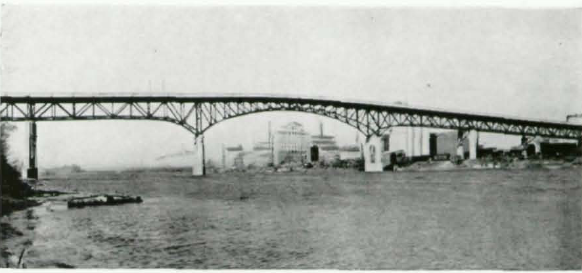
Since 1928, the National Steel Bridge Alliance Prize Bridge Competition has honored more than 300 United States bridges (yeah, I know, that's the third time we've used the word "bridge"  - no, four times - in a single sentence) for excellence in design.  This year, the Alliance, the bridge division of the American Institute of Steel Construction, is promising "the most exciting steel bridge competition in history," a selection of all-time greats from a roster of past winners, with both Industry and People's Choice awards.

So, you the People's have through the end of April to pick your favorites.  You can find the on-line ballot form here.

Illinois is represented by 16 choices.  Indiana has none. (Take that!)  Kansas has one, in Leavenworth, also known as "the bridge no one really wants to cross unless its outbound".   Chicago nominees include the Wabash Avenue bridge, completed in September of 1930 for a mere $1,750,000.
click on images for larger view
Skip forward a half a century and there's the Columbus Drive bridge.  Flat and plain, it looks a little underwhelming today, but when it was completed in 1984, it was one of the largest movable bridges in the world - seven lanes of traffic, two 10-foot sidewalks, 270 feet between pivot points, with each of its twin spans weighing 6.3 million pounds, not counting the guy walking across with that really humongous Great Dane.
There's also 1974's Ramp "Q" Structure, an elevated whipsaw which I believe is on the Bishop Ford Freeway somewhere around Stony Island.  (If anyone has tighter info on the exact location, please let me know.)
photograph: AISC
Of course, the nominees aren't limited to Chicago.  There's also 1933's graceful Cedar Street Bridge in Peoria . . .
photograph: AISC 
Two of my favorite steel bridges, which didn't make the cut, are both on North Avenue (kind of), both the old classic in Lincoln Park (and what other city can claim they have dozens of bridges on LSD?) . . . 
and a much newer addition over the river . . . 
 The good news is that, due to date and technique of construction, such icons as the Brooklyn Bridge are not even in the running.  The bad news, the Zakim Bunker Hill Bridge and Golden Gate are.

But don't let that discourage you.  This is a contest where ballot stuffing is not only not frowned upon, it's encouraged.  You can vote for as many of the nominees as you like, as many times as you want. It's  like a classic  Chicago election - but legal!  Vote early and vote often, here.

A Chicago River sunrise from Bob Johnson

click image for larger view
We've just learned that Saturday was the last day for indefatigable correspondent Bob Johnson at this firm of many years.  In addition to the innumerable great photo's he's provided to this blog, Bob's engineering skill has gone into the construction of some of Chicago's most prominent towers, not to mention his great work on behalf of the Structural Engineers Association of Illinois.  His energetic advocacy has helped expose thousands of Chicago area students to wonders and challenges of engineering, and encouraged them to exercise their own knowledge and creativity in the cause of urban design, through such endeavors as the excellent Future City competition, and this past February's Explore Engineering Day at CAF during National Engineering Week.

Bob tells me he will taking a few weeks off (hopefully the weather will soon actually start to resemble Spring), deliver some lectures, and take up some of the many invitations he's received to become involved in various STEM (Science, Technology, Engineering and Mathematics) Education initiatives, which were a major focus of Barack Obama's State of the Union speech earlier this year.  Just about everyone talks about the central importance of getting more young Americans educated and involved in these fields.  For decades, Bob has been doing something about it.

He says he's not actively looking for another full-time gig right now, but he's still available for consulting, and if you need to get ahold of him, let me know and I'll pass it on.

Just reading all the things Bob is involved in leaves me exhausted, so I think it's only appropriate to illustrate this post with one of Bob's shots of a beautiful sunrise over the Chicago river.

Monday, April 11, 2011

The April Calendar is Up! Tonight: The Great Public Transit Debate at the Cactus Bar & Grill vs. Alex Lehnerer at MCA -

Ok, so it's a taken us a third of the month to get the April Calendar of Chicago Architectural Events up on the web, but here's the strange thing:  from today, Tuesday the 12th, through the end of the month, there's FIFTY great events still to come.
It kicks off tonight at the Cactus Bar and Grill where the Chicago Architecture Foundation offers up the second of its Chicago Debates: Chicago Public Transit: On Track or Derailed, with a blue chip panel featuring Aaron Renn, Chris Robling, Stephen Schlickman, and Mary Wisniewski, with Edward Lifson moderating.  Meanwhile over at MCA, Alex Lehnerer will discuss his work during an informal gallery talk at the Lehnerer installment of the museum's UBS 12 x 12: New Artists/New Work Exhibition.

This coming Saturday afternoon,  April 16th, there'll be a special all-ages version of PechaKucha at Martyr's on Lincoln, Inspire Japan, to benefit Architecture for Humanity's work in that country.  Presenters will include Crandon Gustafson (who is actually doing relief work in Japan), Cathy Ivcich (who will be presenting live Ikebana with colleagues on the PK stage), Photographer Doug Fogelson will show pictures of cherry blossom, Shawna Martell (tales of extreme coupon-ing), Jeweler Carol Blumenthal, Doug Burgett (with some anecdotes of misunderstood artistic endeavors), Laura Bowe from Architecture For Humanity/Chicago, plus other players to be named later.

On Sunday afternoon, the 17th, historian Martin Hackl will lecture on The Life and Work of Prairie School Architect John Van Bergen, the first of a series of talks being presented in conjunction with an exhibition of the architect's work at the Barrington Area Historical Society.

In between on Wednesday the 13th, architects R Thomas Hille and Christopher Lee will present separate lectures at IIT, while Paula Lupkin will discuss Chicago, New York, and the Invention of the YMCA Building lunchtime at CAF.
On Thursday, the 14th, Chris Botti discusses the restoration of the Chicago Cultural Center's Preston Bradley Hall Tiffany dome for AIA Chicago, while on Friday, the 15th, there'll be an opening reception for the new exhibition at the Graham, Anne Tyng: Inhabitating Geometry.

And that's only some of the events just this week.

Later in the month, we've got Young of Architects of Chicago showing their stuff at the Instituto Cervantes on the 19th,  where Spanish architect Antón García-Abril will also lecture on the 25th.
Other highlights?  Julian de Smedt at UIC on the 20th, the SEAOI's annual Midwest Bridge Symposium on the 21st, the same day Kevin Harrington discusses Lake Point Tower for Landmarks Illinois lunchtime at the Chicago Cultural Center.

Well, you get the idea.  There's half a hundred great events still to come this month.  Check out the entire April calendar here.

Chicago Tribune to Prentice: Drop Dead

Update: see the postscript at the end of this post.
click image for larger view
The Chicago Tribune took time off from its second favorite activity of bashing labor to concentrate on its first: shilling for the overprivileged. In a pre-emptive strike as brazen as it was disgusting, the paper used their editorial page to call for the destruction of Bertrand Goldberg's Prentice Hospital, currently the focus of a major preservation battle

Alderman Brendan Reilly recently won a 60 delay in Northwestern University's intention to file for a demolition permit for the structure, pending a re-use study currently being completed by a team headed by Landmarks Illinois. That study should be released soon, but the Tribune couldn't wait.  It swallowed Northwestern's arguments whole, especially one about how the building "uses only one about one-third of the square footage that could be comfortably built on the site."  Translation:  let's have another massive, sidewalk to sidewalk behemoth of the type that has made the Northwestern hospital campus one of the most oppressive and unattractive districts in the city.  Has anyone at the Tribune editorial board actually taken the time to go see it?  Or the the full empty block Northwestern has already leveled just across the street, which stands behind cheap, ugly fences with no sign of life?

The Tribune tries to hide behind their support for saving the old County Hospital to justify its action, but that just falls into their standard MO.  County Hospital was, of course, a government agency, and we all know - because the Tribune tells us - that all government is bad and infantile, so throwing a sop on saving County Hospital is a good way to humor the children.  To the Tribune, however, a private interest like Northwestern is sacred, never to be troubled with tough questions; only served. 

The only remaining question is Trib architecture critic Blair Kamin's role in this.  Did the Trib editorial board do this to defuse Kamin's potential opposition to demolishing Prentice, or did they do it with Kamin's active participation?  His readers deserve to know.

Postscript:  And Blair did respond, with suitable umbrage, in a comment you can see appended to this post.  "You're asking a ridiculous question," he wrote. "Of course I had nothing to do with the writing of today's Tribune editorial." 

I responded that, given the timing of the Tribune's editorial coming so close on the heels of Kamin's April 4th article, the question was anything but ridiculous.  This is Chicago, where a City News Bureau editor once famously ordered a cub reporter, "If your mother says she loves you, check it out." 

The fact that Blair had nothing to do with the writing of the editorial is a two-edged sword.  On one edge, it leaves his journalistic integrity unsullied.  On the other, what does it say when a paper's editorial board rushes into print an editorial directly contervailing the views of its Pulitzer-Prize winning critic that doesn't even acknowledge that he made them?

As I mentioned originally, the claims in the Tribune editorial are deceptive, dissembling and largely untruthful.  Vince Michael does an excellent job of taking them apart one by one, and you can read his analysis here.

Later on Monday, Blair, whose writing is often so measured it can be difficult to make out where he stands on a controversial issue, made himself exceptionally clear:  "It would be a travesty to demolish old Prentice."  Let the battle be joined.

Sunday, April 10, 2011

Last Two Weeks for Young Architects of Spain exhibition at Instituto Cervantes

Update: the exhibition has now been extended through April 25th, and it includes two lecture/panel events that we will be discussing tomorrow.
click images for larger view
You have only two more weeks, through April 25th, to see an ambitious exhibition, Young Architects of Spain (YAS): A Window to the Unknown, at the Instituto Cervantes, which has set up shop at 31 West Ohio, providing a small slice of culture in the banality of the Grand Plaza residential towers. The exhibition, part of the ongoing Architecture and Urban lecture series organized by the Instituto Cervantes of Chicago and MAS Studio and directed by Iker Gil.  "Its goal is to establish a platform in Chicago for an open exchange of design ideas and interesting experiences within the world of architecture and urbanism."

The exhibition grew out of a competition staged by Spanish Ministry of Housing, "an open call to all young Spanish architects [under 40], both within and outside of Spain’s borders." The more than 700 submissions were culled down to 62 by an international jury that included such luminaries as Juhani Pallasmaa. Alberto Campo Baeza, and the omnipresent Kenneth Frampton. The selected works were exhibited first in Madrid in 2007, and then made the rounds to the Columbia School of Architecture in New York, last winter in Brussels, and now here to Chicago.
102 viviendas en Carabanchel, Madrid, Dosmasuno Arquitectos
The handsome, bilingual catalog includes often fascinating essays from each member of the selection committee, with an especially personal one from Campo Baeza, who finds commonality in the designs of Spanish architects along three lines: Idealism (ideas over mere form), sincerity in construction, and functionality. "Their houses," he writes, rather than arbitrary formal exercises, are houses to be lived in happily."
SGAE, Santiago de Compostela,  Ensamble Studio
Jorge Otero-Pailos records some basic facts about the participating firms. First, they are small - two principals, on average, plus four additional architects. Almost a third work from a home office. Only 18% of employees are foreign nationals. Average firm billing is 171,000 (about $250,000 at today's exchange rates). Average salary is between about $20,000 and $31,000, or only about 2 to 3 times the mandated minimum annual wage.
Numancia Gymnasium, PO2 Arquitectos
Otero-Pailos takes note that what may have been the first architectural competition, in 448 BC Athens, for a war memorial on the Acropolis, was decided by popular vote, an unlikely prospect today. He also discusses how the stereotypical set of human figures used to inhabit architectural renderings has descended largely unchanged from the 1870's down to the present day's no-longer-young radicals such as Rem Koolhaas and Ole Scheeren, but the younger generation has different ideas.
[Younger Architects such as] Royo and Morales do not presume to know visitors or wish to reduce architecture to a stage set within which people are understood as videogame avatars and expected to perform predictable behaviors. . . . The commanding function of the author-architect is interrupted by the recognition of an alien presence, the visitor, who creatively interjects and participates in the creation of architecture.
Although the architects are Spanish, the projects are placed throughout the world, including the Puente peatonal, in Shanghai, by Pedro Pablo Arroyo Alba (CA-Group), show below both under construction and completed.
 
Over half a decade after its inception, and in the wake of a grave worldwide recession, Young Architects of Spain now serves as a snapshot of a more optimistic moment.  It continues through April 25 at the Instituto Cervantes, 31 West Ohio.  Gallery hours are 10:00 a.m. to 7:00 p.m., Monday through Thursday, 10:00 a.m. to 3:00 p.m., on Friday, and 9:00 a.m. to 1:00 p.m. on Saturday. 

Chicago Streetscene: I Like Where This is Headed Edition

click images for larger view

Thursday, April 07, 2011

Boyington's Kenwood United Church goes landmark, plus on State Street: Hello Columbus?

click images for larger view
At today's meeting of the Commission on Chicago Landmarks, landmark designation begins for the Kenwood United church of Christ, at 4600 South Greenwood, designed in 1887-1888 by one of Chicago's most active early architects, William W. Boyington.

As always, the Commission staff, in this case Terry Tatum, Lisa Napoles and Nikki Ricks, with Brian Goeken editing, have come up with another first-rate report, 39 pages on the building, its architect, style and time, with a wealth of  great photographs, both historic and current, a small sampling of which you see here.  It's not up on the website yet, but I'm sure it soon will be, and then you'll find it here.  As I mentioned before, these reports are some of the best Chicago history you can find, and you can download the stories of dozens of Chicago landmarks there.
Kenwood United is a perfect example of the trickle-down theory as it applies to architecture.  Built in 1887 as the nondenominational Kenwood Evangelical Church for Chicago's economic elite at a time when the Kenwood neighborhood, then a suburb of Chicago, was described as the "Lake Forest of the south",  membership evolved as the "L" began to bring the common rabble down to the newly constructed apartment blocks that were taking the place of the old mansions.  The congregation was disbanded  in 1954, and the building was handed over the Kenwood-Ellis Community Church, which "had been founded in 1948 to serve Japanese-Americans that lived in the neighborhood as a result of World War II-era relocations."  It's now the Kenwood United Church of Christ, led since 1980 by Rev. Dr. Leroy Sanders, serving the now primarily Afro-American community with both spiritual and social services.

According to the Commission's report, the church was designed in the Romanesque style made popular at the time at Henry Hobbs Richardson . . .
The building’s rough-textured granite and sandstone walls, corner bell tower, round-arched entrances, windows and tower openings, and foliate-detailed columns and sculptural panels comprise a textbook example of this architectural style. A 1924 gymnasium wing by architects Chatten and Hammond is designed in a modest twentieth-century variation on the Romanesque Revival and complements the older church building.
W.W. Boyington was on of Chicago's original architects, arriving in the city in 1853, and designing a large number of the city's most prominent buildings, including the original Board of Trade.  Only a handful survive, most famously the Chicago Water Tower and Pumping Station, whose design was ridiculed by no less than Oscar Wilde ("a monstrosity with pepper boxes stuck all over it."), but which, as a survivor of the Great Fire of 1871, has become a symbol of the city.
Boyington would live until 1898, and one of his most impressive concoctions was the 1892 Columbus Memorial Building, a million-dollar, 16 story skyscraper at State and Washington that was a symbol of the city's wealth. "A million dollars is a large sum to expend . . . when a building costing from $650,000 to $750,000 would  in all probability bring in the same rental," commented the Chicago Tribune, as quoted in Daniel Bluestone's invaluable book, Constructing Chicago.
Above the entrance arch . . . they placed a ten foot high statue of Christopher Columbus that had been sculpted in Rome.   . . The grand entrance for the building was twelve feet high and rose to the third story.  The lower two floors of the building were clad in statuary bronze . . . An octagonal  corner tower on the roof supported an illuminated glass globe of the world on which a cut jewel indicated the location of Chicago.
Vanitas Vanitatum, Omnia Vanitas.  The Columbus was unceremoniously destroyed in 1959 for a one-story "taxpayer" building - so called because it was designed to generate just enough revenue to cover real estate taxes while awaiting a more lucrative development - which was home for decades for Lebolt Jewelers.

That building was demolished, in turn, for the current State Street flagship of Old Navy. Now, over half a century after the destruction of the Columbus Building, that more lucrative development may finally be on tap.  Crain's Chicago Business reported last month that a New York company has acquired the Old Navy property for a cool $23,000,000, a price that can't be justified except by replacing the current structure with a high-rise.  Just don't expect anything like the Columbus's grandeur.

And the cycle continues.
Moses Ezekiel's Columbus Statue, once placed above the entrance of W.W. Boyington's demolished 1892 Columbus building, now in Arrigo Park at Loomis and Polk. 

Tuesday, April 05, 2011

Wind Bracing and Chicago skyscrapers, Rebuilding Together Metro Chicago today, Children's Memorial and Robert Krawczyk tomorrow - more for April

As the April calendar continues to gestate, we bring you the following:
Today, Tuesday, April 5th, the Ron Klemencic lecture we told you about yesterday is sold out, but there's also a lecture by Thomas Leslie on Built Like Bridges: Wind Bracing and the Chicago Skyscraper at AIA/Chicago, while the same organization's First Tuesdays Happy Hour, at Matilda on Sheffield, takes on ReBuilding Together, Metro/Chicago, "a national program to improve the homes of low income, seniors and disable residents."  Information here.
Tomorrow, April 6th, sees Bruce Komiskie of CMH and Martin Wolf of Solomon Cordwell Buenz discussing the new Children's Memorial Hospital at the lunchtime lecture at the Chicago Architecture Foundation, while Robert Krawcyzk lectures on Spirals, Fractals and Music: The Same Only Different at the McCloskey auditorium of the Campus Center at IIT.

Sunday, April 03, 2011

Wong and Gates Monday, Ron Klemencic Tuesday - fragments of the April Calendar

Rumors of the appearance of the April Calendar of Chicago Cultural Events persist, even as we wish to apologize to those of you who may have wanted to hear architect Thomas Leeser, whose firm just completed a warmly received expansion of the Museum of the Moving Image in New York, when he spoke at UIC last Friday, but missed it because we didn't report it.

Here are two events for today, Monday, April 4th:
click images for larger view
At the intriguing start time of 5:50 p.m., in the lower core of Crown Hall at IIT, Ernest Wong of the Site Design Group, Ltd., whose work includes the striking and new Mary Bartelme park at Adams and Sangamon, pictured above, will lecture. Information here.

At 6:00 p.m. at Archeworks, 625 North Kingsbury, there will be a lecture by Loeb Fellow Theaster Gates "will talk about the relationship between his art practice, myth making and urban stewardship and how slippery these relationships are. He will engage the audience and discuss the challenges of the design industry with implications toward pedagogy and emerging practices. By the end of the night, he will create a new design firm with members of the audience." Followed by in-fighting over job titles. RSVP requested.  Information here.
Then on Tuesday, April 5th, [NOTE:  this event is now SOLD OUT] at the Chicago Architecture Foundation, 224 South Michigan, the Structural Engineers Association of Illinois will offer up How’d They Do That?!, a talk by Ron Klemencic, President of Magnusson Klemencic Associates, whose work includes such modern marvels as the Rem Koolhaas/Joshua Prince-Ramus Seattle Public Library, shown above, and Studio/Gang's Aqua.  Klemencic will "present a fast-paced, visual tour through the structural design of some of the more interesting and challenging structures in the world today. The advances in design and construction technologies, materials, and communication capabilities that make these projects possible will be highlighted." The evening begins with a cocktail reception beginning at 5:30 p.m., followed by the lecture at 6:30 and a QandA at 7:30. It's free, but registration is required. Information here.

Saturday, April 02, 2011

Reilly wins 60 day delay on move to demolish Bertrand Goldberg's Prentice Hospital

click images for larger view
In a letter to his constituents Saturday morning, 42nd ward alderman Brendan Reilly announced that he had persuaded Northwestern University to delay for 60 days their filing for a permit to demolish Bertrand Goldberg's Prentice Hospital.

At a meeting last week, the University told Reilly what its spokesman Al Cubbage told Sammy Caiola for a report in the Daily Northwestern, "When it becomes vacant we will begin taking the building down." The building's current tenant, the Stone Institute of Psychiatry, is scheduled to move out this coming September.

And where, you might ask, is the Commission on Chicago Landmarks in all this?  As always when there's a real fight to be fought, MIA. Although the threat to Prentice has been clear ever since construction of the new Prentice was announced, the Commission has taken no action to protect the building.  And since it's a modern building, it never made it onto the Commission's Historic Resources Survey, which means its not even eligible for the 60-day delay that an Orange-rated building on the survey would get once a request for a demolition permit was filed.
Reilly said the University will wait for the release of a re-use study for the building, which is currently being co-ordinated by Landmarks Illinois.

Reilly has become something of a hero among preservationists.  He was instrumental to the fight to save Jarvis Hunt's Lakeshore Athletic Club at 850 North Lake Shore Drive, which was also owned by Northwestern, which wanted to sell it to a developer to be destroyed for a Lucien Lagrange highrise.  Reilly also led City Council opposition to Richard M. Daley's drive to put the Chicago Children's Museum in Grant Park.   Although Reilly ultimately lost, 33 to 16, in the City Council, his opposition made a major contribution to continuing the fight and drying up fund-raising to the point where the Museum now appears to have given up in favor of staying at Navy Pier.
In the case of Prentice Hospital, an absolutely essential piece of Chicago architectural history, Reilly may simply be hedging his bets.  He's already crossed Northwestern, an incredibly powerful and ruthless entity, once, and may be reluctant to do it again.  It could go either way.  Reilly could use the Re-Use study as a rallying point for his opposition to demolition, or he could use it as proof there's no real possibilities for the building, shed crocodile tears and stand aside as its smashed into nothingness.

And, of course, Northwestern loses nothing by conceding the 60 days.  They can't begin demolition until the tenant moves out in September, anyway, and by making what is ultimately a meaningless concession, they can add to their false-front PR profile as a caring institution, covering over the reality on being hell-built on destroying Prentice from day one.

For more information on the importance Bertrand Goldberg's Prentice Hospital, check out Landmarks Illinois, Preservation Chicago, the National Trust, Blair Kamin's recent piece in the Trib, and the Save Prentice page on Facebook.   You can also read Brendan Reilly's full statement, after the break.

Friday, April 01, 2011

Gang disputes Roeder Ford Calumet Environmental Center numbers

click image for larger view
In an email, Studio/Gang architect Jeanne Gang disputed the numbers quoted in a recent article by Chicago Sun-Times real estate reporter on the costs and status of the proposed Ford Calumet Environment Center, which Studio/Gang won a competition to design all the way back in 2004.  Articles around that time quoted it as being s $6,800.000 project.

However, writes Gang, "The project construction budget was established after the competition, in 2006, and was, including site work, $17 million.  Now in 2011 the cost is $20 million (not 27).  The difference is due to time escalation of cost, NOT cost overruns . . . The budget may have to be adjusted now due to [the current] financial situation, but the project is not cancelled.  In fact, they are in the middle of a fundraising campaign."

Having had to deal media flacks his entire career, it's puzzling how Roeder would just swallow a city bureaucrat's latest spin whole.  "If your mother says she loves you, check it out," was the mantra for cub reporters at the old City News Bureau, but perhaps the new realities of print journalism make that it impossible.

Being a blogger rather than a reporter, I'm not double-sourcing Gang's figures, either, but my bet is they're a lot more reliable than a second-hand version of a city bureaucrat's spin.

More importantly, the word that fundraising for the project is continuing is encouraging.  At the time of competition, it's projected completion date was 2006.  If the city had spent half the effort they wasted trying to jam a children's  museum in Grant Park, the Ford Calumet Environmental Center would have been completed long before the challenges of the recent global financial meltdown, and people would be coming to Chicago from throughout the world to see it.

Now up for this month: The Calendar of Chicago Architectural Events

April Fool! (you don't think we'd ever get one of these things up on time, do you?)

To quote Don Corleone, one day, and that day may never come, we'll be posting the April calendar.  For now, just a reminder that:

TONIGHT: there'll be a a launch party for Reveal, Studio/Gang's superb new monograph of their work, which includes an interview I did with uber-developer and Aqua patron James Loewenberg.  It's  at the Stop Smiling Storefront, 1371 N. Milwaukee, Friday, April 1st, from 7:00 p.m., on, kicking off with a 30 minute interview of architect Jeanne Gang, a book signing (books will sold at discount), and a "DJ's after-party til the wee hours". 

other events for this Friday:

History of Seepage
1:00 p.m., Erikson Institute, 451 North Lasalle
- a special demonstration by Professor Ira Saumâtre of the University of Illinois, Sauk Village,  designed for both architects and consumers ages 4 and up, delivered through case history videos, product demonstrations, and hand puppets. 


First Fridays Happy Hour
6:00 p.m., Arrigo and Sons Funeral Home, 5670 West Addison
This month young architects volunteer to cheer up surprised mourners with vodka stingers and funny anecdotes about Peter Zumthor.

Parametricism on Ice
8:00 p.m., UIC Pavilion, 525 South Racine.
Showing a previously unsuspected athleticism,  Patrik Schumacher leads skaters from the Smuckers Stars 2011 Tour in demonstrating through computer-generated choreography the universality of parametricism  and the futility of resistance.

Wednesday, March 30, 2011

Chicago Streetscene: Texture Strips

click image for larger view

Richard M. Daley, the killer of Chicago Architecture, leaves us one last parting gift

Can you name a single building the two-decade administration of Richard M. Daley put up that's in the great tradition of Chicago architecture? (And don't mention Millennium Park, where everything great was the result of the activism of others.)

His father gave us the Daley Center.  The son gave us Block 37, and the wanton destruction of the Michael Reese Hospital campus.  As being reported by the Sun-Times David Roeder,  Daley's last kick in the teeth to the city he supposedly so dearly loves is the death of the Ford Calumet Environmental Center designed by Jeanne Gang/ Studio Gang.  For the better part of a decade, despite funding of $6,000,000 from Ford, the city has failed to move a single brick toward constructing the spectacular design that won a competition all the way back in 2004.

Now, quietly, the bureaucrats at the Department of the Environment, according to Roeder, are saying the Gang design will never be built, because the original $7.600,000 estimate has soared to $27,000,000.  Except maybe not.  "It's unclear if that includes staff and programming," says Roeder, who doesn't know, and is apparently too lazy to find out.  He simply swallowed the city's line whole.

And of course, the city line is that it's all Studio/Gang's fault, just like Richard M. Daley tried to pin the cost overruns at Millennium Park on Frank Gehry during one of his infamous, petulant press conferences.  What's the truth?  We'll probably never know.

What I do know, however, is that Studio/Gang has made its reputation by creating amazing architecture on very tight budgets in projects such as the SOS Community Center, at the Chinese American Service League.  That is part of the public record.  Also part of the public record is that this is the administration that so mis-managed construction of just one key project that they somehow squandered almost half a billion dollars on a "superstation" beneath Block 37 before giving up and putting it in mothballs, never to open.  I will leave to you which party's motivations are the more reliable.


Most cities would be thrilled to get a first class design by a world-class architect like Jeanne Gang, and would be working overtime to make it happen.  Daley's City Hall takes seven years to find out it's too expensive and then just walks away.

Richard M. Daley's PR machine was relentless in portraying him as Chicago architecture's greatest friend, yet the city's architects spent most of his reign trying to appease what was perceived as his great love of neo-classicism, which he picked up on his junkets to Paris.  With friends like these, who needs enemies?