Sunday, April 11, 2010

It's Architecture Week! Thomas Gordon Smith, Lee Bey and Warren Berger on Thursday, Sam Guard on Saturday, plus a seven day Photo Party in Oak Park

Yes, April 12 to the 18th is national Architecture Week, so what better time to add a few more great events to the April calendar.

Seating is limited to 60 people, so it might already be sold out, but Notre Dame professor and architect Thomas Gordon Smith will be lecturing on Vocabulary, Proportion and Invention in Contemporary Classical Architecture for the Chicago-Midwest chapter of ICA-CA at the Richard Driehaus Museum this Thursday, April 15th, at
6:00 p.m., the same evening that Lee Bey will be talking about How Mayor Washington Changed the Face of the City at the Harold L. Washington Library, also at 6:00 p.m. As if that's not enough, at 5:30 the same day, there's a lecture and book-signing by Warren Berger, author of Glimmer: How Design Can Transform Your Life, Your Business, and Maybe Even the World, at Siegel Hall at IIT, co-sponsored by the Harrington College of Design.

On Saturday, the 17th at the Manning Public Library, Mario Machnicki will lead a free workshop, The Care and Maintenance of Your Historic Masonry Home. And on Sunday, the 18th, Jack Spicer and Sam Guard will present An Architectural Walking Tour of Woodlawn Avenue, including the work of Pond and Pond and others.

The 12th through the 18th is also Architecture in Oak Park Week, with "three major architectural scavenger hunts." No, you won't be looking for Sam Zell, but you'll have your choice of a self-guided "Visitor Edition" that starts and ends at the Oak Park Visitors Center and will extend all week, and a "Seasoned Local Edition" on Saturday, the 17th. You'll be given photographs and clues and sent on your way to try to find the addresses of the buildings whose details are captured in the pics.
A third interactive event is being organized by Oak Park Education Foundation’s Architecture Adventure, geared towards families with school aged children. This event will showcase the work and projects of OPEF’s visiting architects program in District 97 schools.
There are still 42 events to come on the April architectural calendar - nearly 20 this week alone, including lectures by Edward Windhorst, Brett Steele, and Juhani Pallasmaa. Check it all out here.

Saturday, April 10, 2010

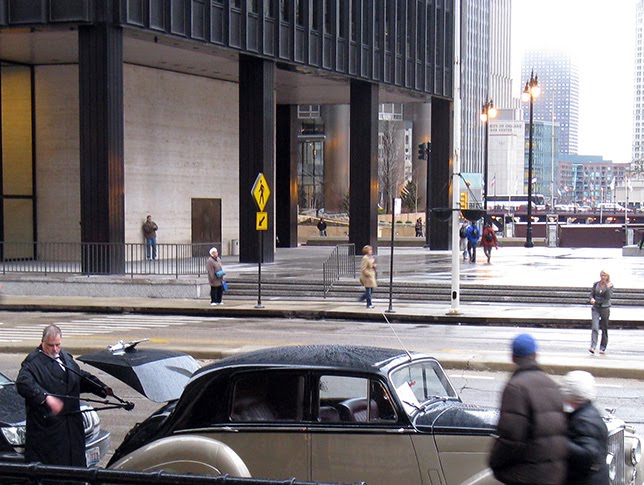
Classic Car Rainy Day at Marina City

They must belong to whoever's renting us all that ugly scaffolding.

Tuesday, April 06, 2010

Trumptastic Riverwalk now open down all three levels

At the moment, still almost eerily quiet. Needs some tables and chairs along the terraces where a flâneur can sit basking in the the sun, sip an overpriced coffee and peer bemusedly over the top of his or her sunglasses at the world passing by.

If you're a dog, however . . . . . . you may already have pretty much everything you need.

Monday, April 05, 2010

John Buck gets his new Park - do we get to name it?

Your tax dollars at work. Above is a photo of the progress of the new pocket park you're bankrolling to the tune of $7 million in TIF money to give the spectacular arcade of Goettsch Partners handsome new 155 North Wacker a more congenial endpoint than a shear wall of alley brick with a faded block letter advertisement for window shades.

According to information in the newsletter of 42nd ward alderman Brendan Reilly, the park "will contain 9,245 square feet of grassy area, low-rise plantings, 23 trees, bicycle parking and seating." 155 North Wacker developer John Buck, reports Reilly . . .
anticipates completion of the park and its landscaping by July 2010.

The Buck Company will construct and maintain the park in perpetuity, however there is a Development and Maintenance agreement in place to return ownership back to the city upon completion. That agreement designates the park land as public open space in perpetuity.
Let's hope "perpetuity" lasts longer than the beautiful park next to Buck's AMA building, which was leveled, after the city failed to take Buck up on his offer to sell it to them, for the just-opened Palomar Hotel.At the moment, the park remains nameless. Should we begin a campaign to convince Reilly and Buck that it should named after Harry Heftman? Harry was the guy who, for over half a century, sold hot dogs at his 300 W. Randolph restaurant where, about a year ago, Mayor Daley and other luminaries stopped by to help Harry celebrate his 100th birthday, just before the city came in and smacked the building down to the ground to make way for the new park?It's not just the big money, but the small gestures that give the streets their woof and weave. No less than with the Crowns or the Pritzkers, the spirit of Chicago is the product of legends like Harry Heftman, who create the micro institutions that give the city character all the way down to the countertops of a cozy corner restaurant, polishing the bedrock of the everyday with a genial smile.

The Revolution Comes (in an Airstream) - to Millennium Park

Via our intrepid correspondent Odile Compagnon comes word that the The Design Revolution Road Show is in Chicago today and tomorrow,10 am. to 4:00 p.m., with the involvement of the School of the Art Institute.

It's designed as "a traveling exhibition and lecture series bringing 'product design that empowers' to 35 high schools and university design programs across the nation in the Spring of 2010 . . . 40 humanitarian design solutions that have been showcased in the book Design Revolution: 100 Products that Empower People. The programming will bring the evidence of and tools for design for social impact to the doorsteps of students, with the ultimate goal of enabling and empowering the next generation of creative problem-solvers to apply their skills to the world’s most pressing problems and improve life on a global scale."

The neat part is that it's all packed up in an Airstream trailer. The website gives its location as "between Randolph, Monroe, Columbus, and Michigan downtown Chicago," which is a lot of ground to cover, but my bet is that an object glittering in the sun in Millennium Park will be pretty easy to spot. (Just don't try to climb inside of The Bean; it'll be the other shiny object.)

Sunday, April 04, 2010

Frank Gehry, Reiser + Umemoto, MOS, Pallasmaa, Lee Bey, Doug Farr, SAH and Chicago in the 70's, Archeworks WPA 2:0 - the April Architectural Calendar

Chicago's April calendar of Architectural events really gets rolling this week with Peter Hales at UIC on Monday, Archeworks Spring Open House showing the entries to WPA 2.0: Working Public Architecture on Tuesday, up against SEAOI's Beyond Failure program, Sample and Meredith of MOS at the Art Institute, and no less than Frank Gehry, in conversation with Thomas Pritzker at the Harold Washington Library.

This coming the Friday, April 9th, UIC has a closing night panel for their A Few Zines exhibition that includes representatives of several of the leading Architectural zines, and also has talks by Brett Steele on the 14th, and Jesse Reiser and Nanako Umemoto on the 19th.

At IIT, there's Harry Mallgrave this Wednesday, Edward Windhorst on the 12th, and Juhani Pallasmaa on the 16th. Doug Farr talks about Walkable Urbanism for Friends of the Parks at the Cultural Center on the 8th, Urban Habitat Chicago considers Lessons from Guatemala on the 7th.

CAF has David Bagnall taking about restoring the Nickerson Mansion this Wednesday, stretching up 300 East Randolph on the 14th, David Swan talking about The Autobiography of Irving Pond on the 21st, and Liam T.A. Ford talking about Soldier Field and the Hopes of Chicago on the 28th.

Beginning on the 21st, the Society of Architectural Historians kick off their 2010 Annual Meeting in Chicago with an enormous range of papers, tours and symposia open to the public, topped off by a big benefit on the 24th honoring the architects and benefactors of Chicago's Cutting Edge 70's.

On the 25th, the Boullée Society will release the Kraken from the Art's Club subterranean cistern, after which he will lecture in the main dining room on his recent book, The Creative Destruction of Derivative Architecture.

On the 20th, the German American Chamber of Commerce of the Midwest brings together a delegation from German companies and local speakers like John Durbrow for their Green Building Innovation Delegation Conference. On the 22nd, SEAOI holds its annual Midwest Bridge Symposium, and on the 29th, Ellen E. Roberts discusses Japanism and the Arts and Crafts Movement at the Richard H. Driehaus Museum. Earlier the same day, Benet Haller discusses the Chicago Central Area Plan at APA Chicago.

Lunchtime on the 15th Landmarks Illinois has a program on Mid-Century Houses of Worship, and in the evening Lee Bey talks about Harold's Chicago: How Mayor Washington Changed the Face of the City at the Harold Washington Library.

And if you think that pretty much covers it, guess again. There's over 60 events already (I always wind up adding some I've missed) on the April calendar. Check out all the great stuff here.

Saturday, April 03, 2010

Thursday, April 01, 2010

Wacker Drive and Marc Fones tonight, Nader Tehrani tomorrow - the April calendar

The April calendar of Chicago architectural events is now complete. April Fool! Actually it's about 90% done, but we wanted to remind you:
Thursday April 1:
12:15 p.m., at the Cultural Center, Ozzie Chavez and Michelle Woods of CDOT lecture on the Wacker Drive Project that will be making you miserable for the next few years for the Friends of Downtown
12:45: Commission on Chicago Landmarks monthly meeting
6:00 p.m.: Architect and designer Marc Fones of THEVERYMANY discusses his latest work BiAxiOiDs, on display at Archeworks, where he's also give his talk.
Friday April 2: 6:00 p.m. Nader Tehrani of Office dA, Boston, lectures at the SofA at UIC
Check out these and the almost 40 events up so far for April here.

Wednesday, March 31, 2010

Yeah, it's all good clean fun until the thing breaks loose from its moorings and starts stomping through the center of the city

Sculptor Anish Kapoor may have designed the iconic Cloud Gate for Millennium Park in Chicago, but even with all his time here the whole "less is more" thing clearly never quite took hold.

Above is Kapoor's latest creation. 377 feet tall - higher than the Statue of Liberty, pedestal and all. What it lacks in height, compared, inevitably, to the Eiffel Tower, it makes up for in audacity. A "continuous looping lattice of tubular steel," designed with the connivance of super-engineer and regular Kapoor collaborator Cecil Balmond, it's to be the symbol of the 2012 London Olympics. (Can we begin a pool now on whether it gets finished in time?) It will stand next to the Populous/Peter Cook Olympic stadium and close enough to Zaha Hadid's sweeping Aquatic Center to poke it in the eye. Kapoor said his work represents the dynamism of a city coming out a recession.

A steal (steel?) at $29,000,000, most of the funding - and the 1,400 tons of steel - will come from Lakshmi Mittal, founder/CEO of global steelmaker ArcelorMittal, whose personal net worth of somewhere around $19 billion should come in handy when the cost overruns come calling.

Branding is already in place. The creature's name? The ArcelorMittal Orbit. Attorneys for Mars Candy's Wrigley division are said to be launching a lawsuit against the developers both for trademark infringement and violating a patent awarded the company in 2001 for the process of "creating elongated, twisting structures through the interaction of chewing gum and masticating teeth." View towards the apex of The ArcelorMittal Orbit, where giant insects from outer space will be lured and made harmless. (all images courtesy ARUP)
700 brave souls an hour will be able to ascend to the observation deck, which will also include a restaurant, a walkway, and a special viewing ledge where on alternate Tuesdays at 11:00 a.m., as part of the campaign to reduce the city's budget deficit, visitors paying an additional £5 will have the opportunity to watch London mayor Boris Johnson's hair frolic in the high winds.

When asked for a reaction to the project, a spokesman for the Pigeon's Guild of Greater London Excepting Hammersmith and Fulham declined immediate comment, but admitted to being "intrigued by the possibilities". Despite the reputation of Balmond's firm ARUP for cutting-edge engineering, London bookmakers this morning were still posting 3-to-1 odds in favor of the Lord Nelson column beating the crap out of The Orbit should a direct confrontation transpire.

Tuesday, March 30, 2010

Chicago Streetscene: Connors Park Pollock

(click for larger view)

Live in John Wellborn Root's house: just $3,250,000!

This is the 1887 house that architect John Wellborn Root built for himself on Astor Street in Potter Palmer's then new Gold Coast. It is less than 19 feet wide. This is the house where he lived, and the house where, on a blustery January evening, he hosted a reception for the illustrious team of architectural superstars, the pride of both Chicago and the East Coast, who would design the 1893 World's Columbian Exposition.

This is where he insisted on seeing his guests to their carriages in the bitter cold, and where he died, only days later, from pneumonia. And this is the house where, just down the stairs from the bedroom where Root's body was already growing cold, in a state of shock from his partner's passing, Daniel Burnham agitatedly paced like a wounded lion, muttering to himself
I have worked. I have schemed and dreamed to make us the greatest architects in the world. I have made him see it and kept him at it—and now he dies—Damn! Damn! Damn!
In the Fall of 2006, the house changed hands for $1,950,000. A year later, it was again on the market with a price tag of $4,500,000. Now Prudential Rubloff is offering to you for a measly tariff of $3,250,000.

You can see purchase information, and photo's of the current interior, on the realtor's website here. You can read our previous history of the house here.

Monday, March 29, 2010

Twisting in the Wind


In the midst of a stiff breeze, Fred and Ginger spin atop the new Greenway Self Park, as their compatriots in the alcoves below remain strangely unmoved.

Sunday, March 28, 2010

Have you heard the one about SANAA winning the Pritzker?

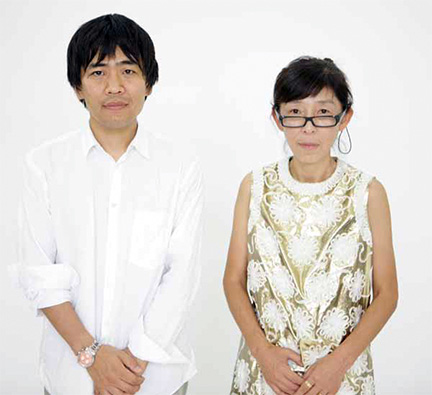
Unless you've been on the dark side of the moon all day (and probably even there, unless you've got AT&T), you've no doubt heard by now that Kazuyo Sejima and Ryue Nishizawa, the duo who make up SANAA, have been awarded the 2010 Pritzker Prize. Apparently, despite what Joe Rosa and Bob Somol told you, Europeans don't have a monopoly on path breaking architecture. (And if you compare SANAA's Serpentine Pavilion from last year to the wildly dysfunctional Hadid Burnham Pavilion in Millennium Park, you can see the kind of quality we could have insisted on, but didn't.)

In an interview with designboom, Sejima resisted citing specific architectural influences, while Nishizawa named the holy trinity of Mies, Le Corbu and Neimeyer, "These are an unforgettable 'trio' for me." Seijima talks about "our interest now is more how to organise ‘a program’ within a building - the layout of rooms and how people move inside. but also how to keep a relationship between the ‘program’ and the outside and then how the outside fits to the surroundings. in each project we have different requirements and the site is different, we try to find our way.," and this appears to be very clear in their recent projects.

There will be an orgy of pontification now that the award has been announced. As I'm seldom let out of the house, I've yet to experience any of SANAA's work firsthand, so I'll restrict myself to couple of cursory observations. . .

The first thing that strikes me about Sejima and Nishizawa's work is how, at the same time, they embrace and subvert that Miesian legacy. (Apologies in advance for the music in these videos - turn down your volume now.)

At roofline and plinth of the Glass Pavilion at the Toledo Museum of Art, the building is a rounded square that defines the basic container, but in between, there doesn't appear to be a single right angle. SANAA addresses individual programs in a series of mostly discrete spaces that can be rectangular, circular or elliptical,. They float within a thin - as little as a meter - ether of separation, and a long snaking foyer and forking exhibition space. The use of glass walls both for the perimeter and the interior, combined with several open air galleries, mediate between transparent, reflective, and opaque. In place of Miesian universal space, you have the specificity of full partitioning, but with an "almost nothing" twist.


The second thing that struck me by looking at the official SANAA photos included in the Pritzker Prize press kit is the emphasis they place on how their work appears in context - not just the context of adjacent structures, but in the wide-angle context of the surrounding community. It's in no way a literal contextualism, a mimicking of surrounding elements, but a more intuitive sense of place. In the case of the New Museum of Contemporary Art in lower Manhattan, the stacked boxes seem a witty riff on the city's congestion and early wedding cake skyscrapers. In the case of the museum in Toledo, a medium density city, it's providing a graceful, low-rise anchor to the mix of parking lots, midrises and even taller trees all around it.

Sejima and Nishizawa will receive their award May 17th on Ellis Island, where they'll be held in protective custody until they can be vetted by the DHS.

A side note of this year's award is that the Pritzker Prize website, since its inception up to a year or so ago an abomination of bad design that seemed to be mocking the prize's mission, is now a pretty professional job, including putting up the press kits as those so-trendy on-line magazines where you actually see and hear (loudly) the pages being turned. (Although there are still rough edges like badly wrapping values in one of the drop-down menus.)

You can also visit the SANAA website, which is Mies minimalist to the extreme - a single page with just six lines of text, consisting entirely of contact information.
portrait photo by Takashi Okamoto, building photographs by Hisao Suzuki,
courtesy SANAA

Thursday, March 25, 2010

What price saving the Rosenwald? $100 million?

Natalie Moore of Chicago Public Radio is reporting that plans for rescuing the historic Rosenwald Apartments on 47th, commissioned by 3rd ward alderman Pat Dowell from the Urban Land Institute, call for a mix of residential and retail, with an optimum price tag of $100,000,000, and a scaled down version, price unrevealed. Dowell told Moore that a scattering of interest from developers has yet to evolve into any concrete plans.

Read our 2009 piece on the 447 unit complex, once an urban showcase, but boarded up and vacant for years, here.

(Dot) Dashing Tower

Keep staring at the above photo and it will start messing with your head.

Balconies are the grand jest of residential towers. Developers know they need them to help push the units. Developers also know that once the sale is made, residents rarely set foot on them - you're more likely to see bicycles on them than people. Perkins + Will's Ralph Johnson has a new take on condo tower balconies, and it's made the new 235 West Van Buren one of the most distinctive presences in the South Loop skyline. Read all about - and see all the photo's - here.

Monday, March 22, 2010

Louis Sullivan: The Struggle for American Architecture - world premiere April 8th

On April 8th, this year's Full Frame documentary film festival in Durham, North Carolina will offer the official world premiere of Mark Richard Smith's new documentary, Louis Sullivan: The Struggle for American Architecture.

Earlier this month, the film had a preview that filled both theaters of the Gene Siskel Film Center. Smith has created a clear, streamlined narrative that eloquently captures the triumphs, tragedies and conflicts of Sullivan's work, life, and thought.

For those who have read any of the biographies of Sullivan, the film covers familiar ground. At a question and answer session after the Chicago screening, Smith, soeaking not just as the director, but as a gay man, himself, responded to a question asking why the film didn't deal with the issue of Sullivan's sexuality . . .
It's a tricky area because like everything connected with his personal life, which is rather vague, in a lot of ways, I as a filmmaker was really limited in what I could really assert without derailing the story, which for me was all about his work and his aesthetic reaction to the world around him. Which I think when you really get down to it doesn't have a lot to do with your sexuality. Your sexuality, the conflicts you have made, draw you to a certain kind of expression , a certain vehemence about it. This is really the first time anyone has treated Sullivan in his entirety as an artist.

The film includes extensive interview segments with Sullivanistas such as preservationist Gunny Harboe, biographer Robert Twombly, authors Lauren Weingarden and Joseph M. Siry, (whose The Chicago Auditorium Building is the Tolstoyan epic of architecture and social forces converging and exploding in late 19th century Chicago), and Chicago Cultural Historian Tim Samuelson, whose long-awaiting show on Louis Sullivan is rumored to be opening in June.

The original score was described by its composer, Michael McLean as a "very eclectic score, it was very fun to write." McLean demonstrated the workings of the score at the Gene Siskel's piano, saying that, just like one of Sullivan's heroes, Richard Wagner, he used leitmotivs. "There's one melody in here that was the one that's the young Louis Sullivan, and as he gets older, he's disillusioned, he's bitter, you can take that melody as young man and turn it into . . . " and here McLean played the audience the same theme, now tinged with the unresolved sadness of the minor mode. "No one thinks of that intellectually, but it affects you at a very deep emotional level and that's what Louis Sullivan's architecture and ornamentation does."

The otherwise capable score includes one major miscalculation. As the camera reveals Adler and Sullivan's astonishing Auditorium Theater, the soundtrack bursts forth with Siegfried's Funeral March, music that screams "look how impressive this is!" with a feudal morbidity and heavy-handed sense of doom that is the very antithesis of Sullivan's graceful triumph.

As with Judith Paine McBrien's fine documentary from last year, Make No Little Plans: Daniel Burnham and the American City, one of the pleasures of the film is to rediscover all of those graphics and photographs we've seen, faded and murky, in books down through the years, cleaned and polished to a pristine condition that makes them things of newborn wonder.

Other than director Smith, the real star of Louis Sullivan is cinematographer Peter Biagi, whose camera glides over and through the architecture and ornament as if making love to it. Using special cranes and just plain skill, Biagi gives the audience what, short of experiencing it first hand, is possibly the most complete expression of the stunning beauty that arose out of Sullivan's fertile imagination. This is a film worth watching for, to see it in a theater, where the scale of the images brings you closer to what encountering the work is really like.

Ultimately, only a great novel could do Louis Sullivan full justice, one that took full advantage of authoritative license to try to get a handle on the great architect's inner life. Mark Richard Smith, in concentrating on the work and the public record, has perhaps done the next best thing: tell a story that is, at once, inspiring, tragic and moving, propelled by art whose inimitable quality and unique achievement has kept the story of its creator - and the questions he raised - compelling down to this very day.

Mark Richard Smith talks about the challenges of filming Louis Sullivan: The Struggle for an American Architecture and the decision to use a female voice to read from Sullivan's writings.


Tunnel Vision

Earlier this month, as reported by the Art Daily Newsletter, London residents had a last chance to tour what was described at its opening, over a century and half ago, as The Eighth Wonder of the World: the 1,300 foot tunnel beneath the Thames, using revolutionary new tunneling technology developed by French-born engineer Marc Isambard Bruneil. The Thames Tunnel took over 40 years to finish, and created a sensation. A week after its opening, more than half of London, including Queen Victoria, Prince Albert, and the poet Byron had paid a penny a piece to stroll along its gaslight arches.
Completed at a cost of £634,000, (one 1843 pound would be worth about 44 today), it never turned a profit. even as it remained a popular attraction, with the spectacular entry pavilion you see above, and later additions of a shopping arcade, pipe organ, theater, fortune tellers and dancing monkeys - "all sorts of contrivances to get your money," in the words of a contemporary observer. It also became known as a favorite prostitute's haunt and a good place to get mugged. In 1865, it was purchased by the East London Railway, and eventually became part of the London Underground. It is scheduled to again serve the East London extension later this year.

As we approach April's fool day, the contemporary illustrations of the tunnel are so fantastical that you'd be forgiven if you thought it was a urban legend. But it wasn't.
There were several great tunnels dug under the Chicago river, including the one at LaSalle Street, whose cross section is depicted above.  The first, 1,600 feet long, under Washington street, opened in 1869; the second, 1890 feet under LaSalle, opened in 1871 at a cost of $566,000, just in time to serve as a major lifeline to the frenzied crowds fleeing the Chicago fire after the wooden bridges had burned and collapsed.

Originally designed for pedestrians and private vehicles, they were turned over to the cable car companies, run by the ultimately infamous Charles T. Yerkes, in a midnight vote at a July, 1886 session of the Chicago City Council, that was euphemistically described by the New York Times as "prolonged and exciting."

There was no Vrdolyak or Burke, or Dick Mell jumping up on a table, but local papers intimated that boodle was flowing freely to aldermen in Yerkes 'pocket. The annual rental fee of $20,000 was cut in half by an ordinance pushed by that era's representative from the Cullerton family, providing a $10,000 credit reimbursing Yerkes for the cost of paving and lighting the tunnel. The Chicago Daily News described the original ordinance as "having been amended so as to practically make the tunnel a present to Mr. Yerkes."

Cable car service in the tunnel continued until 1906. Originally the tunnel was 18 feet below the riverbed, but when the Chicago river was reversed, the dredging of the river exposed the tunnel's top. A wide, deeper replacement was manufactured on Goose Island out of steel plate, floated down the river and lowering into a trench in the riverbed. Completed in 1912, it now served the city's streetcars. It remained in use until 1939, when it was walled up as the Dearborn Street subway was constructed.
photos of the 1911-12 reconstruction: Chicago Daily News negatives collection, Chicago History Museum, from the Library of Congress American Memory collection.