 Click image for larger view.
Saturday, May 08, 2010

Friday, May 07, 2010
Buildings that are a Lot Better than you've Heard: The Max Palevsky Residential Commons
 Philosopher, computer geek and philanthropist Max Palevsky died this week. The son of Russian emigrants, he was born in Chicago in 1924, growing up in Humboldt Park. In 2000, he gave $20 million towards the cost of what would eventually be named the Max Palevsky Residential Commons at the University of Chicago, designed by architect Ricardo Legorreta. "Just doesn't work," was the Trib's Blair Kamin's imperial dismissal after the opening. We thought it was a good time to take another look and see how well his opinion holds up. Read all about it, see the pictures and judge for yourself, here.
Thursday, May 06, 2010

Wednesday, May 05, 2010
Friday: dueling student shows at UIC, IIT
This Friday, May 7th, the architecture schools at both IIT and UIC will be having their year-end shows of student work. At IIT, the exhibition runs from 5:30 to 7:30 p.m.,  with the student award ceremony at 6:30. Over at UIC, the exhibition runs from 5:00 p.m., to 7:30 p.m, in the galleries of the Art and Architecture Building, 845 West Harrison, with a jury presentation to begin at 6:00, followed by the granting of student awards. This year's jury includes the Graham's Sarah Herda, Sharon Johnston of Johnston Marklee, L.A, Sylvia Lavin of UCLA and John McMorrough of OSU.
 with the student award ceremony at 6:30. Over at UIC, the exhibition runs from 5:00 p.m., to 7:30 p.m, in the galleries of the Art and Architecture Building, 845 West Harrison, with a jury presentation to begin at 6:00, followed by the granting of student awards. This year's jury includes the Graham's Sarah Herda, Sharon Johnston of Johnston Marklee, L.A, Sylvia Lavin of UCLA and John McMorrough of OSU.
Tuesday, May 04, 2010
Painted Lady Strips Down
 Other than harvested grain, the McCormick reaper's greatest production was family relations and their mansions. The north side was crawling with them. Founder Cyrus's 1879 palace at 676 North Rush bit the dust in the 1950's; nephew L. Hamilton's 4-story Italian palazzo at 100 E. Ontario is now the two-story Lawry's Restaurant.
Brother Leander's mansion at 660 N. Rush, however, endures. Built as a double house for Leander and his son Robert Hall, it was combined into a single residence after the father's 1900 death, and became the storehouse for R.H.s ever expanding collection of fine art. After the son's death in 1917, the building drifted. Started in 1965, it began a nearly 30-year run as the restaurant Chez Paul, and after that, offices for the Encyclopedia Britannica.
Now the scaffolding's coming off from it's latest exterior rehab, and the previous painted cream facade with battleship gray accents has reverted to a more au naturel, uniform, clay-colored appearance. Better or worse?

(Click image for larger view)
Monday, May 03, 2010
Chicago Architecture for the Aspiring Inebriate
So as not to be among the martyred slaves of time, be drunken, be drunken without ceasing. With wine, with poetry, with virtue, or with architecture, à votre guise.Do I detect a trend here? I wrote yesterday of Preservation Chicago's May 12th membership fundraiser, Drinking in Your History, at the Green Door Tavern. Today, I'm reminded that, not to be outdone, Landmarks Illinois is having a Historic Pub Crawl in Hegewisch this Wednesday,
 May 5th.
Now, I learn that the Chicago Architecture Foundation is offering up a Happy Hour Walking Tour, Monday through Friday at 5:30 p.m., through September, each day a different tour. (Tuesdays are Millennium Park). The tours are actually two hours long - does
 this mean you're only guaranteed to be happy half of the time? The $16.00 tariff ($13.00 for students and seniors, free for CAF members), includes a free drink at local restaurants like the Park Grill, Rhapsody and the Berghoff at tour's end. So get your group together (if
 you're ten or more, advance reservations will be required), draw straws to pick the designated walker to stuff the rest of you into cabs at the end of the evening - remember: no drinking until the end of the tour - and get high on the glories of Chicago's Great Places and Spaces*
*Persistent binge drinking is a serious medical condition requiring professional medical attention. As good as you feel at 12:00 a.m., you will feel equally as miserable by 7:00. If you find yourself at the end of the bar having a heated argument with Charles Atwood, it is time to go home. Charles Baudelaire died at age 46 after suffering a massive stroke at 45. Projectile vomiting on your boss may cause job insecurity. No matter if he appears to understand you like no one else ever has, six-foot-tall rabbits do not exist. Nor does Chicago's Great Places and Spaces, at least for 2010.
Gang, Lurie, Sullivan, Samuelson, Le Corbu, Goldberg and more - fifty+ events on May Architectural Calendar
 Hey, we're only two days late!
The May architectural calendar starts off in a big way this week with Christian Blaser at IIT on Monday, presentation by the finalists for SEAOI's Excellence in Structural Engineering Awards on Tuesday, SOM on the Chicago Riverwalk, CWA's architects doing other things, and Phillip H. Bess of Notre Dame at Pleasant House in Oak Park all on Wednesday, IIT's Open House and student exhibition on Friday, the 7th, plus eight more events for good measure.
Leading up to the opening of his long-awaited Louis Sullivan exhibition next month, Chicago Cultural Historian Tim Samuelson lectures twice, first at a fundraiser for the restoration of Holy Trinity Church on the 14th, and then on Louis Sullivan's Idea at the Chicago Cultural Center for Landmarks Illinois on the 20th.
Pierre-Antoine Gatier, Chief Architect of Historic Monuments and General Inspector of Historic Monuments, lectures on restoring the buildings of Le Corbusier at CAF on the 13th, where Gordon Gill talks about his firm's Chicago Carbon Plan on the 12th, and Julio César Pérez Hernández talks about Preserving Havana Architecture on the 25th.
On May 26th, Jeanne Gang lectures at Fullerton Hall for the Architecture and Design Society of the Art Institute, and on the 27th at the Driehaus Museum in the old Nickerson Mansion, Roberta A. Mayer talks about her book, Lockwood de Forest and the East Indian Craft Revival. Robert Furhoff discusses White House interiors at Glessner House on the 11th, and Brian Reis on Frank Lloyd Wright and the Fine Art Interior at Second Presbyterian on the 6th.
And there's more! Over 50 events, even before we start adding all the stuff we missed. And if it all just sends you reeling, we especially recommend Preservation Chicago's May 12th fundraiser, Drinking in Your History, at the Green Door Tavern.
Check out all the great events here.
Sunday, May 02, 2010

Saturday, May 01, 2010
Chicago Streetscene: Ritz Pit
 When complete, it will be ultra high-end, but for now, a worker climbs out of the foundation work for Lucien Lagrange's Ritz-Carlton Residences on Michigan Avenue
 click on images for larger view
Thursday, April 29, 2010


UrbanLab's Eco Boulevards named as finalist in $100k 2010 Buckminster Fuller Challenge
Eco-Boulevards from UrbanLab, part of the Growing Water concept that won UrbanLabs first place in the 2006 City of the Future competition, today was also named one of six finalists for the 2010 Buckminster Fuller Challenge. First prize for City of the Future was $10,000. First prize for the 2010 Bucky is a cool $100,000. The winner will be announced June 2nd at the National Press Club in Washington.
Archeworks Final Semester Review Tonight, Bertrand Goldberg archives on Saturday
In what I'm fairly confident will be the last addition to the April calendar, Archeworks, Chicago's alternative design school, will be holding it's year-end Student Final Presentation and review of current projects, including the design of Pocket Parks for two vacant sites in Little Village, a Native Seed Farm project on two  Bridgeport sites, and a Mobile Food Collective, "a family of mobile structures that inspire people to play a more active role in the origin, growth, and preparation of fresh foods, and to create a more participatory food culture." The event is open to the public, 6:00 to 8:00 p.m., at Archeworks, 625 N. Kingsbury, at Ontario. RSVP online.
And, thanks to Marina City Online, we bring you news of a lecture Saturday, May 1st, at the Art Institute, where Sarah Whiting, dean of architecture at Rice University will discuss the Ryerson and Burnham libraries archives of architect Bertrand Goldberg. It's from 3:00 to 4:00 p.m., in the Morton Auditorium, on the lower level of the Art Institute, 111 S. Michigan. The lecture is free with the basic $18.00 admission.
The AIC's big show on Goldberg has been pushed back to the fall of 2011. For now, in addition to the lecture, there's an excellent new book on Goldberg's masterpiece, Marina City: Bertrand Goldberg's Urban Vision, by Igor Marjanovic and
 Bridgeport sites, and a Mobile Food Collective, "a family of mobile structures that inspire people to play a more active role in the origin, growth, and preparation of fresh foods, and to create a more participatory food culture." The event is open to the public, 6:00 to 8:00 p.m., at Archeworks, 625 N. Kingsbury, at Ontario. RSVP online.
And, thanks to Marina City
 Online, we bring you news of a lecture Saturday, May 1st, at the Art Institute, where Sarah Whiting, dean of architecture at Rice University will discuss the Ryerson and Burnham libraries archives of architect Bertrand Goldberg. It's from 3:00 to 4:00 p.m., in the Morton Auditorium, on the lower level of the Art Institute, 111 S. Michigan. The lecture is free with the basic $18.00 admission.
The AIC's big show on Goldberg has been pushed back to the fall of 2011. For now, in addition to the lecture, there's an excellent new book on Goldberg's masterpiece,
 Marina City: Bertrand Goldberg's Urban Vision, by Igor Marjanovic and
Wednesday, April 28, 2010
Read it now!: Building Design + Construction vanishes after Friday.
So much for that whole internet Library of Alexandria thing.
Archnewsnow is reporting that Building Design & Construction (BD+C) not only has folded, but all its web content will disappear from the face of earth after this Friday, April 30th. It's part of a Reed Elsevier mass euthanasia of 23 magazines.
Is this the downside of the digital age? At least with print editions you always had a chance of tracking down a copy in some unexpected location. When it's all in the cloud, however, how many copies exist - one, and a couple of backups? And when the owner dies or disinherits it, is all that history then simply annihilated as if it never existed?
Tuesday, April 27, 2010
Friday at the Graham: Havana's Lost City and Abandoned Dream - Felipe Dulzaide: Utopía Posible
 Even with only three day's left, it's still not too late to add an interesting event to the April calendar.
On Friday, April 30th, from 6:00 to 8:00 p.m., the Graham Foundation will be holding an opening reception for its new exhibition, Felipe Dulzaide: Utopía Posible, which will run through July 17th. There will be a talk by Dulzaides at 5:30 p.m.
"Artist Felipe Dulzaides' installation explores the history of the unfinished National Art Schools in Havana."
The story is that in 1961 Fidel Castro and Che Guevara were playing golf at what was, under the old regime, the Havana County Club, when they hit upon the idea of using the site for a new national arts school. Italian architect Vittorio Garatti would design the School of Ballet and Music, Roberto Gottardi the School of Dramatic Art and Cuban architect Ricardo Porro, those for the Fine Arts and Modern Dance.
After four years of construction, and a shift in ideology, alliance and aesthetics to all things
 Soviet, the sensuous designs, using locally produced bricks and terra cotta and deploying Catalan vaults to creates and archways, were declared decadent. Although Porro's and Garatti's buildings were essentially complete, the project was halted, and the structures left to rot, to be trashed and looted, for four decades, before a new effort to restore and complete the complex began in 1999. In 2003, it was added to the Tentative List of UNESCO World Heritage sites.
 The history of this project continues to fascinate. Cuban artist Felip Dulzaides was born in the same year the National Arts School project was shut down, and his installation "addresses different aspects of a compelling story about the unfinished dramatic art school at the Instituto Superior de Arte in Havana whose architecture captures the Utopian ideals of the Cuban Revolution. "
The centerpiece of Utopía Posible focuses on Roberto Gottardi and his quest to finish the School of Dramatic Arts, aprocess that has taken more than 40 years and led him to develop four different schemes.
The exhibition also features two new video pieces: Next Time It Rains, about Garatti's School of Ballet, which was 90 percent complete in 1965 but never occupied and left to be overgrown by jungle; and Broken Glass, about Porro's School of Dance, the first building of the complex to be completed during initial construction. The School of Dance was modeled after the shape of a broken piece of glass, a metaphor for an emotional explosion and the sense of fragility that characterized the revolution in its earliest stages. Together, these works contribute another dimension to this unique story of intense creativity, experimental architecture, and politics.

(all images courtesy The Graham Foundation)

Sunday, April 25, 2010
Buildings We've Grown to Love: Harry Weese's River Cottages
From the west, they look a bit forbidding, the cottages architect Harry Weese designed in 1988 along the west bank of the Chicago river, just south of the Kinzie Bridge. A long, monolithic concrete wall gives off an almost bunker-like vibe, until you notice that the windows that occasionally puncture it are a bit eccentric - portholes, triangular sashes, bays that look more like something you'd find on a shack than an upscale townhouse.
 When you get to the river, however, you're on a different planet, where the funkiness subverts a tight, organizing geometry to create one of the more engaging structures in the city. (Click on the photographs to see a larger view.)
 Weese's nautical idioms came naturally, both from his wartime service in the Navy, and his love of sailing. On her very fine blog, BLUEPRINT: Chicago, Caroline Nye writes that Weese's "inspiration for the cottages came from a trip he took down the Danube River in Hungary thirty years prior to their completion in 1988. There he had seen a collection of unique cottages where people were able to build whatever they wanted with minimal government interference."
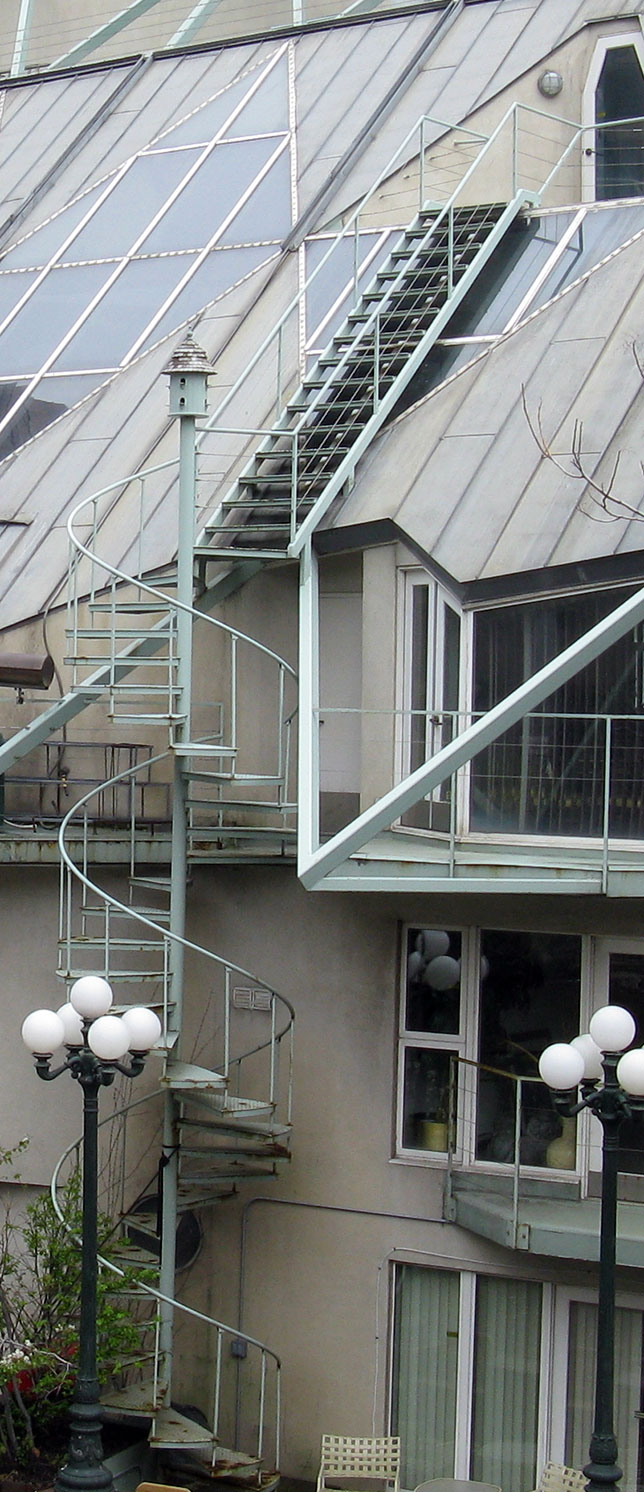
And, indeed, Weese's sly take seems to be an homage to what squatters might have put up if they only had the money - and imagination. The six levels of the four townhouses stack atop each other like cabins on a hillside, with a external stair that winds like a corkscrew up to a steep, ladder like series of steps leading to a glass, coffin-shaped door at the back of a terrace. A birdhouse serves as a filial to the tall pole anchoring the stairway.


The sharply-angled roof, expressed in a grid of rectangles and triangles, alternates between solid and glass for the skylights, and solid and voids for the terraces. Jut-angled brackets pop out of the facade. Pipe chimneys punctuate the roofline. This is probably one of the few buildings where satellite dishes seem perfectly at home in the overall design.
 The central courtyard seems less willed than improvised. To paraphrase FLW, the cottages look like they were built not on the riverbank, but of it.
 I keep thinking that the cottages would be right at home in Sweethaven, the huge set Wolf Kroeger constructed for Robert Altman's 1980 film Popeye, which remains a major tourist attraction on the island of Malta down to this very day.

 The cottages, similarly, are a one-of-a-kind, unsanitized delight, an anti-Miesian romp that rejects uniform repetition for a playful mosaic that, like a master juggler, keeps a boatload of variations in the air all at the same time. Yesterday, even this goose seemed to find serenity in contemplating Weese's cottages from his perch in the river.

 When you get to the river, however, you're on a different planet, where the funkiness subverts a tight, organizing geometry to create one of the more engaging structures in the city. (Click on the photographs to see a larger view.)
 Weese's nautical idioms came naturally, both from his wartime service in the Navy, and his love of sailing. On her very fine blog, BLUEPRINT: Chicago, Caroline Nye writes that Weese's "inspiration for the cottages came from a trip he took down the Danube River in Hungary thirty years prior to their completion in 1988. There he had seen a collection of unique cottages where people were able to build whatever they wanted with minimal government interference."
And, indeed, Weese's sly take seems to be an homage to what squatters might have put up if they only had the money - and imagination. The six levels of the four townhouses stack atop each other like cabins on a hillside, with a external stair that winds like a corkscrew up to a steep, ladder like series of steps leading to a glass, coffin-shaped door at the back of a terrace. A birdhouse serves as a filial to the tall pole anchoring the stairway.

The sharply-angled roof, expressed in a grid of rectangles and triangles, alternates between solid and glass for the skylights, and solid and voids for the terraces. Jut-angled brackets pop out of the facade. Pipe chimneys punctuate the roofline. This is probably one of the few buildings where satellite dishes seem perfectly at home in the overall design.
 The central courtyard seems less willed than improvised. To paraphrase FLW, the cottages look like they were built not on the riverbank, but of it.
 I keep thinking that the cottages would be right at home in Sweethaven, the huge set Wolf Kroeger constructed for Robert Altman's 1980 film Popeye, which remains a major tourist attraction on the island of Malta down to this very day.

 The cottages, similarly, are a one-of-a-kind, unsanitized delight, an anti-Miesian romp that rejects uniform repetition for a playful mosaic that, like a master juggler, keeps a boatload of variations in the air all at the same time. Yesterday, even this goose seemed to find serenity in contemplating Weese's cottages from his perch in the river.

Sunday Reading: Weiwei on Twitter; Schama on Rothko in Russia
“In Chinese [in 140 characters] you can seduce a girl or write a constitution. You can write a short novel or tell a beautiful story." So says Chinese artist, architect  and activist Ai Weiwei about his love of Twitter in an extensive interview with David Pilling in this weekend's Financial Times. Weiwei talks about his clash with Chinese authorities, his work on Bird's Nest Olympic stadium in Beijing, and what his father learned from cleaning toilets during the Cultural Revolution.
Also in the FT's weekend edition is another excellent article by Simon Schama on the return of the work of painter Mark Rothko, who claimed that the scar on his nose came from a cossack whip, to larger Russia via a major new retrospective at Moscow's Garage Centre for Contemporary Culture.
 and activist Ai Weiwei about his love of Twitter in an extensive interview with David Pilling in this weekend's Financial Times. Weiwei talks about his clash with Chinese authorities, his work on Bird's Nest Olympic stadium in Beijing, and what his father learned from cleaning toilets during the Cultural Revolution.
Also in the FT's weekend edition is another excellent article by Simon Schama on the
 return of the work of painter Mark Rothko, who claimed that the scar on his nose came from a cossack whip, to larger Russia via a major new retrospective at Moscow's Garage Centre for Contemporary Culture.
Saturday, April 24, 2010

Friday, April 23, 2010
John Cage, Water Walk, on I've Got a Secret, 1960
Via the New Republic's David Hajdu, here's John Cage with Gary Moore on I've Got a Secret, circa 1960, performing Water Walk, minus the sound of five radios due a union jurisdictional dispute.. Hajdu's take on the program, cultural attitudes, and Cage, himself, is worth reading, but what's perhaps most nostalgic is that this a full 9 minute, 23 second segment without commercial .interruptions.
Thursday, April 22, 2010
John Ronan talks about his new design for the Poetry Foundation
 "It may be easier," said architect John Ronan, when asked about the affinities between architecture and poetry, "to talk about what we didn't do, which is to read a poem and design a building."
He was speaking at a Wednesday lunchtime event at the Arts Club at which the Poetry Foundation was celebrating the groundbreaking for its first real home of its own, made possible by a $100,000,000 gift from the late heiress Ruth Lilly, which will soon liberate the organization from nearly a century of often hand-to-mouth existence in small rented rooms and cramped basements.
 Construction is set to begin soon on the new $9,700,000, 26,000 square-foot-building at the southwest corner of Dearborn and Superior. Ronan's design creates an angle of repose in the midst of busy River North with a large garden inside a visually permeable screen wall made of a black zinc that turns solid over the other parts of the building.

I expect to be writing a lot more about this building, and about Studio/Gang's new Media Center for Columbia College, but for today, we'll let Ronan do the talking:
. . . there are aspects of the building that are very much like a poem, and try to be like a poem. It's not a building that's a one-liner. It's not something you see right away. You might have to go back to it two or three times. You might have to see it at different times of day or year to really get an understanding of it, just as you might come back to a poem time and time again and get something different out of it each time that you read itThe two videos below capture Ronan's presentation on his design. I apologize for the visual quality, but you should be able to still get a decent view of the illustrations. The most comprehensive source for a selection of many of the same graphics used in the Arts Club presentation, in much better quality, can be found in the newly published Explorations: The Architecture of John Ronan, from Princeton Architectural Press, which provides a rich overview of the work of one of Chicago's best architects. You can also find slideshows of images on the websites of both the Poetry Foundation, and of John Ronan Architects.
. . . Poets don't invent words. They just arrange words in a way to uncover new meaning or make us think about something that was hiding in plain sight, that we didn't see. And that's what I try to do. I'm not inventing new materials. I'm notinventing forms. Just putting them together in such a way that you may have to rethink things and draw your attention to them in unexpected ways.


(Click on the videos to view them in a larger size.)
Part One:
Part Two:
Subscribe to:
Posts (Atom)