Showing posts with label Wright's Roots. Show all posts

Saturday, June 08, 2013

Retro Saturday: Happy 146th Birthday, Frank Lloyd Wright! A Miscellany Portrait of the Reprobate ‘World's Greatest Architect’

click images for larger view

“I.K”, [Frank Lloyd Wright] said with almost no prelude. “I.K, I have been conventional too long! I am a genius, I know no conventions, a genius knows no law. A genius must and will live his own life. From today I cast aside conventions; from today I live my own life!” That was the gist of a ten or fifteen minute prattle, in which the words 'genius', 'life', 'conventions' were flung about like confetti at a carnival. At first, I thought that as usual architecture was on his mind . . . but the next day the papers carried as an item of news that our genius had 'eloped with the wife of a client.'
- from The Autobiography of Irving K. Pond: The Sons of Mary and Elihu
It's been said that Frank Lloyd Wright's greatest creation may have been himself.  Through many rocky decades, he clung to his self-image of ‘world's greatest architect’, and by the time he died at 91 in 1959, he had convinced most of the rest of us, as well.  On this day, June 8th, that would have been Wright's 146th birthday, the old scoundrel's sorcery remains as potent and inspiring as ever, so what better time than provide this highly selective, impromptu portrait from our writings down through the years . . .
The Night Frank Lloyd Wright Spent in Hennepin County Jail was a direct consequence of Wright's willful liberation from his second wife.

Frank Lloyd Wright and the Japanese Print - The Art Institute had a great show last fall displaying many of the Japanese prints Wright had collected early on and sold to sustain himself during the lean times.  Among the prints were some of the original spectacular Japanese-influence renderings that had helped made his work world famous, many of which came not from Wright's hand, but from that of his employee, the richly talented Marion Mahony . . .

Frank Lloyd Wright's Right-Hand Woman

Also last year, the indispensable Tim Samuelson, who currently has another great show, Modernism's Messengers: The Art of Alfonso and Margaret Iannelli, up at the Cultural Center, curated an overview of Frank Lloyd Wright's early work, centered on the time he spent as an employee of Dankmar Adler and Louis Sulivan.

Wright's Roots
 
Wrights Roots: Garrick Theater colors seen for first time in over a century
In May, a joint campaign was announced in which the Alphawood Foundation would contribute up to $10 million in matching funds towards the restoration of Wright's 1908 Unity Temple in Oak Park,, which, if successful, could also see ownership transferred from the Unitarian Universalist
congregation which originally commissioned the building to ownership by a new, endowed foundation.

Frank Lloyd Wright's Unity Temple among National Trust's 11 Most Endangered 

See Frank Lloyd Wright's Boiler!

Back in 2006, actor Peter Weller brought his own stamp to Wright in his portrayal in Richard Nelson's play at the Goodman Theatre, an interesting effort to capture Wright at his point of exile, the long, lean years between his early triumphs as his re-emergence as an architectural powerhouse in the 1930's.

Frank Lloyd Wright's Pacific Overture
Robocop channels Frank Lloyd Wright

The play also featured Harris Yulin as an alcoholic and exhausted Louis Sullivan, but when, during the play's run, a major American magazine created a list of 100 Influential Americans, Sullivan had a bit of revenge, coming in at position 59 to Wright's 76.

Koolhaas, Wright, Sullivan score in Overnights

Wright continues to be influential, as can be seen in Hyde Park, where Wright's Robie House . . .
. . . is both subtly mirrored and re imagined in Rafael Viñoly's Graduate School of Business for the U of C.
Rafael Viñoly talks Wright, new hospital, at the Logan Center for the Arts

And for dessert, a small Wrightian miscellany . . .

Frank Lloyd Wright archives won't be bleeding Art Institute Red

Frank Lloyd Wright Hits the Wall

Wright's dog house
 Let's Get Small - Frank Lloyd Wright's American System-Built Homes in Beverly
Psssst, hey - buddy!  Wanna buy the Larkin Building?


Sunday, September 09, 2012

New: Patrica Patkau, Doug Fogelsen, Wright's Roots Extended - more for September!

The hits just keep coming to the September Calendar of Chicago Architectural Events, with several new items just added.
click images for larger view
We've just added a lecture by Royal Architectural Institute of Canada Gold Model winner Patricia Patkau of Patkau Architects, Vancouver.  6:00 p.m.,  Tuesday, September 18th, will be in Fullerton Hall at the Art Institute of Chicago, to give a lecture for SAIC (AIADO).

This Wednesday, September 12th, student group iitExposure kicks off a lecture series on architectural photographers with Doug Fogelson, 12:30 in the Lower Core at Crown Hall.  (More on this interesting series, and on the great new Vivian Maier show, tomorrow.)  Later Wednesday (6:00 p.m., Mikyoung Kim lectures at IIT at the Campus Center.

Also on Wednesday, Bastiaan Bousma discusses this year's edition of the amazing Open House Chicago at CAF lunchtime, Massamilliano Fuksas is at the Graham Tuesday evening.  Thursday, it's Larry Levy at the Chicago Club for Crain's, Rick Valicenti at the SAIC, and Glessner Houses' 125th anniversary Gala at Symphony Center.  And much more.

On the exhibition front, Tim Samuelson's don't-miss exhibition, Wright's Roots, has been extended at Expo 72 Gallery, 72 East Randolph, through October 14th.
There are over 25 great items just this week, and over 60 still come this month.  Check it all out - plus three new exhibitions - on the September Calendar of Chicago Architectural Events.

Sunday, July 29, 2012

Frank Lloyd Wright Hits the Wall

click images for larger view
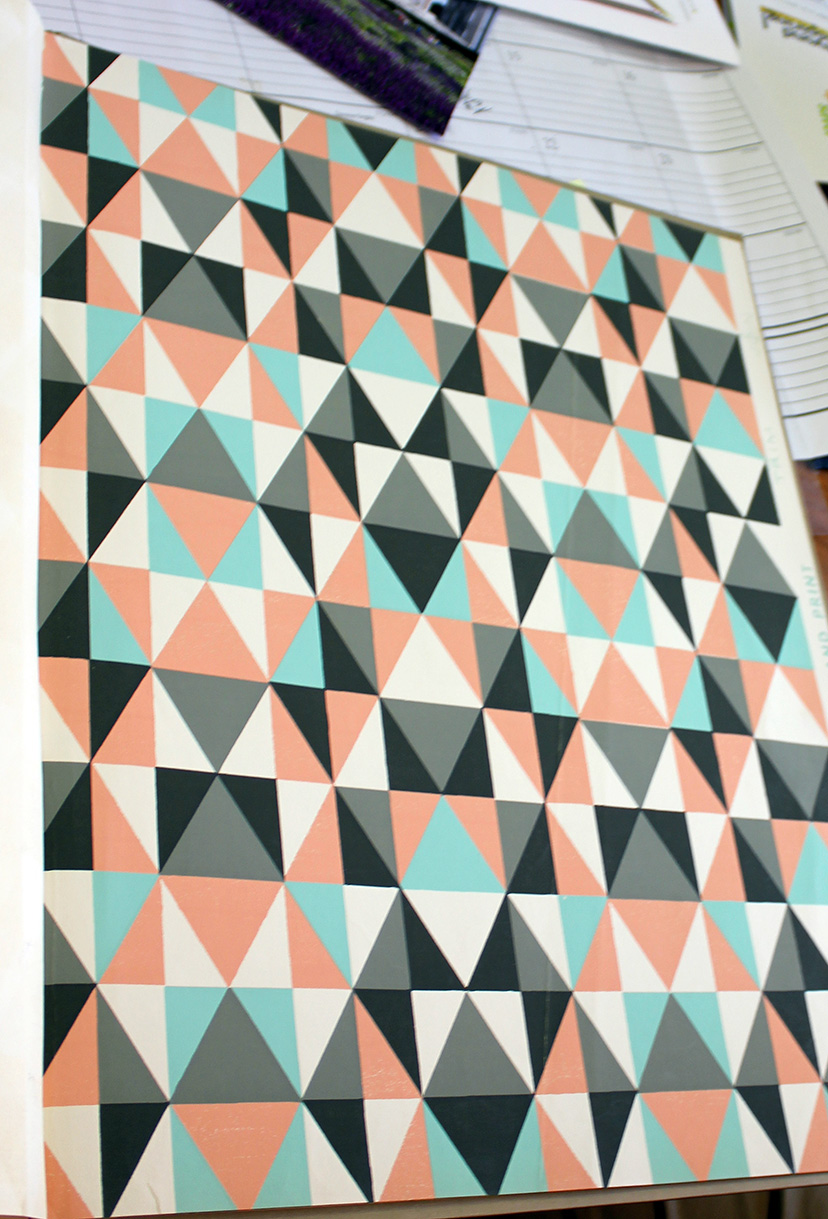
In 1955, House Beautiful editor Elizabeth Gordon was instrumental in introducing the Taliesen Line of fabrics designed by architect Frank Lloyd Wright that were produced by the company founded by Frederick Schumacher in 1899.
 "Schumacher's Take Pride in Introducing Fabrics and Wallcoverings  Designed by World Famed Frank Lloyd Wright," read the advertisement, showing the architect standing at a table covered with the fabrics, while a roll of the wallpaper, curling up at the bottom, can be seen to his left.  It was the first and only textile line produced by Wright, and it was also accompanied by a palette of 36 paint colors for the Martin-Senour Company.
Samples of the products can be found in such institutions as the Art Institute of Chicago, and London's Victoria and Albert Museum.  Last year, the Price Tower Arts Center, housed in the Frank Lloyd Wright designed skyscraper in Oklahoma City, had designer Lauren Dreiling draw upon the fabrics to create the Mary Lou, a jacket honoring the wife of Price Company founder, H.C. Price. 
Even the catalogue for the wallpapers is now a collector's item, and it's not surprising that one copy is in the hands of Chicago Cultural Historian Tim Samuelson, whose excellent show, Wright's Roots, tracing the early years of Frank Lloyd Wright is now running at the Expo Gallery across the street from the Chicago Cultural Center.

The wallpaper collection draws on many of the fabric patterns . . .
 . . . including patterns with elements on a very large scale.
Many of the samples, however, were of the same geometric composition rendered in different combinations of color, some of which were very much of their time, if even then . . .
 This, more sedately hued version of the pattern . . .
has been recreated on one wall of Wright's Roots.  You can see it in the photo below, as Tim Samuelson tells me about how Wright's change of mind about the windows of the Roloson Houses, is unveiled in Wright's Roots after being hidden for 85 years.  But that's a story for another day.
Wright's Roots runs through September 30th at the Expo Gallery, 72 East Randolph.


Wednesday, June 27, 2012

Wright's Roots are Showing: Garrick Theater colors seen for first time in over a century

click images for larger view
It's always difficult to imagine the architecture of the past as it actually appeared to people in its time.  When it comes to the Chicago of the late 19th century, that past, now mostly wiped from the cityscape, passes through the desaturating black-and-white photographic record.   Later photos may be more plentiful, but they usually depict buildings substantially altered from their original design.

We also see architecture of that time through the backward lenses of mid-century modernism, which emphasizes the simplicity of the commercial architecture of what has now been classified as the first Chicago School, seeing it as a precursor to the minimalist modernism of the International Style and the Second Chicago School of Mies van der Rohe and his followers.

But Louis Sullivan won't let you get away with it.  The beautiful simplicity of his Carson Pirie Scott store is anchored by an entrance floor marked by huge shop windows enveloped by the rich, foliate ornament for which Sullivan was famous.  His interiors, especially, were anything but austere, rich with stenciling, often designed with collaborators Louis J. Millet and George Healy, some of which, in a not uncontroversial restoration, was on display at a Crown Hall exhibition at few years back.

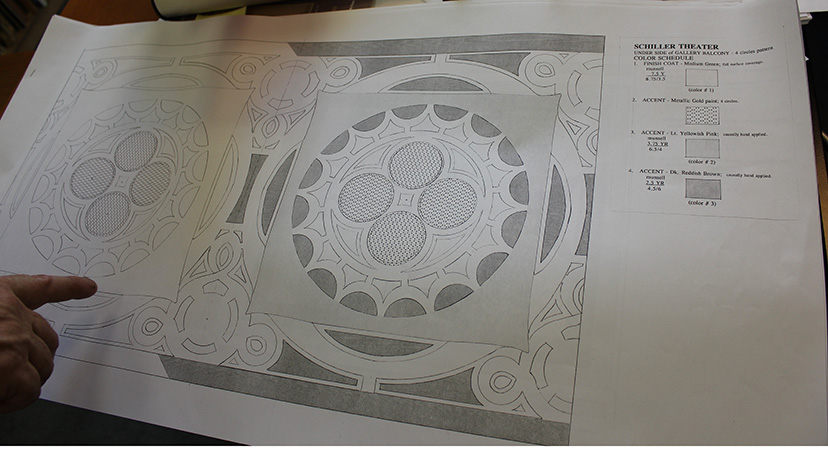
Adler and Sullivan's 1891 Schiller/Garrick Theater is a case in point.  Not only was the building itself tragically demolished in 1961, it's original interior design was painted over just seven years after the theater's opening.

As part of the new exhibition Wright's Roots, at the Expo 72 Gallery at 72 East Randolph through September 30th, 2012. curator and Chicago Cultural Historian Tim Samuelson endeavored to reveal, for the first time in over a century, the original color scheme of the ornament above the balcony, on the underside of the gallery.
Architectural finishes analyst Robert Furhoff was provided a rescued sample of the ornament, on which he burrowed down all the later paint jobs to document the original color palette.
Erin McNamara executed a sculptural repair of the original, made a mold of the repair and cast new pieces.  Anthony  Kartsonas  of Historic Surfaces LLC, who you see with Samuelson in the video below, then recreated the original paint pattern, using Furnoff's analysis.  And last Friday, Tim Samuelson was kind enough to let us be a witness as, for the first time in nearly 114 years, the original colors were again revealed.

The walls on which Wright's Roots is mounted are painted in the colors of that palette.
Of course, the Victorian palette can take some getting used to - one observer at Friday's unveiling commented it wasn't a palette they would want to paint any part of their home with - but to truly get a feeling of what the experience of an Adler and Sullivan building was like, it's invaluable to be able to imagine being immersed in the colors of the original design.

A substantial part of Wright's Roots traces the early, formative years when young Frank Lloyd Wright worked under the direction of Louis Sullivan, the man for whom he never lost his deep admiration and affection.    Wright's hand can still be seen in many of Adler and Sullivan's buildings of that period, and Samuelson  painstakingly lays out key examples.
The decorative panel you see above came from a Chicago apartment building built for Adolph and William Loeb in 1892.  It was rescued by Samuelson, hanging upside-down from the roof, just before the structure was demolished. The apartments were attributed,  rightly, to Adler and Sullivan, but as Samuelson relates . . .
When shown a photograph of the this long-forgotten project by architectural historian Richard Nickel in 1957, the ninety-year-old Frank grew momentarily quiet and then said, "So . . . you found THAT one, did you?"  After another pause, he said the design was his.
Another piece of ornament that didn't make it into Wright's Roots documents the different route Frank Lloyd Wright would take from that of his mentor Louis Sullivan.
In the above photo from the Chuckman Collection of the Garrick Theater under demolition, notice the large rectangular lozenges forming the outermost part of the arch.  (The flat, white interior surfaces of the rectangles were originally a nine-part stencil.)  Notice the border around each lozenge.  It was designed by young Frank Lloyd Wright, and this is what it looked like . . .
This is about as far from Sullivan's style of ornament as you can get.  Rigidly geometric, it has a vaguely Mayan feel that seems to anticipate Wright's later work.

There are a lot more fascinating stories in Wright's Roots, which we hope to write about in more detail (famous last words) soon.    Needless to say, it's a don't-miss event.  See it, and let your own imagination run free.


Tuesday, June 19, 2012

back to Wright's Roots, forward to Chicago Unseen City - two new exhibitions open Friday

click images for larger view
We may be heading into summer, but that hasn't stopped two exhibitions from making their way into the city this week, both with official Friday, June 22nd openings.
Over at the Expo 72 Gallery at 72 E. Randolph, Chicago's Cultural Historian Tim Samuelson is curating Wright's Roots, which explores the formative years of architect Frank Lloyd Wright.  When we think of Frank Lloyd Wright, we think of the larger-than-life persona he created for himself as the self-proclaimed "greatest architect on earth".  Wright's Roots looks beneath the veneer . . .
Every icon has their start somewhere. Frank Lloyd Wright’s reputation as a brilliant architect and outsized personality came from complex roots – many going back to his early years in Chicago.

Since his death in 1959, the story of Frank Lloyd Wright’s life and career has become legendary – and sometimes drifted into myth. Many of today’s perspectives came from Wright’s own accounts of a professional career that spanned three quarters of a century. His path to becoming a colorful public figure synonymous with modern architecture was filled with many little-known detours and diversions, but all contributed to his lasting fame and reputation.

Using seldom-seen illustrations and original artifacts to tell the story of his complex personal journey during the often-overlooked early period of his life and career, Wright’s Roots explores Wright’s formative years. 
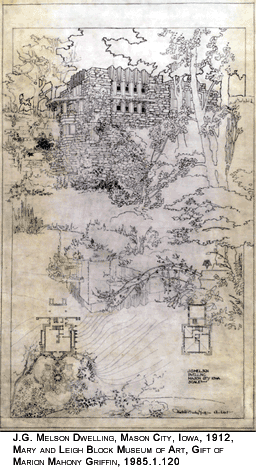
That rendering at the top of this post?  Not a Charles Atwood special, but a youthful indiscretion by a young FLW, the man said to have selected the names of composers included on the Auditorium's proscenium.

While the official opening is Friday, I'm hearing you may want to stop by next week to see the show in its full glory.  Wright's Roots runs through September 30th.

Meanwhile, over at the Chicago Architecture Foundation, 224 South Michigan,  there's another opening on Friday the 22nd.  The Unseen City: Designs for A Future Chicago, four Chicago academic institutions presents their visions of the future for city life.  Participating are Archeworks, UIC and IIT, in partnership with the Council on Tall Buildings and Urban Habitat and Adrian Smith + Gordin Gill Architects, rethinking such locations as Cermak Road and Garfield Boulevard.

We've just added a new event for June.  On Monday, June 25th, in the Lower Core of Crown Hall at IIT, Rajnish Wattas will lecture on Chandigarh's Identity Crises: Garden City to Urban Juggernaut?  On Thursday June 28th, there'll be an all-day symposium Trees as a Legacy in Design and Development, at the Chicago Botanic Garden.  There are still over a dozen great items to come on the June 2012 Calendar of Chicago Architectural Events.