Sunday, December 23, 2007

Downside of Sidewalk TV News Studio Revealed

And, no, it's not Vincent Falk's day-glow wardrobe or a spectator giving the finger just as the cameras turns on the onlookers waving from the other side of the glass.

Minutes into Sunday's 10 P.M. newscast, viewers heard a loud crash. A startled look crossed anchor Ravi Baichwal's face as a silver mini-van crashed into the ABC7 Chicago studio on State Street, smashing a large plate glass window and leaving it in a precipitous incline into the space. In what bystanders described as a deliberate act by the van's driver after the driver was asked to move the vehicle, the crash occurred less than thirty feet from the desk from which Baichwal was broadcasting, in an area of the set used for studio-based sit-down interviews, thankfully unoccupied. The newscast continued, as a headline describing the incident soon began scrolling across the studio's animated ticker, just above the van and smashed window it was describing.

Friday, December 21, 2007

Dark City

The long night approaches.

The sun, six hours stolen from peak summer flush, crouches low in the sky, buried alive beneath the skyscrapers. Birds chirp their anxiety from bare, snowdripped branches. An urban brew of filth-informed slush mires streets and sidewalks. We go to our jobs in darkness, return home in darkness, while in workday hours, the eviscerated rays scarcely penetrate the panes of glass sweating cold into dry, overheated rooms.

Winter solstice, Natalis Invicti, day of the new sun's birth, become, under a later Julius, the next the first, birth date of the son of God, harbinger of personal salvation.

Lights array to refute the darkness. Forced festivals hunger for the satisfactions of ancient rituals.

Winter's discontent will linger, but from this day, the darkest rotation is past for another year. Each day a little longer, light begins to insinuate its coming triumph. Unease like ice slides beneath our footing, but we celebrate. We plan. We hope.

Wednesday, December 19, 2007

Tristan Nuggets and Isolettes

If you didn't happen to be in Italy for the evening-after broadcast of the Daniel Barenboim Tristan and Isolde at La Scala in Milan, here's Waltraud Meier's stellar Liebestod, to give you an idea of what was up.

You have to think that this production is a prime candidate for a future Great Performances installment, but for now, here's a direct link to it on You Tube, where, if you're patient, you should be able to listen to the entire opera by piecing together all of the eight to ten minute fragments. Meier is excellent, Tristan Ian Storey struggles a bit, Lyric alumni Matti Salminen is still hanging in there with a fraying around the edges but powerful King Marke, and Gerd Grochowski's warmly sung Kurwenal markes him as someone to watch . Barenboim gets beautiful playing from his pit band, and sustains the through line supporting the Wagnerian spell so strongly that the conductor can be seen instinctively flinching after applause intrudes on the silence after the opera's final measures.

Tuesday, December 18, 2007

Pedro E. Guerrero's American Century

Looking for a great last-minute Christmas gift? Check out Pedro E. Guerrero's A Photographer's Journey, which combines his strikingly beautiful and often iconic pictures of the work of Frank Lloyd Wright, Alexander Calder and Louis Nevelson, among others, with a memoir that provides both the stories behind the shots and the poignant saga of the trials and triumphs of his Mexican-American immigrant family. It's a book that's continued to linger in my mind since I first read it this past spring. You can read about Guerrero's quietly epic story, and see a few of the photographs, here.

Thursday, December 13, 2007

Tigerman awarded AIA Topaz Medallion

The Board of The American Institute of Architects (AIA) and the Association of Collegiate Schools of Architecture (ACSA) today announced the awarding of its 2008 Topaz Medallion for Excellence in Architectural Education to Stanley Tigerman, who has influenced and worked with generations of Chicago architects, as well as the moving spirit, along with co-founder Eva Maddox, behind Archeworks, the city's alternative design school.

The award "honors an individual who has made outstanding contributions to architecture education for at least 10 years, whose teaching has influenced a broad range of students and who has helped shape the minds of those who will shape our environment."

From the AIA release:
In a culture that struggles to grasp a deep or broad understanding of the power and delight of architecture, Tigerman has been a remarkably influential and effective advocate of the profession we love and the work we do,” wrote Jane Weinzapfel, FAIA, principal of Leers Weinzapfel Associates in her nominating letter. “Tigerman is a nonpareil instructor whose impact on the students he has taught formally and informally for so long is magnified many times over by the informed and passionate love of architecture those students, now teachers and practitioners themselves bring to the world.
Previous recipients of the award include Lance Jay Brown (2007), William G. McMinn (2006), Denise Scott Brown in 1996, Henry Cobb in 1995, and Charles Moore in 1989.

The award comes as Tigerman, 77, is preparing to pass on the reins to Archeworks, which he has been running with Eva Maddox since they co-founded the institution in 1993.

Archeworks is sponsoring a January 16th symposium, Passing the Baton: The New Generation of Design Leadership in Chicago, at which the schools new co-directors are scheduled to appear, along with a panel of Chicago architectural illuminati including:
  • former Sun-Times architecture critic and Chicago deputy mayor and current Central Area Committee Executive Director Lee Bey
  • Sarah Herda, Director of the Graham Foundation
  • Hennie Reynders, Chair, Architecture, Interior Architecture and Designed Objects at the School at the Art Institute of Chicago
  • Joseph Rosa, John H. Bryan Curator of Architecture and Zoe Ryan, Neville Bryan Curator of Design, both at the Art Institute of Chicago
  • Robert Somol, recently named Director, UIC College of Architecture and the Arts.
The panel will be moderated Ned Cramer, formerly curator at the Chicago Architecture Foundation and now Editor-in-Chief of the new Architect Magazine, who in a recent editorial expressed a desire to crawl back into the womb of classicism, which he equates with the teaching of "traditional design."

"Tradition", of course, is what the great orchestra conductor Arturo Toscanini once defined as "the last bad performance." All great architecture draws on the past; most bad architecture, including much of what passes as "traditional design," merely parrots it. The Tigerman-McCurry website talks of tradition, not as a generic slather, but as having its roots in "the Chicago architectural tradition of innovative design, as well as construction."

It should be an interesting evening.

Wednesday, December 12, 2007

Erector Set on Clark Street

On a site once dominated by the massive, Central Cold Storage warehouse, now long forgotten, 353 North Clark, a 600+foot-high, 46-story skyscraper, rises between Marina City and the terra cotta Thompson Building. Lohan Anderson are the architects, and the building will be the new headquarters both for Mesirow Financial, moving from the Thompson, and the powerhouse law firm of Jenner and Block, abandoning an IBM building falling under Trump's shadow.

Not long ago, the project's crane sections were corralled like pieces from an erector set.

Now they've been stacked and assembled into what itself is a tower, looking deceptively fragile as it rises high into the sky, an ephemeral backbone destined to be demolished and removed once the tower it supports reaches completion in 2009.
At a million.2 square feet, the project is so big that even the construction trailers are double-stacked.

At night, with its earthen ramp, the site looks like a stage set from an Indiana Jones movie.
What a collage of ungainly equipment, raw steel, dense mud, makeshift barriers. weirdly angled supports, tortured rebar - a riot of mismatched, rough pieces - which will all somehow metamorphose into the final slick engine of perfection rendered below.

Tuesday, December 11, 2007

Figuration in Contemporary Design opens Thursday at Art Institute

Figuration in Contemporary Design, the latest production from the Art Institute of Chicago's Curator of Architecture and Design Joseph Rosa, opens this Thursday, December 13th.

According to the museum, the exhibition, mounted in the usual Gallery 227, seeks to posit a trend away from modernist minimalism:

"Ever since the Austrian architect Adolf Loos declared that ornament was “crime” in 1909, modern architects and designers have heeded his argument. From the clean, industrial lines of the Bauhaus and International style to the wares for sale today in Design Within Reach, figuration—the use of representational elements—in modern design has been pushed to the margins. [Figuration in Contemporary Design] makes the argument, however, that figuration is returning to contemporary design, leading to an inventive and unique aesthetic."

Rosa promises "a dazzling display of the contemporary design arts, focused on the return of representation that engages with long dormant ideas such as romanticism, subjectivity, nature, and anti-intellectualism."

Among the 28 designers represented are Herzog & de Meuron, Zaha Hadid, Greg Lynn, Petra Blaisse, UNStudio, and Joep Verhoeven of the Dutch design firm Demakersvan, whose computer-designed "Lace" industrial fencing. is pictured here. A catalogue accompanying the exhibition will be either 96 or 112 pages long, depending on whether you're reading the AIC's website or email.

The Art Institute is open on Thursdays until 8:00 P.M., and after 5:00 admission is free. Figuration in Contemporary Architecture will have an extremely long run, through June 8, 2008.

Sunday, December 09, 2007

Doctor Atomic to debut at Lyric - will Robert Spano keep his shoes on?

While Chicago media has been filled with reports on the upcoming premiere this Friday of John Adams' latest opera, Doctor Atomic, in a Peter Sellars production at Lyric Opera, you still have to hand it Old Europe for its deep engagement with the art form. As reported by the irreverent and indispensable Opera Chic, for "the opening of La Scala's new season, Milan reacts kinda like the USA does for the Superbowl," including Tristan und Isolde inspired confections in bakery windows, and a 23-page supplement in Milan's Corriere Della Sera, Italy's largest daily, with a full calendar for La Scala's season, and the complete(!) libretto for Tristan. You can download the section here. (Beware, its over 30MB).

Opera Chic's offers up her own blow-by-blow account of the six-and-a-half hour premiere. The images here are OC's screen grabs from a complete video rebroadcast of the performance the following evening, to which I must add her obligatory legal disclaimer: "The following shots are pictures taken from a television broadcast, and are not promotional materials of Teatro alla Scala."

OC's report includes everything from the show outside, to teh performance, itself, its intermissions, an ongoing, slightly obsessed speculation over the relentlessly unfurrowed brow of the evening's Isolde, soprano Waltraud Meier, and a soxian (or is it Sachsian?) coverage of the footwear transformations of the evening's conductor, the increasingly cherubic former music director of the CSO, Daniel Barenboim, whom OC praises for his "thorough understanding and embrace of Wagner, washing the audience in the most gorgeous strains of orchestral brilliance." (Act I: shoes discovered to be badly worn. Act II, Scene 1: replacement with borrowed shoes. Act II, Scene 2 shoes too tight, conductor leads Wagner's lovers to their doom in his stocking feet. As with life, itself, apparently the first rule of conducting Wagner is wear comfortable shoes.)

Such pragmatism would no doubt find a warm reception here, the town of Shoeless Joe Jackson, but I'm still betting Doctor Atomic's conductor, Robert Spano, will most likely remain shod throughout the evening. The opera, first produced in San Francisco, "takes place in New Mexico’s desolate mesas in the hours before the test detonation of the world’s first atomic bomb near Alamogordo at 5:29 a.m., July 16, 1945", and centers on the brilliant, troubled head of the project, legendary scientist J. Robert Oppenheimer.

Doctor Atomic," says composer John Adams, "has at its core the hottest of all mythic images that Americans have – the atomic bomb. The bomb contains a host of signals: scientific understanding and achievement, political and military power, global responsibility, and the potential to forever destroy the planet."

In his earlier enfant terrible days, Atomic director Peter Sellars mounted a notorious 1988 Lyric Opera production of Wagner's Tannhauser, which placed the action within the recent fall of televangelist Jimmy Swaggert. The omnipotently wise New York Times decreed it a production that "quickly palls." Not for me. While I may have gone to the opera (don't we all?) for the nude dancers, in the Venusburg scene, I found Sellar's conception, despite it's often jokey flipness, increasingly powerful, and his setting of the final scene of Tannhauser's redemption in an airport waiting lounge, those hermetic contemporary spaces mingling alienation, rootlessness and hope, not only brilliantly apt, but profoundly moving.

Doctor Atomic's local tie-in is that while the first bomb was tested in New Mexico, it was at the University of Chicago, three years earlier, under the stands of abandoned Stagg Field, that a team led by the great physicist Enrico Fermi created the first controlled nuclear reaction, on December 2nd, 1942. Today, the site, behind the new Riccardo Legoretta dorms, is marked by Nuclear Energy, a sculpture by Henry Moore.

Doctor Atomic runs at Lyric Opera for eight performances, through January 19th.

Wednesday, December 05, 2007

Building Smashes Wrecking Ball: Jarvis Hunt's 1927 Lake Shore Athletic Club Survives

In a signature victory for preservationists and independent 42nd ward alderman Brendan Reilly, both Crain's Chicago Business and the Sun-Times David Roeder are reporting that Northwestern University has struck a deal for Integrated Development Group LLC to acquire the former Lake Shore Athletic Club, a 1927 work of architect Jarvis Hunt.

Back in April, the University had filed for a permit to demolish the building, in order to sell the cleared site, for a reported $40 million, to Fifield Companies, for the construction of a Lucien Lagrange highrise. The proposal drew the opposition of local community groups SOAR (Streeterville Organization of Active Residents) and the Lake Shore Preservation Group. The Athletic Club had been named by Preservation Illinois to its 2007 Ten Most Endangered Historic Places list. Grass-roots group Preservation Chicago made saving the building the focal point of several initiatives, including a June 3rd rally, attended by the newly elected Reilly, where many participants dressed in athletic gear.

That same month, Fifield SVP Alan Schachtman, seeing a threat to developers' accustomed unchallenged status in the city, sent a letter to his compatriots urging them to pressure Reilly not to get in Fifield's way, because it would guarantee the property "will not be redeveloped due to the economic unfeasibility to do so . . . the building would remain empty and unused." Reilly was unmoved, and in July announced his opposition to the demolition.

Preservation Chicago's Michael Moran relates how the group helped turn back another pro-demolition lobbying effort. "After Northwestern sent out an ill-conceived postage-paid postcard directed to Alderman Reilly, we encouraged residents to send this postcard to Alderman Reilly but with a twist. We encouraged residents to scratch out that they supported Northwestern's plan and to write in that they OPPOSED Northwestern's plan. Northwestern unwittingly paid the postage for these anti-demolition postcards!"

Integrated Development Group was formed only last year, and the Lake Shore Athletic Club would appear to be its first major project. With a projected $80 million cost for renovating the property into 150 residences for seniors, plus a purchase price that may not be much less than the $40 mil Fifield was offering, a lot of money would appear to be at stake for such a new company. However, company president Matthew Phillips is a former executive at Hyatt Classic Residences, the lodging behemoth's senior housing arm, so it could happen. David Roeder reports Integrated is expected to close on the property by the end of next January.

Reilly told Crain's that "we have found a way to preserve almost all of the exterior and much of the interior, historic components of the building." Exactly how that will play out is still to be determined. The Lake Shore Athletic Club is not a city landmark, and enjoys none of the protections of designation.

"We are hopeful," said Preservation Chicago's Moran, "that the new proposal will include preservation of as much of the interior spaces as is possible. The beautiful staircases and dining rooms, the elegant lobby, and the great original woodwork are all important. The reuse of the building as a senior residences seems like a great option for this property."

Booth Hansen has been named architects for the renovation.

Tuesday, December 04, 2007

And I Want to Thank My Agent, Who Made This Building Possible

Great moments in architecture - It was announced yesterday that powerhouse talent agency CAA's latest production will be a building. It's partnering with Rem Koolhaas to add a baby brother to Manhattan's 60-story, elite-feeding One Madison Park. OMA's contribution will be a second tower with 22 floors, 21 units and a "CAA Screening Room, which will deliver a state-of-the-art experience for residents of the tower and CAA guests." Press release here.

It's The Great Chicago Christmas Tree (some assembly required)

New York City's Rockefeller Center takes the east way out. Each year, they just raid Connecticut, find some 84 foot Norwegian Spruce that's been growing since 1947, ignominiously chop it down, strap it onto a 115-foot long trailer, and haul it to midtown Manhattan to serve as that seasons' Christmas tree.

In Chicago, on the other hand, we make things. We've got an 85-foot-high tree, but it's made up of 113 Wisconsin Balsam Firs, laid out like tinker toys awaiting assembly under the watchful gaze of Chicago's Picasso in the Richard J. Daley Center Plaza. See how it's done - including all the pictures - here.

Monday, December 03, 2007

It's a Gaudiful Life - December Architectural Events

"But they built the cathedral, Clarence - I've seen pictures!" "No, George they never finished that cathedral. They haven't finished it to this day. Remember, you were never born. So there was no one to save him from getting run over by that tram."

George ran the back of his hand across his mouth, as he was prone to do in times of great stress. "I just don't understand, Clarence, I just don't . . . wait a second, 1926. That's when I was working for Mr. Gower! I stopped him from writing that bum prescription that would have poisoned that kid. Goshdarnit, you showed me that yourself, Clarence - why, I was just a kid, myself. And a kid in Bedford Falls, don't forget. My folks wouldn't even let me go to Cleveland. Now how exactly was I supposed to be in Barcelona, Spain, halfway around the world, Clarence, just at the right moment to grab that guy's arm and say, Mr., Señor -however the heck you say it; I don't even speak Spanish, for the love of Pete - Mr. Gaudi, there's a big old streetcar coming, and you need to get out of the way before it slices you up like a Salami. I'm getting a little tired, Clarence, listening to you just - - by golly, don't you think I've been responsible for enough horrible things happening in this town just by my crime of not being born? Do I have to take on the whole gothic hyperboloid weight of Sagrida Familia on my shoulders, too?"

"Well, when you put it that way, George . . . never mind."

Devout Catholic though he may have been, I've never really equated the great Catalan architect with Father Christmas, but over the last few years he's become a holiday staple on the December calendar as the Gene Siskel Film Center, for the third year, is showing Woman of the Dunes director Hiroshi Teshigahara's 1985 documentary, Antonio Gaudi, the week before Christmas.

The rest of month is shaping up as a mini book festival, with talks and signings at the Prairie Avenue Bookshop, for a new monograph on Carol Ross Barney's work, Doug Farr's new book on Sustainable Urbanism, and the issue of a reprint of Edward R. Garczynski's 1890 book on Adler & Sullivan's Auditorium Building, Over at CAF, there are lunchtime book signings for Greg Borzo's book The Chicago "L", Eric Bronsky and Neal Samors photobook, Chicago in Transition, David Stone's Classical Chicago Architecture, and Peter Exley's Design for Kids.

Elsewhere, new director Sarah Herda is restarting public programs at the Graham Foundation with a lecture by Bjarke Inges at opening of its new exhibition, The Big CPH Experiment, Seven Architectural Species from the Danish Welfare State, while Randall Mattheis of Valeri Dewalt Train will discussing the firm's striking design for Garmin's Michigan Avenue store at a Friends of Downtown lecture, and Jim Peters of Landmarks Illinois will talk about a new survey of architecturally significant buildings on the North Shore covering 1935 to 1975. Glessner House holds its annual Prairie Avenue holiday festival this coming weekend, and there are parties and benefits galore. Check all of the events on the December calendar here.

Friday, November 30, 2007

I Hab a Bab Cod

. . . so, self-pitying wretch that I am, it's been Ich bin der Welt abhanden gekommen time the last few days. For your edification, here's a portrait of my treatment (my masseuse didn't want to be photographed for some reason; I guess I can see her point), as well as a few extra Christmas shots: the IBM Building and Garage, giant iPod-wielding nutcrackers, and Marina City, the IBM, Trump Tower and the Wrigley Building - for your trouble.

Tuesday, November 27, 2007

Exploring Forgotten Chicago

Despite Blogger.com's best efforts, including those annoying word verification fields (which I never seem able to get right at first attempt), spam still occasionally makes it through to the comments area of my blog - unrelated plugs for resorts, remedies for mold and, increasingly, invitations to websites written in Chinese that seem to be pitching vendors for various types of equipment. A recent Chinese language spam lists the word "reactor" over a dozen times - I can only hope they don't mean nuclear. As I soon as I find any of these spam listings, I delete them.

Which was just what I about to do with a supposed spam for a Forgotten Chicago website. Wrong. Forgotten Chicago turns out to be a highly personal and almost addictive repository of pieces on lesser known aspects of the city, informative and with great photographs and illustrations.

Want an explanation of Chicago's pre-1909 street numbering system? Here it is. Did you know St. Ignatius High School has a great outdoor collection of artifacts from lost Chicago architecture, including bas reliefs from the Old Chicago Stadium, and a piece of the cornice from Louis Sullivan's Stock exchange building? They do, and you can see pictures of them on the Forgotten Chicago website here.

For years, I was wondering what happened to Johannes Gelert's statue of a herald, which had originally adorned Burnham and Root's 1891 Chicago Herald building on Washington. Long after that building was lost, the sculpture had stood, seemingly forever, on the roof of a forlorn one story parking garage that had taken over the site. When that garage was torn down, the sculpture had briefly reappeared in a niche on the far larger multi-story facility that replaced it. And then, one day, it was gone. Now I know it's found safe harbour at St. Ignatius.

Ever visit Schuba's on Belmont and wonder about those Schlitz globes on the facades? Well, they were part of a short-lived "tied house" era. Forgotten Chicago's web page on the subject not only explains what that was (a system where certain taverns were "tied" to sell products of one brewery exclusively), but provides a list of all the known surviving examples, many with photographs.

There also's a great story on Ogden Avenue, one of the diagonal streets that were an integral part of the 1909 Burnham Plan, that originally ran all the way to Clark Street - perhaps the only North Side diagonal that ran in a northeasterly, rather than the usual northwesterly, direction. North of North Avenue, it was demolished beginning in the 1960's in another urban renewal initiative that may ultimately prove to be rather short-sighted. You can sense its absent presence in the open "Ogden Mall" sitting outside Ranalli's Pizza on Lincoln, and in mess of streets around Menomonee and Hudson that Ogden's removal sliced into disconnected cul-de-sacs. And you can find the bas-reliefs rescued from the demolished Ogden viaduct at St. Ignatius.

Great stuff, and there's a lot more where that came from. Check out the Forgotten Chicago website here.

Saturday, November 24, 2007

Norman Mailer - Futurist Blockhead

I was reading Sneed's Sunday column in the Chicago Sun-Times (hey - it could happen) when I came across the following item:
Legendary novelist Norman Mailer may have left behind a mountain of prose, but he also left behind a ton of Legos: a 15,000 piece "City of the Future."
The image of such a construction popping up, Rosebud-like, in a warehouse of the late author's belongings sent me back to my copy of Mailer's 1966 Cannibals and Christians, in which the following photograph, by Simeon C. Marshall, forms the frontispiece.
What's strange about the above image is that Mailer hated modern architecture ("collective sightlessness for the species") and seemed to have thought the work of Mies, LeCorbusier and Frank Lloyd Wright interchangeable and equally dreadful.

But in an essay in the book originally written in 1964 for the Architectural Forum, Mailer riffed on a contemporary projection that by 2016, the U.S. would have 400,000,000 inhabitants, and be 4/5 urban. Like most radicals, he was in many aspects supremely conservative, even reactionary. He could see sprawl coming, and he didn't like it:
If we are to spare the countryside, if we are to protect the style of the small town and of the exclusive suburb, keep the organic center of the metropolis and the old neighborhoods, maintain those few remaining streets where the tradition of the nineteenth century and the muse of eighteenth century still linger on the mood in the summer cool of any evening, if we are to avoid a megalopolis five hundred miles long, a city without shape or exit, a nightmare of ranch houses, highways, suburbs and industrial sludge . . . then there is only one solution: the cities must climb, they must not spread, they must build up, not by increments, but by leaps, up and up, up to the heavens.
And so Mailer, working with Eldred Mowery, Jr., created an expression of his vision in a 7 foot high model constructed out of 20,000 Legos, a "vertical city of the future more than a half mile high, near to three-quarters of a mile in length, with 15,000 apartments for 50,000 people." Far from offering up a classicist's idyll, it out-Jetsons anything Wright or Corbu ever envisioned. Mailer wondered whether "a large fraction of the population would find it reasonable to live one hundred or two hundred stories in the air." Garrett Kelleher is probably pondering that same question this very moment.

Thursday, November 22, 2007

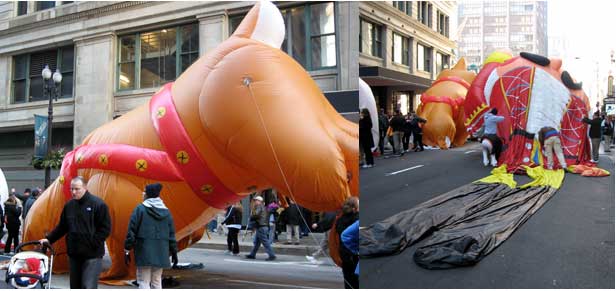
The Short, Brutal Life of a Parade Balloon

from the archive

One moment you're flying high, the center of attention. Young children on their parent's shoulders point to you and laugh in delight. The marching bands and anemic floats meander past with scarcely concealed envy, knowing the spectators regard them as little more than the filler leading up to your appearance. A thousand cameras focus on each step of your journey, while on TV screens throughout the city, you float down the canal of grand old buildings like a Godzilla who had come to Tokyo, not to destroy it, but to dance through its streets.
Then you turn the corner, just out of the sight of the adoring crowds, and suddenly you're getting the air knocked out of you. You're being punched, kicked, pummeled. Your nose falls flush against the pavement and your nether end hangs indecorously in the air. You feel your spine being squeezed out of you , your legs stomped flat as pancakes. You collapse.
Yet the assault continues, without mercy, until you're nothing more than a bundle of brightly colored rag, stuffed into a bag and put up on a dark shelf, to spend all the seasons of the coming year consumed in angst, worrying whether some freshborn cartoon will steal your place in next November's resurrection.

Tuesday, November 20, 2007

Nouvel Khan, Tatlin garnish

As a Chicagoan born and bred, it's impossible to look at Jean Nouvel's stunning new 53 West 53rd, a 75-story hotel/condo tower to be erected next to the Museum of Modern Art in Manhattan, without thinking of its early precedents: the diagonal-braced tube skyscrapers of the great engineer Fazlur Khan, most especially the iconic John Hancock Building on North Michigan avenue, designed at Skidmore, Owings and Merrill in collaboration with architect Bruce Graham.

Separated by four decades, the two towers offer up cogent and contrasting expressions of their respective era's. Read all about it, and see the pictures, here.

Sunday, November 18, 2007

Marina City Follies Continue - Who Will They Sue?

The Marina Towers Condo Association Board met last Thursday, and as expected, blew past the concerns of unit owners in attendance and passed a new set regulations including the notorious Rule Number 5, which claims that the association owns copyright to the building and can shake down anyone wanting to take and publish a photograph of the complex to require MCTA permission and pay royalties . For those so inclined, you can actually download a recording of the meeting, from the Marina City Online website, here.

MTCA attorney Ellis Levin furiously backpedaled from the copyright claim, despite the fact that it's explicitly cited in Rule 5, and now contends the claimed protections derive from trademark law. Yeah, right.
1. How can the MTCA trademark something it doesn't own? Condo owners own the top 40 floors, other entities own the first 20 floors and the other elements in the complex.
2. As you can see from this list on this website of a seller of royalty-free stock footage, numerous buildings including, in Chicago, the Wrigley Building and Board of Trade, have obtained trademark protection, and as you can see from the webpage, it has intimidated companies like this to avoid problems by not accepting photos of these trademarked buildings. However, to the best of my knowledge, there is not a single successful prosecution against the photographers of trademarked buildings that has prevailed in court.
3. The Sixth Circuit of Appeals specifically rejected a trademark infringement lawsuit filed by the I.M. Pei designed Rock 'n Roll Museum against a defendant who featured an image of the building on posters he sold.
4. A claim at a previous MTCA board meeting that WBBM-TV Chicago paid the MTCA for use of the building's image, used to bolster the case for Rule 5, was refuted by station manager Joe Ahern, who stated clearly that the fee paid was only for renting space in the complex, "We do not pay to take shots of buildings”

Infatuated with their sense of self-importance, the MTCA board, in the best Captain Queeq tradition of paranoia, is obsessed with the idea that anyone could confuse authorship of photographs or writings on Marina City with the versions officially sanctioned by the MCTA. Rather than embrace an absolutely splendid website like Marina City Online, which offers up a dazzling collection of information and history on the complex, the MCTA would have us all sink to the level of the MTCA's own embarrassing web presence, pathetically designed and shamefully uninformative.

News flash to the MTCA board. Outside of you and your immediate families, the rest of the world not only doesn't even know the MTCA exists, it couldn't care less. To everyone else on the planet, Marina City is architect Bertrand Goldberg's architectural masterpiece. To demand that everyone must bow down before you is like the night janitor at the Louvre demanding top billing over Da Vinci. To be able to live in one this city's greatest masterworks is a rare privilege, and it would behoove the MTCA board to divert a little of the time they spend as Napoleonic grifters to being responsible caretakers of one of Chicago's great treasures.

For now, however, the rule has passed. There'll be no more news unless the MTCA board is actually stupid enough to try to enforce it.

Weekend News - Brown Takes on TIF's, Prokofiev's Happy Ending for Romeo and Juliet

TIF Scandal Spurs Phony Tax Bills - Add Chicago Sun-Times columnist Mark Brown to growing roster of those unmasking one of the Daley administrations dirtiest secrets: the way TIF's are eviscerating the city's tax base to funnel increasingly large and questionable subsidies to connected institutions and developers. Brown's Sunday column exposes the basic fraudulence of tax bills sent to property owners in TIF districts, using the bill for the Mayor's own home as an example. Brown discovers that more 89% of the $13,056 bill is diverted to the TIF. While the tax bill lists $6,641 as going to the Chicago Board Education, the actual figure is more like $713. Read the column here.

Romeo and Juliet - Happily Ever After - If you think putting a smiley face on tragic tales began with Disney, catch this article by Patricia Cohen in the Sunday New York Times. Sergei Prokofiev's ballet score after Shakespeare has long been one of the most popular compositions in classical music, but the composer's original was much different than the one to which we've become accustomed.

In addition to the aforementioned matter of Juliet waking up in the tomb and walking off into the sunset with her Romeo, there was at least 20 minutes more music, but the same Stalinist pressure that had produced the 1936 denunciation of Dmitri Shostakovich resulted in five years of delays for the premiere of Prokofiev's new ballet, during which the most dissonant and difficult passages were cut, the orchestration thickened, and the drama recast as a battle between, according to Cohen, "arrogant old aristocrats and youthful progressives." Oh, and the principals again died.

Prokofiev's original score remained secreted in the Russian archives until it was uncovered by musicologist Simon Morrison in 2006. Now it's being painstakingly reconstructed, and the original score, with choreography by the amazing Mark Morris, is set to debut at Bard College next July, followed by a world tour. Read the story here.