Tuesday, October 31, 2006

Robocop Channels Frank Lloyd Wright

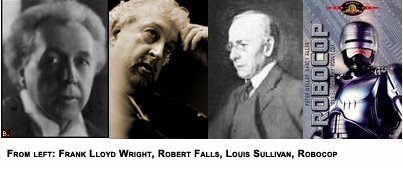
Peter Weller, the actor whose film work ranges from Robocop to David Cronenberg's Naked Lunch, will play Frank Lloyd Wright in the Goodman Theatre production of Frank's Home, which begins previews on November 25th, with a run from December 5th through the 23rd. The play is written by Richard Nelson, whose musical adaptation of James Joyce's short story, The Dead, was an intimate Broadway triumph in 1999, and it's being directed by the legendary Robert Falls, fresh from his recent staging of King Lear with Stacy Keach. Read about it here.

(our thanks to AIA/Chicago's Joan Pomaranc for bringing this event to our attention.)

Monday, October 30, 2006

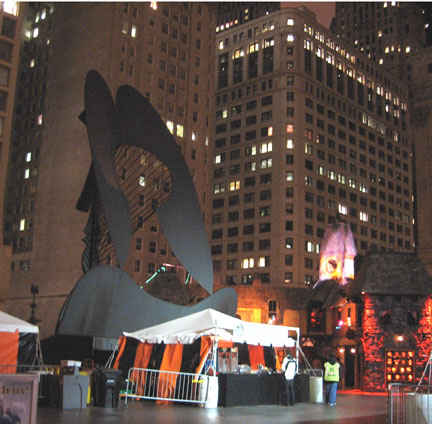
Chicago Streetscene - Happy Halloween from the Daley Center Picasso


As usual, she's looking the other way, but don't take it personally, Halloween. She usually has a bit of attitude about her - you would too, with all those kids sliding down your neck.

Will Chicago's Landmark Farwell Building be Peeled Like A Grape?

The 600 block of North Michigan Avenue is in for some big changes, some temporary, some grand, and one a potential time bomb that could decimate Chicago's rich architectural legacy.

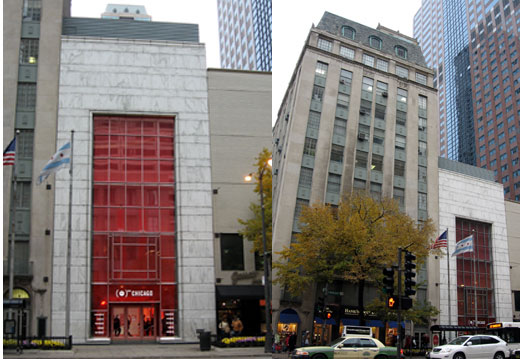
First the temporary. Just as the leaves turn crimson just before they fall, the building formerly housing the entrance to the Terra Museum of American Art on went red over the last week to house a "pop-up" store for Project Red, the initiative launched by rocker Bono to help bankroll the Global Fund to Fight Aids. The store, which sold merchandise tied in with the campaign, is the subject of an interesting article on this archenewsnow webpage.

The Museum, founded by industrialist Daniel Terra to showcase his extensive collection of American Art, closed in 2004, eight years after Terra's death, following an acrimonious and ultimately unsuccessful battle to move the museum to Washington, D.C. The property was put on the block, and ultimately acquired by Prism Development, which plans to erect The Ritz-Carlton Residences, a 40 story tower designed by architect Lucien Lagrange containing just 86 high-end residences. The building site includes two other parcels. To north, there's a small structure that is best known for being the long-time home of the city's legendary Stuart Brent booksellers. (A Starbucks now claims the space.)

More crucially, another parcel to the south contains the Farwell Building, an officially designated Chicago landmark, a graceful classical 1920's high-rise in Indiana limestone, designed by architect Philip Maher, that is one of the few suriving examples of the kind of elegance that dominated Michigan Avenue before it was overrun by often ghastly new construction such as 600 North Michigan and the Marriott Hotel.

The Farwell is the center of a truly astounding proposal - one that somehow actually made it onto the Commission on Chicago Landmarks' October agenda - calling for the "Proposed dismantlement, demolition and facade reconstruction of the Farwell Building." In plain English, this means that Prism Development is seeking to remove the facades from the Farwell, demolish the building, erect a new structure and face it with the old Farwell facades, which would then have blind windows fronting a parking garage.

It's hard to decide which is more outrageous - that any developer would even attempt such a proposal, or that a Chicago architect of the caliber of Lucien Lagrange, who makes his home in one of the city's few surviving Louis Sullivan buildings, would allow himself to be aligned with such a project. The proposal was yanked from the October Landmarks Commission agenda at the last minute, and is not on the November agenda as currently published. Still, it's inevitable Prism will be back, and this much is certain: if the Commission gives Prism its way, it means the effective end of landmark protection in the city of Chicago.

Thursday, October 26, 2006

Wirt Dexter postscript

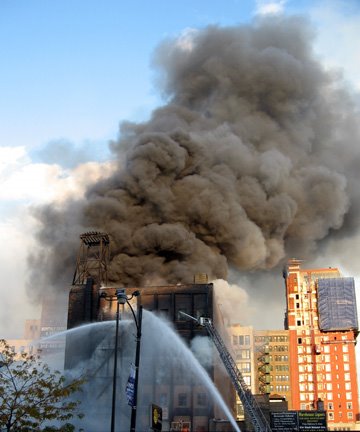
Today's Chicago Tribune has a great article by Ron Grossman and Josh Noel, covering the sad recent history of Adler and Sullivan's landmark Wirt Dexter building, leading up to its destruction by fire on Tuesday. The story draws heavily on an interview with preservation Jim Peters of Landmarks Illinois, who says the fire was starting by workers using acetylene torches to cut up an old boiler in the basement for scrap. Peters a touching profile of owner Loraine Phillips, who had been hoping to renovate the building back to its former glory. It's a tale of missed opportunties and soured business deals. - the story's lead is Peters saying she had just been seeking advice and funding from Preservation Illinois for restoring the building. She apparently had no insurance on the structure, which is currently being demolished, the famous back wall with its tall external iron beams being the first to go yesterday afternoon

Wednesday, October 25, 2006

Massive fire claims Adler & Sullivan's Wirt Dexter Building


A five-alarm fire Tuesday claimed the landmark Wirt Dexter building in Chicago's south Loop, one of the few surviving structures from the partnership of Louis Sullivan and Dankmar Adler, Coupled with the loss of the firm's K.A.M. Pilgrim Baptist Church, also to fire, early this past year, it raises questions about the city's commitment to protecting its architectural legacy. Read the full story and see all the pictures here.

Tuesday, October 24, 2006

Office Condo Market considered this Thursday at ULI breakfast session

Today (Tuesday, the 24th) is the on-line pre-registration deadline for the Chicago Chapter of the Urban Land Institute's breakfast program, "The Office Condo Market", at The Mid-Day Club which will feature Michael Horowitz, President of the Chicago School Of Professional Psychology, Bert Scherb, President, Ameritus LLC, and Phillip R. Utigard, EVP, Transwestern. Registration begins at 7:45 A.M, with news updates and the morning's program at 8:15 A.M. The tariff is $35.00 for ULI members, $45.00 for non-members and $10.00 for students. Pre-register by end of day today online.

Monday, October 23, 2006

Mies van der Rohe's IBM Building going condo

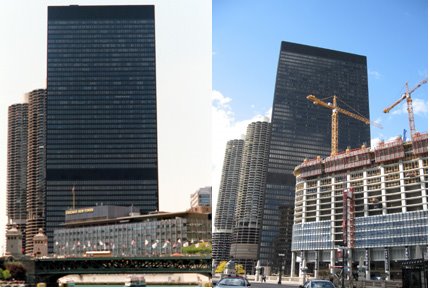
When it was first opened, Chicago's IBM Building, a tower designed by the firm of Mies van der Rohe, and completed in 1973, four years after the architect's death, was one of the city's most prestigious addresses. Things change, however, and the building's present owner, Prime Realty Group, is seeking approval to convert an increasing portion of the structure to residential use.

In some ways, the tower is even more classically Mies than the iconic Seagram Building in New York. There's no bustle at the back, just a pure rectangle almost 700 feet tall, sited on a raised plinth that maintains its uniform height even as State Street to its west inclines steeply as it flows down from the level of the bascule bridge crossing the Chicago River.

For years, along with the twin cylindrical towers of Bertrand Goldberg's Marina City, just across the street, the IBM dominated the north bank of the river, placed in gentle perspective against the low Chicago Sun-Times building to the east. That building is gone now, however, replaced with an under-construction Donald Trump behemoth, a 1,100 foot high tower that is casting the IBM into its shadow. (It was reported that when Trump's project still had an office component, it was being marketed to current IBM tenants with the argument that the Trump would block all of their views.)

Earlier this year, IBM left for other quarters, and the iconic, cubic IBM sign was changed to the property's new, prosaic name of 330 North Wabash. The Chicago Tribune reported earlier this month that 36% of the building's space is currently vacant. Its current signature tenant, the powerhouse law firm of Jenner and Block, is also set to leave for new digs in another couple years, leaving another 16 floors empty.

For now, the plan is to convert floors 3 through 14 into 275 condos. More floors may be converted as they become vacant. While reported sale prices will be about half that of the high-end Trump units next door, the fact that the IBM is hemmed in by taller structures along its long and east and west facades could make it a tougher sell.

Despite the IBM's extraordinary quality of design and its importance in Chicago's cityscape, it has yet to be designated an official landmark. It has no legal protection against dramatic, or even destructive alterations. Its current owners can do with it pretty much whatever they want.

Saturday, October 21, 2006

Weekend Reading - Smith's Shingle, Whitewashing Harry Weese, Felsen and Dunn at Home

Smith Takes on SOM
In the Sunday Sun-Times, art and architecture Kevin Nance profiles Adrian Smith's move from SOM to his new firm, Adrian Smith+ Gordon Gill Architecture, which - unlike SOM itself, which is housed in Burnham's Santa Fe Building- will actually make its home in an SOM design, the Harris Bank building at 111 W. Monroe. Smith expects to have 60 to 80 people on staff by the end of the year. Sustainability will be one of the key goals at the new firm, which Nance reports is already in negotiation to build a 50 story zero-energy residential tower in Vancouver.

Whitewash at Harry Weese Landmark
Tribune architecture critic Blair Kamin has a good story on how the GSA is mucking up one of Chicago's modernist icons, Harry Weese's Metropolitian Correction Center on south Dearborn, but its concrete exteriors are being covered in a protective paint that essentially destroys the character of the exterior. Architects are always glad to talk about their triumphs, but the fact that both George Butler and Associates and Wiss, Janney, Elstner Associates declined to be interviewed for the story on their work at the MCC is in indication that even they know they;re not exactly doing the right thing.

UrbanLab Goes Glossy

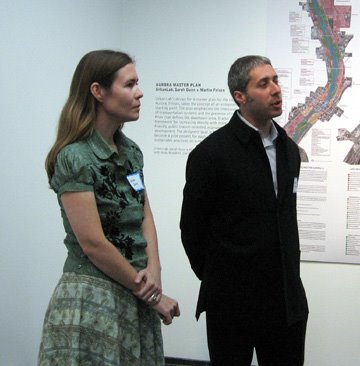
The November issue of Chicago Magazine includes a profile of Martin Felsen and Sarah Dunn, the wife and husband team behind UrbanLab, on the city's most innovative and rising firms, whose work is currently featured in both the MCA's Sustainable Architecture in Chicago show, and the upcoming Young Chicago at the Art Institute, opening November 16.

Will Chicago Music lose its way in our digital world? Deborah Voight's Salome Brings Chicago's Lyric Opera back to the Air

After a four year absence, Lyric Opera of Chicago returns to the airwaves with this evening's (Saturday, October 21st) opening night performance of Richard Strauss's Salome, sung by the newly-svelte Deborah Voight and conducted by the company's music director Andrew Davis. The broadcast, which begins at 7:00 P.M. on WFMT, 98.7, also reunites the broadcast team of Lois Baum, former WFMT program director Norman Pellegrini, as well as adds current morning co-host Lisa Flynn. The season's other opening night performances are also scheduled to be broadcast, and later syndicated to an international audience estimated to include 21,000,000 people.

Two factors made the renewal of the broadcasts possible. A new union contract substitute up-front fees and revenue-sharing for traditional royalties. And just today, Lyric general director William Mason announced a $2,000,000 grant from the family of Lyric trustee Matthew Bucksbaum, head of General Growth Properties, the shopping mall powerhouse whose local properties include Water Tower Place, Northbrook Court, and Oakbrook Center. The gift is conditional on Lyric raising an additional $2,000,000 from other sources, and would provide funding for the broadcasts through 2011-12 season.

Will Chicago's Classical Music and Opera Ever Find It's Way in our Digital World?
This puts Lyric far out front of the Chicago Symphony Orchestra, whose own broadcasts have been off the air since 2001, and which hasn't issued a commercial recording in several years. The Metropolitan Opera has launched its own channel on Sirius Satellite radio that includes both live performances, as well as all-day schedules of historic performances. (The all-day schedule includes, for example, includes a 1951 Rigoletto with Richard Tucker and Leonard Warren today, and a 1955 Tales of Hoffman with Tucker, Rise Stevens, and Roberta Peters, conducted by Pierre Monteux.)

Last month, Mason told Tribune reporter Charles Storch that Lyric is also exploring such options as streaming performances on the internet. Chicago arts companies can be notorious for not playing well together, but if we were smart, we'd be contemplating a Chicago-based non-profit corporation that would draw on the city's rich classical music landscape. Both the Lyric and CSO have astounding archives of recorded performances, as does WFMT, which includes broadcasts of the Chicago Sinfonietta and Grant Park Symphony.

Add in the performances from the Music Now and Music of the Baroque series, and the highly innnovative productions of Chicago Opera Theater, and you'd have not only one of the most potent collections of great performances in the world, but a branding powerhouse that could power its own broadcast channel, issue recordings both as physical CD's and as downloadables that could be available on the individual organizations websites as well as on-line outlets such as iTunes.

Right now, the Met is one of only three classical channels on Sirius (the other being generic "Symphony Hall" and "Classical Pops" outlets.) That situation will not last long, and if Chicago doesn't move quickly, it will find itself shoved to the sidelines as the traditional outlets on which classical music and opera have depended continue to undergo slow, painful deaths. CD retailing is collapsing -once-mighty Tower Records is undergoing liquidation- while FM stations devoted to classical decline in number, and those that survive are increasingly run on auto-pilot.

This is one of those small windows of opportunities that determine the shape of the future. If you're not on the inside when they slam shut, you'll be on the isolated and increasingly troubled side of history.
Wednesday, October 18, 2006

Tuesday, October 17, 2006

The Unexplored Power of Architecture in Film

Here's a tardy follow-up to a heads-up from AIA Chicago's Joan Pomaranc to Turner Classic Movie's festival Architecture in Film, which is running 20 different movies tieing into an architectural theme, each Wednesday evening in October.

If this is the first you've heard about this, you've already missed The Fountainhead, The Towering Inferno, and Naked City, one of the first Hollywood films to be shot entirely on location, providing in the process an incredibly rich portrait of 1948 New York City. This Wednesday's offerings, under the title of Home, Sweet Home, range from The Magnificent Ambersons to Roger Corman's House of Usher. Next Wednesday's theme is Reconstructing History, and the pictures include The Alamo, and Fall of the Roman Empire.

This is a topic I think deserves a lot of attention, which will have to come back to later when I have more time, but here's a couple of initial thoughts.

1. Film as a preservation medium. Films can provide extraordinary documentation of lost urban landscapes. To me, the heart-stopping moment in The Seven Year Itch is not the iconic shot of Marilyn Monroe's skirt billowing up from the gust from a subway grating, but the glimpse in an early scene - in full color - of the concourse of the lamentably vanished Penn Station.
2. Film can explore the three dimensional aspects of architecture much more vividly than static - and often deceptively idealized - commercial still photography.
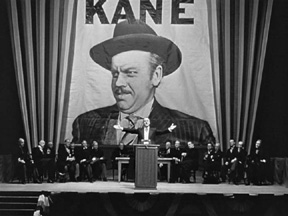
3. The combination of moving images and sound can give a real sense of a physical space. Think of the convention scene in Citizen Kane, a highly artificial set where the actual hall is never portrayed but the sense of it is made palpable through the imaginative use of sound.
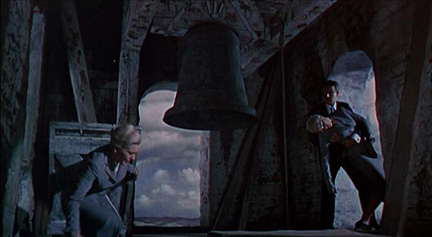
4. Film is an incredibly powerful medium for expressing the psychology of space. No one knew this better than Alfred Hitchcock and the brilliant art directors and set designers who were his collaborators. In Vertigo, the film inhabits San Francisco and its architecture in a way that gives the city a highly specific character that both reflects and informs the psychology of the film. The individual rooms - Scottie's bachelor apartment, Elster's men's club, the passion-red walls of Ernies, the small hotel room, bathed in green light that becomes the orgone box for the refabrication of Scottie's primal desires, and, most especially, that extraordinary, almost surreal, dark room at the top of the bell tower, reverberating with passion and fear, guilt and retribution, death and cold triumph all in little more than a minute of film. Piranesi couldn't have done it any better.

Monday, October 16, 2006

Time Change on tonight's Grant Park Advisory session on proposed Chicago Children's Museum

We've just gotten word that there's been a time change on tonight's Grant Park Advisory Council meeting on the proposed move of the Chicago Children's Museum to just east of Millennium Park. The new time is 6:00 P.M., at Daley Bicentennial Plaza - 337 E. Randolph just east of Columbus Drive and directly south of the Blue Cross/Blue Shield building. The Council's Bob O'Neill notes that October 16th marks the 106th anniversary of A. Montgomery Ward's first filing to keep Chicago's lakefront "Forever, Open, Clear and Free." Details for tonight's event here.

Chicago Tribune - World's Most Boring Newspaper?

If you ever wonder why newspapers are dying, consider this. Chicago is a city which votes overwhelmingly Democratic, but where both dailies hew hard right editorially. (The Tribune has the risible distinction of NEVER endorsing anyone but a Republican for President in its century-plus history.)

I always knew that conservatism was a primary Trib tenant, but until today, I never realized that also being deathly boring was not a failing, but a matter of editorial principal.

In an endless bit of naval-gazing that gets funnier every time I read it, Public Editor (i.e., newspaper ombudsman - and isn't that a concept that's had all value wrung out of it) Timothy J. McNulty practically falls on his knees apologizing to what the paper apparently considers its primary readership - the super-rich.

What caused this orgy of self-flagellation? An October 8th Sunday Magazine issue on mega-mansions rising on Orchard Street in Chicago's Lincoln Park. Although I had my own disagreements with the piece, it was extremely well researched and written by writer Susan Chandler, with a thoughtful commentary from architecture critic Blair Kamin. My own take was that is was, in anything, too serious. What makes the subject interesting to us, after all, is our fascination with foibles of the rich, a factor that the Trib's graphic staffs captured a lot more honestly than the actual stories, with a tabloid-styled cover that screamed, "Attack of the Giant Houses!"

But fear not, delicate, trembling readers of exceptional wealth. Your frail sensibilities have found their protector. McNulty has come to save you - and us. There will be no more "holding the subjects . . . up to ridicule", no "innuendo", no "reverse snobbery", "class superiority." No more Kamin's fueling the fire, or using a psychiatrist to analyze the obsession for bigness, no more covers that look like "horror movie posters." Tsk. Tsk. Tsk. We'll have no more of that.

Lighten up, McNulty. The stories were in the Sunday Magazine, not the front page. Or was the real sin that the articles clashed with all those catnip-for-the-wealthy-ads for the likes of Patek Philippe watches and pricey designer furniture? The Trib has a talent for deadening everything it touches. How did they manage, for example to transform Phil Rosenthal's column, a lively read when he wrote for the Sun-Times, into a dull slog at the Trib?

The Tribune Company is under siege these days, and in its endemic confusion of ponderous self-regard for seriousness, continues to march under the flag of "tastefulness" right towards the grave.

Sure - It may look like fun to drive a car off Marina City

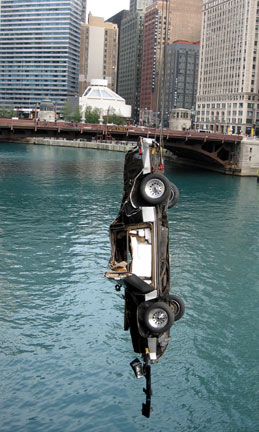
Film director Phil Joanou was in town over the weekend to shoot a million dollar commercial for Allstate Insurance, created by Leo Burnett, that had cars racing at speeds up to 75 MPH along the streets of downtown Chicago, underneath the city's historic "L", and, for the big finish, off the 17th floor of Marina City.

And yes, the sight of a car plunging into the Chicago river sure looked like fun, and yes, it sent the crowd of teen-age girls screaming not once, but twice, as the stunt was repeated, but remember this, all of you who may be tempting to try this at home: in the commercial it may look, as intended, just like the famous scene in Steve McQueen's last film The Hunter, but after the cameras stop rolling, the aftermath looks more like the last shot in Psycho.

The new Carson's: Floor 12 - woodshop, laser cutting and 3-D digital printing, courtesy of the SAIC

We still don't know what will happen to all that space when the Carson Pirie Scott department store vacates its landmark Louis Sullivan Building early next year, but the top floor, just behind the newly restored cornice and ornately columned arcade has already been claimed by the School of the Art Institute of Chicago. On October 10th, the school dedicated it's new Architecture, Interior Architecture & Designed Object department in 31,000 square feet of newly renovated space. Motorola CEO Ed Zander was on hand for the dedication. The Motorola Foundation contributed $100,000 to SAIC to the GFRY Design Studio, honoring the memory it's late Chief Marketing Officer Geoffrey Frost.

The opening took place just as SAIC announced three new graduate design programs: Master of Architecture, Master of Architecture–Emphasis in Interior Architecture, and Master of Design in Designed Objects. The new facility may be aggressively high-tech, but the view out over the city through the prism of Sullivan's organically-inspired ornament provides a valuable counterpoint both of Chicago's rich design history, and of the persistence of an art informed by nature in our own, often relentlessly synthetic world.

Sunday, October 15, 2006

Ken Shuttleworth's Crescent, the CSO's St. Bernard, and Lifestyle Malls go Willoughby

Some compelling reading for this weekend:


Crescents and Bleached Galleries. The Financial Times has two interesting pieces in its current weekend edition, In the first, architect Ken Shuttleworth, who split from Foster and Partners to open his own firm, Make, talks about his incredibly handsome Crescent House. In the other, architecture critic Edwin Heathcote talks about some antidotes, including the Great Turbine Hall at the Tate Modern, and London's Whitechapel Gallery, to the generic white cubes that are the anti-climatic reveal to the often spectacular exteriors of the current rash of new museums.

St. Bernard? In this Sunday's edition of the Chicago Sun-Times, critic-at-large Andrew Patner offers up an engaging profile of the Chicago Symphony Orchestra's new principal conductor Bernard Haitink, who will be in town this week to conduct highly anticipated performances of the Mahler 3rd symphony. As modest and self-effacing as he is preternaturally talented, Haitink, 77, is at the stage of his long, distinguished career where he's in danger of being canonized. CSO patrons are already indebted to him for agreeing to step in to help fill a leadership vacuum left by the sudden departure of former music director Daniel Barenboim at the end of last season. Haitink shares responsiblities with principal guest conductor emeritus Pierre Boulez. Amazingly, until last year, the two had never met - "not even in an airport queue!" Haitink tells Patner. When they finally got together at Boulez's Lucerne home in September, the Dutch conductor was overwhelmed by the depth of Boulez's knowledge of the CSO. "He knows nearly every member by name! There was also real electricity as we started talking about ideas and programs. My only concern with this partnership is that we have together almost 160 years of age!"

Willoughby Redux? And finally, catching up on my reading, here's a great article from the September 25th Advertising Age (registration required) on Yaromir Steiner, who's working overtime creating those new open-air "lifestyle" type malls like the 90-acre Easton Town Center, outside of Columbus, Ohio, that are positioning themselves as the inevitable successors to traditional enclosed shopping centers with their department store anchors, and the big box retailers floating in a sea of parking. Steiner is planning for these lifestyle malls to eventually incorporate the original, but unrealized vision of the inventor of the modern mall, architect Victor Gruen, which included a substantial residential component. Steiner's is planning space for up to 10,000 residents in his proposed "Glorypark" development in Arlington, Texas, sandwiched between the Texas Rangers Ameriquest Field and the new, under construction stadium for the Dallas Cowboys. The trend ties into the goals of the New Urbanism, but with what, at least in its infancy, with the most empty kind of patische architecture imaginable.

Saturday, October 14, 2006

Olympimania!

The City of Chicago, in the midst of a full-court press to become home to the 2016 Summer Olympics, last week revealed the logo for its campaign. It features an abstraction of the city's skyline as the flame atop a green (for Chicago as America's greenest city) and blue torch.

It's pretty lame. The torch looks more like a golf tee, and the skyline making up the flame is so generic it could be anywhere. But then most Olympic logos look like they were designed by committee. The best of those pictured here is probably the one for Beijing, which got to cheat because they have a pictograph writing system that's a lot more inherently visual than the West's drastically more limited set of staid characters.

On this week's Hello, Beautiful, the Sunday arts program on WBEZ-FM (91.5 - 10:00 A.M.), host Edward Lifson will be talking to Ross Wimer, the rising new star at Skidmore, Owings and Merrill, the powerhouse architectural firm responsible for the Chicago Olympics master plan. Perhaps there'll also be time to talk about the internal changes at SOM which have seen long-time design partner Adrian Smith leave to set up his own firm with a still undetermined number of co-exiles.

Then on Monday, October 23rd, the Chicago Architectural Foundation is sponsoring a special free lunchtime lecture at 12:15 P.M. where SOM partner Thomas Kerwin will join Patrick Ryan, Executive Chairman of Aon Corporation and Chairman of the Chicago 2016 committee, to discuss how the city's plan for the games "integrate with the city’s downtown area and surrounding neighborhoods"

Also last week, Mayor Richard M. Daley, Frank Kreusi at his side, announced that he is suspending all mayoral elections through a newly scheduled special election in May of 2017. "It is essential," Daley said, "to keep partisan politics from getting in the way of this vital program that will so greatly benefit this city, its citizens and its contractors, as well as provide the rationale for everything I could possibly want during the next 10 ten years, from a new CTA Circle Line, to a privatized $1.5 billion express train system to O'Hare, and a summer 2016 program to kidnap and transport 300,000 downtown residents to undisclosed resorts in Michigan's upper peninsula to minimize congestion during the games." (Just kidding - I hope.)

Friday, October 13, 2006

A Correction and an Apology on Massive Change symposium listing

Our abject apologies to all of you suffered sticker shock when you went to sign up for SEGD Chicago's all-day symposium, Massive Change Global Design, at the Museum of Industry on October 30th. No matter what our monthly Calendar of Architectural Events may have misled you to believe, this is not a free event. You have to pony up anywhere from $200 to $275.00 ($125.00 for students) to hear Bruce Mau, Elva Rubio, and Fred Dust of IDEO. But with a roster like that, what's money? SEG Chicago is recommending you register by October 19th, and you can find instructions, as well as a lot more detail on the day's programs, here. (By the way, am I the only one who finds a page dense with tiny white type against a blood red background not so much edgy design as a painful invitation to eyestrain?)

AIA Chicago seeks to create new LEED certified HQ at Jewelers Building

The Chicago chapter of the American Institute of Architects has announced that it will leave its present headquarters in the Merchandise Mart to move to the 35 East Wacker, usually known as the Jewelers Building that, with its great domed tower and four lower cuppolas, has been a landmark at Wabash and the river since its opening in 1927. The structure is already home to Murphy/Jahn Architects, which has its great conference/dining room in the high ceiling penthouse space just beneath the dome that was reputed to be a 1920's speakeasy.

AIA Chicago is taking over a 5,000 square foot space overlooking the river, from which they'll be able to watch the rising of Trump Tower on the north bank. Earlier this year, a competition for the design of the build-out received responses from 26 teams. The winners are a team of four design professionals, all under 30, collectively named "interface", which includes Daimian Hines and Natalie Johnson (both of HOK Chicago), Daniel West of KEO International Consultants in Abu Dhabi, and Andrew Senderak of Gensler in Chicago. AIA is working to make the renovation LEED certified, and hopes to move into the headquarters this coming January.

Thursday, October 12, 2006

A decade after his passing, CSO conductor Sir Georg Solti still on the move

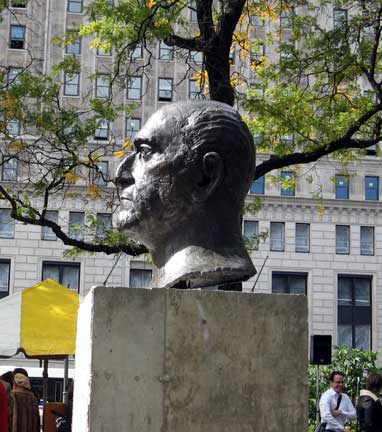
"They should erect a statue to me,” is how Georg Solti testily responded, in that unmistakable voice with its thick Hungarian accent that could rise from a guttural growl to high falsetto in the space of a single sentence . . .

And Chicago did, in 1987. Now the memorial bust has just found a new home. Read all about it and see pictures here.