Wednesday, October 11, 2006

Ken Yeang adds Friday noonday lecture at IIT

Architect Kenneth Yeang, whose lecture tonight (Wednesday) at the Graham Foundation is waitlisted, has added a noon lecture this coming Friday, October 13th in the lower core of Crown Hall, at 3360 South State on the Illinois Institute of Technology campus. The title is Current Projects.

To quote from the Graham Foundation description of its lecture:
"Kenneth Yeang is an internationally renowned architect specializing in the design of "green" architecture, or ecologically-responsive large buildings and master plans. He has designed more than a dozen high-rise towers and over two hundred projects worldwide, including the 40-story eco-tower Elephant and Castle in London; the 24-story IBM building in Malaysia; the 15-story Mesiniaga Building, also in Malaysia, which received the prestigious Aga Khan Award; and the National Library in Singapore, honored by the government of Singapore with a Green Platinum Prize, the highest award for a green and sustainable building. His most recent book is Ecodesign: A Manual for Ecological Design."
Also this Friday an exhibition, Ken Yeang: Green Design and Planning in Architecture, will open at I space, running through November 11th. I space is located at 230 West Superior, 2nd Floor, Chicago

Tuesday, October 10, 2006

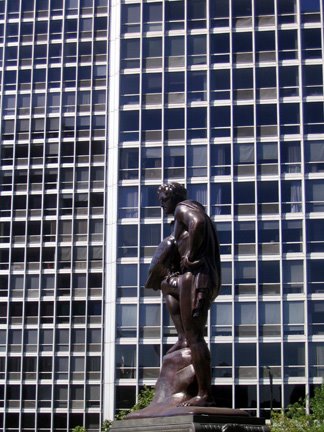
Mr. Becker regrets . . .

. . . that I'm currently engaged finishing up an article. So, for today, here's a photo of the Goethe memorial against a backdrop of Mies van der Rohe's Commonwealth Apartments, plus a sign I found at the base of the CNA building.

Monday, October 09, 2006

Leslie Robertson, Charles Landry, Curitiba and Modernism Road Show among late additions to October calendar

As if the October calendar of Chicago architectural events weren't already crowded enough (20 items this week alone), here are some crackerjack late additions. On Thursday, Charles Landry, authority on what makes cities work and author of both The Creative City and the soon-to-be-published The Art of City Making, will lecture at the Chicago Architecture Foundation. Next week, legendary engineer Leslie Robertson, principal structural engineer on the twin World Trade Towers, will talk at IIT in anticipation of the upcoming Council on Tall Buildings and Urban Habitat symposium the following week.

On October 26th, Design Evanston will be sponsoring Carmen Vidal-Hallett and Mark Hallett will lecture on Learning from Curitiba, the environmentally progressive Brazilian city.

Finally, a couple of offbeat additions. On the 18th, the Chicago Architectural Club is sponsoring what it calls Open Mic night at I-Space, where past, present and future club members are being encouraged to present and talk about work that is unbuilt, under construction or conceptional. And on Sunday the 28th, Antiques Roadshow stalwarts David Rago and John Sollo come to IIT's Crown Hall to provide appraisals of your modernist furniture, fine and decorative arts.

There a cornucupic logjam of great events this week, including a weekend long symposium on the ocassion of Louis Sullivan's 150 birthday. Free up your schedule, and see details on all of them here.

Saturday, October 07, 2006

Chicago's Orchard Street - Urban Menace?

Today's Chicago Tribune Sunday magazine is largely devoted to how the city's wealthy elite are creating mega-mansion mania on a several block stretch of Orchard Street in the city's Lincoln Park area. "There goes the neighborhood," is the Trib's Blair Kamin's take. Why?

What's really going on? Is the Tribune Sunday Magazine, in the words of its editor, "indulging in real estate pornography?" Or should we all lighten up and just enjoy it? Read all about it - and see all the photos - here.

Friday, October 06, 2006

A Preview (Solti Bust Rededicated) and a Reminder (Uptown doc runs on WTTW's Image Union Tonight)


Two Friday items:

Here's a photo previewing a story that will go up, probably later this weekend, on the rededication of the bust of former Chicago Symphony Orchestra music director Georg Solti at a new location in Grant Park just south of Orchestra Hall. We'll have more details on the history and on the ceremony, which was attended by Solti's widow, Lady Valerie Solti, as well as by Chicago First Lady Maggie Daley.

Also a reminder that the award-winning documentary Uptown: Portrait of a Palace, which tells the story of Chicago's legendary 4,500 seat movie house, will have its television debut tonight (Friday, October 6th) at 10:30 P.M. on WTTW, Channel 11's Image Union, which will repeat at midnight this Sunday.

Thursday, October 05, 2006

Newsbits - Uptown update, plus So Far, but so Close

Two interesting newsbits:

Uptown Theater: The Chicago Sun-Times real estate columnist David Roeder reports today on action taken at last week's Community Development Commission meeting to help rescue Chicago's historic Uptown Theater, the 4,500 seat movie palace that has been closed for a quarter century. The Commission passed a resolution authorizing the city to "forcibly acquire" the property. What would happen after that remains anyone's guess.

So Far, but So Close: Tad Friend in this week's New Yorker confirms what many had long suspected - the Goodman Theater skull long claimed to be that of the insanely great - and greatly insane - Chicago improvisational legend Del Close is not. Apparently, people willing to remove a head from its body are hard to come by in our politically correct age, and so, after his death in 1999, Close - head and all - was cremated instead of honoring his last wish to keep his place in the theater by playing Yorick in Hamlet, among other, similarly corporeally-challenged roles. Tad Friend's tale of longtime collaborator Charna Halpern's quest to find a another cranium to stand in as Close's ceremonial self is less a story about the uncovering of a hoax than of a quirky, loving odyssey that ultimately became a fitting tribute to Close's legacy and spirit.

Tuesday, October 03, 2006

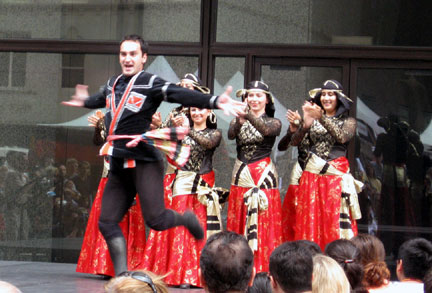
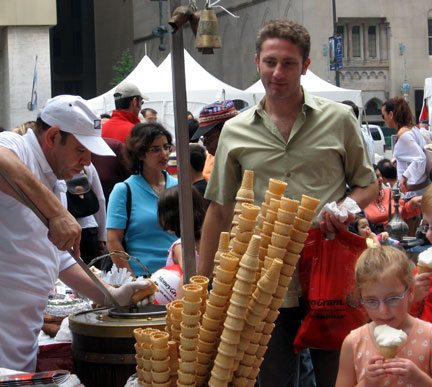
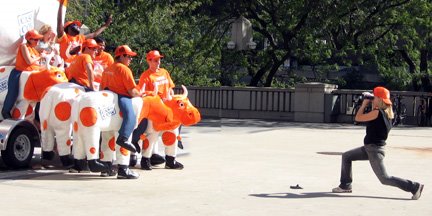
Chicago Streetscene - Turkish Fest, Daley Plaza, September 16, 2006


Adrian Smith leaving SOM?

WBEZ's Edward Lifson has a new posting on his blog passing on an unconfirmed report that architect Adrian Smith is splitting from Skidmore Owings and Merrill and taking 50 people with him to start up his own firm. Read what Edward has heard here.

UPDATE: This item has been confirmed, with a detailed story in today's Chicago Tribune by its architectural critic Blair Kamin.

Is this the face of Zoë Ryan, newly named curator of design at the Art Institute of Chicago?

It was announced today that Joseph Rosa, curator of architecture and design at the Art Institute of Chicago, has named Zoë Ryan, currently senior curator at New York's Val Alen Institute, as the Neville Bryan Curator of Design at the Art Institute, effective October 31.

"Her exhibitions, writings, and presence in the community - as well as her enthusiasm for good design - have contributed greatly to the further understanding of how aesthetics of design and methods of fabrication have evolved since mid-century," said Rosa in a press release. In addition to curating its exhibitions, Ryan has also been editor of the Val Alen Report, the Institute's quarterly. Ryan organized The Good Life: New Public Spaces For Recreation, a Val Alen exhibition that closed last Sunday exploring "the reinvention of urban public spaces to meet the needs of 21st century recreation." and featuring projects by Ábalos & Herreros, Acconci Studio, Adjaye/Associates, Diller Scofidio + Renfro, Weiss/Manfredi, and others, as well as editing the catalogue, distributed by Princeton Architectural Press.

No photograph accompanied the press release, so we rummaged the web for the image you see here, which is of a Zoë Ryan at a recent New York event that may - or may not - be the curator, herself. If you know for sure, let us know.

Monday, October 02, 2006

From Mau to Mendes de Rocha and much more - over 50 events on Chicago's October architectural calendar


October sees an explosion of events on Chicago's architectural calendar, including an all-day symposium with Bruce Mau at the Museum of Science and Industry, a lecture by Pritzker-Prize winning architect Paulos Mendes de Rocha at the Art Institute, where on another date famed photographer Julius Shulman will have a conversation with curator of Architecture and Design Joseph Rosa.

The celebration of Louis Sullivan's 150 birthday culminates with a three-day symposium at the newly reopened and redesigned Chicago History Museum, and later in the month the Council on Tall Buildings and Urban Habitat will have its own two-day conference, Thinking Outside the Box – Tapered, Tilted, Twisted Towers that will include an address by Daniel Libeskind. Friends of Downtown will host a session on the future of Wabash Avenue at the Prairie Avenue Bookshop, and there'll be gala benefits, for the Chicago Art Deco Society at the Tavern Club, and AIA Chicago's Design Night at Navy Pier.

Stanley Tigerman speaks with Elizabeth Smith at MCA, and on the 11th there's a scheduling train wreck with Joe Rosa, Jeanne Gang, Ken Yeang, Transsolar's Helmut Meyer and Henry Cisneros at Arquitectos's Annual awards event all competing for your attention at the same hour. Believe it or not, that's just the tip of the iceberg. I could have hyperlinked it all in this posting, but it's midnight and I want to go to bed. Check it all out for yourself here.

Sunday, October 01, 2006

Great Weekend reading - Kamin on Classicism and the GSA, Huxtable nails the situation at WTC, and von Rhein blasts CSO on digital cluelessness

Three great pieces you should check out before they disappear into paid archive hell within just a few days:

Blair Kamin on the battle over GSA's new chief architect. On September 6th, the Wall Street Journal ran an article (no longer available online for nonsubscribers) that related how, after the recent retirement of Edward Feiner, classicist architect Thomas Gordon Smith was set to be named as the chief architect for the General Services Administration, which oversees $10 billion of federal construction. Smith is a crawl-back-into-the-womb kind of guy, addicted to buildings that look like Greek Temples and Roman palaces, seemingly right in tune with the Bush administration's mindset of empire. Despite its sure-fire nature to generative controversy, however, I saw that story covered nowhere else until this past Thursday, when the Chicago Tribune's architecture critic Blair Kamin wrote the GSA claims to be "still in the selection process." It's all a bit strange, but Kamin does his best to sort it out.

Ada Louise Huxtable nails the situation at the World Trade Center
. The ongoing, tragi-comic sequence of events over reconstructing the World Trade Center has claimed entire forests of newsprint in coverage and comment, but no one gets it as right, and with such concision and conviction, than Huxtable in last Thursday's Wall Street Journal. While most observers have been so relieved to finally have anything of quality announced for the site that they fell over themselves praising three towers just announced to be designed by Norman Foster, Richard Rogers and Fumihiko Maki. Huxtable brings an unclouded eye to looking at these projects. She's heart-breakingly eloquent on the process that brought the initial high idealism over the rebuilding to its knees:
"The balance of commercial and cultural facilities meant to be the basis of the area's rebirth and regeneration is also gone, sabotaged by the supine political response to the escalating demands of those bereaved families whose inconsolable grief required the elimination of the plan's cultural components on the disturbing and specious grounds that the arts and liberties that mark a free society equaled disrespect, or less honor to the dead. They became Ground Zero's censors and de facto designers, eliminating buildings and dictating content to a commission that seemed to have no clue about appropriateness or professional expertise."
Finally, in CSO fiddling away chance to forge digital future, Chicago Tribune music critic John von Rhein exposes the management of the Chicago Symphony Orchestra's complete and willful failure to come to grips with the evolving world of digital classical music. It's been years since the London Symphony created what has become its own, incredibly successful music label, to which the San Francisco Symphony has followed suit. The BBC streams its Prom concerts. The New York Philharmonic has put its concerts on ITunes, where they've become runaway bestsellers. The Metropolitan Opera is offering its productions on Sirius Satellite Radio. The Philadelphia Orchestra has begun selling downloads of concerts on its own website, both as MP3's, and, for a slight increment, in higher-quality lossless formats that we audiophiles prefer. (You can even download a recent performance of the Beethoven 5th conducted by the orchestra's music director Christoph Eschenbach for free.)

And the Chicago Symphony? Its concerts have been off the air since 2001, and it hasn't done a commercial CD since 2003. Digital downloads? It's own label? Radio broadcasts? You must be joking. "I don't want to move funding from sponsorship of our concert season to radio, because then I've got to replace the concert sponsors," is what CSO manager Deborah Card tells von Rhein. There's money for a concert whose program includes the overture to Spielberg's 1941, and "The Love Theme from Splash", but none to keep the CSO from becoming marginalized, its music making confined to an increasingly isolated and geriatric audience, even as it fades into a hidden, largely forgotten treasure for the rest of the world.

Friday, September 29, 2006

Ned Cramer - Avenging Angel? Architecture Magazine put to sleep, Architect Magazine born

In 1995, the venerable magazine Progressive Architecture, which for fifty years was the somewhat scrappier alternative to the mainstream Architectural Record, was sold for $1,000,000 by Penton Publishing to VNU, the Global media conglomerate based in the Netherlands whose holdings include Billboard, Adweek, the Hollywood Reporter and AC Nielsen, which promptly shut down P/A and merged its circulation list with Architecture.

Now, as revealed in a late-Friday evening posting on the Archnewsnow newsletter, Architecture magazine is joining P/A in the graveyard. It's been purchased by trade and housing aftermarket publisher Hanley Wood, a $240,000,000 company owned by J.P Morgan Partners, and is being shut down and merged into Architect, a new title whose first issue is due in October.

It's a reversal of circumstances for Architect's Editor-in-Chief Ned Cramer, who held various editorial positions at Architecture beginning in 1997 that saw him rise to Executive Editor four years later. Not long afterward, in September of 2002, he resigned to become curator at the Chicago Architecture Foundation, a post he held until May of this year, when he moved to Washington, D.C. to help engineer Architect's startup.
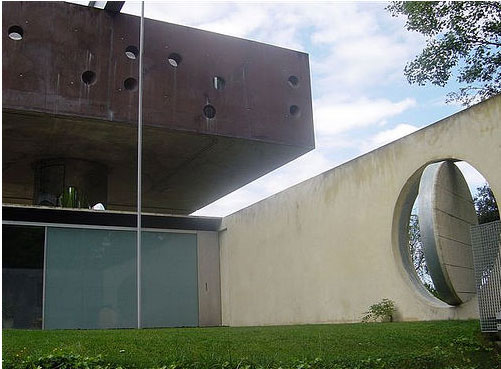
Although Cramer promises Architect will provide both "information and inspiration", Hanley Wood stakes its shingle on being a business-to-business publisher, which could mean that once again a publication with thoughtful discussion on architecture is being replaced with a nuts-and-bolts trade magazine with little interest in analysis or controversy. It was rumoured that it was just such a progression that led Cramer to leave Architecture.

Will Cramer wind up being window dressing for a magazine that's little more than a catalogue for purchasing agents, or will he be the strong editorial hand that creates a product worthy of the best of its predecessors' legacy? (It's been announced that the PA Awards will continue, with the winners to be announced in the January issue of Architect.)

Or has the growing junkpile of dead magazines already proven that such balances of commerce and idealism are no longer possible? Assuming Architect meets its announced October debut date, we'll soon to be able to judge for ourselves

Wednesday, September 27, 2006

Slumming up Marina City


One of Chicago's great architectural icons is underdoing a bit of renovative vandalism as the base of the House of Blues Hotel in Marina City, architect Bertrand Goldberg's pioneering mixed-use development along the Chicago river just north of the Loop, is being smothered in the kind of battleship gray paint usually reserved for back-alley loading docks. Read all about it - and see the photos - here.

Tuesday, September 26, 2006

Detroit's Lafayette Park at 50 - Mies's greatest triumph?

October 16th marks the 50th anniversary of the groundbreaking for Detroit's Lafayette Park, an 78-acre mixed use development not far from the city's waterfront that has proven an enduring success even as much of the city around it fell into deep distress.

Lafayette Park is the product of a team of four that gravitated around Mies van der Rohe in Chicago. First, there was developer Herbert Greenwald, who also took the risk to build Mies's 860-880 Lake Shore Drive Apartments, arguably the first modernist residential high rises. There was Mies himself and two of his IIT colleagues, the great landscape architect Alfred Caldwell, and Ludwig Hilberseimer, the planner who taught with him at the Bauhaus, and who followed him from Germany to teach at IIT.

Lafayette Park brought together these four men at the peak of their powers. It could be said to the one place where Mies, who had been steeped in socialist theory while in Germany but built his American practice on well-heeled patrons, actually married his art to social conscience. But perhaps the most extraordinary thing about Lafayette Park is the way it turns today's conventional wisdom about planning on its head. The development shears off the basic street grid, and personifies Le Corbusier's concept of the Radiant City, a series of tall skyscrapers set amidst abundant parks largely isolated from through streets. It's a basic matter of faith these days that these are all terrible ideas, but at Lafayette Park, they worked, and have continued to work for half a century.

Via PLANetizen, here's a great article from the Detroit Free Press by its architectural critic John Gallagher that tells the story. What is now called the Mies van der Rohe Residential District is listed on the National Register of Historic Places. There's also a book, Lafayette Park Detroit, edited by Charles Waldheim, who will be speaking this Wednesday, September 27th on landscape urbanism at a Chicago Architectural Club session, which will also include Sprawl author Robert Brueggman, at 6:30 P.M. at the Ispace Gallery.

Oh, and at Lafayette Park, a three bedroom condo can still be had for $135,000.,

Monday, September 25, 2006

Beyond the Usual Campus Suspects


Chicago's college campuses have always been home to some of the city's best architecture.Here's a few gems that frequently get overlooked. (Originally published September 22, 2006, in a far-better edited form in the Chicago Reader under the title, It's All Around You.) Read all about it - and see the photos - here.
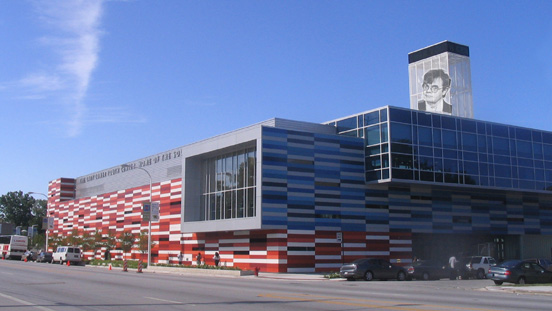
Friday, September 22, 2006

Legacy of Fazlur Khan considered at IIT September 27th

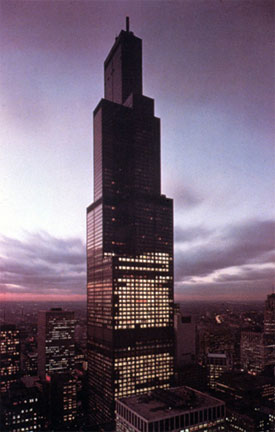
The College of Architecture at the Illinois Institute of Technology has announced a September 27th evening dedicated to the brilliant structural engineer Fazlur Khan, whose work at Skidmore, Ownings and Merrill with architect Bruce Graham included both the Sears Tower, for decades the world's tallest building, and what is arguably Chicago's most beautiful skyscraper, the John Hancock Center on North Michigan Avenue, a gently tapering, 1,127 foot high shaft whose facade is sculpted by a series of massive x's formed by the structure's cross bracing. Khan, who died in 1982 at the age 52, is generally credited for developed the braced and bundled tube systems of tall building construction.

A 5:30 P.M. reception in the center core of Mies van der Rohe's Crown Hall, at 3360 South State, will include a display of Khan's work, and will be followed at 6:30 at the nearby McCloska auditorium of the schools new campus center by a lecture, Reflections on the Work of Fazlur Kahn, by A.G. Davenport, professor emeritus at the University of Western Ontario. A 7:00 panel discussion will include Mahjoub Elnimeiri, Micheal Hogan, John Zils and Yasmin Khan Byron, Kahn's daughter, author of Engineering Architecture: The Vision of Fazlur R. Khan.

Thursday, September 21, 2006

Historic Uptown Theater to be Purchased by City of Chicago?

The eagle eyes of someone at Compass Rose Cultural Crossroads has come across the fact that the just-published agenda for the City of Chicago's monthly Community Development Commission meeting next Tuesday, September 26th includes an item indicating the city may be purchasing the 4,300 seat Uptown Theater, shuttered since 1981, which to date has so far resisted all efforts to save and restore it.

The agenda item reads: "Request authority to acquire the Uptown Theater, a Chicago Landmark, located at 4816 North Broadway Avenue in the Lawrence/Broadway Tax Increment
Financing Redevelopment Project Area."

A TIF (tax increment financing) district diverts all new property tax revenues in a defined geographic area into a special fund used to spur development in that area. In Chicago's Loop, $70,000,000 was kicked in from Central Loop TIF to help fund restoration of the three of Chicago's grandest movie palaces, the Chicago, Palace and Oriental, as well as for building a new home for the Goodman theater behind the preserved facades of the Harris and Selwyn Theaters. The final cost of these projects, however, was several times the TIF contribution.

The cost to restore the massive Uptown, which takes almost all of a full city block, could be $30 to $50 million and up. The building has received minimal maintenance over the past two decades and is in an advanced state of decay. The city could probably pick up the Uptown, which an official city landmark since 1991, for a million or two, simply to secure the building from further harm.

Tuesday, September 19, 2006

Uptown: Portrait of a Palace to run on WTTW

The documentary Uptown: Portrait of a Palace, which debuted at the Portage Theater earlier this year, is now out on DVD, and will also be aired on Chicago's WTTW, Channel 11 on the season premiere of Image Union on October 6th at 10:30 P.M. The 4,000+ seat Uptown, one of the grandest of Chicago's movie palaces, has been closed since 1981, and continues to deteriorate as advocacy groups such as Friends of the Uptown continue to try to find a way to save it. In the words of the press release, the documentary "explores the history of the Uptown and why the biggest and arguably most elaborate movie theatre in the country has been left vacant for more than twenty-five years. It uses interviews with subjects close to the theatre combined with breathtaking footage from inside the rarely seen venue to ask What is really important in a society fueled by money and private interest?" Is the Uptown a remnant of the long-forgotten past, or is it, as Rapp & Rapp remarked when they built it, a theatre 'not for today, but for all time?'"

The 26-minute DVD of the documentary, pressed in a limited quantity of 500, is available for $10.00, plus $4.00 shipping and handling, from Compass Road Cultural Crossroads.

Monday, September 18, 2006

Emerging Chicago Architecture - Sexton, Ronan, Felsen and Dunn and their buildings - on one time only CAF tour

Here's one you've got to assume will fill up fast. On Saturday, October 7th, beginning at 10:30 A.M., the Chicago Architecture Foundation will be offering a one-time-only bus tour, Emerging Chicago, where three of Chicago's most distinctive new buildings will be discussed - by their architects. Mark Sexton of Krueck & Sexton will discuss the new Spertus Institute on South Michigan, now under construction; John Ronan will provide commentary on his just-opened Comer Youth Center in Grand Crossing, and UrbanLab's Martin Felsen and Sarah Dunn will conduct a tour of their South Side home and studio. And if that's not enough, writer Philip Berger will also be tagging along to provide his own perspective. The tour costs $40.00 for CAF members, $45.00 for non-members, making it not only a great opportunity but an exceptional value. CAF members can reserve tickets by phone; the rest of us can go through Ticketmaster

Saturday, September 16, 2006

Massive Change's Bruce Mau to appear with Edward Lifson on WBEZ Sunday

Designer Bruce Mau, in town to launch the Chicago opening of his exhibition, Massive Change, at the Museum of Contemporary Art will be a guest on this Sunday's edition of Edward Lifson's Hello, Beautiful on WBEZ (91.5 FM).

Mau created this almost madly ambitious exhibition, with the students of Institute Without Boundaries, a school he founded at the School of Design at George Brown college in Toronto. In the words of its website, it explores 11 different economies "that address the fundamental role of design in all aspects of human life, from manufacturing and transportation to health and the military. In each area, visitors will encounter the objects, images, ideas and people that are reshaping the role of design in the world." The Chicago run is accompanied by an additional exhibition, Sustainable Architecture in Chicago, that showcases forward looking projects from a diverse group of architects that includes Jeanne Gang, UrbanLabs Martin Felsen and Sarah Dunn, Elva Rubio of Gensler, Adrian Smith and Gordin Gills' of SOM, Doug Farr, Helmut Jahn and Stanley Tigerman. We'll write a lot more on both shows later.

For now, Lifson's interview with Mau promises to offer up an excellent introduction to Massive Change and the ideas behind the exhibition. The broadcast begins at 10:00 A.M. If you miss the original broadcast, a streaming version is put up on the Hello, Beautiful site later in the week.

Friday, September 15, 2006

Sullivaniana

The 150th birthday celebration of all things Louis Sullivan continues today with the opening of an exhibition of letters, drawings, photographs and architectural objects at William Hasbrouck's legendary Prairie Avenue Bookshop at 418 South Wabash, often cited as the world's largest bookshop devoted to architecture. The exhibit is open to the public during the store's regular hours of business: 10 a.m. to 6 p.m, weekdays, and 10 a.m to 4 p.m. on Saturday, and we're told the staff will be happy to discuss the items on display, some of which will be offered for sale when the exhibition closes early next year. (You can also buy pieces of Sullivan's Stock Exchange Building at the newly renamed Macy's on State, but that's a story for later next week.)

On another front, the Charnley-Perksy House Museum is offering two celebrity tours of the landmark Sullivan/Wright designed home. Both are $10.00, and are limited to 30 people, so this Saturday's 1:00 tour with restoration architect John Eifler, who led the 1986 restoration of the building, could already be full (call 312/573.1365 to make reservations), but if you can't get in this coming Saturday, there's another tour on Saturday October 14th, also at 1:00 P.M., with architect John Vinci, whose many restoration projects include overseeing the reinstallation of the trading room from the Chicago Stock Exchange building into its current location at the Art Institute. The museum offers regular, non-celebrity tours of the house as well. Check out all the info here.

Wednesday, September 13, 2006

Thursday's River North Rendezvous to benefit Archeworks.

Tickets are still available for tomorrow's (Thursday, September 13th) 7th Annual River North Rendezvous, a gallery walk with cocktails and food along 12 galleries and home furnishings showrooms that will benefit Archeworks and 11 other institutions including the Anti-Cruelty Society and Gilda's Club Chicago. The event begins at 5:30 P.M. Tickets will be 75.00 at the door, at the Ambiente Collection, 223 West Huron. Get the info here.

The Incredible Rising Blue Cross Blue Shield

Matt Larson of Goettsch Partners, sends me these before and after renderings of the firm's Blue Cross-Blue Shield Building at 300 East Randolph, just north of Millennium Park. As you know, this structure opened as a 32-story tower in 1997, but was designed with the capacity to add height later to meet the expanding space needs. Now, an additional 25 floors and 800,000 square feet are to be added in a $270,000,000 project scheduled to be completed in 2010, increasing the building's population from 4,200 to 8,000 workers. The present, soaring atrium, which rises the full height of the current building, will reportedly be filled in by two new elevator banks that will serve the added floors.

If this were a spec office building, the expansion would probably never have taken place. Occupany levels in the East remain weak - new office expansion is now largely concentrated in the West Loop. Blue Cross-Blue Shield's parent company, Health Care Service Corporation, has been on a roll, however. The corporation, which provides policies in Illinois, New Mexico, Oklahoma and Texas, has seen its base of policyholders grow from 3 to 11 million over the last decade. Still, according to Crain's Chicago Business, while Blue Cross is the exclusive tenant of the existing building, about half of the new space is set to be leased out to other tenants.

At a final 741 feet above its Randolph Street entrance, the completed building will match up more evenly with both the neighboring 1,136 foot-high Aon Center and the new residential towers rising in the nearby Lakeshore East development. It will become an increasingly prominent part of the backdrop to Millennium Park and the Pritzker Pavilion bandshell. Most importantly, it will provide an even larger billboard for the next time one of Chicago's sports teams are in the midst of a championship battle.

Tuesday, September 12, 2006

12 years of Archeworks, Learning from North Lawndale among late entries to September architectural calendar


Several intriguing events have been added to Repeat's September architectural calendar. Going head to head on the evening of Wednesday the 20th is Convention Challenged: 12 Years of Archeworks, a reception marking the publication of a new book capturing the history and works of the alternative design school founded in 1993 by Stanley Tigerman and Eva Maddox. At the Chicago Architectural Foundation, there's the opening reception for the exhibition Learning from North Lawndale, which shares its name and content from the Chicago Architectural Club's 2006 Burnham Club Competition, whose winner will be announced at CAF on that evening.

Elsewhere, SEPAC, the political action committee of the Structural Engineers Association of Illinois, will be hosting a cocktail party at the Columbia Yacht club on Thursday, the 21st, Charles Waldheim (Landscape Urbanism) and Robert Bruegmann will be speaking on, respectively, landscape urbanism and waterfront infrastructure at a Chicago Architectural Club event at the iSpace gallery on Wednesday the 27th.

Check out the details on these events and the full September calendar here.

Greening Rooftops seeks papers for April 2007 Conference


We've gotten an email from the folks at Green Roofs for Health Cities, letting us know they're solicitating papers for their Fifth Annual Greening Rooftops for Sustainable Communities Conference, Awards, & Trade Show, to be held in Minneapolis next April 29th to May 1st. The conference's three major themes will be Programs and Policies to Support Green Roof Infrastructure, Green Roof Design and Implementation and Research/Technical Papers on Green Roof Performance. Submissions, which should include a 300 word abstract and 50 word biography, can be made via email to Jennifer LeBlanc or via fax or snail mail. Details can be had here.

Monday, September 11, 2006

The Trib's Blair Kamin takes on architecture after 9-11

The Arts and Entertainment Section of yesterday's Sunday Chicago Tribune is largely devoted to What Price Security? Architecture in an anxious age, a series of features by architecture critic Blair Kamin with photos by E. Jason Wambsgans on the effect of 9-11 on nation's skyscrapers and airports, and on Washington, D.C. (today's edition of the invaluable ArchNewsNow newsletter also contains a great cross section of articles on architecture after 9-11.)

If you can, pick up a print copy of the section. The internet version that you can access here at first gives the impression the Tribune is finally getting the web. It opens up to a slide show of compelling images, leading to a main menu screen that includes a video of Blair Kaminn introducing the series. But Kamin's talking head is the only video in the series, all the photos are in black and white, many of the key graphics are presented as Acrobat files rather than html, and all of the illustrations that amplify the stories are stripped from the web versions of the articles, although there's plenty of room for such incongruous sidebar photo teasers as "best bartender 06' and "They're sizzling: New Chicago clubs and bars." The autopilot design, in this context, is more than a little tasteless.

Getting on to the content, Kamin provides a great analysis of where we find ourselves today. His portrait of a Washington, D.C. locked down from both potential terrorists and its citizens is grim and frightening. He shows how knee-jerk - and wrong - reaction to the tragedy has been by quoting a Crain's Chicago Business article from October, 2001 that pontificated that new skyscrapers would be put on hold for at least a decade. Our cities have been transformed into a landscape of bollards and barriers, conveniently ignoring the fact that Timothy McVeigh didn't have to drive into the Alfred P. Murrah Building in Oklahoma City to bring the structure down - he simply parked his explosives-laden truck across the street. Yet we cling to these things, less because they are effective, than because they look effective.

In talking about the planters around the John Hancock building, and Helmut Jahn's new open designs at O'Hare airport, and Norman Foster's dazzling new Hearst Tower in New York, Kamin shows how security and good design don't have to be mutually exclusive.

"We cannot design a world that makes us 100 percent safe," says Kamin. "Invulnerability is an illusion. We need a vision that is at once tough-minded and humanistic. That means assessing potential threats realistically, not emotionally. And it means designing defenses not just against terrorism, but for cities, which form the human habitat."

Sunday, September 10, 2006

Koolhaas's CCTV begins to tower over Beijing


In case you don't subscribe to the indispensible Archinect newsletter, we're passing on one of their current links, to an extraordinary set of photographs from flickr.com, posted by a user who identifies herself as miss min, a student at the Architectual Association School of Architecture in London, of the construction of the Rem Koolhaas designed headquarters for CCTV, the Chinese TV monopoly, in Beijing. Due to be completed for the 2008 Olympics, the 230-meter-high, 400,000 square-meter structured is to be a continuous loop of horizontal and vertical elements. Miss Minn's photoset also includes a number of great shots of Tiananmen Square, as well as of the also-under-construction Herzong and De Meuron Olympic Stadium.

This kid gets around, as every student should. Her flickr pages offers up photo sets of trips to Paris, Athens and other locales, including Mongolia, as well as over a hundred photos beautifully documenting Koolhaas's first major commission, the Maison de Bordeaux.

Thursday, September 07, 2006

Chicago Streetscene - 823-25 Blackhawk, September 2, 2006


They don't make them anymore like the tower at 823-825 Blackhawk, shown here undergoing a radical and irreversible alteration. Most recently a paint factory for the True Value hardware co-operative, it was part of an industrial district, hugging the Chicago river just south of North Avenue, that goes back more than a century and includes two abject yet surviving factories designed by Adler and Sullivan. As manufacturing has declined, the neighborhood has been gentrifying. What was once a liquor store patronized by both yuppies and winos is now a jewelry store. North Avenue has become a major commercial strip, with Crate & Barrel, Victoria's Secret, Old Navy, and a new Circuit City, in a transformed four-story loft. Just across the street from the Blackhawk factory, another long-time resident, the brightly-bricked New City YMCA has been sold to cash in on the current real estate boom. It's destined for demolition and redevelopment, just like the TrueServ factory, which is making way for more slick new retail.

Wednesday, September 06, 2006

Garrison Keillor at John Ronan's Comer Youth Center


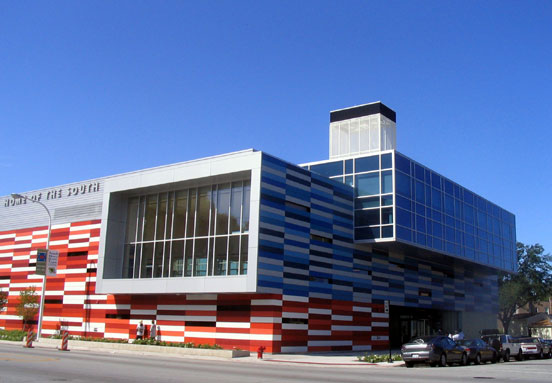
Word comes from architect John Ronan that on Friday, September 15th at 7:30 P.M., Garrison Keillor and Friends will be appearing at the recently opened Gary Comer Youth Center, the striking new building he designed for the South Shore Drill Team at 7200 S. Ingleside, at South Chicago Avenue. Keillor's friends will include singer Jearlyn Steele and musician Richard Dworsky, as well as the South Shore Drill Team and Performing Arts Ensemble, itself. Tickets, which are limited, cost only $35.00, and can be reserved by contacting Michelle Priest at mpriest@gcychome.org or 773/358.4100, by this Friday, September 8th. The show, which will support the center, will be taped for broadcast over NPR.

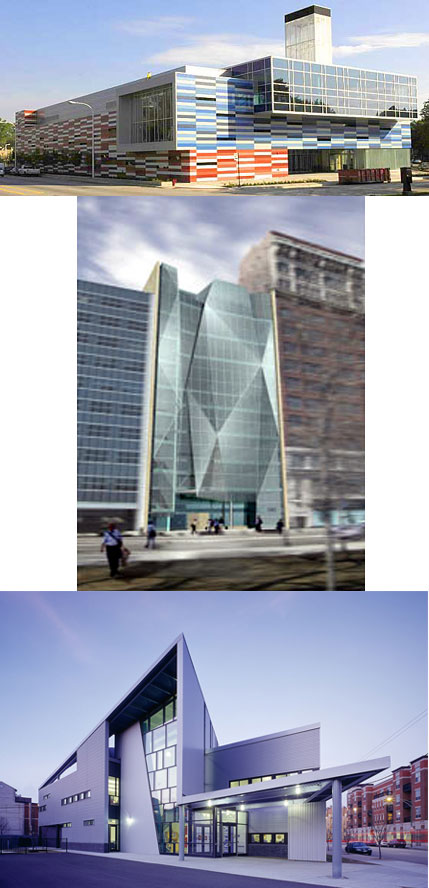
I'm not quite sure how a Drill Team will come off on radio, but for a measly $35.00, you get to not only hear, but actually see the Drill Team in action, plus be entertained by Garrison Keillor, and get to check out Ronan's stunning new building, which combines classic form with rich color to create a instant landmark in the Grand Crossing neighborhood.

Monday, September 04, 2006

September Architectural Calendar goes from 0 to 40 in 25 days

The September calendar of Chicago architectural events comes out of the quiet of summer with a roar, with the city's institutions firing up on all cylinders. The centerpiece is Louis Sullivan at 150, the 6 week celebration of the famed architect's birth, with tours, workshops and lectures. But wait - there's more! Bruce Mau comes to town to talk about Massive Change, his exhibition at the Museum of Contemporary Art. Daniel Coffey talks about his latest projects at CAF. At IIT, there's Piet Oudolf on landscape design, Leslie van Duzer on Adolf Loo's Muller Villa, and Carlos Ferrater about his own architecture. Chicago Bauhaus and Beyond leads a tour of Riverwoods. David Woods of the GSA speaks at a Friends of Downtown lunchtime event on what the federal government plans to do with the recently acquired block on the State Street next to the Dirksen Building. All that and, you know, much, much more - check it all out here.

Sunday, September 03, 2006

Happy 150th Louis

Sunday, September 3rd, marks the 150th anniversary of the birth of architect Louis Sullivan. The event is being celebrated in Chicago with Louis Sullivan at 150, a six week series of events being co-ordinated by the newly renamed Chicago History Museum. The website includes a full calendar of all the events, which kicks off today with a Sullivan's Autobiography of an Idea Bus Tour, sponsored by the Hyde Park Historical Society. Today's tour is already sold out, but it's scheduled to be repeated three Sundays from now, on September 24th.

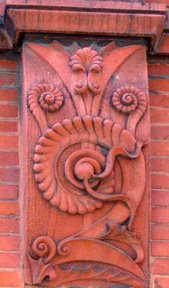
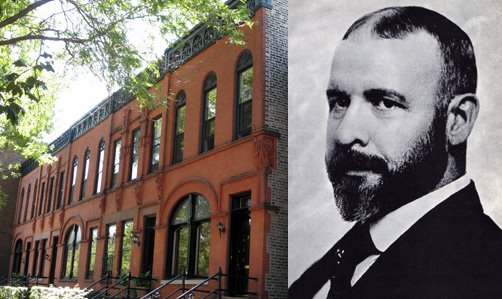
A lot of ink stands to be spilled on the Sullivan's architecture, life and legacy. First out of the gate is Chicago Sun-Times architecture critic Kevin Nance, with his take, The Tragic Tale of Louis Sullivan. No doubt I'll weigh in, as well, but for now, here's a photo of one of Sullivan's lesser known surviving Chicago structures, the Ann Halsted row houses of 1884-1885, in the 1800 block of Lincoln Park West.

Thursday, August 31, 2006

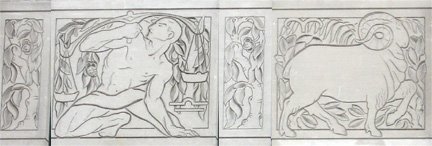
Relief(s) in Summer- Eugene and Gwen Lux's McGraw Hill panels

The facades of showcase Chicago buildings of the 20's and 30's are often ripe with restrained ornament. How often do we really see it? How often, instead, do we just see past it, letting it fade into the visual noise of the contemporary streetscape?

Recently, I'm been taking a closer look and, frankly, a lot of it is pretty stiff - well crafted but ossified depictions of classical motifs, like the lady to the left, who resides on the 545 North Michigan Building that hosts a new Nokia store. You might take her home to mother, but probably not for a night on the town.

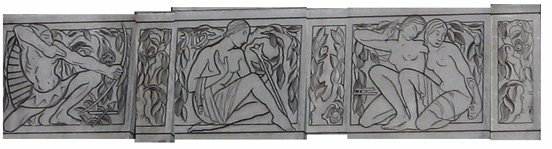
The reliefs at the McGraw Hill Building, at 520 North Michigan are different. The work of artists Gwen Lux and Eugene van Breeman Lux, they use the same types of subjects found everywhere else, but the lines are clean, loose - almost improvisational, like pencil sketches. I can't decide whether the style reminds me more of early Picasso or James Thurber, but the result is delightful. (I've compressed the proximity of the panels by taking out the windows in between.)
The building itself is probably the biggest-scale facadectomy in architectural history. In 1999, after an agreement between preservations and developer John Buck, over 4,000 stone panels were painstakingly removed and the actual building, a 16-story high, 1929 design from Thielbar & Fugard, demolished. It had seen better days. I worked in the building for a time and remember two things: the faded but still impressive, wood-paneled chairman's office on the penthouse floor, with its impressive views down Michigan avenue, and the day I reached down to pick up what I thought was a tortoise-shell comb only to discover it was actually a ridged potato chip crawling with ants.

A new building was erected, matching the massing of the original, and the facades carefully re-assembled, like a jigsaw puzzle, using the original panels. The historic storefronts have been restored and retail still commands the lower floors, part of the Nordstrom's-anchored North Bridge Mall, but the rest of the building is now a modern hotel.
The ram you see above is paired at the opposite end of the floor with an equally charming ram. The next time you're walking down this stretch of the Mag Mile, especially if it's a sunny day, look up. It's one of the best shows on the street.

Wednesday, August 30, 2006

5. P.M. Deadline today for voting on entries to Sustainable Design Competition for New Orleans

We received a reminder yesterday from the folks from Global Green that 5:00 P.M today, Wednesday, August 30th is the deadline for casting your vote for one of the six finalists in the organization's Sustainable Design for New Orleans Competition, which includes an entry from Chicago's Brininstool & Lynch. The competition was co-sponsored by Brad Pitt, and jury is to include Thom Mayne, Walter Hood and Marion Weiss. You can go to the competition's website, register you email address, look at all the entries, and place your vote. Even without voting, you can see all the boards here.

Previous ArchitectureChicago Plus post, from July 18th:
The Two Brads (Lynch and Pitt) on Rebuilding New Orleans

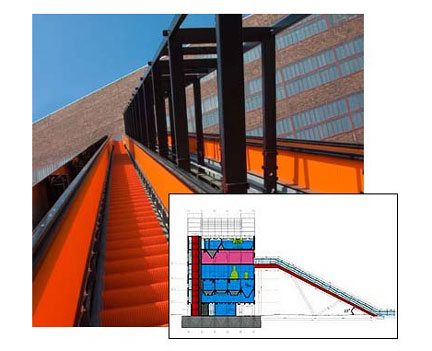
Germany's new tallest escalators are orange - three guesses whose building they're in.

We recently came across the announcement from ThyssenKrupp Fahrtreppen that they've has just completed installation of the "two tallest freestanding escalators in Germany", with a total rise in excess of 23 meters. Guess who the architect is (hint: the escalators are bright orange) and read more about the remarkable Zeche Zollverein complex in Essen, Germany here.

Monday, August 28, 2006

End of The Road

Last Friday saw the sudden announcement by its current owners that the century-old Carson Pirie Scott department store on State Street, one of architect Louis Sullivan's greatest masterpieces, will be shut down by March of next year. I'll be writing a lot more about this, and about the journey of Chicago's State Street from one of the world's greatest shopping venues to a a diminished collection of discounters and outlet stores, when Federated rebrands the venerable Marshall Fields in Macy's colors as its local flagship in September, but for now here's a few initial thoughts - and more pictures - and what's going on and where we might be heading. Read and see it here.

Thursday, August 24, 2006

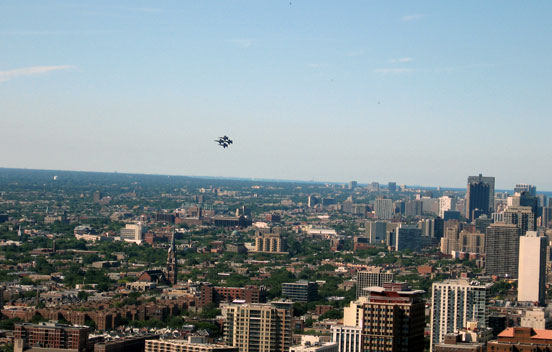
Precision Bombers as Architectural Punctuation

Late each August, the Chicago Air and Water Show draws millions of people to the city's lakefront, and each year the big finale everyone waits for is the precision maneuvers of the U.S. Navy's Blue Angels (alternating yearly with the Air Force's Thunderbirds).

The six F/A-18 Hornets race in and out across the city to regroup over their performance site just beyond the lakefront beaches, emitting a piercing pinpoint roar as they tear through the sky, only to disappear out of view in an instant. And then that sharp crescendo returns, at first faintly, but in a split second escalating to an ear-crunching roar, only to retreat into sharp diminuendo seemingly at the concurrent moment of its arrival.

It's an impressive routine no matter where it takes place, but over the center of a great, dense city like Chicago, it has a power it has nowhere else, combining the exhilaration of flight with an unsettling subtext. As the planes move with their blazing speed over the sea of moored towers, you get a sense of mirrored vulnerabilities. Against the huge mass of the city, the jets look like specks that you could fling from the sky with a flick of your thumb, but at the very same time you can't help but remember the true purpose of these stunningly sleek machines as delivery systems for destruction and death; their small yet powerful presence intimates the fragility of all of our mighty and manifold constructions. A terrible beauty, as Yeats once said.